November 11, 2026
RFID tags for clothes help apparel brands, clothing manufacturers, wholesalers, and retailers improve inventory accuracy, streamline garment identification, and increase supply chain visibility. Unlike traditional barcodes, passive UHF RFID tags can be read without direct line of sight, making it possible to identify multiple garments within a properly configured reading zone.
For businesses sourcing custom clothing RFID tags, selecting the right solution requires more than choosing a chip or label. Tag format, operating frequency, antenna design, encoding requirements, garment materials, and reader compatibility all influence performance.
This guide explains how clothing RFID tags work, compares different tag types, outlines essential technical specifications, and provides practical advice for selecting a reliable RFID tag manufacturer.
What Are RFID Tags for Clothes?
RFID tags for clothes are radio-frequency identification devices used to identify and track garments throughout manufacturing, distribution, retail, and garment management processes.
A typical passive RFID tag consists of an RFID chip connected to an antenna. Depending on the application, it can be integrated into a paper hangtag, adhesive label, woven label, care label, or washable textile tag.
Each tag carries an identifier that can be linked to a garment’s product information in an inventory or enterprise management system. This information may include the product style, size, color, SKU, and individual item serial number.
For example, a clothing brand selling one shirt in four colors and four sizes has 16 product variants. Each variant can have its own product identifier. If individual garment tracking is required, each physical shirt can also receive a unique serialized identifier.
GS1 provides standardized identification frameworks that help businesses connect product identifiers with RFID data and supply chain information.
How Do RFID Tags for Clothes Work?
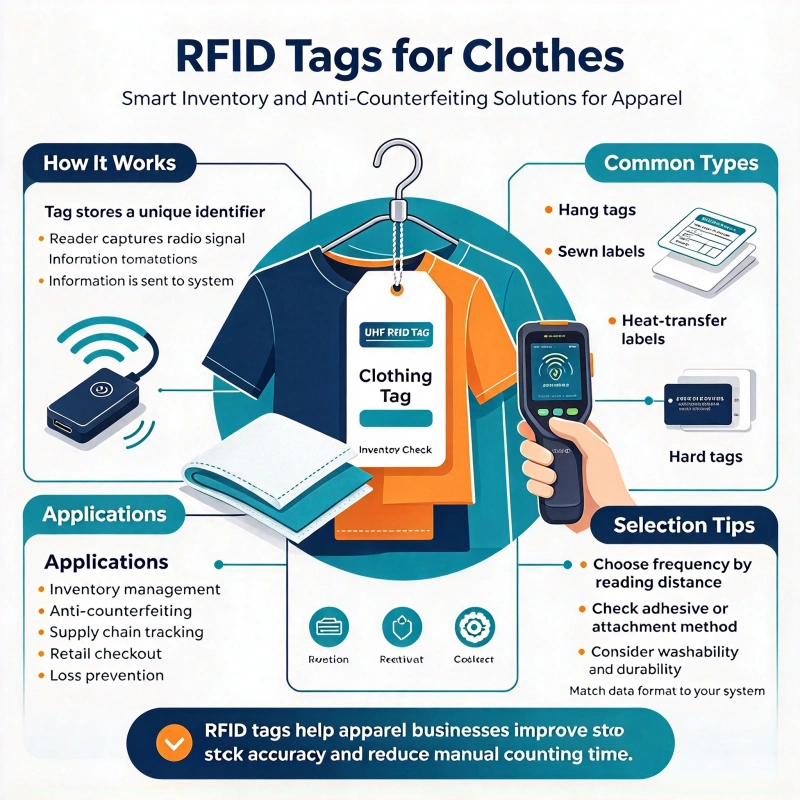
A clothing RFID system typically includes four components:
- RFID tag: Stores an identifier associated with a garment.
- RFID reader: Sends radio signals and receives responses from compatible tags.
- RFID antenna: Transmits and receives radio-frequency signals.
- Inventory software: Links tag identifiers to product records and processes inventory information.
When an RFID reader interrogates tags within its reading zone, compatible tags respond with their stored identification data. The software matches the identifiers to garment records, allowing businesses to count inventory, verify shipments, and locate products more efficiently.
For example, an apparel manufacturer can encode RFID tags during production, verify them before packing, and use RFID readers to check cartons before shipment. A retailer can subsequently use handheld readers to count garments on racks or reconcile stockroom inventory.
Passive UHF RFID systems can typically read tags over several meters under suitable conditions. Actual reading distance depends on tag design, reader power, antenna configuration, tag orientation, surrounding materials, and RF interference.
Source: GS1 RFID Read-Range Guidance
Benefits of RFID Tags for the Apparel Industry
1. Improve Inventory Accuracy
RFID enables businesses to identify tagged garments without scanning every barcode individually. This can help reduce discrepancies between physical stock and inventory records.
A GS1 Norway apparel case study reports that participating stores improved inventory accuracy from approximately 70% to 95% or higher after implementing EPC/RFID-based stocktaking. These results are case-specific and should not be treated as guaranteed outcomes for every retailer.
Source: GS1 Apparel Inventory Management
2. Speed Up Stocktaking
Traditional barcode counting generally requires individual labels to be presented to a scanner. RFID can identify multiple tags within a properly configured reading zone, potentially reducing manual scanning time.
GS1 apparel resources have cited a University of Arkansas study reporting a 93% reduction in stocktaking time among leading US retailers. Actual savings depend on the inventory process, system configuration, and staff workflow.
3. Improve Shipment Verification
RFID can help manufacturers, distributors, and retailers compare expected shipment contents with the items actually detected during receiving or dispatch.
Research summarized by GS1 US in its EPC/RFID retail supply chain data exchange study reported order accuracy of up to 99.9% in participating implementations. This is a reported study result, not a universal performance guarantee.
Source: GS1 US EPC/RFID Retail Supply Chain Data Exchange Study
4. Support Item-Level Tracking
When every garment has a unique serialized identifier, businesses can distinguish individual physical items rather than relying solely on product-level information.
This supports inventory reconciliation, product movement tracking, and more detailed supply chain visibility.
5. Support Omnichannel Retail
More reliable inventory information can help retailers coordinate store stock, warehouse inventory, and online order fulfillment. RFID does not automatically guarantee accurate availability, but it can provide better data when integrated with suitable inventory management processes.
Types of RFID Tags for Clothes
Different clothing applications require different tag constructions. The most suitable format depends on the garment lifecycle, attachment method, printing requirements, and environmental conditions.
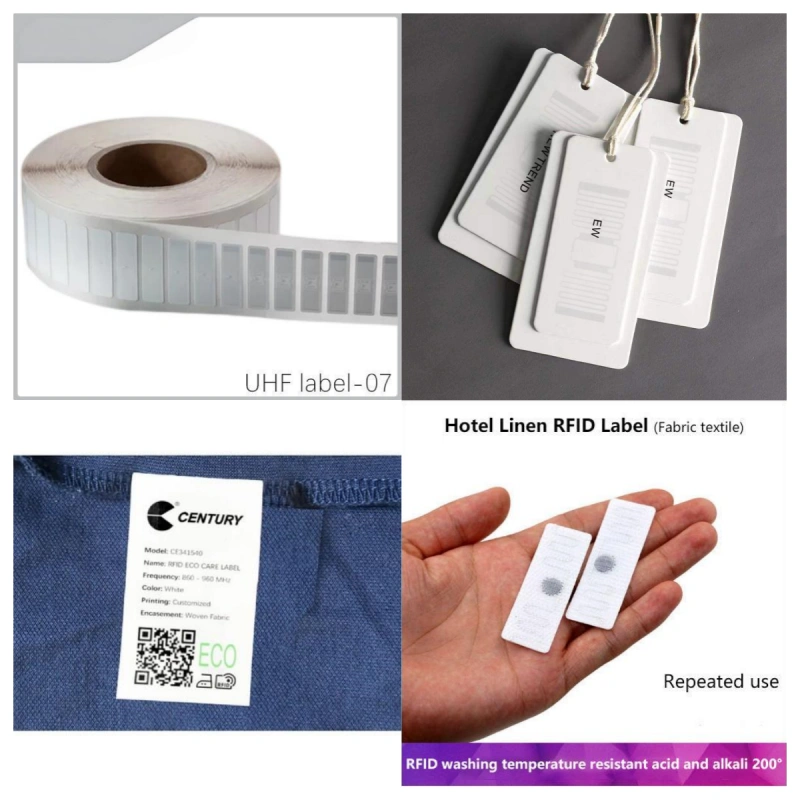
1. RFID Clothing Hang Tags
RFID hangtags typically combine a passive RFID inlay with a printed paper or synthetic tag attached to a garment using a string or fastener.
Best for: Fashion brands, retail clothing, apparel manufacturers, footwear, and accessories.
Key advantages include:
- Custom logos, colors, and product information.
- Compatibility with suitable barcode and QR code printing.
- Convenient application during garment production.
- Options for pre-encoded RFID identifiers.
Standard paper hangtags are generally intended for retail handling rather than repeated laundering.
2. RFID Sew-In Clothing Labels
RFID sew-in labels integrate an RFID component into a textile or composite label that can be attached to a garment.
Best for: Workwear, uniforms, selected branded apparel, and garments requiring a more permanent identifier.
Important considerations include stitching, bending, abrasion, wearer comfort, label placement, and any washing requirements.
The tag construction must be validated for the actual garment and intended service conditions.
3. RFID Stickers and Adhesive Labels
Adhesive RFID labels combine an RFID inlay with a printable face material and adhesive layer.
Best for: Garment packaging, warehouse identification, distribution operations, and suitable product-label applications.
Buyers should confirm adhesive compatibility, surface conditions, moisture resistance, label dimensions, and compatibility with their printing and encoding equipment.
4. Washable Textile RFID Tags
Washable RFID tags are designed for garments and textiles that undergo repeated use, cleaning, or industrial laundering.
Best for: Rental uniforms, hospitality textiles, healthcare garments, workwear, and reusable linen.
These tags may require specialized constructions to withstand washing, drying, pressure, detergents, and mechanical stress.
Before purchasing, request documented durability test results that match the actual laundry process. Do not assume that an ordinary clothing RFID label can withstand industrial washing.
Technical Specifications of RFID Tags for Clothes
When requesting a quotation, apparel buyers should define the technical requirements instead of specifying only “UHF RFID clothing tags.”
| Specification | Common options or considerations |
|---|---|
| RFID frequency | UHF, commonly within regional 860–960 MHz allocations |
| Air-interface standard | EPC Class 1 Gen 2 / ISO/IEC 18000-63-compatible systems |
| Tag technology | Passive RFID for most retail apparel inventory applications |
| Tag format | Hangtag, adhesive label, sew-in label, or washable textile tag |
| RFID chip | Selected according to compatibility, memory, and encoding requirements |
| Identifier | EPC, serialized GTIN, or another supported identification structure |
| Tag dimensions | Customized according to antenna design and garment requirements |
| Printing | Logo, product information, barcode, QR code, or variable data |
| Encoding | Blank, pre-encoded, or encoded during production |
| Durability | Defined according to handling, moisture, abrasion, and washing conditions |
| Packaging | Rolls, sheets, or individually packed tags, depending on the application |
GS1’s EPC Gen2 specification defines air-interface requirements for passive UHF RFID systems, while ISO/IEC 18000-63 specifies the Type C air interface for item-management applications operating within the 860–960 MHz band.
Buyers should confirm the relevant regional frequency requirements and verify compatibility with the intended RFID readers.
Sources: GS1 EPC Gen2 Technical Resources and ISO RFID Standards.
Which RFID Frequency Is Best for Clothing?
RFID systems commonly operate at low frequency (LF), high frequency (HF), or ultra-high frequency (UHF).
| Frequency | Characteristics | Typical apparel applications |
|---|---|---|
| LF | Short-range identification for specialized applications | Selected proximity-based identification systems |
| HF | Short-range communication, including certain NFC applications | Customer interaction and compatible contactless applications |
| UHF | Supports multi-item reading and longer reading distances under suitable conditions | Retail inventory, distribution centers, and garment tracking |
For mainstream apparel inventory management, passive UHF RFID is usually the most practical starting point because it supports rapid stocktaking and item-level identification.
However, UHF RFID and NFC are not interchangeable. A smartphone’s NFC reader generally cannot read a standard UHF clothing tag directly.
If a brand needs both warehouse inventory tracking and smartphone-based customer interaction, the project should evaluate whether separate RFID technologies or a suitable dual-frequency solution is necessary.
How to Choose the Right RFID Tag for Your Clothing Business
Step 1: Identify the Garment Type and Application
Determine whether the tag is intended for retail hangtags, permanent garment identification, packaging, or repeated laundry cycles.
A paper hangtag designed for retail inventory has different durability requirements from a washable RFID tag used in uniform rental services.
Step 2: Confirm RFID Reader Compatibility
Ask your RFID system provider to specify the required frequency band, air-interface standard, reader model, antenna configuration, and encoding procedure.
A tag that performs well in one reading environment may not perform equally well in another.
Step 3: Define the Data and Serialization Requirements
Determine whether the tag needs a product-level identifier or a unique identifier for each physical garment.
If the retailer requires GS1-based item-level identification, confirm the GTIN association, serialization structure, EPC encoding, and data ownership rules before production.
The chip does not automatically identify a garment’s size, color, or price. These attributes must be linked to the identifier in the appropriate business system.
Step 4: Test Samples on Actual Garments
Test representative samples on the intended fabrics, garment folds, hanging arrangements, and packaging configurations.
Evaluate reading performance using the actual reader and antenna setup rather than relying only on advertised maximum read distance.
Step 5: Verify Printing and Encoding Quality
Check that the printed barcode matches the encoded identifier and that the RFID system can read the tags reliably.
For serialized applications, establish procedures to detect duplicate identifiers and prevent incorrect data assignment.
Step 6: Define Quality Acceptance Criteria
Before mass production, agree on the required checks for printing, encoding, readability, tag dimensions, packaging, and any durability requirements.
A successful sample test is useful, but it should be followed by production quality checks under the agreed specification.
RFID Tags for Clothes vs. Traditional Barcode Labels
RFID and barcodes serve different operational purposes and can be used together.
| Feature | RFID clothing tags | Traditional barcode labels |
|---|---|---|
| Reading method | Radio waves | Optical scanning |
| Direct line of sight | Generally not required | Required |
| Multiple-item reading | Possible within a configured reading zone | Usually scanned individually |
| Unique item identification | Supported with suitable serialization | Supported when unique codes are assigned |
| Infrastructure | Requires compatible readers, antennas, and software | Often uses existing barcode scanners |
| Typical strengths | Rapid inventory counts and shipment verification | Checkout, manual verification, and basic identification |
For example, a warehouse may use UHF RFID to count hundreds of tagged garments while retaining a printed barcode for checkout or manual verification.
For many apparel businesses, a combined label containing an RFID inlay, barcode, and human-readable information offers practical flexibility.
How Much Do RFID Tags for Clothes Cost?
The price of RFID clothing tags depends on the chip, antenna design, tag format, material, printing, encoding, order quantity, and durability requirements.
A standard paper hangtag with a passive UHF inlay is a different product from a custom-printed and pre-encoded label or a washable textile RFID tag. A reliable quotation therefore requires a defined specification.
When comparing suppliers, request separate pricing for:
- Standard RFID inlays or blank labels.
- Custom-printed clothing hangtags.
- Pre-encoded RFID tags with serialized identifiers.
- Sew-in labels and washable textile tags.
- Sample production and testing.
- Packaging, freight, and any required data-management services.
Make sure every supplier quotes the same or equivalent chip requirements, dimensions, printing coverage, encoding format, quality criteria, order quantity, and shipping terms.
How to Calculate the Total RFID Project Cost
A practical budgeting model is:
Total project cost = tag purchase + encoding and application + reader and software costs + integration and testing + training and maintenance.
This is a planning framework rather than a quoted price. Some components may already be available or included in a supplier’s package.
For apparel manufacturers supplying international retailers, one important decision is whether tags must arrive pre-encoded and ready for application or whether encoding will take place on the production line.
This affects equipment requirements, production workflow, traceability, and quality control.
Common Mistakes When Purchasing RFID Tags for Clothes
Choosing Tags Based Only on Maximum Read Distance
Maximum read distance does not guarantee reliable reading when garments are stacked, folded, packed closely together, or exposed to RF interference. Test the tag in the actual operating environment.
Reusing the Same Identifier for Every Garment
A product-level identifier may distinguish a style or variant, but it cannot identify individual physical garments when unique item-level tracking is required. Confirm serialization rules before encoding.
Ignoring Tag Placement
Reading performance can change with tag orientation, antenna placement, nearby materials, and garment configuration. Test the proposed placement on actual garments.
Using Standard Hangtags for Industrial Laundry
Ordinary paper hangtags are not designed for repeated industrial washing. Reusable uniforms and rental garments generally require purpose-built textile RFID tags with suitable durability evidence.
Ordering Bulk Quantities Before Testing
Validate chip compatibility, encoding, print quality, reading performance, and application requirements before approving mass production.
Failing to Define Quality Requirements
Agree on acceptance criteria for encoding accuracy, duplicate identifiers, barcode quality, reading performance, durability, and packaging before production begins.
These precautions help apparel manufacturers and retailers reduce avoidable compatibility problems and sourcing costs.
How to Work with a Clothing RFID Tag Manufacturer
A reliable RFID tag manufacturer should understand how the tag construction, garment application, encoded data, and reader system work together.
A typical sourcing process includes:
- Requirement confirmation: Define garment type, tag format, frequency, chip requirements, dimensions, printing, encoding, and quantity.
- Artwork and data review: Confirm logos, barcodes, product information, EPC format, and serialization rules.
- Sample production: Produce samples using the proposed materials and RFID inlay.
- Performance validation: Test the samples with the intended readers and representative garment arrangements.
- Mass production: Manufacture the approved specification and implement the agreed quality-control process.
- Final inspection and delivery: Verify printing, encoding, quantities, packaging, and shipping documentation.
Before selecting a supplier, confirm whether it can support custom printing, pre-encoding, serialized identifiers, sample testing, and the tag format required by your production workflow.
For international orders, clarify destination-market frequency requirements, retailer-specific RFID specifications, packaging standards, and delivery terms before placing the order.
Frequently Asked Questions About RFID Tags for Clothes
What type of RFID tag is best for clothing?
Passive UHF RFID hangtags are a common choice for retail apparel inventory and supply chain tracking. Sew-in labels and washable textile tags are more suitable when the identifier must remain attached during extended garment use or repeated laundering.
Can RFID tags be sewn into clothes?
Yes. RFID components can be integrated into textile labels and sewn into garments. The construction must accommodate stitching, bending, abrasion, and any applicable washing requirements.
Can RFID tags for clothes be washed?
Some textile RFID tags are designed for repeated washing and industrial laundry. Ordinary paper hangtags and standard adhesive labels should not be assumed to withstand laundering. Buyers should request test evidence for the actual washing and drying conditions.
What is the typical reading distance of a clothing RFID tag?
Passive UHF RFID tags can typically be read over several meters under suitable conditions. Actual performance depends on the tag, reader, antenna, orientation, and surrounding environment.
Do clothing RFID tags require batteries?
Most RFID tags used for retail clothing inventory are passive and do not require an internal battery. They obtain the energy needed to respond from the reader’s radio signal.
Can RFID clothing tags be customized with a brand logo?
Yes. Suitable RFID hangtags and labels can be customized with logos, colors, product information, barcodes, and QR codes. The printing method and layout should be selected according to the material and encoding requirements.
Can one RFID tag identify a garment’s size and color?
Yes, when its identifier is linked to the corresponding product record. Individual garments can also receive unique serialized identifiers when item-level tracking is required. The tag does not automatically detect size or color.
Are clothing RFID tags compatible with every RFID reader?
No. Compatibility depends on frequency, air-interface protocol, regional regulations, chip features, and reader configuration. Confirm these requirements before purchasing tags in bulk.
Can RFID tags completely replace clothing barcodes?
Not always. RFID is useful for bulk inventory reading, while barcodes remain valuable for checkout and manual identification. Many apparel businesses use both technologies on the same hangtag.
What information should I provide when requesting a quotation?
Provide the garment type, intended application, tag format, frequency, reader requirements, chip preferences, dimensions, artwork, encoding format, order quantity, durability requirements, and delivery destination. If the retailer has an RFID specification, share it with the manufacturer before sampling.
Conclusion
RFID tags for clothes help apparel manufacturers, fashion brands, wholesalers, and retailers improve garment identification, inventory accuracy, and supply chain visibility.
For retail clothing, passive UHF RFID hangtags are often the first format worth evaluating. For uniforms, rental garments, and reusable textiles, washable RFID labels may be more appropriate.
Before placing a bulk order, confirm the required frequency, chip and data format, tag construction, printing, reading performance, and quality criteria. Testing representative samples before mass production is one of the most effective ways to avoid compatibility issues and unnecessary costs.
For businesses sourcing custom RFID tags for clothing, a clearly defined specification is the foundation of a reliable and scalable RFID deployment.
When clothing manufacturers need RFID tags, they are generally not just looking for a product, but rather for a professional provider of garment labeling solutions. Consequently, label manufacturers capable of offering such solutions are the partners that apparel brands most prefer to work with.
Sources and Technical References
- GS1 — Apparel Inventory Management: Industry case study on RFID and inventory accuracy.
https://discover.gs1.org/apparel/fragments/retail/inventory-management-did-you-know/ - GS1 US — EPC/RFID Retail Supply Chain Data Exchange Study: Research summary covering item-level RFID and shipment accuracy.
https://www.gs1us.org/content/dam/gs1us/documents/industries-insights/case-studies/apparel-general-merchandise/Case-Study-Executive-Summary-EPC-RFID-Retail-Supply-Chain-Data-Exchange-Study.pdf - GS1 — RFID Read Range: Technical guidance on factors affecting reading distance.
https://support.gs1.org/support/solutions/articles/43000734166-what-is-the-read-range-for-a-typical-rfid-tag- - GS1 — EPC Gen2 UHF Air Interface Protocol: Technical resources for passive UHF RFID systems.
https://www.gs1.org/standards/epc-rfid/uhf-air-interface-protocol - ISO — ISO/IEC 18000-63: RFID air-interface standard for item-management applications.
https://www.iso.org/standard/87122.html
Industry results cited in this article are specific to the studies and implementations referenced. Actual performance varies according to the RFID system, garment characteristics, and operational environment.

Do RFID is a leading China-based manufacturer with over 15 years of experience. We specialize in customized RFID readers, tags, and cards, delivering high-quality, tailored solutions that meet your unique business needs and drive seamless, efficient identification.