
Small formats · Different ways to read
Find a micro RFID tag that fits the product and the job
We supply micro RFID tags for projects where the available space is part of the design: a small plastic component, an embedded identifier or a metal tool that needs its own ID.
Compare compact HF/NFC formats with small industrial UHF options below. Choose the construction around the surface, reader and installation space—not the chip size alone.
For compact near-field projects
For small metal-mounted identifiers
Start with the reading task
A phone tap and an industrial read need different tags
HF / NFC: approach one item
Use a compact NFC format when a person or reader can approach the marked position. Examples include opening product information, identifying an accessory or reading a tag inside a small plastic housing.
See FPC and PCB options →UHF: build a reader-based identification point
Use an industrial UHF option when identification is part of a handheld-reader or fixed-reader workflow. The tag, mounting surface and antenna arrangement work together; an NFC phone does not replace a UHF reader.
See compact industrial options →Compact HF / NFC products
Small formats for close-range interaction and integration
These three products address different space and chip requirements. Their dimensions describe the tag outline; leave room for its thickness, protective construction and attachment in the finished part.
A small round footprint
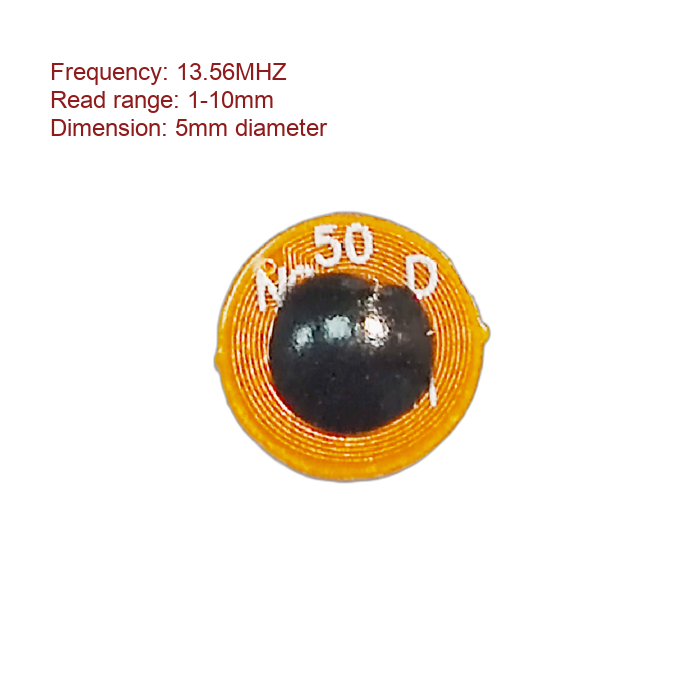
5 mm FPC · NTAG216
DO-5MM-FPC-NTAG216 · Ø5 mm
13.56 MHz · ISO/IEC 14443-A
A starting point for a small plastic part or enclosure with little circular space. NTAG216 has 888 bytes of user memory; the application and record format determine how much fits.
The FPC construction offers a thin format, but its antenna still needs a workable position relative to the reader. Try it in the assembled housing before fixing its location.
View the 5 mm FPC tag →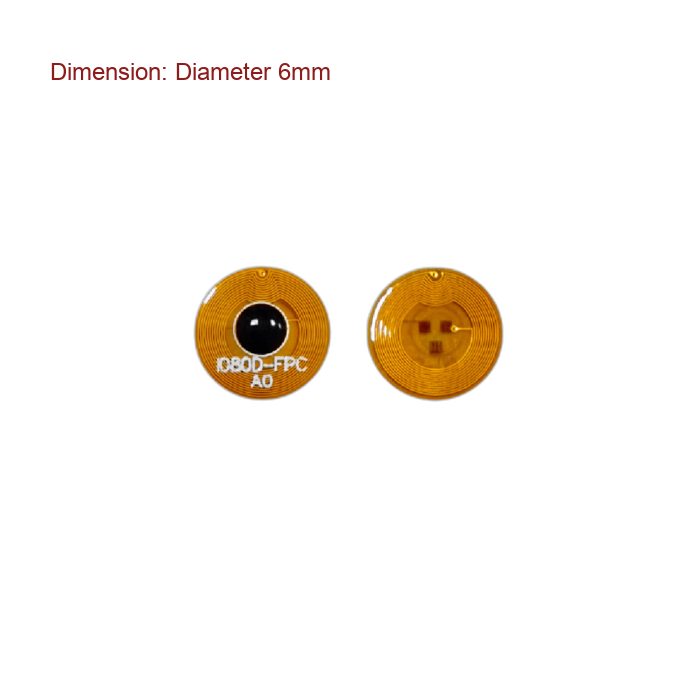
A security-focused chip choice
6 mm FPC · NTAG424 DNA
DO-6FPC-NTAG424DNA · Ø6 mm
13.56 MHz · NFC Type 4
For a small accessory that needs an authenticity check, our 6 mm NTAG424 DNA format can provide cryptographically verifiable data for a configured application. Choose it for that verification requirement, rather than for extra storage.
A working authentication application also needs appropriate keys, tag configuration and verification software. A compact tag by itself does not deliver the complete service.
View the 6 mm FPC tag →
A narrow rectangular space
4.7 × 11.5 mm PCB · ICODE SLIX2
DO-PCB-4711 · 4.7 × 11.5 mm
13.56 MHz · ISO/IEC 15693
A rigid, narrow option when the part has more length than width. It belongs in an ISO/IEC 15693 reader workflow, with its outline and mounting position checked against the assembly.
The 4.7 mm figure is its width, not its diameter or complete size. ICODE SLIX2 is a Type 5 chip; test the phone and application for the intended operation.
View the PCB tag →Miniature ceramic UHF formats
4 mm and 5 mm tags for small metal parts
These ceramic UHF tags give a small metal tool or component its own readable identifier. Both attach with adhesive and are 3 mm thick. Compare the complete dimensions with the mounting area, then test the tag on the actual part with your intended UHF reader.
A 4 mm square footprint
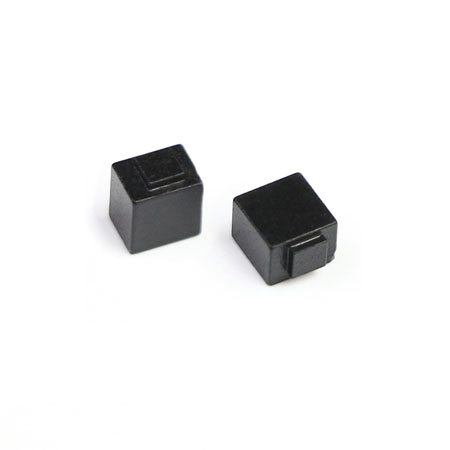
CER0404 ceramic UHF tag
4 × 4 × 3 mm · Alien Higgs-3
EPC Gen2 / ISO 18000-6C · On metal
For a small metal component or tool where a larger label cannot fit. Its ceramic body provides a compact adhesive-mounted format; leave room for the full thickness and attachment layer.
Published on-metal read range is up to 0.8 m with a fixed reader or 0.4 m with a handheld. Reader setup, orientation and the mounted part determine the working result.
View the CER0404 4 mm tag →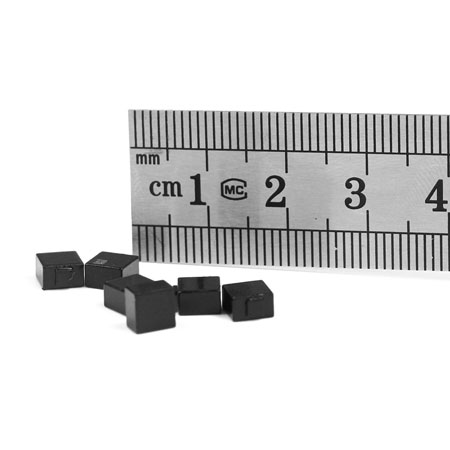
A 5 mm square footprint
CER0505 ceramic UHF tag
5 × 5 × 3 mm · Alien Higgs-3
EPC Gen2 / ISO 18000-6C · On metal
A compact option for a tool, metal part or equipment item with room for a 5 mm square tag. Use its identifier to connect the item to an issue, inspection or maintenance record.
Published on-metal read range is up to 1.0 m with a fixed reader or 0.6 m with a handheld. Evaluate the actual mounting position rather than assuming the larger footprint always reads farther.
View the CER0505 5 mm tag →Both models offer regional US 902–928 MHz and EU 865–868 MHz options. Choose the version for your reader installation; a phone’s ordinary NFC interface cannot read these UHF tags.
Working on animal identification instead? See our small LF glass transponders for animal identification. This is a separate tag-and-reader application from phone NFC and industrial UHF.
Compare what has to fit
Micro RFID tag selection at a glance
| Model / chip | Tag footprint | Reader / communication | Installation to evaluate | Main selection point |
|---|---|---|---|---|
| 5 mm FPC / NTAG216 | Ø5 mm | Compatible NFC phone or ISO/IEC 14443-A reader | Small non-metal housing; test after assembly | Round footprint and encoded record |
| 6 mm FPC / NTAG424 DNA | Ø6 mm | Compatible Type 4 NFC interface and application | Small enclosure with a defined tap position | Cryptographic application requirements |
| PCB-4711 / ICODE SLIX2 | 4.7 × 11.5 mm | ISO/IEC 15693 reader; test phone/app use | Narrow space that accepts a rigid tag | Complete length and reader protocol |
| CER0404 / Higgs-3 | 4 × 4 × 3 mm | Regional EPC Gen2 / ISO 18000-6C reader and antenna | Adhesive mounting on a small metal component | 4 mm footprint, complete thickness and mounted read result |
| CER0505 / Higgs-3 | 5 × 5 × 3 mm | Regional EPC Gen2 / ISO 18000-6C reader and antenna | Adhesive mounting on a small metal tool or part | 5 mm footprint, reading position and working distance |
There is no single read-distance number for every micro RFID tag. Reader power and antenna, orientation, construction and nearby materials affect the result. Compare samples under the same conditions, then test the exact mounted configuration.
From product to working identifier
Two ways a small tag becomes useful
A plastic accessory that opens product information
The outside tap position should line up with the NFC tag inside. A good location in an empty shell may behave differently after batteries, metal fasteners or other components are fitted.
- Position the sample. Try a suitable FPC or PCB format in the available space. Keep its antenna away from avoidable metal obstruction; check the complete wall and adhesive stack.
- Prepare the record. For a phone-link application, encode a supported NDEF URL pointing to your instructions or support page. That online page carries the detailed information.
- Test the assembled part. Read from the intended outside position with the target phone or reader. Repeat with the internal components in place before settling the tag location.
The NFC record opens the destination; that page can be maintained later. For a deeper test method and failure diagnosis, read our small NFC tag integration guide.
A metal tool identified at a work point
Here the tag links a physical tool to a record in the operator’s system. The reader reports an identifier; software uses it to retrieve the appropriate tool or maintenance record.
- Choose the mounting position. Fit a 4 × 4 × 3 mm CER0404 or 5 × 5 × 3 mm CER0505 ceramic tag to a suitable metal area with adhesive. Include the attachment layer, handling conditions and any protective recess in the sample.
- Create a controlled read point. Use a matching UHF reader and antenna. Evaluate orientation and surrounding metal with the tool in its normal position.
- Connect ID to the workflow. Map each chosen identifier to its system record. Verify that the intended tool is read at the intended work point.
This gives software an identification event when a reader detects the tag. It does not turn a passive tag into a GPS tracker or establish the tool’s position between read points.
Working with DO RFID TAG
Bring the tag, assembly and reader into the same sample trial
We help turn the available space and intended use into a practical tag configuration. For small parts, that means comparing the physical format and chip with the installation—not leaving the antenna or mounting problem until production.
Shortlist the physical format
Start with the space drawing, surface material and intended reader. We can discuss a suitable FPC, PCB or industrial construction and direct you to relevant models.
Evaluate a representative assembly
Use the intended tag position, enclosure, fixing and internal components. Test the reading action the customer or operator will actually perform, including the intended data record.
Define the order configuration
Bring the model, chip, attachment and encoding requirements together. Sample arrangements, quantity, packing and production timing follow the specific configuration and order.
Need another finished shape or branding format? Our custom NFC tag service covers broader formats, while this page focuses on small-space identification.
Questions about small RFID tags
Before choosing a micro tag
How small can an RFID tag be?
It depends on the frequency, antenna and finished construction. This selection includes 4 × 4 × 3 mm and 5 × 5 × 3 mm ceramic UHF tags, 5 mm and 6 mm round FPC tags, and a 4.7 × 11.5 mm PCB format. Compare the complete outline and thickness. A bare chip dimension does not describe a ready-to-install tag or guarantee a useful reading result.
Can a phone read these micro RFID tags?
A compatible NFC phone can be part of the HF/NFC workflow, subject to the chip, record, application and assembled tag performance. Test the intended action. The industrial UHF examples need a UHF reader; a phone’s ordinary NFC interface cannot read them.
Can I put a small FPC or PCB tag directly on metal?
FPC and PCB describe construction, not automatic suitability for metal. Metal can change antenna behaviour and obstruct reading. Choose a construction designed for that surface or evaluate suitable separation. Test on the actual part instead of transferring a free-air result to a metal installation.
Does a larger memory mean better authentication?
Memory describes storage. Passwords, write locks, chip originality checks and application authentication serve different purposes. A project requiring dynamic cryptographic verification needs the specified security chip and a configured verification system; memory size alone is not the deciding factor.
Are “microtags” all the same type of RFID tag?
No. In RFID discussions the name can describe different small constructions. It does not identify a shared frequency, protocol or mounting method. Specify the reader, available space and installation surface when comparing them.
Chip references: NXP NTAG213 / 215 / 216NXP NTAG424 DNANXP ICODE SLIX2