September 14, 2026
Radio Frequency Identification (RFID) technology is everywhere. You see it in retail stores, warehouses, and even libraries. But not all RFID chips are the same. Some are basic memory chips. Others are smart, programmable, and secure.
One of the most powerful RFID chips on the market is the Impinj Monza 4QT. This chip is famous for its QT (Quiet Tag) technology. But what does that mean? Why should you care?
This article explains the Monza 4QT in simple language. You will learn:
- What the Monza 4QT is and how it works
- Where to use it (real application scenarios)
- What problems it solves for businesses
- How it compares to competing chips
Let’s dive in.
What Is Impinj Monza 4QT?
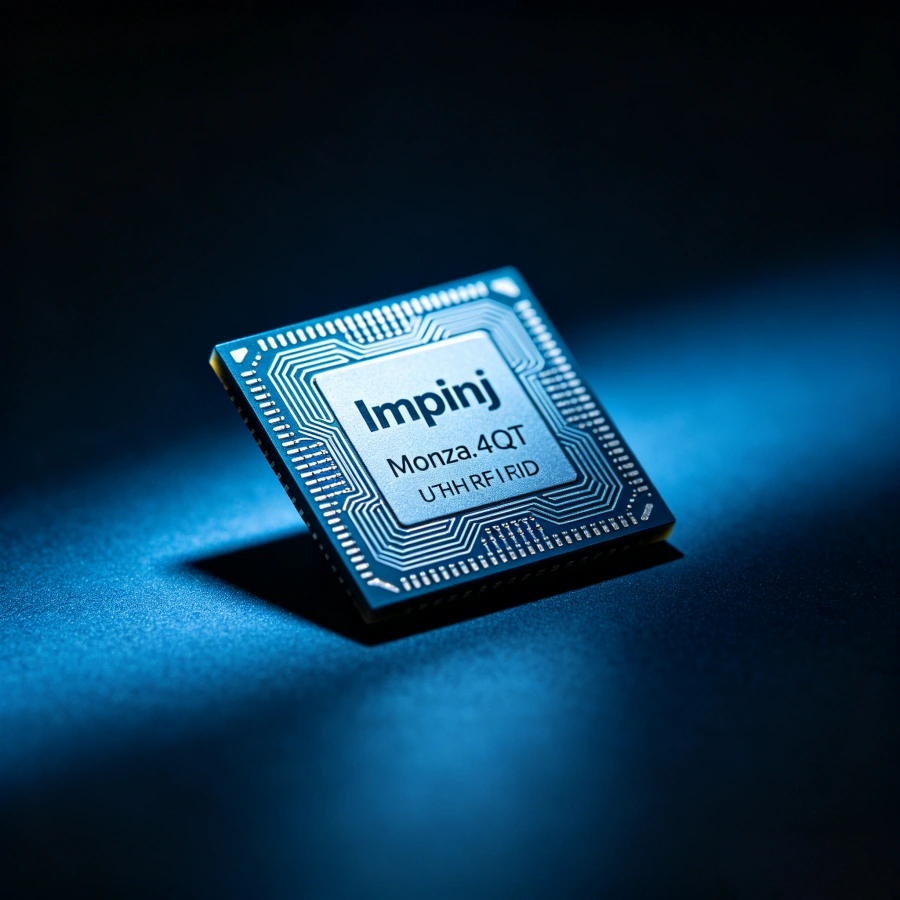
The Monza 4QT is a UHF RFID chip (integrated circuit) manufactured by Impinj, a leading RFID company. It operates in the 860–960 MHz frequency band (global UHF). The chip is designed for high-performance RFID labels and tags used in item-level tracking, supply chain, and retail.
The “4” in the name means it is part of the Monza 4 family. The “QT” stands for Quiet Tag – the chip’s signature feature.
Key Technical Specifications
| Parameter | Value |
|---|---|
| Frequency range | 860–960 MHz |
| Memory (User) | 128 bits |
| Memory (TID) | 96 bits (32-bit unique) |
| Memory (EPC) | Up to 496 bits (configurable) |
| QT technology | Yes (private/public modes) |
| Read sensitivity | -21.5 dBm (excellent) |
| Write sensitivity | -16.0 dBm |
| Self-adjust capability | AutoTune™ for antenna matching |
| Operating temp | -40°C to +85°C |
The Core Feature: QT Technology
Normal RFID tags always respond to a reader. If someone has a reader, they can read your tag. This is fine for inventory but bad for privacy.
The Monza 4QT has two modes:
- Public mode – Works like a normal tag. High read range. Good for scanning inventory.
- Private mode – The tag hides its EPC memory. It only responds if the reader sends a special password. Read range is also reduced. This prevents unauthorized scanning.
With a password, you can switch between modes. Without the password, the tag stays quiet (private). This is revolutionary for asset tracking, where privacy matters.
Other features:
- AutoTune™ – The chip automatically adjusts its antenna settings to match the tag’s environment. This means consistent performance across different materials (plastic, cardboard, and some metals).
- High memory flexibility – You can configure EPC memory from 96 bits up to 496 bits. Store serial numbers, dates, or batch codes.
- Fast write speed – Writes are fast and reliable, which is important in high-speed conveyor lines.
Application Scenarios
Where would you actually use the Monza 4QT? The QT technology makes it ideal for applications where a tag needs to be “normal” during inventory but “hidden” at other times.
1. Retail Apparel and Luxury Goods
Imagine a clothing store. Each shirt has an RFID tag for inventory. At the warehouse, tags should be readable from a distance. That’s public mode. But when the customer buys the shirt and takes it home, they don’t want the store tracking them. With Monza 4QT, the cashier can switch the tag to private mode at checkout. The shirt stays in the customer’s closet without broadcasting its ID.
For luxury handbags or watches, private mode prevents thieves from scanning bags on the street to find expensive items.
2. Consumer Product Manufacturers
If you make electronics, tools, or high-value items, you can embed Monza 4QT tags. During distribution, read tags in public mode to track shipments. Once the product reaches the consumer, the consumer (or a final step) switches the tag to private mode. The tag becomes invisible to random readers.
Some brands use this for warranty registration. The consumer scans the tag while it’s still public, registers the product, then the tag goes private permanently.
3. Library Book Tracking
Libraries use RFID for self-checkout and inventory. A normal tag can be read by anyone. A patron might worry about privacy after borrowing a book. With Monza 4QT, the library system switches the tag to private mode when the book is checked out. The book still works for security gates (using a different memory bank) but cannot be read by a random smartphone reader. When the book returns, the system switches it back to public mode.
4. Returnable Transport Items (RTIs)
Pallets, crates, and totes that move between companies often contain valuable goods. You want partners to scan them for inventory. But you don’t want competitors reading your asset IDs outside your facility. Monza 4QT lets you set the tag to private mode when the asset leaves your site. Only your authorized readers can wake it up.
5. Supply Chain Visibility
In a typical supply chain, multiple parties handle a product: manufacturer, distributor, retailer. Each needs to read the tag. Monza 4QT works in public mode for all of them. No password is needed. But after the final sale, the tag can be switched to private mode. This prevents “wardriving” – people scanning packages in transit to steal cargo information.
Problems Solved (Pain Points)
Businesses and consumers face real problems with standard RFID chips. The Monza 4QT fixes several of them.
Pain Point #1: Privacy Invasion from Unauthorized Scans
- The problem: Regular RFID tags always respond to any reader. A stranger with a $20 UHF reader can walk through a parking lot and read your laptop tag, your luggage, or your expensive tools. This is dangerous for personal safety and corporate espionage.
- How Monza 4QT solves it: The QT private mode requires a password to read the EPC. Without the password, the tag is silent. Even the presence of the tag is hidden from unauthorized readers.
Pain Point #2: No Way to “Turn Off” a Tag After Sale
- The problem: Retailers put RFID tags on products for inventory. But after you buy the product, the tag remains active. You cannot easily remove it without damaging the product. You are stuck with a broadcasting device.
- How Monza 4QT solves it: At checkout, the cashier (or self-checkout kiosk) sends a command to switch the tag to private mode. From that moment, only the retailer’s specific readers can see it – but the retailer doesn’t need to scan it anymore. For consumers, it acts like a disabled tag.
Pain Point #3: Poor Performance on Different Surfaces
- The problem: Many chips lose sensitivity when attached to different materials (plastic, cardboard, metal, liquid). Tag manufacturers have to design different antennas for each material. That’s expensive and complex.
- How Monza 4QT solves it: AutoTune™ technology automatically adjusts the chip’s capacitance to match the antenna and environment. This gives stable read performance across a wide range of materials. One chip design works for many tag types.
Pain Point #4: Limited Memory for Extra Data
- The problem: Basic chips have only 96 or 128 bits of EPC memory. That’s enough for a serial number but not for extra information like production date, batch number, or inspection results. You have to look up that data in a cloud database.
- How Monza 4QT solves it: You can configure up to 496 bits of EPC memory. That is enough to store custom data directly on the tag. No database lookup needed. For example, you can write a 32-character alphanumeric code or multiple small fields.
Pain Point #5: Slow Writes in High-Speed Lines
- The problem: In a factory conveyor belt moving at 3–4 meters per second, you need to write data to tags quickly. Some chips are slow – they require the tag to stay in the reader field for a long time. This causes missed writes.
- How Monza 4QT solves it: Excellent write sensitivity (-16 dBm) means even low-power readers can write quickly. Fast write commands reduce the time needed. This increases line throughput.
Competitor Analysis
The Monza 4QT competes with other UHF RFID chips, mainly from NXP and Alien Technology. Let’s compare it to three key competitors.
Competitor A: NXP UCODE 9
NXP’s UCODE 9 is a popular, high-performance chip.
| Feature | Monza 4QT | NXP UCODE 9 |
|---|---|---|
| User memory | 128 bits | 0 bits (some variants have 128 bits) |
| EPC memory | Up to 496 bits | Up to 128 bits |
| Privacy mode | Yes (QT private) | No (no built-in privacy toggle) |
| Read sensitivity | -21.5 dBm | -24 dBm (slightly better) |
| AutoTune | Yes | No (fixed tuning) |
| Write sensitivity | -16.0 dBm | -18 dBm (better) |
| Typical price per chip | ~$0.06–$0.10 | ~$0.05–$0.08 |
Verdict: UCODE 9 has slightly better sensitivity (both read and write) and lower cost. But it lacks any privacy mode. If you need QT, Monza 4QT wins. If raw read range and low cost are all that matter, UCODE 9 is a competitor.
Competitor B: NXP UCODE DNA (or DNA2)
This chip is designed for authentication and security. It has a cryptographic feature (AES-128).
| Feature | Monza 4QT | NXP UCODE DNA |
|---|---|---|
| Privacy mode | Yes (QT password) | Yes (crypto-protected mode) |
| Security level | Password-based | AES-128 encryption |
| User memory | 128 bits | 2 kbits (much larger) |
| EPC memory | 496 bits max | 256 bits |
| Read sensitivity | -21.5 dBm | -20 dBm (slightly lower) |
| Cost | Moderate | Higher (due to crypto) |
Verdict: UCODE DNA is for high-security applications like pharma anti-counterfeiting. Monza 4QT is for privacy (hiding data) rather than cryptographic authentication. If you need strong crypto, choose DNA. If you need simple password privacy, choose Monza 4QT.
Competitor C: Alien Technology Higgs 9
Alien is another major RFID chip maker. Higgs 9 is their latest high-performance chip.
| Feature | Monza 4QT | Alien Higgs 9 |
|---|---|---|
| User memory | 128 bits | 128 bits |
| EPC memory | Up to 496 bits | Up to 128 bits |
| Privacy mode | Yes (QT) | No |
| Read sensitivity | -21.5 dBm | -23 dBm (better) |
| Fast write | Yes | Yes |
| AutoTune | Yes | No (fixed) |
| Cost | Similar | Similar |
Verdict: Higgs 9 has better read sensitivity, which means longer range. But again, no privacy mode. If you are building a long-range inventory system and privacy doesn’t matter, Higgs 9 is worth considering. For privacy, Monza 4QT is the choice.
Summary Comparison Table
| Feature | Monza 4QT | NXP UCODE 9 | NXP UCODE DNA | Alien Higgs 9 |
|---|---|---|---|---|
| QT privacy | ✅ | ❌ | ✅ (crypto) | ❌ |
| User memory (bits) | 128 | 0–128 | 2048 | 128 |
| Max EPC (bits) | 496 | 128 | 256 | 128 |
| Read sensitivity (dBm) | -21.5 | -24 | -20 | -23 |
| AutoTune | ✅ | ❌ | ❌ | ❌ |
| Best for | Privacy & item tracking | Low-cost, long-range | Anti-counterfeit | Long-range inventory |
When Should You Choose Monza 4QT?
Choose Monza 4QT if:
- You need to hide tag data from unauthorized readers (privacy).
- You want to switch a tag on/off after sale or after leaving a facility.
- You need flexible EPC memory (more than 128 bits).
- Your tags will go on different surfaces (AutoTune helps).
- You don’t require cryptographic authentication (simple password protection is enough).
Do not choose Monza 4QT if:
- Your only goal is maximum read range at lowest price – pick NXP UCODE 9 or Alien Higgs 9.
- You need military-grade encryption – pick NXP UCODE DNA.
- You need very large user memory (over 1 kbit) – pick a dedicated memory-focused chip.
Final Thoughts
The Impinj Monza 4QT is not the newest chip on the block – there are Monza 6 and Monza R6 families. However, the Monza 4QT remains highly relevant because of its unique QT technology. Newer Monza chips (like Monza R6) removed QT to save cost and space. So if you want the privacy switching feature, Monza 4QT is still one of the best choices.
For businesses that value customer privacy, asset security, and supply chain control, the Monza 4QT offers a simple and effective solution. It is easy to use, works with any standard UHF reader, and adds a layer of protection that basic chips lack.
SEO tip: When searching for suppliers, use the exact phrase “Impinj Monza 4QT inlay” or “Monza 4QT tag”. Look for datasheets that confirm QT support and memory configuration options.

Do RFID is a leading China-based manufacturer with over 15 years of experience. We specialize in customized RFID readers, tags, and cards, delivering high-quality, tailored solutions that meet your unique business needs and drive seamless, efficient identification.