September 14, 2026
125 kHz RFID cards are among the most widely used contactless identification technologies worldwide. From office access control systems and hotel key cards to employee attendance management and parking systems, these low-frequency RFID cards continue to provide reliable, cost-effective, and secure identification solutions.
Although newer RFID technologies such as 13.56MHz NFC cards and UHF RFID tags have gained popularity, 125kHz RFID cards remain the preferred choice for many businesses due to their simplicity, affordability, durability, and proven performance.
This comprehensive guide explains what 125kHz RFID cards are, how they work, their technical specifications, advantages, limitations, applications, and how they compare with competing RFID technologies.
What Are 125kHz RFID Cards?
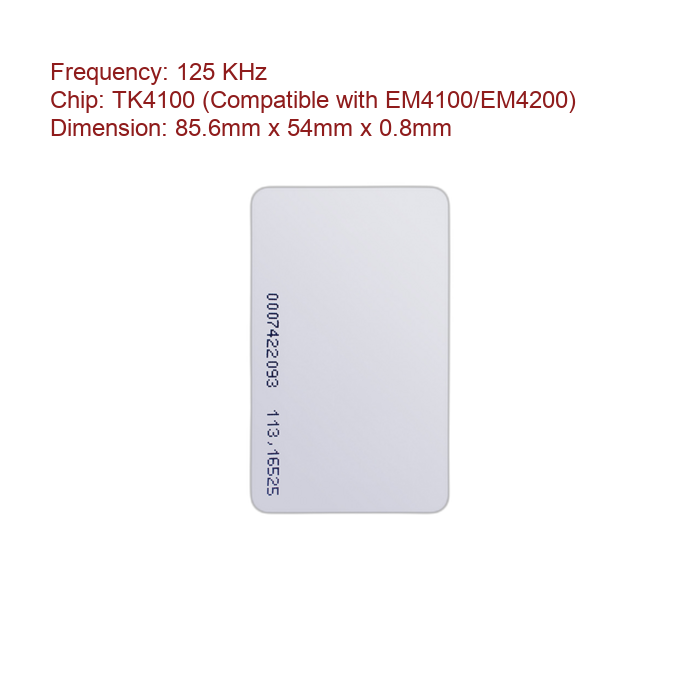
A 125kHz RFID card is a contactless smart card that uses Low Frequency (LF) Radio Frequency Identification technology operating at 125 kilohertz.
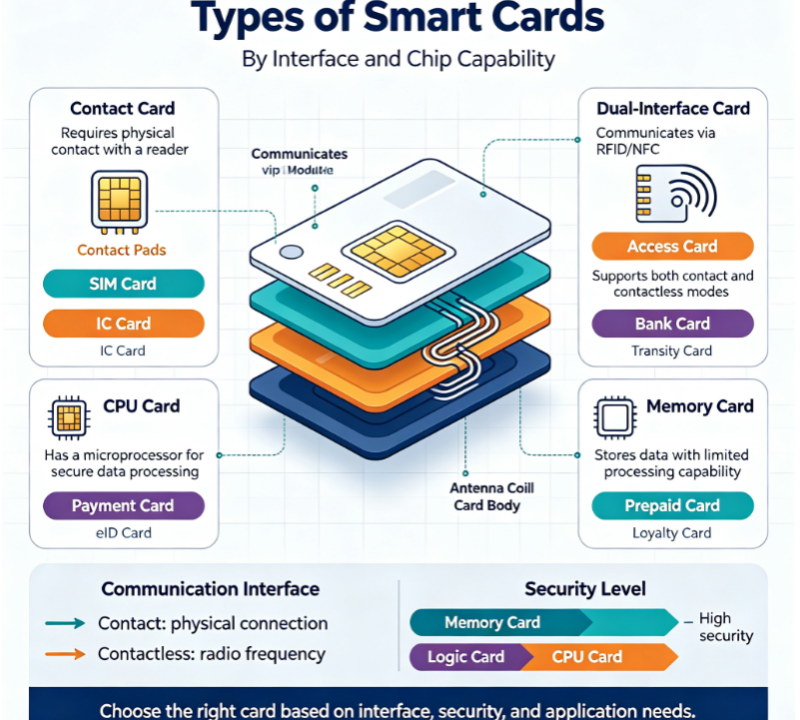
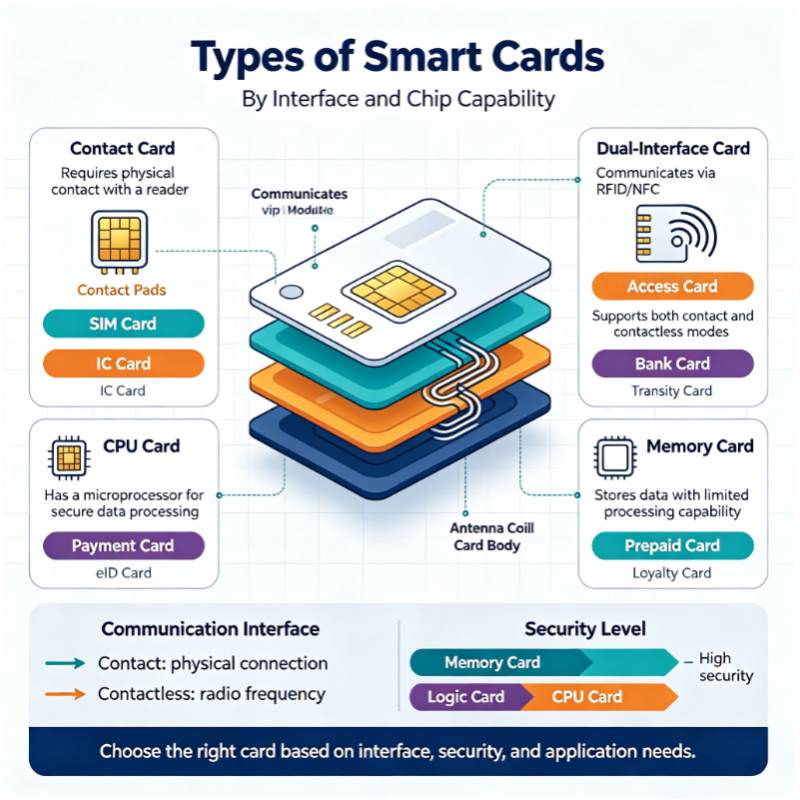
The card contains:
- RFID microchip
- Copper antenna coil
- PVC or composite card body
- Unique identification number
When brought near an RFID reader, the card transmits its stored identification data without requiring physical contact.
Unlike traditional magnetic stripe cards, RFID cards offer faster operation, reduced wear and tear, and enhanced convenience.
Most 125kHz RFID cards are passive RFID cards, meaning they do not contain a battery. Instead, they receive power from the electromagnetic field generated by the RFID reader.
How Does a 125kHz RFID Card Work?
The working principle of a 125kHz RFID card is based on electromagnetic induction.
Step 1: Reader Generates an RF Field
The RFID reader continuously emits a low-frequency electromagnetic field at 125kHz.
Step 2: Card Enters Reading Zone
When the RFID card comes within the reader’s operating range, the antenna coil inside the card captures energy from the reader’s field.
Step 3: Chip Activation
The RFID chip becomes energized and activates.
Step 4: Data Transmission
The chip transmits its unique identification code back to the reader.
Step 5: Verification
The reader sends the data to a controller, database, or access management system for authentication.
Step 6: Action Execution
If the card is authorized, the system performs the programmed action:
- Unlocking doors
- Recording attendance
- Opening gates
- Granting access
- Logging entry times
The entire process typically takes less than one second.
Main Components of a 125kHz RFID Card
RFID Chip
The chip stores identification data and controls communication with the reader.
Popular chip types include:
- EM4100
- EM4200
- TK4100
- T5577
- HITAG S256
- HITAG S2048
Antenna Coil
The antenna receives power and transmits information between the card and reader.
Card Body
Most cards are manufactured using:
- PVC
- PET
- ABS
- Composite materials
The card body protects internal components from environmental damage.
Technical Specifications of 125kHz RFID Cards
| Parameter | Specification |
|---|---|
| Frequency | 125kHz |
| Technology | Low Frequency RFID |
| Reading Distance | 2-15 cm |
| Card Size | 85.6 × 54 mm |
| Thickness | 0.76 mm |
| Material | PVC/PET/ABS |
| Data Retention | 10+ years |
| Read Cycles | 100,000+ |
| Operating Temperature | -25°C to +70°C |
| Communication Method | Contactless |
| Power Source | Passive |
| Waterproof Option | Available |
Why Are 125kHz RFID Cards Still Popular?
Many people assume newer technologies automatically replace older ones. However, millions of organizations continue using 125kHz RFID cards.
Proven Reliability
125kHz systems have been used for decades and have demonstrated excellent stability.
Low Cost
The infrastructure and cards are significantly cheaper than many smart card alternatives.
Easy Deployment
Installation is straightforward and requires minimal technical expertise.
Durable Design
The cards withstand:
- Daily use
- Dust
- Moisture
- Temperature fluctuations
Fast Authentication
Users simply tap or wave the card near a reader.
Pain Points Solved by 125kHz RFID Cards
Eliminates Traditional Keys
Physical keys create several challenges:
- Lost keys
- Duplicated keys
- Costly lock replacement
- Difficult access management
RFID cards solve these problems through digital access control.
Improves Security
Organizations can:
- Track access history
- Restrict unauthorized users
- Disable lost cards instantly
- Manage permissions centrally
Reduces Administrative Costs
Traditional manual attendance tracking consumes time and labor.
RFID automation reduces:
- Human errors
- Paper records
- Administrative workload
Enhances User Convenience
Employees, residents, and visitors gain quick access without carrying multiple keys.
Supports Large-Scale Management
Businesses can manage thousands of users using a centralized database.
Common Applications of 125kHz RFID Cards
Access Control Systems
This is the most common application.
Used in:
- Office buildings
- Factories
- Warehouses
- Government facilities
- Residential communities
Employees simply present the card to gain entry.
Employee Attendance Tracking
Companies use RFID cards to:
- Record clock-in times
- Record clock-out times
- Generate attendance reports
- Reduce time theft
Hotel Key Cards
Many hotels use RFID cards instead of traditional metal keys.
Benefits include:
- Easy replacement
- Better guest management
- Enhanced security
Parking Management
RFID cards allow authorized vehicles and drivers to enter parking facilities.
School Identification Systems
Schools use RFID cards for:
- Student attendance
- Campus access
- Library management
- Cafeteria payments
Gym Membership Management
Fitness centers use RFID cards to manage member access and usage tracking.
Apartment and Residential Communities
Residents can use a single card for:
- Main entrance access
- Elevator access
- Parking access
- Shared facilities
Advantages of 125kHz RFID Cards
Excellent Penetration Ability
Low-frequency signals can perform well around:
- Water
- Human bodies
- Non-metallic materials
This makes them suitable for access control environments.
Low Power Consumption
Passive cards require no batteries.
Benefits include:
- Maintenance-free operation
- Long service life
- Reduced ownership costs
Affordable Infrastructure
Readers and cards are generally less expensive than high-frequency smart card systems.
High Durability
RFID cards resist:
- Scratches
- Moisture
- Daily wear
Simple Integration
Compatible with many existing access control platforms.
Limitations of 125kHz RFID Cards
While highly reliable, 125kHz RFID cards have certain limitations.
Short Reading Range
Typical reading distance ranges from 2 to 15 centimeters.
For long-distance identification, UHF RFID is often preferred.
Limited Data Storage
Most basic cards only contain identification numbers.
Lower Security Compared with Smart Cards
Traditional EM4100 and TK4100 cards may be vulnerable to cloning if additional security measures are not implemented.
Slower Data Transfer
Compared with HF and UHF RFID technologies, data transmission speed is lower.
125kHz RFID Cards vs 13.56MHz RFID Cards
| Feature | 125kHz RFID | 13.56MHz RFID |
|---|---|---|
| Frequency | 125kHz | 13.56MHz |
| Cost | Lower | Higher |
| Reading Range | Short | Medium |
| Security | Basic | Higher |
| Data Capacity | Limited | Larger |
| Access Control | Excellent | Excellent |
| NFC Compatibility | No | Yes |
| Smart Applications | Limited | Extensive |
Which Is Better?
Choose 125kHz RFID cards if you need:
- Cost-effective access control
- Attendance systems
- Basic identification
Choose 13.56MHz cards if you need:
- Encryption
- Smart payments
- NFC compatibility
- Advanced authentication
125kHz RFID Cards vs UHF RFID Cards
| Feature | 125kHz RFID | UHF RFID |
|---|---|---|
| Frequency | 125kHz | 860-960MHz |
| Read Distance | 2-15 cm | Up to 15 meters |
| Cost | Lower | Higher |
| Anti-Collision | Limited | Excellent |
| Asset Tracking | Basic | Advanced |
| Access Control | Excellent | Moderate |
UHF RFID is typically used for:
- Logistics
- Warehousing
- Inventory tracking
- Vehicle management
125kHz RFID remains superior for close-range secure access applications.
Customization Options
Modern manufacturers offer extensive customization services.
Printing Options
- Full-color printing
- Company logos
- Employee photos
- Barcodes
- QR codes
Encoding Services
Cards can be pre-programmed with:
- Unique IDs
- Access credentials
- Employee numbers
Material Options
- Standard PVC
- Eco-friendly materials
- Waterproof materials
- High-temperature materials
Surface Finishes
- Glossy
- Matte
- Frosted
Security Considerations
Organizations should implement best practices to maximize security.
Use Encrypted Systems
Where possible, choose secure chip technologies.
Regular Access Audits
Review user permissions periodically.
Immediate Card Deactivation
Lost cards should be disabled immediately.
Multi-Factor Authentication
Combine RFID cards with:
- PIN codes
- Biometrics
- Mobile authentication
This significantly improves overall security.
Industries Using 125kHz RFID Cards
Corporate Offices
Access control and attendance management.
Manufacturing Facilities
Employee tracking and restricted area access.
Healthcare Facilities
Staff identification and secure access.
Educational Institutions
Student and faculty management.
Hospitality Industry
Guest room access and facility management.
Government Agencies
Secure identification and building access.
Transportation Systems
Parking and fleet management.
How to Choose the Right 125kHz RFID Card Supplier
When selecting a manufacturer, consider:
Product Quality
Look for:
- ISO-certified production
- Consistent chip performance
- Strict quality control
Chip Options
Ensure the supplier offers:
- EM4100
- TK4100
- T5577
- HITAG series
Customization Capabilities
Choose suppliers that provide:
- Printing
- Encoding
- OEM branding
Production Capacity
Large-scale projects require reliable manufacturing output.
Technical Support
Strong after-sales support reduces deployment risks.
Future of 125kHz RFID Cards
Despite advancements in NFC and UHF RFID technologies, 125kHz RFID cards continue to maintain a strong position in the market.
Their affordability, reliability, and ease of implementation make them ideal for access control and identification systems worldwide.
Future developments are expected to focus on:
- Improved anti-cloning technologies
- Better integration with cloud platforms
- Hybrid RFID solutions
- Enhanced security features
As organizations seek cost-effective identification solutions, 125kHz RFID cards will remain a practical and dependable technology for years to come.
Conclusion
125 kHz RFID cards are among the most proven and cost-effective contactless identification technologies available today. Using low-frequency electromagnetic communication, they provide reliable solutions for access control, attendance tracking, parking management, hotel access, and employee identification.
Their simple architecture, low cost, durability, and ease of deployment make them an excellent choice for businesses, schools, hospitals, residential communities, and industrial facilities. While newer RFID technologies offer additional capabilities, 125kHz RFID cards continue to address critical operational challenges, including security management, access control, attendance automation, and administrative efficiency.
For organizations seeking a stable, affordable, and highly reliable identification solution, 125kHz RFID cards remain one of the best investments in modern access management systems.

Do RFID is a leading China-based manufacturer with over 15 years of experience. We specialize in customized RFID readers, tags, and cards, delivering high-quality, tailored solutions that meet your unique business needs and drive seamless, efficient identification.