September 14, 2026
Radio Frequency Identification (RFID) technology has transformed the way businesses identify, track, authenticate, and manage assets, people, and animals. Among the various RFID frequencies available today, 125 kHz RFID readers remain one of the most widely used and reliable solutions for access control, attendance systems, animal identification, industrial automation, and security applications.
While newer RFID technologies such as 13.56 MHz HF RFID and UHF RFID have gained popularity in recent years, 125 kHz low-frequency RFID systems continue to dominate many industries due to their stability, affordability, and excellent performance in challenging environments.
Whether you are a security integrator, access control installer, system developer, distributor, or business owner, understanding how a 125 kHz RFID reader works and how it compares with alternative RFID technologies is essential for selecting the right solution.
This comprehensive guide explores everything you need to know about 125 kHz RFID readers, including their working principles, specifications, applications, advantages, limitations, comparison with competing technologies, and how to choose the best reader for your project.
What Is a 125 kHz RFID Reader?
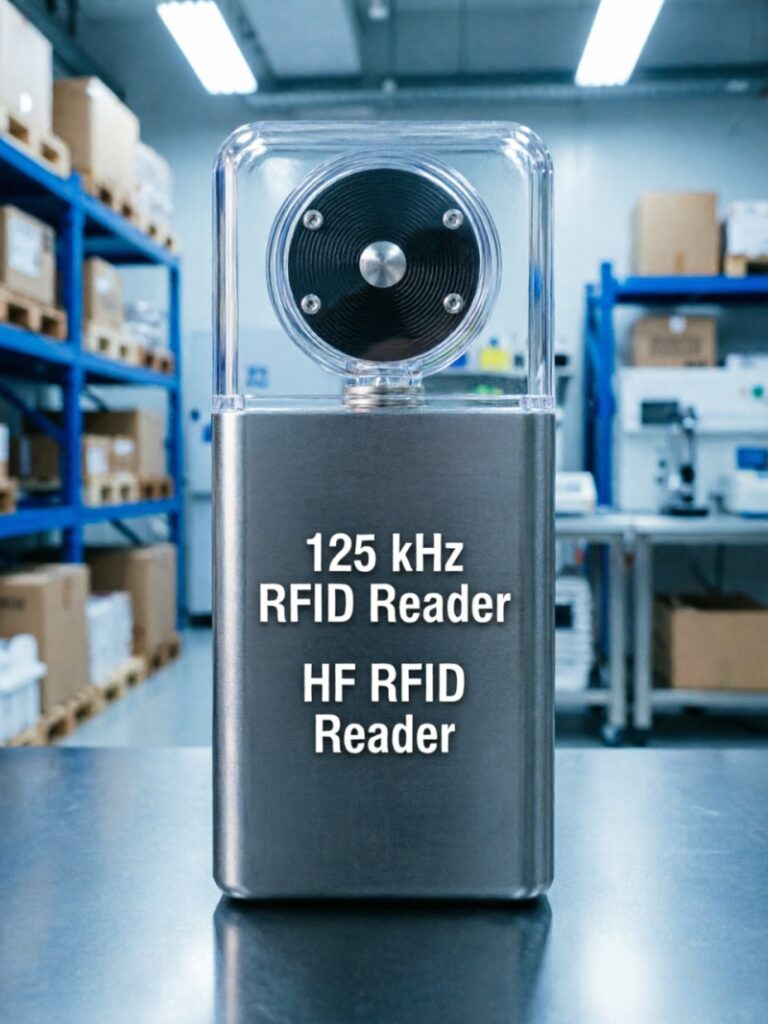
A 125 kHz RFID reader is a low-frequency RFID device designed to communicate with compatible RFID tags or cards operating at 125 kilohertz.
The reader generates a low-frequency electromagnetic field through its antenna. When a compatible RFID tag enters this field, it becomes energized and transmits its unique identification to the reader.
The reader then sends the data to a host system for authentication, identification, access control, attendance recording, or asset management.
A typical 125 kHz RFID system consists of:
- RFID reader
- RFID antenna
- RFID tags or cards
- Controller or software platform
- Communication interface
These systems are often used for short-range identification where reliability is more important than long reading distance.
How Does a 125 kHz RFID Reader Work?
Understanding the working principle helps explain why low-frequency RFID remains popular in many industries.
Step 1: Reader Generates an Electromagnetic Field
The RFID reader continuously emits a 125 kHz electromagnetic signal through its antenna.
This creates a reading zone around the reader.
Step 2: RFID Tag Enters the Field
When a compatible RFID card, keyfob, wristband, or animal tag enters the electromagnetic field, energy is transferred from the reader to the passive tag.
Most 125 kHz tags are passive and do not contain batteries.
Step 3: Tag Activates
The tag harvests energy from the reader’s field and powers its internal chip.
Step 4: Data Transmission
The tag transmits its stored identification number to the reader via modulation techniques.
Step 5: Reader Processes Information
The reader decodes the information and sends it to the connected system.
The system then determines:
- Access granted or denied
- Employee attendance recorded
- Animal identified
- Asset authenticated
This entire process occurs within milliseconds.
Main Components of a 125 kHz RFID Reader
RFID Antenna
The antenna generates the electromagnetic field required for communication.
RF Module
Handles signal generation and reception.
Decoder
Interprets tag information.
Microcontroller
Processes data and manages communication protocols.
Communication Interface
Common interfaces include:
- USB
- RS232
- RS485
- Wiegand
- TCP/IP
- Bluetooth
- Wi-Fi
Typical Specifications of 125 kHz RFID Readers
Although specifications vary by manufacturer, typical parameters include:
| Parameter | Typical Value |
|---|---|
| Frequency | 125 kHz |
| Reading Distance | 2-20 cm |
| Protocol | EM4100, EM4200, TK4100 |
| Communication | USB, Wiegand, RS232 |
| Power Supply | 5V-12V DC |
| Reading Speed | <100 ms |
| Operating Temperature | -20°C to +70°C |
| Protection Rating | IP54-IP67 |
Industrial-grade models may support outdoor environments and harsh operating conditions.
Types of 125 kHz RFID Readers
Desktop RFID Reader
Used for:
- Software development
- Membership management
- Card registration
Access Control Reader
Installed near doors and gates.
Common applications include:
- Office access
- Apartment security
- Parking control
Embedded RFID Reader Module
Designed for integration into:
- Kiosks
- Vending machines
- Attendance terminals
Long Range LF Reader
Specialized designs can achieve greater reading distances.
Animal Identification Reader
Used in:
- Livestock management
- Veterinary clinics
- Pet identification
Advantages of 125 kHz RFID Readers
Excellent Reliability
Low-frequency RFID performs consistently in difficult environments.
Strong Penetration Ability
125 kHz signals perform better around:
- Water
- Moisture
- Biological tissue
This makes them ideal for animal identification.
Low Cost
Both readers and tags are highly affordable.
Mature Technology
The technology has been used for decades and is proven in real-world applications.
Easy Integration
Most systems integrate easily with existing access control infrastructure.
Long Service Life
Low-frequency RFID readers typically offer years of maintenance-free operation.
Pain Points Solved by 125 kHz RFID Readers
Many businesses still rely on manual identification processes that create inefficiencies and security risks.
Eliminates Manual Data Entry
Employees no longer need to enter identification numbers manually.
Reduces Human Error
Automatic identification improves accuracy.
Improves Security
Only authorized cards can gain access.
Speeds Up Attendance Tracking
Employee attendance becomes automatic.
Simplifies Animal Management
Livestock can be identified instantly.
Reduces Administrative Costs
Automation minimizes labor requirements.
Prevents Unauthorized Access
Access control systems improve facility security.
Major Applications of 125 kHz RFID Readers
Access Control Systems
Perhaps the most common application.
Used in:
- Office buildings
- Factories
- Residential communities
- Hospitals
- Schools
Employee Attendance Systems
Employees simply scan their RFID card.
The system automatically records:
- Arrival time
- Departure time
- Work hours
Parking Management
RFID cards automate vehicle access.
Hotel Key Card Systems
Guests can access rooms securely.
Animal Tracking
Widely used for:
- Pet identification
- Livestock management
- Veterinary records
Industrial Automation
RFID enables process tracking and workflow management.
Membership Management
Gyms, clubs, and libraries frequently use RFID-based identification.
125 kHz RFID Reader vs 13.56 MHz RFID Reader
Many buyers compare LF and HF technologies.
Reading Distance
125 kHz:
- 2-20 cm
13.56 MHz:
- 2-50 cm
Winner:
13.56 MHz
Cost
125 kHz systems are generally less expensive.
Winner:
125 kHz
Security
HF systems often support encryption.
Winner:
13.56 MHz
Environmental Resistance
LF performs better near water and biological materials.
Winner:
125 kHz
Access Control Applications
Both are commonly used.
Winner:
Tie
125 kHz RFID Reader vs UHF RFID Reader
Reading Distance
125 kHz:
- Up to 20 cm
UHF:
- Up to 15 meters or more
Winner:
UHF
Anti-Collision Capability
UHF can read many tags simultaneously.
Winner:
UHF
Cost
LF systems are often more affordable.
Winner:
125 kHz
Precision
LF provides highly predictable reading zones.
Winner:
125 kHz
Asset Tracking
UHF dominates large-scale tracking projects.
Winner:
UHF
New Generation vs Traditional 125 kHz RFID Readers
RFID technology continues to evolve.
Traditional Readers
Features:
- Basic ID reading
- Wired communication
- Limited integration
Advantages:
- Low cost
- Simple installation
Modern RFID Readers
Features:
- Bluetooth connectivity
- Mobile app integration
- Cloud platform support
- Advanced encryption
- Multi-protocol compatibility
Advantages:
- Greater flexibility
- Better security
- Easier management
Which Should You Choose?
For basic access control, traditional readers remain highly effective.
For smart building applications, modern RFID readers offer additional capabilities.
Common RFID Card Types Supported
EM4100
One of the most common 125 kHz card formats.
TK4100
Compatible with many access control systems.
EM4200
Improved functionality and reliability.
T5577
Rewritable RFID card.
Popular among developers and testing environments.
How to Choose the Best 125 kHz RFID Reader
Determine Reading Distance Requirements
Most applications require only short-range reading.
Choose a reader that matches your actual needs.
Consider Installation Environment
For outdoor use, select:
- Waterproof housing
- IP65 or higher protection
Verify Protocol Compatibility
Ensure compatibility with your RFID cards.
Evaluate Communication Interfaces
Choose based on system requirements:
- USB
- Wiegand
- RS485
- TCP/IP
Check Software Support
Good software compatibility reduces integration costs.
Consider Future Expansion
Select a scalable solution if future upgrades are likely.
Common Industries Using 125 kHz RFID Readers
Education
Student attendance systems.
Healthcare
Staff identification and access control.
Manufacturing
Worker management and facility security.
Agriculture
Animal identification and livestock tracking.
Hospitality
Hotel access systems.
Transportation
Parking and vehicle access management.
Government
Secure building access.
Future Trends in 125 kHz RFID Technology
Although UHF and NFC technologies continue growing, 125 kHz RFID remains highly relevant.
Emerging trends include:
- Cloud-connected readers
- Mobile management platforms
- Bluetooth-enabled readers
- Smart building integration
- IoT connectivity
- Enhanced security protocols
Manufacturers are combining traditional RFID reliability with modern connectivity features.
Competitive Analysis: Is 125 kHz RFID Still Worth Buying?
Despite newer RFID technologies entering the market, 125 kHz RFID readers continue to offer compelling advantages.
Best For
- Access control
- Employee attendance
- Animal identification
- Membership systems
- Parking access
Not Ideal For
- Warehouse inventory management
- Long-range asset tracking
- Large-scale logistics systems
For these applications, UHF RFID is usually more suitable.
Conclusion
The 125 kHz RFID reader remains one of the most reliable, cost-effective, and widely deployed RFID technologies in the world. Its simple operating principle, strong performance near water and biological materials, low system cost, and proven reliability make it an excellent choice for access control, attendance management, animal identification, parking systems, and industrial automation.
While newer technologies such as 13.56 MHz HF RFID and UHF RFID offer additional capabilities, 125 kHz RFID continues to provide unmatched value in applications requiring short-range, secure, and dependable identification. By carefully evaluating reading distance, environmental conditions, communication interfaces, and system compatibility, businesses can select the ideal 125 kHz RFID reader to improve security, efficiency, and operational control.

Do RFID is a leading China-based manufacturer with over 15 years of experience. We specialize in customized RFID readers, tags, and cards, delivering high-quality, tailored solutions that meet your unique business needs and drive seamless, efficient identification.