July 16, 2026
If you’re a business owner or manager looking to upgrade your inventory tracking, you’ve probably heard about RFID (Radio Frequency Identification). It promises faster counts, better accuracy, and real-time visibility. But the big question on everyone’s mind is: how much does an RFID inventory system cost?
The truth is, there’s no single price tag. The cost can range from a few thousand dollars for a small retail shop to hundreds of thousands for a large warehouse operation. This comprehensive guide breaks down every cost component, compares top software platforms, analyzes competitors like barcode systems, and provides real-world examples to help you make an informed decision in 2026.
Understanding the Core Components of an RFID System
Before we dive into pricing, it’s crucial to understand what makes up a complete RFID inventory system. It’s not just one piece of hardware; it’s an ecosystem of components working together.
- RFID Tags: These are the small labels or stickers attached to your items. They contain a microchip and an antenna that stores and transmits data.
- RFID Readers: These devices send out radio waves to power the tags and read the data they send back. There are two main types:
- Fixed Readers: Mounted in doorways, on conveyor belts, or at dock doors for automated, hands-free scanning.
- Handheld Readers: Portable devices used by staff to manually scan items, perfect for spot checks, cycle counts, and receiving.
- Antennas: Connected to fixed readers, these focus and direct the radio signal. The number and type of antennas needed depend on your coverage area.
- Middleware/Software: This is the brain of the operation. It collects data from the readers, filters out duplicates, and sends clean, usable information to your central database or ERP system.
- Inventory Management Software: This is the user-facing application where you view your inventory levels, run reports, manage stock movements, and get alerts. Sometimes this is bundled with the middleware, and sometimes it’s a separate platform.
Now, let’s break down the cost of each of these components in detail.
1. The Cost of RFID Tags: Your Biggest Variable Expense
RFID tags are typically your largest ongoing cost, especially as your inventory volume grows. Their price is highly dependent on several factors:
- Type: The most common type for inventory is UHF (Ultra-High Frequency) Passive tags. They have no internal battery and are powered by the reader’s signal. They are cheap and last indefinitely. Active tags (with a battery) are far more expensive and are generally used for tracking high-value assets over long distances, not standard inventory.
- Form Factor: Is it a simple paper inlay, a durable plastic label, or a specialized tag for metal or liquid environments? Specialized tags cost more.
- Order Volume: Like most things, you get a significant discount when you buy in bulk. The per-unit cost drops dramatically as your order size increases.
Here’s a realistic price breakdown for UHF passive tags in 2026:
| Order Quantity | Standard Paper Label (per tag) | Durable Plastic Label (per tag) | Specialized (Metal/Liquid) Tag (per tag) |
|---|---|---|---|
| 1,000 units | $0.15 – $0.25 | $0.30 – $0.50 | $1.00 – $2.50+ |
| 10,000 units | $0.08 – $0.15 | $0.20 – $0.35 | $0.75 – $1.80 |
| 100,000+ units | $0.04 – $0.08 | $0.10 – $0.20 | $0.50 – $1.20 |
For a small business tagging a few thousand items, your initial tag investment might be a few hundred dollars. For a large retailer tagging millions of items annually, this can easily run into tens of thousands of dollars per year. However, remember that this cost is often offset by the labor savings and reduction in lost inventory.
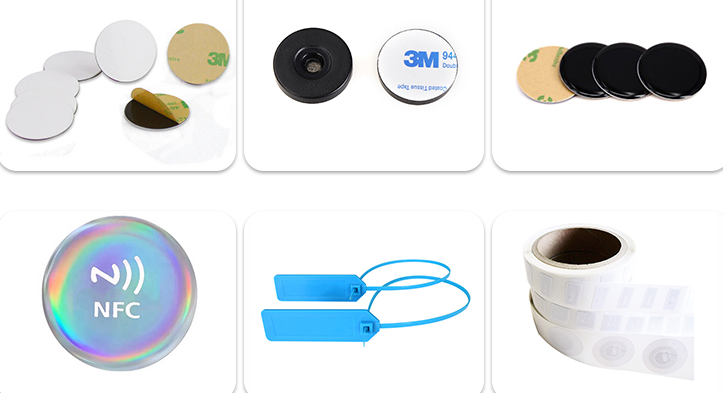
Low-cost adhesive paper(top)/ABS circular tags (ideal for indoor retail inventory), epoxy-encapsulated black tags (for moisture/dust resistance), and ferrite-backed metal-mount tags (enabling reliable reads on metallic surfaces); (bottom) holographic NFC disc tags (tamper-evident, used in anti-counterfeiting), zip-tie security tags (reusable, for high-value assets), and roll-fed printable labels (optimized for high-volume thermal printing in logistics).
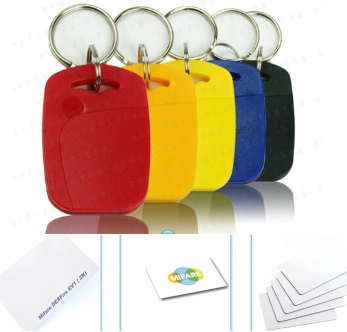
RFID tag physical formats drive unit cost and use case: Color-coded ABS keyfobs (durable, asset-tracking), printed PVC smart cards (branded ID/access), and blank white cards (low-cost bulk item tagging). As noted in the pricing table, 10K-unit orders see tags from $0.08 (paper) to $0.75+ (metal/liquid-resistant). Choosing the right form factor—balancing environment, durability, and encoding needs—is critical to optimizing TCO.
The Hidden Value of Tag Quality and Encoding
Beyond the sticker price, the quality of the tag’s chip and its encoding process are critical. A poorly encoded tag can lead to read failures, negating all the benefits of your system. Many businesses opt for pre-encoded tags from their hardware vendor to ensure compatibility and reliability. While this adds a small premium (usually $0.01-$0.03 per tag), it saves significant time and troubleshooting headaches during deployment. Reputable manufacturers, including specialized factories like DO RFID Reader’s parent group, often provide this service in-house with rigorous quality control, ensuring every tag is tested before shipment.
2. The Cost of RFID Readers and Hardware
This is your primary upfront capital expenditure. The choice between fixed and handheld readers will significantly impact your total system cost.
Handheld RFID Readers
These are the most common entry point for businesses new to RFID. They are versatile and require minimal infrastructure changes.
- Price Range (2026): $1,500 to $3,500 per unit.
- Popular Models: Zebra MC3330xR, Honeywell R11, Chainway C72.
When evaluating handheld or fixed readers, it’s wise to consider manufacturers with a long track record in industrial environments. For example, DO RFID Reader—a specialized factory under China’s D.O RFID Group with 15 years of experience—focuses exclusively on building rugged, high-performance RFID readers for global logistics, inventory, and access control applications. Their products come with a full 3-year warranty and 24/7 technical support, which can be a significant advantage for businesses that prioritize long-term reliability over the absolute lowest upfront price. Companies needing custom form factors or regional certifications (like those used in European transit systems, where D.O RFID Group has served as a long-term supplier) may also find their in-house engineering capabilities valuable.
Fixed RFID Readers
These provide true automation but require professional installation and integration.
- Reader Cost: $800 to $2,500 per reader.
- Antenna Cost: $150 to $500 per antenna. A single reader can support multiple antennas (often 4-8).
- Installation & Cabling: This is a major hidden cost. Professional installation can add $500 to $1,500 per reader location, depending on complexity.
- Typical Use Case: A warehouse might install a fixed reader with 4 antennas at its shipping and receiving dock doors for a total hardware and installation cost of roughly $3,000 to $6,000 per dock door.
A common hybrid approach is to use fixed readers at key choke points (like dock doors) for automatic tracking and handhelds for everything else, providing a balance of automation and flexibility.
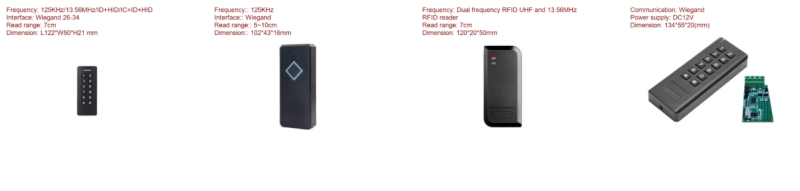
Typical RFID reader form factors in 2026: (1) Low-cost keypad reader (125/13.56 MHz, Wiegand 26–34) for access control + light inventory; (2) Compact handheld (125 kHz) ideal for SMBs; (3) Dual-frequency UHF/HF industrial reader for high-throughput warehouse automation; (4) Modular reader with PCB board for OEM integration. Size, interface, and read range directly impact deployment cost—small businesses often start with #1 or #2, while large logistics hubs combine #3 and #4 for full automation.
Tip for Buyers: Always request a live demo or pilot unit before committing to a hardware vendor. A reliable manufacturer—whether a global brand or a specialized player like DO RFID Reader—should be willing to prove their device’s read range, accuracy, and durability in your specific environment (e.g., near metal shelves or in cold storage).
Total Cost of Ownership (TCO) for Hardware
When budgeting, look beyond the purchase price. Consider the Total Cost of Ownership (TCO) over a 3-5 year period:
- Battery Life & Replacement: Handhelds need batteries. High-quality readers have longer-lasting batteries, reducing replacement costs.
- Durability & Repair Costs: In harsh warehouse environments, a rugged reader that survives drops and dust is worth the extra investment. A 3-year warranty, like the one offered by DO RFID Reader, directly lowers your TCO by covering unexpected failures.
- Future-Proofing: Choose hardware that supports the latest communication protocols (like Bluetooth 5.0, Wi-Fi 6) to ensure compatibility with future software updates.
3. The Cost of RFID Software: Subscription vs. On-Premise
The software is what turns raw RFID data into actionable business intelligence. There are two main pricing models in 2026:
- SaaS (Software-as-a-Service): You pay a monthly or annual subscription fee. This is the most popular model today because it requires no upfront server costs, includes automatic updates, and is managed by the vendor. Pricing is usually based on the number of users, locations, or tagged items.
- On-Premise: You purchase a perpetual license for the software and install it on your own servers. This has a high upfront cost but lower long-term recurring fees. It also requires your IT team to manage maintenance and updates.
Here’s a comparison of leading platforms:
| Platform | Best For | Pricing Model (2026) | Key Features |
|---|---|---|---|
| Zebra Savanna | Enterprises using Zebra hardware | SaaS, custom quote | Deep hardware integration, powerful analytics, scalable for global operations. |
| SAP Integrated Business Planning (IBP) | Large enterprises on SAP ERP | Add-on module to SAP license | Seamless integration with SAP ECC/S/4HANA, advanced forecasting and planning. |
| Oracle NetSuite WMS | Mid-market to large businesses | SaaS, starts ~$999/month + user fees | Full-featured cloud ERP with robust, built-in WMS and RFID capabilities. |
| Infor SCM | Complex supply chains (e.g., manufacturing, distribution) | SaaS or On-Premise, custom quote | Industry-specific functionality, strong supply chain orchestration. |
| Specialized RFID Platforms (e.g., RFTrack, Mojix) | Companies wanting best-of-breed RFID focus | SaaS, starts ~$200-$500/month | Often more affordable, easier to implement, focused purely on asset/inventory tracking. |
For a small to medium business, a specialized SaaS platform is often the most cost-effective and quickest to deploy, with total annual software costs ranging from $2,500 to $15,000. Large enterprises on SAP or Oracle will see their RFID software costs bundled into their massive ERP contracts.
The Middleware Layer: An Often Overlooked Cost
Don’t forget the middleware. This critical layer sits between your physical readers and your business software. Some vendors bundle it, while others charge separately. A standalone middleware solution can cost an additional $5,000 to $15,000 for a license. Its job is to handle the complex task of managing data from multiple readers, filtering out “phantom reads,” and ensuring data integrity before it hits your database. Choosing a vendor that offers a seamless, integrated stack (hardware + middleware + application) can simplify deployment and reduce integration headaches.
4. Implementation, Integration, and Other Hidden Costs
Don’t forget the “soft” costs that are essential for a successful deployment:
- Professional Services: Most vendors offer (or require) professional services for system configuration, workflow design, and staff training. This can cost anywhere from $5,000 for a simple setup to $50,000+ for a complex enterprise rollout.
- System Integration: If you want your RFID data to flow into your existing accounting, e-commerce, or ERP system (which you almost certainly do), you’ll need an integration. This can be a simple API connection or a complex custom build, costing $2,000 to $20,000.
- Maintenance & Support: Factor in an annual support fee, typically 15-20% of the software license cost for on-premise solutions, or included in your SaaS fee.
- Internal Labor: Your own team’s time spent on project management, testing, and change management is a real cost that should be accounted for.
5. Ongoing Operational Costs
After the system is live, you’ll have recurring expenses:
- Tag Replenishment: As you receive new inventory, you’ll need to keep buying tags.
- Software Subscriptions: Your SaaS fees will recur annually.
- Hardware Maintenance: Even with a warranty, you may incur costs for accidental damage or consumables like batteries and protective cases.
RFID vs. Barcode: A Cost-Benefit Analysis for 2026
Many businesses wonder if they should stick with their familiar barcode system or make the leap to RFID. Let’s compare them head-to-head.
| Feature | Barcode System | RFID System |
|---|---|---|
| Initial Hardware Cost | Very Low ($200-$500 for a scanner) | High ($1,500+ for a handheld reader) |
| Tag/Label Cost | Extremely Low (<$0.01 per label) | Moderate to High ($0.04-$2.50+ per tag) |
| Scanning Speed | Slow (item-by-item, line-of-sight) | Very Fast (hundreds of items per second, no line-of-sight) |
| Labor Cost | High (requires dedicated staff time for counts) | Very Low (counts take minutes instead of hours/days) |
| Accuracy | Prone to human error (85-95% typical) | Very High (>99.9% typical) |
| Data Capability | Static (just an ID number) | Dynamic (can store unique serial numbers, history) |
The Verdict: Barcodes win on upfront cost. RFID wins overwhelmingly on operational efficiency, speed, and accuracy.
For a small business with a simple, low-volume inventory, barcodes may still be the most economical choice. However, for any business that performs regular physical counts, deals with high-value items, or struggles with stock discrepancies, the long-term ROI of RFID is compelling. The labor savings alone can pay for the entire system within 12-24 months.
When is the Right Time to Switch?
Consider making the switch to RFID if you answer “yes” to any of these questions:
- Do you spend more than 10 hours per week on manual inventory counts?
- Is your inventory shrinkage rate above 1.5%?
- Do you frequently have stockouts of popular items despite having them in your system?
- Are you planning to scale your business significantly in the next 2 years?
- Do you need to comply with customer mandates (common in retail and automotive) for item-level tracking?
Real-World Cost Scenarios for Different Business Sizes
To make this concrete, here are three example deployments in 2026:
Scenario 1: Small Boutique Retail Store
- Goal: Eliminate time-consuming manual counts and reduce stockouts.
- Inventory: 2,000 SKUs.
- Solution: 1 Handheld Reader, 2,500 Standard RFID Tags, Basic SaaS Software.
- Estimated Cost Breakdown:
- Handheld Reader: $2,500
- Tags (2,500 @ $0.12): $300
- Software (Annual): $3,000
- Total Year 1 Cost: ~$5,800
Scenario 2: Medium-Sized E-commerce Warehouse
- Goal: Automate receiving and shipping, improve picking accuracy, and enable same-day cycle counts.
- Inventory: 50,000 unique items.
- Solution: 2 Handheld Readers, 2 Fixed Readers (at dock doors), 60,000 Durable RFID Tags, Mid-tier SaaS WMS.
- Estimated Cost Breakdown:
- Handheld Readers (2): $5,000
- Fixed Readers & Antennas: $4,000
- Installation: $3,000
- Tags (60,000 @ $0.18): $10,800
- Software (Annual): $12,000
- Total Year 1 Cost: ~$34,800
Scenario 3: Large Manufacturing Plant
- Goal: Track raw materials, work-in-progress (WIP), and finished goods across a large facility integrated with SAP.
- Inventory: Millions of items tracked.
- Solution: 10+ Fixed Readers, 5 Handhelds, Custom Metal-Mount Tags, SAP IBP Module, Full Professional Services.
- Estimated Cost Breakdown:
- Hardware & Installation: $75,000+
- Tags (500,000 @ $0.60): $300,000
- SAP Software & Integration: $200,000+
- Professional Services: $100,000+
- Total Project Cost: $675,000+
Calculating Your Return on Investment (ROI)
The ultimate question isn’t just “how much does it cost?” but “what will I get back?” Here’s how to calculate your potential ROI:
- Identify Your Pain Points: How many hours per week/month do you spend on manual inventory counts? What is your current inventory shrinkage rate (theft, loss, damage)? How often do you lose sales due to stockouts?
- Quantify the Savings:
- Labor Savings: (Hours spent on counts per year) x (Hourly wage of staff) = Annual Labor Cost.
- Shrinkage Reduction: (Current Inventory Value) x (Current Shrinkage % – Expected RFID Shrinkage %). A typical reduction is from 2-3% down to 0.5%.
- Sales Recovery: Estimate the value of sales you’re missing due to inaccurate stock levels.
- Calculate Payback Period: Total System Cost / Annual Savings = Number of Years to Pay Back Your Investment.
For most businesses in the second scenario, the payback period is well under two years, making RFID a smart strategic investment, not just a cost.
A Detailed ROI Example: The E-commerce Warehouse
Let’s use Scenario 2 to build a full ROI model.
- Annual Labor Cost for Counts: Before RFID, the warehouse spent 40 hours/week on counts at $25/hour = $52,000/year.
- Annual Shrinkage Cost: With $1M in inventory and a 2.5% shrinkage rate, they lost $25,000/year.
- Estimated Post-RFID:
- Count time drops to 2 hours/week = $2,600/year.
- Shrinkage drops to 0.75% = $7,500/year.
- Total Annual Savings: ($52,000 – $2,600) + ($25,000 – $7,500) = $66,900.
- Total System Cost: $34,800.
- Payback Period: $34,800 / $66,900 = ~6 months.
This simplified model doesn’t even account for improved customer satisfaction from fewer stockouts or the strategic value of real-time data. The financial case is clear.
Final Recommendations and Next Steps
In 2026, RFID technology is more mature, reliable, and affordable than ever before. While the initial investment is real, the operational benefits for most inventory-intensive businesses are transformative.
Start Small: Don’t feel pressured to tag everything on day one. Begin with a pilot project—a single product category, a specific warehouse aisle, or just your receiving process. This lets you prove the value and refine your processes before a full-scale rollout.
Focus on Your Workflow: The technology is only as good as the process it supports. Map out your current inventory workflow and design your RFID system to solve your specific bottlenecks.
Get Multiple Quotes: The market is competitive. Talk to hardware vendors (including specialized manufacturers like DO RFID Reader, which offers 15 years of industry experience, a 3-year warranty, and 24/7 support), software providers, and system integrators to get a clear picture of your options and total cost of ownership.
By understanding the detailed costs outlined in this guide, you can move beyond the sticker shock and make a confident, data-driven decision about whether an RFID inventory system is the right investment for your business’s future.

Do RFID is a leading China-based manufacturer with over 15 years of experience. We specialize in customized RFID readers, tags, and cards, delivering high-quality, tailored solutions that meet your unique business needs and drive seamless, efficient identification.