September 14, 2026
The RFID industry has transformed supply chain management, retail inventory control, asset tracking, livestock identification, logistics automation, and industrial IoT applications. At the center of every RFID system is the RFID integrated circuit (IC), commonly known as the RFID chip. Among the most widely adopted UHF RFID chips in the global market is the Higgs-3 chip.
Developed by Alien Technology, the Higgs-3 RFID chip became one of the industry’s most successful EPC Gen2 UHF RFID ICs due to its reliability, affordability, excellent read performance, and broad compatibility. Even years after newer RFID chips entered the market, Higgs-3 remains widely used in RFID labels, RFID asset tags, RFID logistics tags, RFID library systems, warehouse management solutions, and livestock identification applications.
This comprehensive guide explains what the Higgs-3 RFID chip is, how it works, the challenges it solves, its practical applications, advantages and limitations, and a detailed comparison between Higgs-3 and Higgs-4 RFID chips.
What Is the Higgs-3 RFID Chip?
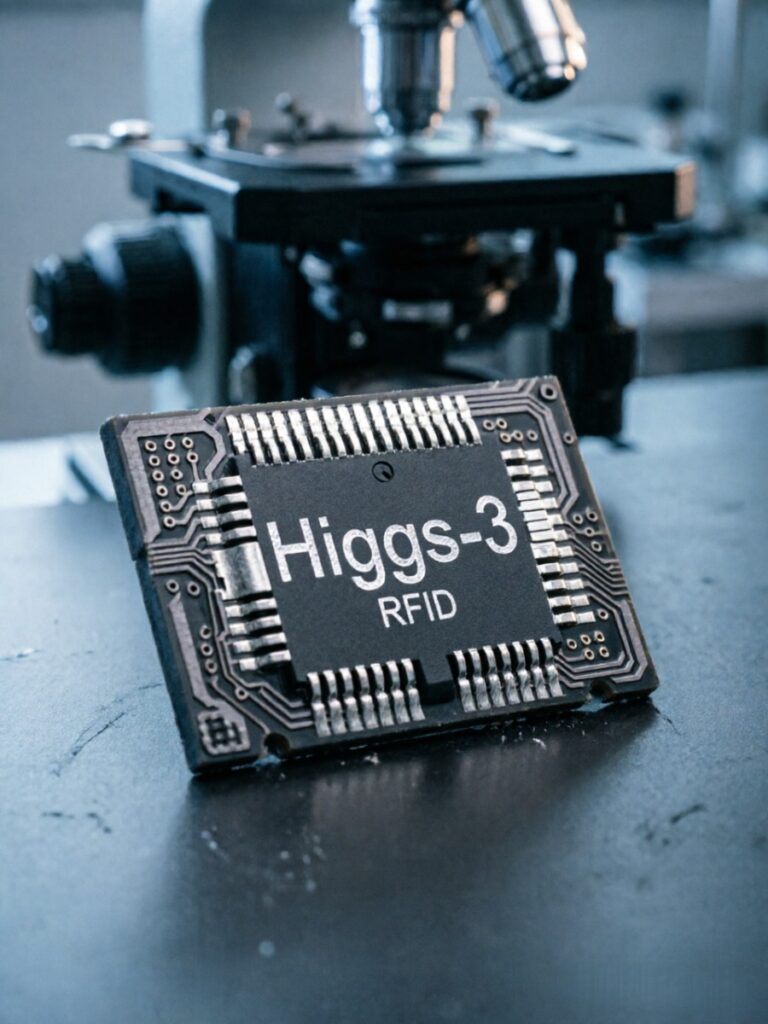
Higgs-3 is a passive Ultra High Frequency (UHF) RFID integrated circuit developed by Alien Technology for EPC Gen2 RFID applications.
The chip is designed to provide:
- Long-range RFID identification
- Fast data transmission
- Reliable tag reading
- High-volume inventory management
- Cost-effective RFID deployment
Higgs-3 complies with international RFID standards including:
- EPC Class 1 Gen 2
- ISO 18000-6C
These standards ensure compatibility with most major RFID readers, antennas, and RFID management platforms worldwide.
Because of its strong performance and low cost, Higgs-3 became one of the most widely used RFID chips in the RFID industry.
Understanding UHF RFID Technology
Before examining Higgs-3 specifically, it is important to understand UHF RFID technology.
RFID stands for Radio Frequency Identification.
UHF stands for Ultra High Frequency.
Typical operating frequencies include:
- 860 MHz
- 865 MHz
- 902–928 MHz
- 960 MHz
Depending on regional regulations.
Unlike barcodes, RFID tags can be identified wirelessly without direct visual contact.
This enables:
- Faster scanning
- Bulk tag reading
- Automated inventory management
- Real-time asset tracking
The Higgs-3 chip serves as the “brain” inside the RFID tag.
How Does the Higgs-3 RFID Chip Work?
The Higgs-3 chip operates using passive RFID technology.
Unlike active RFID devices, passive tags contain no battery.
Step 1: RFID Reader Sends Radio Signals
An RFID reader emits UHF radio frequency energy through its antenna.
Step 2: RFID Tag Receives Energy
The Higgs-3 chip receives energy from the electromagnetic field generated by the reader.
This energy powers the chip temporarily.
Step 3: Chip Activation
Once powered, the chip activates and prepares its stored information.
Step 4: Backscatter Communication
The chip reflects radio signals back to the reader using a technique called backscatter modulation.
Step 5: Data Transmission
The RFID reader receives:
- EPC code
- User memory data
- Tag identification information
Step 6: Data Processing
The software platform processes the collected information for business applications.
This entire process occurs in milliseconds.
Higgs-3 Memory Structure
One reason for the popularity of Higgs-3 is its flexible memory architecture.
Typical memory configuration includes:
EPC Memory
96-bit Electronic Product Code (expandable)
Used for:
- Product identification
- Asset tracking
- Inventory management
User Memory
512-bit user memory
Used for:
- Additional asset information
- Product data
- Manufacturing information
- Custom identifiers
TID Memory
64-bit unique Tag Identification number
Provides permanent factory-programmed identification.
Reserved Memory
Contains:
- Access passwords
- Kill passwords
Used for security functions.
The large user memory was considered a significant advantage when Higgs-3 was introduced.
Key Features of the Higgs-3 Chip
Long Read Range
Higgs-3 supports excellent read distances when paired with optimized antenna designs.
Depending on the tag design and reader power, read ranges can reach several meters.
High Reading Accuracy
The chip supports anti-collision technology, allowing multiple tags to be read simultaneously.
EPC Gen2 Compliance
Compatible with most RFID infrastructure worldwide.
Large User Memory
Compared with many older RFID chips, Higgs-3 provides generous user memory capacity.
Cost Efficiency
Its balance between performance and price made it ideal for large-scale deployments.
Global Frequency Support
Suitable for international RFID applications.
Problems Solved by Higgs-3 RFID Technology
Traditional identification methods face many limitations.
Higgs-3 helps solve these challenges.
Problem 1: Slow Manual Inventory Counting
Barcode scanning requires line-of-sight reading.
Workers must scan items individually.
Higgs-3 enables bulk scanning of hundreds of items simultaneously.
Problem 2: Human Error
Manual recording often leads to mistakes.
RFID automation improves data accuracy.
Problem 3: Lack of Real-Time Visibility
Businesses need accurate inventory information.
Higgs-3 enables automatic tracking throughout the supply chain.
Problem 4: Asset Loss
Organizations often lose track of valuable assets.
RFID improves visibility and accountability.
Problem 5: Inefficient Warehouse Operations
RFID automation reduces labor costs and improves operational efficiency.
Applications of Higgs-3 RFID Chips
The flexibility of Higgs-3 has led to adoption across numerous industries.
Retail Inventory Management
Retailers use Higgs-3 RFID labels for:
- Stock counting
- Shelf monitoring
- Inventory accuracy
- Loss prevention
Large retailers can scan thousands of products within minutes.
Warehouse Management
Distribution centers use Higgs-3 tags to monitor:
- Incoming inventory
- Outgoing shipments
- Storage locations
- Order fulfillment
Asset Tracking
Businesses track:
- IT equipment
- Manufacturing tools
- Medical devices
- Rental assets
Logistics and Supply Chain
RFID enables visibility across transportation networks.
Applications include:
- Container tracking
- Pallet management
- Parcel identification
- Shipment verification
Library Management
Libraries use RFID tags for:
- Book circulation
- Self-service checkout
- Inventory audits
- Anti-theft protection
Healthcare
Hospitals track:
- Medical equipment
- Surgical tools
- Pharmaceutical inventory
- Patient-related assets
Livestock Identification
Higgs-3 chips are commonly embedded in:
- Cattle RFID ear tags
- Sheep RFID tags
- Animal tracking systems
These applications improve traceability and herd management.
Why Higgs-3 Became an Industry Standard
Several factors contributed to its widespread adoption.
Excellent Price-to-Performance Ratio
The chip offered strong performance without high cost.
Reliable Read Performance
Stable reading capabilities made it suitable for industrial deployments.
Broad Reader Compatibility
Works with most EPC Gen2 RFID readers.
Proven Market Acceptance
Millions of RFID tags worldwide were built using Higgs-3.
Flexible Tag Design Options
Manufacturers incorporated Higgs-3 into:
- RFID labels
- Hard tags
- Windshield tags
- Asset tags
- Animal tags
This versatility accelerated adoption.
Limitations of Higgs-3
Despite its success, Higgs-3 has limitations compared with newer RFID chips.
Older Semiconductor Technology
Newer chips benefit from more advanced manufacturing processes.
Higher Power Requirements
Modern RFID chips often provide better sensitivity.
Larger Chip Size
Recent generations achieve better performance with smaller footprints.
Limited Memory Security Features
Advanced security options available in newer chips may be absent.
These limitations encouraged the development of successor products.
Introduction to Higgs-4 RFID Chip
Alien Technology introduced Higgs-4 as the next-generation RFID IC technology.
The goal was to improve:
- Read sensitivity
- Reading speed
- Reliability
- Memory efficiency
- Performance in challenging environments
Higgs-4 quickly gained popularity in advanced RFID deployments.
Higgs-3 vs Higgs-4: Detailed Comparison
Chip Generation
| Feature | Higgs-3 | Higgs-4 |
|---|---|---|
| Generation | Earlier | Newer |
| Technology Platform | Legacy | Advanced |
| Market Introduction | Older | Improved Successor |
Higgs-4 benefits from newer semiconductor design techniques.
Read Sensitivity
| Feature | Higgs-3 | Higgs-4 |
| Tag Sensitivity | Good | Better |
| Read Distance | Long | Longer |
Higgs-4 generally achieves improved reading performance.
Performance in Dense RFID Environments
| Feature | Higgs-3 | Higgs-4 |
| Anti-Collision | Good | Enhanced |
| High-Density Reading | Moderate | Better |
Large-scale inventory environments often favor Higgs-4.
Power Efficiency
| Feature | Higgs-3 | Higgs-4 |
| Power Requirement | Higher | Lower |
| Energy Harvesting | Standard | Improved |
Improved efficiency contributes to longer read ranges.
Memory Architecture
Both chips support EPC Gen2 functionality.
However, memory structures differ depending on the specific chip variant and application requirements.
Industrial Performance
Higgs-4 generally offers:
- Better sensitivity
- Improved reliability
- Stronger performance near challenging materials
However, many applications still perform exceptionally well with Higgs-3.
When Should You Choose Higgs-3?
Higgs-3 remains a strong choice for:
Cost-Sensitive Projects
Large deployments often prioritize affordability.
Standard RFID Applications
Typical warehouse and inventory systems perform well with Higgs-3.
Proven Legacy Systems
Many existing infrastructures are already optimized for Higgs-3 tags.
Large Volume Label Production
Manufacturers continue using Higgs-3 due to its established supply chain and stable performance.
When Should You Choose Higgs-4?
Higgs-4 is often preferable when:
Maximum Read Distance Is Required
Longer reading performance can improve operational efficiency.
Dense RFID Environments Exist
Large warehouses benefit from enhanced anti-collision capabilities.
Future Expansion Is Planned
New deployments often adopt the latest RFID technology.
Challenging Read Conditions Are Present
Metal-rich or complex environments may benefit from improved sensitivity.
Future Trends Beyond Higgs-3 and Higgs-4
RFID technology continues evolving rapidly.
Emerging trends include:
Increased Read Sensitivity
New chips continue extending read range.
IoT Integration
RFID systems increasingly connect with cloud platforms.
Advanced Security Features
Future chips include stronger authentication mechanisms.
Sensor-Enabled RFID
RFID tags increasingly incorporate:
- Temperature sensing
- Humidity monitoring
- Shock detection
Smart Supply Chains
RFID will play a central role in Industry 4.0 initiatives.
Conclusion
The Higgs-3 RFID chip has played a major role in the global adoption of UHF RFID technology. As one of the most successful EPC Gen2 RFID integrated circuits ever developed, it helped organizations improve inventory visibility, automate asset tracking, streamline logistics operations, and reduce labor-intensive processes.
Its combination of reliable performance, large user memory, broad compatibility, and cost efficiency made it a preferred choice for applications ranging from retail inventory management and warehouse automation to livestock identification and healthcare asset tracking.
While the newer Higgs-4 chip offers improved sensitivity, better read performance, enhanced efficiency, and stronger operation in demanding environments, Higgs-3 remains highly relevant for many standard RFID deployments due to its proven reliability and attractive cost structure. For organizations evaluating RFID solutions, the choice between Higgs-3 and Higgs-4 ultimately depends on performance requirements, deployment scale, environmental conditions, and budget considerations.
As RFID technology continues advancing toward smarter, more connected, and data-driven ecosystems, both Higgs-3 and Higgs-4 remain important milestones in the evolution of modern RFID identification systems.

Do RFID is a leading China-based manufacturer with over 15 years of experience. We specialize in customized RFID readers, tags, and cards, delivering high-quality, tailored solutions that meet your unique business needs and drive seamless, efficient identification.