March 3, 2026
In the world of NFC (Near Field Communication), tiny chips quietly power billions of interactions. Tap a phone to a poster. Scan a product label. Pair a device instantly. Behind that seamless “tap” experience often sits one of two popular NFC chips: NTAG213 or NTAG215.
At first glance, they look nearly identical. Same frequency. Same protocol. Same compatibility with smartphones. But dig deeper, and the differences matter — especially when you’re designing NFC tags for marketing, authentication, gaming, asset tracking, or access systems.
This guide breaks down NTAG213 vs NTAG215 using real technical data, practical use cases, and decision logic. No fluff. Just clarity.
1. What Are NTAG213 and NTAG215?
Both NTAG213 and NTAG215 are NFC Forum Type 2 Tag chips developed by NXP Semiconductors. They operate at:
- Frequency: 13.56 MHz
- Standard: ISO/IEC 14443A
- Communication Speed: 106 kbps
They are designed for short-range wireless communication, typically within 0–4 cm.
If you’ve used NFC stickers, smart posters, anti-counterfeit labels, gaming figures, or smart packaging — you’ve likely interacted with one of these chips.
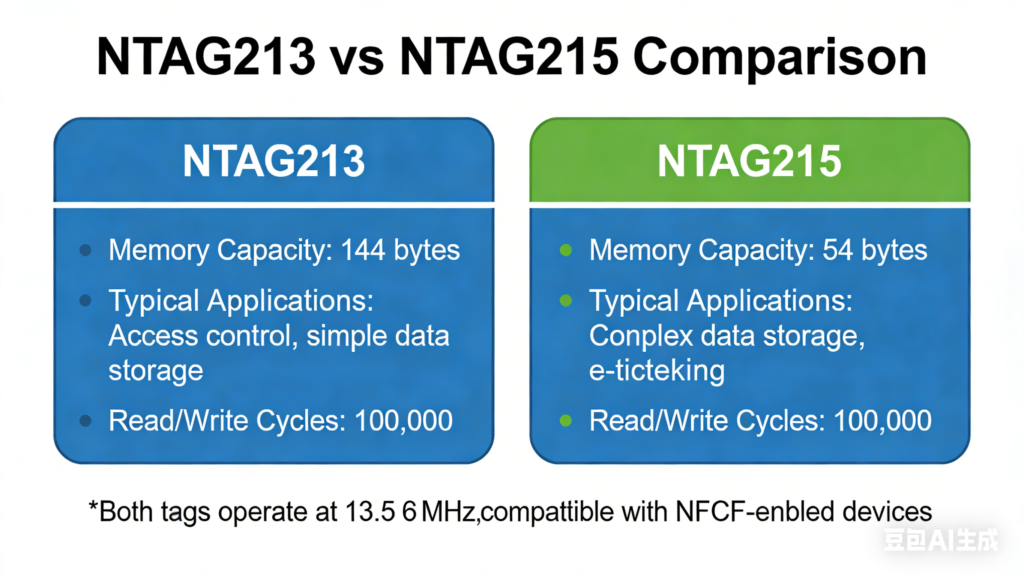
2. Core Technical Comparison Table
Let’s start with the raw data.
| Feature | NTAG213 | NTAG215 |
|---|---|---|
| Total Memory | 180 bytes | 540 bytes |
| User Memory | 144 bytes | 504 bytes |
| UID Length | 7 bytes | 7 bytes |
| Frequency | 13.56 MHz | 13.56 MHz |
| Protocol | ISO14443A | ISO14443A |
| NFC Forum Type | Type 2 | Type 2 |
| Read Range | 0–4 cm | 0–4 cm |
| Write Endurance | 100,000 cycles | 100,000 cycles |
| Data Retention | 10 years | 10 years |
| Password Protection | Yes | Yes |
| ECC Signature | Yes | Yes |
| Typical Price | Lower | Higher |
The most important difference is memory capacity.
That’s where decision-making begins.
3. Memory: The Critical Difference
Memory determines what kind of data your NFC tag can store.
NTAG213:
- 144 bytes usable memory
- Enough for:
- URL (shortened)
- Small text record
- Basic contact information
- Simple configuration commands
NTAG215:
- 504 bytes usable memory
- Enough for:
- Longer URLs
- vCard contact details
- Wi-Fi configuration data
- Gaming character data
- Larger NDEF records
Real Data Example
A typical URL like:
Consumes approximately 25–35 bytes depending on encoding.
If you use URL shortening, NTAG213 can store multiple short records.
But if you need:
- Full contact cards
- Custom encrypted payload
- Application-specific data
- Multi-record NDEF structures
NTAG215 becomes necessary.
Memory is not a luxury. It’s a design constraint.
4. Performance: Are They Different in Speed?
Technically, both chips:
- Operate at 13.56 MHz
- Use 106 kbps data rate
- Have similar read range (0–4 cm)
In real-world testing, scan speed differences are negligible.
Reading usually completes within:
- 100–500 milliseconds
Performance differences are not about speed — they are about storage.
5. Security Features: Identical Foundations
Both NTAG213 and NTAG215 include:
- 7-byte Unique Identifier (UID)
- 32-bit password protection
- Read/write lock bits
- ECC-based originality signature
The ECC (Elliptic Curve Cryptography) signature allows verification that the chip is genuine NXP silicon.
This matters for:
- Anti-counterfeit products
- Brand authentication
- Secure ticketing
Security architecture is comparable between the two models.
6. Write Endurance & Durability
Both chips support:
- 100,000 write cycles
- 10-year data retention
That means:
If you rewrite a tag once per day, it would theoretically last over 270 years.
Practical lifespan depends more on physical tag material than chip durability.
In industrial use:
- Temperature resistance typically ranges from -25°C to +70°C (depending on tag construction)
- Embedded in PVC, PET, ABS, epoxy, or silicone
The chip itself is robust.
7. Real-World Use Cases
Let’s shift from theory to application.
NTAG213 Typical Use Cases
- Marketing Campaign Tags
Small NFC stickers in posters or packaging. - Business Cards
Basic tap-to-website functions. - Smart Labels
Redirecting to product pages. - Social Media Tags
Simple URL redirection. - Anti-Counterfeit (Basic)
UID-based authentication.
Why choose NTAG213?
Lower cost + sufficient memory for basic functions.
NTAG215 Typical Use Cases
- Amiibo-Compatible Tags
Nintendo’s Amiibo uses NTAG215 due to memory requirement. - Advanced Authentication
Encrypted payload storage. - Digital Business Cards (Full vCard)
Name, phone, email, address, company, website. - IoT Device Pairing
Wi-Fi credentials require more bytes. - Multi-record Applications
Multiple NDEF records stored simultaneously.
Why choose NTAG215?
When memory matters.
8. Cost Considerations
In bulk production, approximate market differences:
- NTAG213 is typically 15–25% cheaper than NTAG215.
- Price difference scales significantly in large volumes (100,000+ units).
For example:
If the per-unit difference is $0.05:
- 100,000 units = $5,000 difference.
Cost efficiency becomes critical in mass deployments.
Choosing larger memory “just in case” can quietly inflate budgets.
9. Storage Efficiency Strategy
Here’s something practical.
If you use URL shortening services:
- A shortened link might consume 20 bytes.
- NTAG213 (144 bytes) can easily handle this.
But if you store:
- Full vCard contact (typically 250–400 bytes),
- NTAG213 cannot support it.
- NTAG215 fits comfortably.
Design starts with data mapping.
Memory planning avoids over-engineering.
10. Compatibility with Smartphones
Both chips are:
- Fully compatible with Android NFC devices.
- Compatible with iPhone (iPhone 7 and later for reading).
- NFC Forum Type 2 compliant.
No difference in mobile compatibility.
User experience remains identical.
11. Security vs Memory Trade-Off
Many buyers assume larger memory equals better security.
That’s incorrect.
Security mechanisms are nearly identical.
NTAG215 does not automatically increase encryption strength.
It simply stores more data.
Security depends more on:
- Password configuration
- Application-level encryption
- Backend validation
- Secure UID verification
Memory ≠ security.
12. Data Structure Examples
Let’s look at approximate byte consumption.
Example 1: Basic URL Record
- 30–50 bytes
- NTAG213: Suitable
- NTAG215: Overkill
Example 2: Full vCard Contact
- 300–400 bytes
- NTAG213: Not possible
- NTAG215: Suitable
Example 3: Gaming Character Data
- 500+ bytes
- NTAG215: Required
Example 4: Wi-Fi Config
- 200–350 bytes
- NTAG215 recommended
13. Storage Architecture Insight
Both chips use EEPROM memory.
EEPROM allows rewriting but has:
- Page-based structure
- Lock bits to prevent overwriting
- Configurable access control
NTAG215 simply provides more pages.
Structurally, architecture remains similar.
14. Deployment Scenarios by Industry
Retail
NTAG213 for:
- Smart posters
- Promo stickers
- Basic redirect tags
Gaming & Collectibles
NTAG215 required for:
- Amiibo-compatible tags
- Game data storage
Corporate ID & Digital Business Cards
NTAG215 preferred if storing full contact data.
Asset Tracking
Either chip works if data stored in backend.
If tag only stores ID:
NTAG213 is sufficient.
15. Anti-Counterfeit Applications
If you rely on:
- UID validation
- Cloud-based authentication
Memory requirement is minimal.
NTAG213 works well.
If storing:
- Encrypted tokens
- Larger validation blocks
NTAG215 provides flexibility.
16. Future Scalability
When designing NFC products, consider:
Will your data expand later?
If yes, upgrading from NTAG213 to NTAG215 later may require:
- New tag production
- Software reconfiguration
- Re-deployment
Planning ahead avoids migration cost.
17. Environmental Stability
Both chips:
- Operate typically between -25°C to +70°C (tag dependent)
- Handle humidity within industrial ranges
- Survive bending when embedded in flexible substrates
Reliability depends more on antenna design and tag material than chip selection.
18. Decision Framework
Choose NTAG213 if:
- Budget-sensitive
- Only storing short URL
- UID used as database key
- Large volume deployment
Choose NTAG215 if:
- Storing vCard or Wi-Fi data
- Gaming compatibility required
- Multi-record storage needed
- Long-term scalability expected
The correct choice balances cost and data requirement.
19. Data Planning Checklist
Before choosing, answer:
- How many bytes will your NDEF record consume?
- Will you store multiple records?
- Is future data expansion expected?
- Are you cost-sensitive at high volume?
- Is gaming or proprietary application compatibility required?
Data-driven decisions prevent expensive mistakes.
20. Final Summary: NTAG213 vs NTAG215
Both chips are:
- NFC Forum Type 2
- ISO14443A compliant
- 13.56 MHz frequency
- 100,000 write cycles
- 10-year retention
- Smartphone compatible
- Secure with password and ECC signature
The real difference:
Memory capacity.
- NTAG213 = 144 bytes usable
- NTAG215 = 504 bytes usable
That single specification shapes cost, application scope, and deployment strategy.
Choosing the right chip is not about picking the “better” one.
It’s about matching memory capacity to real data requirements.
Overengineering wastes budget. Underengineering limits function.
Precision matters.
In NFC design, bytes are strategy.