
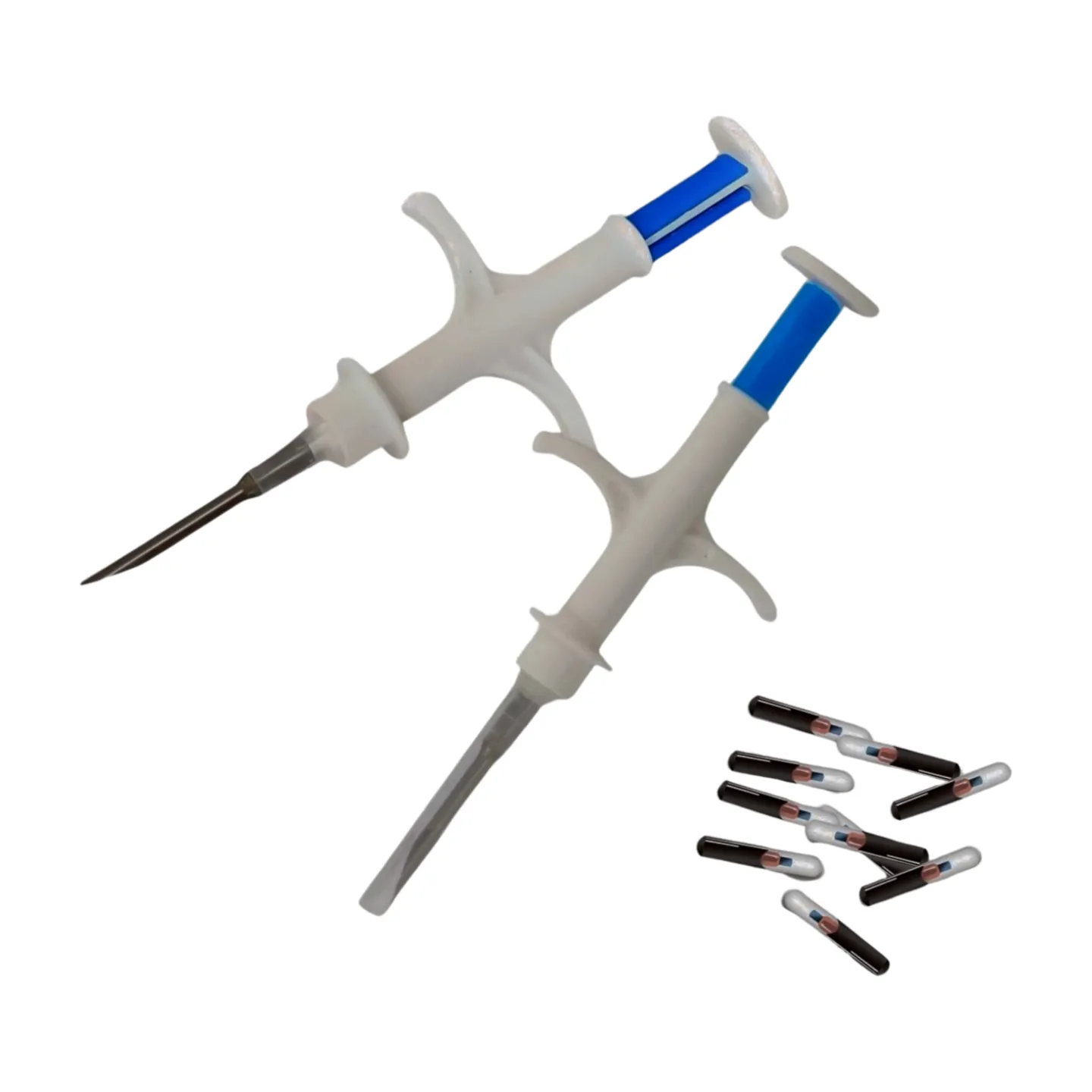
RFID Temperature Sensor Microchip for Animal Monitoring
Product Overview
This product represents an advancement in animal management technology. It is a passive, implantable RFID microchip that integrates a unique identification number with a precise temperature sensor. This dual-function capability transforms a standard identification tool into a vital health monitoring system.
Beyond Identification: Integrated Health Monitoring
The core value of this microchip lies in its ability to provide two critical data points simultaneously. It delivers permanent, tamper-proof identification for traceability and ownership while enabling non-invasive monitoring of a key health indicator. This allows for early detection of potential illness through changes in body temperature.
Target Industries & Users
This professional-grade solution is engineered for B2B applications across the animal industry.
- Veterinary Medicine
- Livestock Management (Dairy, Swine, Cattle)
- Equine Health
- Animal Shelters & Breeding Facilities
- Zoological & Wildlife Conservation Programs
Key Features & Benefits
Dual-Function Technology
Unique UID Identification: Each microchip contains an unalterable, globally unique identification number. This provides a permanent digital record for the animal, essential for medical history, ownership proof, and supply chain traceability.
Integrated Temperature Sensor: The embedded sensor captures the animal’s body temperature at the implant site. This allows for routine health checks and serves as an early warning system for fevers or infections, enabling timely veterinary intervention.
Designed for Animal Safety & Compliance
Biocompatible Bioglass Encapsulation: The microchip is encased in a smooth, sterile bioglass capsule. This material is designed for biocompatibility, promoting safe tissue acceptance and long-term stability within the animal’s body.
ISO 11784/11785 FDX-B Compliant: Full compliance with international standards ensures the chip works seamlessly with existing FDX-B readers worldwide. This guarantees system interoperability and meets regulatory requirements for animal identification and movement.
Practical & Reliable
Passive RFID Technology: The chip requires no internal battery. It is powered entirely by the radio frequency signal from a compatible reader, ensuring a functional lifetime equal to that of the animal.
Miniature Size (1.4 x 8.5mm): The compact dimensions make it suitable for implantation in a wide range of animal species, from small companion animals to large livestock, using a standard pre-loaded syringe applicator.
How the RFID Temperature Microchip Works
The FDX-B Communication Protocol
The microchip operates on the Full Duplex (FDX-B) communication standard at 134.2 kHz. When a compatible reader is brought within range, it emits a constant activation signal. The microchip harnesses energy from this signal to power its circuits. It then transmits a continuous data stream back to the reader, which includes both its unique ID number and the current temperature reading.
From Implantation to Data Insight
The workflow is straightforward for the professional user.
- A trained professional implants the microchip subcutaneously, typically in the standard site for the target species.
- Using an ISO-compliant FDX-B reader, the animal is scanned.
- The reader instantly displays the data in a clear format, for example: UID: 985121001234567 | Temp: 38.6°C.
Primary Application Scenarios
Livestock Health Management
Enable early, individual detection of illness within herds, such as mastitis in dairy cows or respiratory diseases in swine. This facilitates targeted treatment, improves herd health, and can help reduce blanket antibiotic use.
Veterinary Clinical Care
Streamline patient intake by automatically retrieving identity and recording a baseline temperature. Continuously monitor core temperature in critical patients during surgery, recovery, or hospitalization for more informed care.
Breeding & Genetic Programs
Accurately track pedigree and individual performance data. Monitor health parameters related to reproductive cycles and overall wellbeing, supporting data-driven breeding decisions.
Pet Wellness Programs
Veterinary practices can offer enhanced wellness plans, combining permanent identification with proactive health screening during annual check-ups, adding value to client services.
Technical Specifications
| Specification | Detail |
|---|---|
| Product Name | RFID Temperature Sensor Microchip |
| Chip Type | Custom Sensor Chip |
| Frequency | 134.2 kHz |
| Communication Standard | ISO 11784 / 11785 FDX-B |
| Encapsulation Material | Bioglass |
| Dimensions | 1.4 mm diameter × 8.5 mm length |
| Core Functions | Unique Identification (UID) + Temperature Sensing |
| Power Source | Passive (Induced from Reader Signal) |
Benefits for Your Business or Practice
- Enhance Animal Welfare: Move from reactive to proactive care by identifying health issues at an earlier, more treatable stage.
- Improve Operational Efficiency: Automate the capture of identity and health data, reducing manual handling time and minimizing transcription errors in records.
- Increase Traceability & Service Value: Strengthen breeding and production records for livestock. Offer a premium, technology-driven service for pet owners that differentiates your practice.
- Ensure Global Compliance: The ISO standard ensures your identification system is recognized internationally, facilitating trade and meeting regulatory mandates.
FAQ: RFID Temperature Sensor Microchips
What is an RFID temperature sensor microchip?
It is a passive, implantable electronic device that, when scanned by a compatible reader, transmits both a unique identification code and the current body temperature reading from the implant site.
How does the microchip measure temperature?
The custom integrated circuit includes a precision temperature sensor. When activated by the reader’s RF field, this sensor measures the local temperature, which is a reliable proxy for core body temperature, and encodes this data digitally for transmission alongside the UID.
Is it compatible with my existing animal RFID reader?
Compatibility requires a reader that supports the ISO 11785 FDX-B protocol at 134.2 kHz. Most readers designed for standard animal identification will read the ID number. To also display the temperature data, the reader’s software must be configured to decode and present the full data stream from this specific chip type.