October 21, 2026
An HF UHF dual frequency RFID card combines two ways of communicating with readers in one physical card. In the architecture described here, each interface responds independently to a compatible reader. One card can therefore serve two supported systems, but its construction does not automatically connect their data, permissions or applications.
The existing DO RFID TAG description presents an ISO/IEC 14443 Type A 13.56 MHz HF interface alongside a UHF interface, with separate chips and antennas. The explanation below concerns that stated architecture rather than an independently verified hardware configuration.
How the two interfaces operate
The described hybrid RFID card contains two independent radio interfaces. Each receives energy and communicates through its corresponding reader.
HF: inductive coupling and load modulation
A compatible HF reader creates an alternating magnetic field at 13.56 MHz. The card’s HF antenna couples with that field, supplying energy to the HF chip. The reader sends commands, and the card responds by modulating the load on the coupled field—a technique called load modulation.
This supports a close presentation interaction, such as bringing a card near a door reader. Physical contact is unnecessary. Powering the chip and exchanging data establish communication; whether the door opens depends on the access system.
The HF interface can respond without a preceding UHF transaction. Having both interfaces inside the card does not turn an HF exchange into a UHF exchange.
UHF: reader energy and backscatter
A compatible UHF reader supplies radio-frequency energy to the UHF interface and sends interrogation commands. The UHF chip responds through backscatter: it changes how its antenna reflects the reader’s signal, encoding information in those changes.
This can support identification at a greater distance than the close presentation interaction described for HF. Actual reading distance depends on the card, reader and operating conditions; a UHF interface alone does not establish a particular range.
UHF operation does not require a preceding HF tap. Each interface responds to its corresponding reader, rather than relying on the other interface to activate it.
What independence means for data and applications
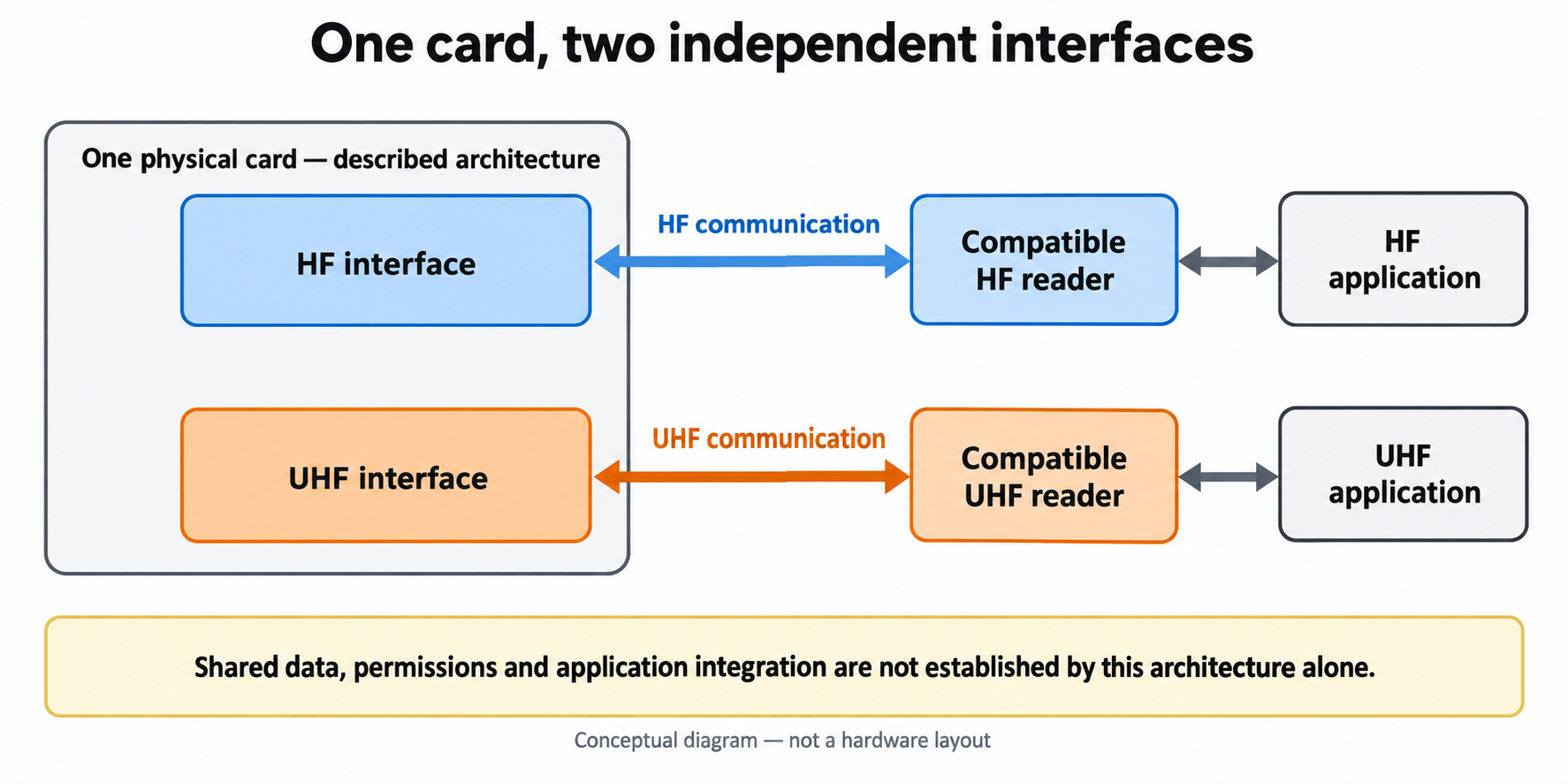
Putting two interfaces in one card establishes two communication paths. It does not establish a connection between their stored data or the systems receiving it.
| What the described architecture provides | What it does not establish |
|---|---|
| HF and UHF interfaces in one card | One shared application or account |
| Separate communication with compatible readers | Shared memory or synchronized identifiers |
| Two ways for supported systems to read the card | Automatic acceptance by either application |
| One physical item for the holder to carry | Replacement of every existing credential |
For example, a write through one interface should not be assumed to update information available through the other. Shared information would require an expressly supported design or application arrangement; it cannot be inferred from the phrase “dual frequency.”
The same distinction applies outside the card. Two readers may report to separate systems that have no connection to each other. Coordinating their records or actions is an application capability, separate from housing two interfaces in one card.
Communication, acceptance and authorization are different
A successful radio exchange means that a reader can obtain a response from the card. Application acceptance means that the receiving system recognizes and can use the information. Authorization means that the system permits the requested action.
These distinctions explain why dual-frequency construction cannot ensure universal compatibility. A reader might obtain a response while its application rejects the credential. An application might recognize a credential while denying access because it lacks permission. Adding a second interface does not automatically change either outcome.
ISO/IEC 14443 Type A describes the stated HF communication interface. It does not, by itself, establish support for every access or payment application using contactless cards. Likewise, UHF identification does not automatically create an authorized access event.
Example: HF door access and UHF identification
Consider a card used with an HF door reader and a separate UHF identification reader, with support for the relevant interface confirmed in each system.
At the door, the holder presents the card near the HF reader. If the access system accepts the credential and grants permission, the door can unlock. Elsewhere, the UHF reader may detect the card and report an identification event to its own application.
These are independent events. A UHF detection does not prove that the holder tapped at the door, and an HF access decision does not automatically authorize an action in the UHF application.
Receiving power from a reader also differs from completing an action without user intervention. The door interaction may still require deliberate presentation, and the application decides what follows a read.
One hybrid card can reduce the number of cards a person carries when both systems support it. It cannot be assumed to replace credentials for unrelated or unsupported systems.
Frequency does not guarantee security
HF and UHF describe radio operation, not a security rating. Short reading distance does not by itself prove secure authentication, and adding UHF does not strengthen the HF credential.
Security depends on the implemented authentication mechanisms, protection of credentials and the application’s decisions. Reading an identifier is not equivalent to proving that the credential is authentic. Similarly, a password that controls a chip operation does not, by itself, establish protection against cloning or unauthorized entry across the whole system.
The practical benefit of the described card is carrying two independent RFID interfaces in one object. A unified application requires additional support from the systems using them.