September 14, 2026
In modern agriculture and livestock farming, data-driven management is no longer a luxury—it’s a necessity. From tracking animal health to ensuring regulatory compliance, farmers and agribusinesses need reliable identification systems that go far beyond traditional methods.
That’s where High-Quality UHF RFID Animal Ear Tags come in.
These smart tags combine durability, long-range identification, and real-time tracking capabilities, making them an essential tool for efficient livestock management. Whether you’re managing cattle, pigs, or sheep, RFID ear tags provide a scalable solution for traceability, productivity, and disease control.
In this comprehensive guide, we’ll explore:
- What UHF RFID animal ear tags are
- How they are manufactured
- Their working principle
- Key applications
- Pain points they solve
- Competitive analysis
- Bulk procurement strategies
What Are High-Quality UHF RFID Animal Ear Tags?
UHF RFID animal ear tags are passive RFID identification devices designed to be attached to livestock ears for tracking and data collection.
Unlike traditional visual tags or barcodes, RFID ear tags enable:
- Contactless identification
- Bulk scanning
- Real-time data integration
They comply with global standards like ISO 18000-6C and EPC Gen2, ensuring compatibility with most RFID systems worldwide.
Key Product Features
- Passive UHF RFID technology (no battery required)
- Long reading distance (up to 3 meters)
- Durable TPU outer material
- Lightweight and animal-friendly design
- Waterproof and weather-resistant
- Customizable size and design
Technical Specifications
| Parameter | Specification |
|---|---|
| Frequency | 860–960 MHz |
| Protocol | EPC Class1 Gen2 / ISO 18000-6C |
| Chip Options | Alien Higgs-3 / Alien Higgs-4 |
| Memory | Up to 512 bits |
| Size | 80 × 70 × 2.5 mm (customizable) |
| Inlay Material | PET + Aluminum |
| Outer Material | TPU |
| Reading Distance | Up to 3 meters |
| Operating Temperature | -20°C to +50°C |
| Storage Temperature | -40°C to +100°C |
| Operating Mode | Read/Write |
| Packaging | 200 pcs per pack |
How Are RFID Animal Ear Tags Manufactured?
The production process combines RF engineering, material science, and livestock safety considerations.
1. Inlay Production
The RFID inlay consists of:
- Aluminum antenna (etched for UHF frequency)
- RFID chip mounted on PET substrate
The chip—such as Alien Higgs-3 or Alien Higgs-4—is attached using precision bonding technology.
2. Antenna Design Optimization
The antenna is designed to:
- Maximize reading distance
- Ensure stable signal performance
- Adapt to animal movement
3. Encapsulation in TPU Material
The inlay is embedded into TPU (thermoplastic polyurethane):
- Soft and flexible for animal comfort
- Resistant to UV, moisture, and chemicals
- Durable against wear and tear
4. Tag Molding and Shaping
The tag is molded into ergonomic shapes to:
- Fit securely on animal ears
- Prevent injury or discomfort
5. Quality Testing
Each tag undergoes:
- Signal performance testing
- Durability checks
- Environmental resistance testing
Working Principle of UHF RFID Animal Ear Tags
The tag operates using passive UHF RFID technology.
How It Works:
- An RFID reader emits radio frequency signals
- The tag antenna receives the signal
- The chip is powered by the signal
- The tag transmits stored data back
- The system records and processes the information
Key Advantages:
- No battery required
- Fast identification of multiple animals
- Accurate data collection
- Reduced human intervention
Main Applications
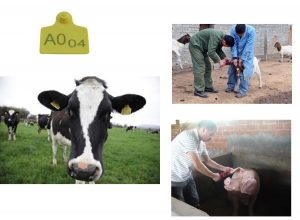
1. Livestock Identification
Used for:
- Cattle
- Sheep
- Pigs
Benefits:
- Unique ID for each animal
- Easy tracking and management
2. Health Monitoring
Tracks:
- Vaccination records
- Medical history
- Disease outbreaks
3. Breeding Management
Helps manage:
- Lineage tracking
- Breeding cycles
- Genetic records
4. Farm Management
Improves:
- Inventory control
- Feeding schedules
- Movement tracking
5. Supply Chain Traceability
Tracks animals from:
- Farm → Processing → Distribution
What Pain Points Does It Solve?
1. Manual Tracking Errors
Problem: Traditional tagging methods are prone to errors.
Solution: RFID enables automated and accurate identification.
2. Time-Consuming Processes
Problem: Manual scanning takes time.
Solution: RFID allows bulk reading in seconds.
3. Lack of Traceability
Problem: Difficult to track animal history.
Solution: RFID provides complete lifecycle tracking.
4. Animal Stress and Handling
Problem: Frequent handling causes stress.
Solution: Contactless scanning reduces handling.
5. Data Management Challenges
Problem: Hard to maintain accurate records.
Solution: RFID integrates with digital systems.
Competitive Analysis
1. RFID Ear Tags vs Visual Tags
| Feature | RFID Tags | Visual Tags |
|---|---|---|
| Data Storage | High | None |
| Reading Method | Contactless | Manual |
| Accuracy | High | Low |
2. UHF vs LF/HF RFID
| Feature | UHF RFID | LF/HF RFID |
|---|---|---|
| Range | Long | Short |
| Speed | Fast | Moderate |
| Use Case | Large farms | Close-range |
3. TPU vs Plastic Tags
| Feature | TPU | Standard Plastic |
|---|---|---|
| Flexibility | High | Low |
| Durability | High | Moderate |
| Comfort | Better | Lower |
Advantages Over Competitors
- Long reading distance
- High durability
- Animal-friendly design
- Global standard compatibility
- Scalable for large farms
Bulk Procurement Guide
1. MOQ (Minimum Order Quantity)
Typical MOQ:
- 1,000 – 5,000 pieces
2. Customization Options
- Logo printing
- Unique ID encoding
- Color customization
3. Pricing Factors
- Chip type (Higgs-3 vs Higgs-4)
- Order quantity
- Customization level
4. Supplier Evaluation Checklist
- Manufacturing capacity
- Quality certifications
- Experience in RFID production
- Export capabilities
5. Packaging & Logistics
- Standard: 200 pcs per pack
- Protective packaging for transport
- Global shipping options
Installation Guidelines
- Use proper ear tagging tools
- Ensure correct placement on ear
- Avoid excessive pressure
Maintenance Tips
- Regularly check tag condition
- Replace damaged tags
- Ensure readability
Future Trends in RFID Livestock Management
- Integration with IoT platforms
- Real-time health monitoring
- AI-based livestock analytics
- Smart farming automation
Final Thoughts
High-quality UHF RFID animal ear tags are transforming livestock management by providing efficient, accurate, and scalable tracking solutions.
With their:
- Long-range reading capability
- Durable TPU construction
- Reliable performance
- Easy integration
…they offer a powerful way to improve productivity, traceability, and animal welfare.
In today’s competitive agricultural landscape, adopting RFID technology isn’t just about keeping up—it’s about staying ahead.
Because when every animal counts, smart tracking makes all the difference

Do RFID is a leading China-based manufacturer with over 15 years of experience. We specialize in customized RFID readers, tags, and cards, delivering high-quality, tailored solutions that meet your unique business needs and drive seamless, efficient identification.