October 19, 2026
NFC Review Card vs Stand: Which Should You Choose?
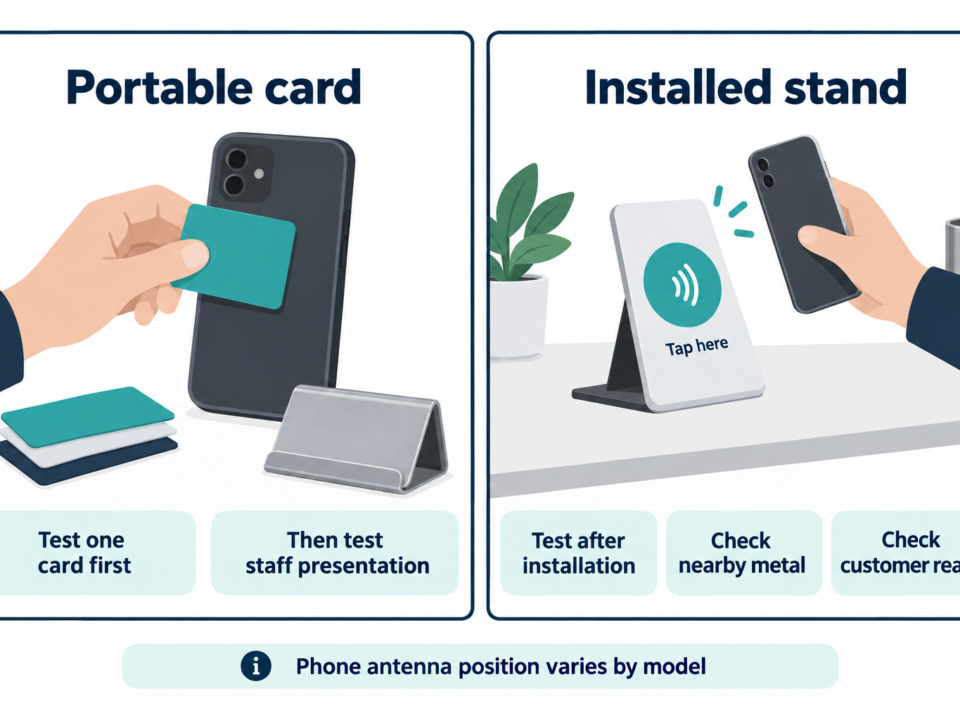
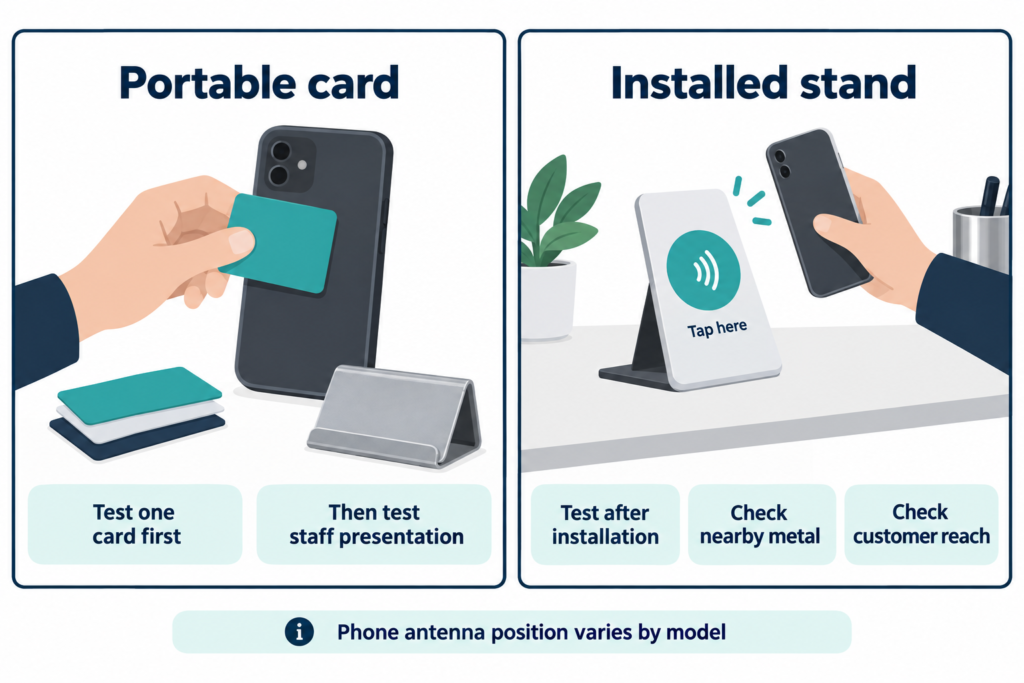
An NFC review card and a fixed review stand may open the same approved link. Their main difference is operational: a card belongs to a person and moves through the service journey, while a stand belongs to a location and stays visible at a predictable touchpoint.
Choose the format around where the customer naturally pauses, who presents or maintains the prompt, and how the business will keep destinations accurate.
Quick choice
Choose a stand
Use a fixed NFC review stand when customers consistently reach reception, checkout, a front desk, pickup point or service counter.
Choose a card
Use a portable NFC review card when employees meet customers away from a fixed prompt, such as table service, appointments, field work or mobile sales.
Use both
Combine formats when the journey includes a reliable fixed endpoint and staff who also interact with customers elsewhere.
The stand is a location-owned touchpoint
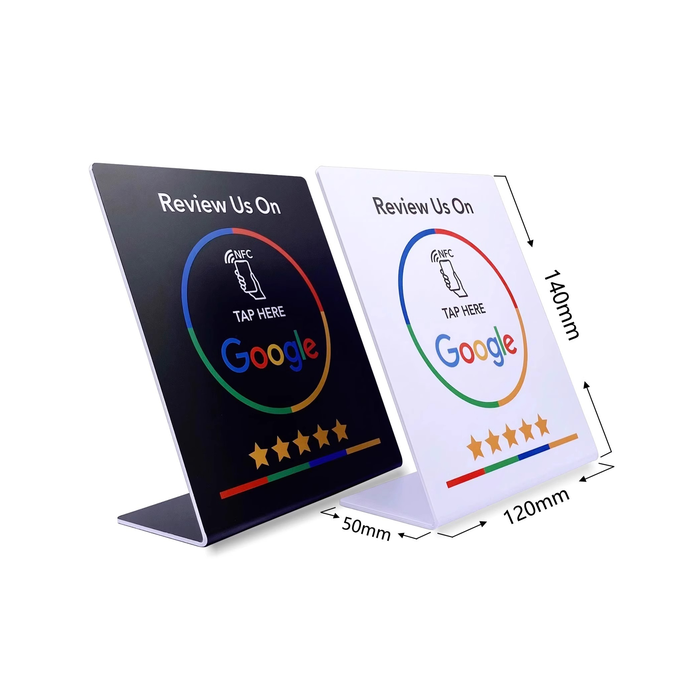
A stand remains visible without an employee carrying it. It is strongest where the customer already stops and can comfortably reach the tap or scan area.
Placement still matters. A fixed display can be overlooked if it sits outside the natural end of the service journey, competes with payment signage or is hidden by counter clutter. Stability, glare, viewing angle and staff access should be tested in the real position.
The image shows real acrylic stand construction as Product Truth; its artwork is an example and does not imply Google affiliation.
The card is a staff-owned touchpoint
A portable NFC review card brings the prompt to the customer. It can fit table service, home visits, installations, appointments, delivery handoffs and events where there is no dependable counter or reception point.
That flexibility introduces an operating requirement: someone must carry, present and return the card appropriately. Cards may be misplaced, shared between employees or used outside the intended location. This guide keeps construction generic because the approved acrylic evidence establishes stand formats, not a fixed DO RFID card specification.
Compare the operating model
| Decision factor | Portable card | Fixed stand |
|---|---|---|
| Ownership | Assigned to a person, team or mobile kit. | Assigned to a location or service point. |
| Visibility | Appears when staff presents it. | Can remain continuously visible. |
| Customer reach | Moves to the customer. | Customer approaches or reaches the display. |
| Consistency | Depends on staff practice and availability. | Depends on placement, maintenance and keeping the area clear. |
| Loss/control | Can travel, be misplaced or be shared. | Easier to inventory by location but can still be moved or damaged. |
| Artwork space | Usually compact; message must stay concise. | More room for instructions, branding and an NFC + QR layout. |
| Best examples | Table service, field teams, appointments, events. | Reception, checkout, counters, desks and pickup points. |
Five questions that reveal the right format
- Does the customer reliably reach one final service point?
- Does an employee move to the customer instead?
- Who will present, clean, store or replace the item?
- Does each location or employee need a separate destination?
- Would an NFC and QR review interaction help customers choose between tapping and scanning?
A Google review card vs stand decision—and the related choice of an NFC card or review stand—is therefore less about the chip and more about physical workflow. The best object is the one the business can place, present and verify consistently.
Multi-location and team deployment
For several branches, document which location owns each fixed display, which destination it opens and how replacements are checked. For employee-held cards, add assignment and return controls appropriate to the team.
One destination can be shared where the business workflow allows it. Location- or employee-specific links require a defined data file, encoding, verification and labeling process; a physical item does not automatically include a unique-data management platform.
A hybrid setup can reduce compromise
A portable vs fixed review display plan can place a stand at the main touchpoint and issue cards only to staff roles that work away from it. This keeps the always-visible prompt where most customers finish while giving mobile teams a portable option.
Both formats should use approved destinations, neutral review wording and a test record. Neither format guarantees review completion, and neither should imply platform endorsement.
When the fixed format wins
If the workflow points to a stand, the next decisions are acrylic form, placement, artwork, NFC or NFC + QR behavior, destination, sample and quantity. Those commercial choices belong to the custom fixed Google review stand page rather than this comparison guide.
An initial supplier inquiry can stay simple: describe the intended location and approximate quantity. Artwork, URL and detailed configuration can be confirmed afterward.
Frequently asked questions
Is an NFC card technically different from a stand?
Both can contain an NFC tag that opens an approved web link. The physical format, available artwork area and operational ownership create the practical difference.
Should every employee receive a review card?
Only when the workflow needs portable prompts and the business can manage assignment, link accuracy, appropriate presentation and replacement.
Can a card and stand share one review link?
Yes. Each encoded item should still be verified. Location- or employee-specific links need a documented data workflow.
Which format lasts longer?
Durability depends on material, construction, handling, placement and environment. Do not assume one format universally lasts longer without comparing actual specifications.

Do RFID is a leading China-based manufacturer with over 15 years of experience. We specialize in customized RFID readers, tags, and cards, delivering high-quality, tailored solutions that meet your unique business needs and drive seamless, efficient identification.