August 13, 2026
Specification
Independent intellectual property design;
High stability, 60 × 24 hours high temperature copy machine, uninterrupted and stable operation;
Support RJ45, RS232 and other communication modes;
Support iso18000-6c (EPC C1 Gen2) protocol electronic tags;
Adjustable RF output power;
Advanced tag collision processing algorithm, high reading rate;
The integrated RF chip makes the performance of the module more stable and more suitable for the harsh application environment with high requirements;
Excellent anti-interference performance and circuit lightning protection design;
Adopt standard API interface, provide demo and source code, support development routines such as C #, Java, VC, VB, etc
Easy to integrate with RFID software;
Suitable for application: Book / file management, jewelry inventory, drug management, store counter settlement, electronic dinner plate settlement
And so on.
| Physical Parameters: | |
| Size | 370X280X24mm |
| Weight | 3kg |
| Material | ABS+metal |
| Antenna | Built-in |
| Performance parameters: | |
| Working frequency | 13.56Mhz |
| Supporting protocol | ISO15693 |
| Material | Metal+ABS |
| Reading range | 0 – 100cm |
| Writing range | 0 – 10cm |
| Communication interface | RS232,TCP/IP , Type C |
| Power supplier | 12VDC / 3A |
| I/O | One trigger input or two relay outputs (customized) |
| Environment Parameters: | |
| Working temperature | – 20 ℃ – 55℃ |
| Store temperature | – 20 ℃ – 55℃ |
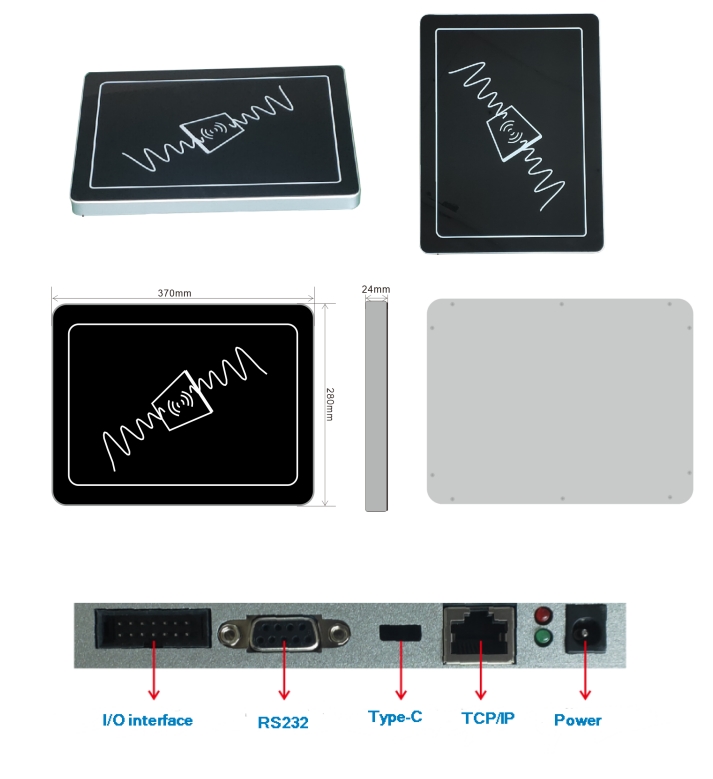
As digital identification and contactless data collection continue to expand across libraries, archives, healthcare facilities, manufacturing plants, and asset management systems, demand for reliable RFID readers has grown rapidly. Among the most widely adopted HF RFID technologies is the ISO15693 RFID/NFC standard, which offers longer read ranges and superior anti-collision performance compared to many traditional NFC solutions.
An ISO15693 RFID/NFC Desktop Reader Library Reader is a high-frequency RFID reader designed to read, write, encode, and manage ISO15693-compliant RFID and NFC tags from a desktop workstation. It is commonly used in library automation systems, document tracking, inventory management, access control, and smart asset tracking applications.
What Is an ISO15693 RFID/NFC Desktop Reader?
An ISO15693 RFID/NFC Desktop Reader is a stationary RFID device operating at 13.56 MHz that communicates with RFID labels, smart cards, NFC tags, and RFID library tags based on the ISO15693 standard.
Unlike handheld readers, desktop readers are designed for fixed-position operation and provide stable, high-speed tag reading for daily business operations.
The device typically connects to a PC, laptop, kiosk, self-service terminal, or library management system through USB, RS232, Ethernet, or other communication interfaces.
Its primary functions include:
- RFID tag reading
- RFID tag writing
- UID collection
- Data encoding
- Inventory verification
- Self-service borrowing and returning
- Authentication and identification
How Does an ISO15693 RFID Reader Work?
The reader generates a 13.56 MHz electromagnetic field through its built-in antenna.
When an ISO15693 RFID tag enters the reading zone:
- The reader emits RF energy.
- The RFID tag harvests energy from the field.
- The tag activates and transmits stored information.
- The reader receives the data.
- The software processes the tag information.
This process occurs within milliseconds and enables fast identification of books, files, assets, or products.
Typical Specifications
Technical Specifications Table
| Parameter | Specification |
|---|---|
| RFID Standard | ISO15693 |
| NFC Support | NFC Forum Compatible |
| Frequency | 13.56 MHz |
| Reading Distance | 0-20 cm |
| Writing Distance | 0-15 cm |
| Communication Interface | USB, RS232, TCP/IP |
| Reading Speed | Up to 100 Tags/Second |
| Anti-Collision Function | Supported |
| Power Supply | USB Powered or DC Adapter |
| Operating System | Windows, Linux, Android |
| SDK Support | C#, Java, Python, VB, C++ |
| Operating Temperature | -20°C to +70°C |
| Housing Material | ABS Plastic or Aluminum Alloy |
These specifications may vary depending on antenna size, reader power, and manufacturer configuration.
Main Features of ISO15693 RFID Desktop Readers
Long Reading Range
Compared with many NFC readers, ISO15693 readers provide significantly longer reading distances.
Typical NFC readers:
- 2-5 cm
ISO15693 readers:
- 10-20 cm
This improves operational efficiency and user convenience.
Fast Multi-Tag Reading
Advanced anti-collision algorithms allow simultaneous reading of multiple RFID tags.
Benefits include:
- Faster inventory checks
- Bulk book processing
- Efficient document tracking
- Reduced labor costs
High Compatibility
Supports various RFID chips including:
- NXP ICODE SLIX
- ICODE SLIX2
- ICODE DNA
- ST25 Series
- Fujitsu RFID Tags
Easy Integration
Most readers include SDK libraries supporting:
- Windows applications
- Linux systems
- Android terminals
- Cloud-based software
This simplifies deployment into existing systems.
Application Scenarios
Smart Libraries
Library automation is one of the largest applications for ISO15693 desktop readers.
Functions include:
- Book borrowing
- Book returning
- Self-service checkout
- Inventory management
- Anti-theft systems
A single reader can process multiple books simultaneously, greatly improving circulation efficiency.
Archive and Document Management
Government agencies and corporations often manage thousands of documents.
RFID desktop readers help:
- Track document movement
- Prevent file loss
- Improve retrieval efficiency
- Maintain audit trails
Asset Management
Organizations use ISO15693 tags to identify:
- Laptops
- Medical equipment
- Laboratory devices
- Industrial tools
Desktop readers provide rapid verification and asset registration.
Healthcare
Hospitals use RFID readers for:
- Medical record tracking
- Patient identification
- Equipment monitoring
- Laboratory sample management
Manufacturing
Manufacturers use RFID readers for:
- Work-in-progress tracking
- Production management
- Tool identification
- Quality control
Education
Universities deploy RFID systems for:
- Student libraries
- Equipment checkout
- Attendance systems
- Asset control
Pain Points Solved by ISO15693 RFID Desktop Readers
Manual Data Entry Errors
Traditional barcode systems require manual scanning and often lead to human errors.
RFID readers provide:
- Automatic identification
- Accurate data collection
- Reduced administrative workload
Slow Inventory Processes
Large libraries and warehouses can spend days conducting inventory checks.
RFID technology enables:
- Bulk reading
- Rapid verification
- Real-time tracking
Inventory time can be reduced by more than 80%.
Lost Assets
Organizations frequently lose equipment and important documents.
RFID readers create:
- Digital audit trails
- Asset visibility
- Real-time monitoring
This reduces losses and improves accountability.
Labor Costs
Manual management requires significant staffing.
RFID automation helps:
- Reduce repetitive tasks
- Improve operational efficiency
- Lower labor expenses
Poor User Experience
Library users dislike waiting in long checkout lines.
RFID self-service systems provide:
- Instant borrowing
- Faster returns
- Improved customer satisfaction
ISO15693 RFID Reader vs Barcode Scanner
| Feature | ISO15693 RFID Reader | Barcode Scanner |
|---|---|---|
| Line-of-Sight Required | No | Yes |
| Multi-Item Reading | Yes | No |
| Reading Speed | Very Fast | Moderate |
| Data Capacity | High | Low |
| Durability | Excellent | Moderate |
| Automation Level | High | Low |
| Labor Requirement | Low | High |
RFID technology significantly outperforms traditional barcode systems in high-volume environments.
ISO15693 RFID Reader vs ISO14443 NFC Reader
Many buyers compare ISO15693 readers with ISO14443 NFC readers.
ISO15693 Advantages
- Longer reading distance
- Better inventory management
- Multi-tag reading capability
- Ideal for libraries and asset tracking
ISO14443 Advantages
- Faster transaction speed
- Better for payment systems
- Widely used in access control
- Common in transit cards
Comparison Table
| Feature | ISO15693 | ISO14443 |
|---|---|---|
| Frequency | 13.56 MHz | 13.56 MHz |
| Reading Distance | Up to 20 cm | Up to 10 cm |
| Multi-Tag Reading | Excellent | Limited |
| Library Applications | Excellent | Moderate |
| Asset Tracking | Excellent | Good |
| Payment Systems | Limited | Excellent |
For libraries and inventory management, ISO15693 is usually the preferred choice.
Competitive Analysis
ISO15693 Desktop Reader vs Handheld RFID Reader
Desktop Reader Advantages
- Lower cost
- Stable operation
- Continuous use
- Easy integration
- Suitable for fixed workstations
Handheld Reader Advantages
- Mobility
- Flexible inventory scanning
- Field operations
Desktop readers are better suited for front-desk operations and self-service terminals.
ISO15693 Desktop Reader vs RFID Gate Reader
Desktop Reader
Best for:
- Check-in/check-out stations
- Encoding stations
- Service desks
RFID Gate Reader
Best for:
- Security exits
- Automated entrances
- Theft prevention
Most modern libraries use both systems together.
ISO15693 Desktop Reader vs UHF RFID Reader
| Feature | ISO15693 HF RFID | UHF RFID |
|---|---|---|
| Frequency | 13.56 MHz | 860-960 MHz |
| Reading Distance | 20 cm | Up to 10 m |
| Precision | High | Moderate |
| Library Use | Excellent | Limited |
| Metal Resistance | Better | Lower |
| Document Tracking | Excellent | Moderate |
For close-range identification and document management, ISO15693 readers provide better performance and accuracy.
Future Trends
The future of ISO15693 RFID desktop readers includes:
- NFC smartphone integration
- Cloud-based asset management
- AI-powered inventory systems
- IoT connectivity
- Real-time analytics
- Enhanced security encryption
As smart libraries, digital archives, and intelligent asset management systems continue to expand, demand for ISO15693 RFID readers is expected to grow significantly worldwide.
Conclusion
An ISO15693 RFID/NFC Desktop Reader Library Reader is a powerful contactless identification device designed for library automation, document management, asset tracking, healthcare, manufacturing, and educational applications. Operating at 13.56 MHz, it offers longer reading distances, superior anti-collision performance, and excellent multi-tag reading capabilities compared with many traditional NFC readers and barcode systems.
By solving common challenges such as manual data entry errors, slow inventory processes, asset loss, and high labor costs, ISO15693 RFID desktop readers help organizations improve efficiency, accuracy, and user experience. Compared with barcode scanners, handheld readers, UHF readers, and ISO14443 NFC readers, ISO15693 desktop readers provide a balanced combination of performance, reliability, and cost-effectiveness, making them an ideal solution for modern RFID-based management systems.

Do RFID is a leading China-based manufacturer with over 15 years of experience. We specialize in customized RFID readers, tags, and cards, delivering high-quality, tailored solutions that meet your unique business needs and drive seamless, efficient identification.