November 2, 2026
Choose a PIT tag reader for fish or wildlife by matching three things: the transponder it must decode, the place where identification happens, and the record your project needs afterwards. A handheld identity check, a phone-connected survey and an unattended fish passage are different reading jobs, even when they use the same tag.
We supply several reader formats, including compact handhelds, desktop USB readers, phone-connected readers, stick readers, fixed readers and Android terminals. The useful comparison starts between those arrangements. Once the arrangement fits the project, differences in housing, weight and controls help select a particular model.
Find your starting point by application
| What the project needs | Reader arrangement to compare | DO RFID starting candidates |
|---|---|---|
| Check an individual during handling or recapture | A supported handheld reader, with display or a connected recording device | DO-W90 / DO-W91 series; DO-DW portable models |
| Enter IDs at a hatchery or laboratory computer | A USB workstation reader and an agreed input method | DO-W81 / DO-W82 |
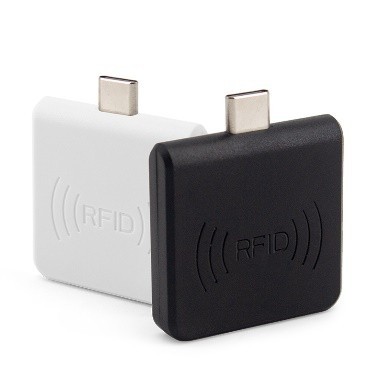
| Use an existing phone for mobile verification | An LF reader attachment, compatible host device and application | DO-W86 |
| Capture IDs and other observations on one terminal | An Android LF handheld configured for the project software | DO-V9000S-LF |
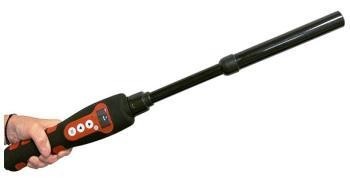
| Reach a tag without holding the reader body beside it | A stick reader or a reader with a suitable remote antenna | DO-DW04 / DO-DW06 for stick-format comparison |
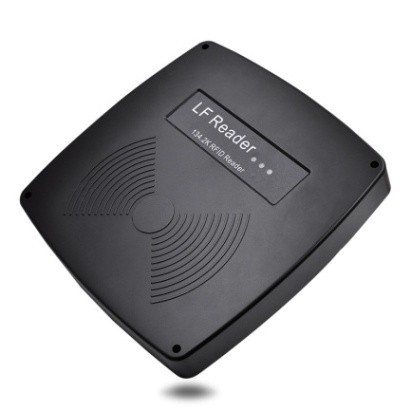
| Record tags at a controlled fixed reading point | A fixed reader connected to a controller or logging system | DO-W70 / DO-DW01; assess the required reading zone separately |
These are starting configurations from our 2026 animal-reader catalog, not a statement that every model serves every fish or wildlife installation. A stream-spanning antenna array, a bird-feeder antenna and a small fixed identification point need different antenna and controller arrangements.
Understand EMID, FDX-B and HDX before comparing hardware
125 kHz and 134.2 kHz are frequency specifications; EMID, FDX-B and HDX identify different supported transponder formats. A dual-frequency label does not, by itself, tell you which messages the reader can decode. Equally, a reader supporting FDX-B and HDX can cover two formats in the same nominal 134.2 kHz animal-identification band.
| Transponder type | Frequency in our catalog | What changes the purchasing decision |
|---|---|---|
| EMID | 125 kHz | Relevant when the installed tag population includes supported EMID transponders. An FDX-B-only reader is not the same compatibility choice. |
| FDX-B | 134.2 kHz | A common animal-identification format. The tag responds while the reader’s energizing field is present. |
| HDX | 134.2 kHz | The reader alternates charging and listening periods. The tag uses stored energy to respond during the listening period, requiring an HDX-capable decoder. |
| FDX-A and other formats | Use the exact format specification | They need an explicit supported-format entry. Our DO-DW03 and DO-DW04 additionally list FDX-A; do not treat FDX-A as another name for EMID. |
FDX-BEnergizing field presentTag response received during energizing
HDXCharge the tagSwitch off the charge field and listen
The practical consequence is decoder compatibility, not an automatic verdict that one format is better. FISHBIO’s technical introduction explains the different transmit/receive timing. For a project with existing FDX-B tags, an HDX-only station will not solve the reading task. For mixed FDX-B and HDX cohorts, both formats belong in the specification.
Our 2026 catalog lists EMID, FDX-B and HDX support for the DO-W90 and DO-W91 series and the DO-W81/DO-W82 desktop readers. DO-W86 and DO-W70 list FDX-B/HDX at 134.2 kHz. The DO-DW range varies by model: DO-DW02 and DO-DW05 list FDX-B, while other models add HDX or FDX-A. Start with the actual tag type and the complete supplied reader model, especially when matching older equipment.
For a new tagging program, choose the tag and reader ecosystem together. Tag dimensions, animal suitability, existing detection sites and future data exchange can constrain the choice before a reader’s enclosure matters. The fish PIT tag size guide addresses the tag side of that decision.
Compare the DO RFID product families by what they do
The following map covers the 20 models in our 2026 catalog. It separates changes in operating arrangement from smaller choices within one family.
| Models | Supported transponders | Listed connection | Useful distinction |
|---|---|---|---|
| DO-W90A/B/C/D; DO-W91A/B/C/D; DO-W91 | EMID / FDX-B / HDX | Micro USB on DO-W90A; USB Type-C on the others | Handheld identification; compare grip, controls, mass and the actual recording arrangement |
| DO-W81 / DO-W82 | EMID / FDX-B / HDX | USB | Computer-based registration and verification |
| DO-W86 | FDX-B / HDX | USB Type-C | A small reader attachment for a compatible phone or host device |
| DO-DW02 / DO-DW05 | FDX-B | USB 2.0 / Bluetooth on DO-DW02; USB on DO-DW05 | Portable or mini formats when the project uses FDX-B |
| DO-DW03 | FDX-A / FDX-B / HDX | Mini USB data cable | Portable multi-format reading with a wired connection |
| DO-DW04 / DO-DW06 | FDX-A / FDX-B / HDX on DO-DW04; FDX-B / HDX on DO-DW06 | USB / Bluetooth on DO-DW04; USB on DO-DW06 | Stick formats for additional physical reach |
| DO-W70 / DO-DW01 | FDX-B / HDX | RS232 / RS485; DO-W70 also lists Wiegand 26/34 | Fixed-point integration with an external controller or recording system |
| DO-V9000S-LF | FDX-B / HDX | SIM / PSAM / TF / Type-C facilities | An Android terminal combining LF reading with application-based data collection |
A protocol difference can exclude a model immediately. An interface difference changes how it joins the workflow. A form-factor difference changes where an operator can place it. Those are more useful filters than choosing a device because its housing looks similar to an existing scanner.
Handheld and stick readers: separate compatibility, connection and reach
For fish handled at a measuring station, a compact handheld may provide the required identity check. For repeated work across different tag populations, supported formats become more important. A model that reads the right tag but cannot deliver its ID in the required way is still an incomplete choice.
There are meaningful trade-offs within the DO-DW range. DO-DW02 lists FDX-B with USB 2.0/Bluetooth. DO-DW03 adds FDX-A and HDX but lists a Mini USB data cable. DO-DW04 combines those three formats with a 650 mm stick body and USB/Bluetooth. DO-DW06 is a 790 mm stick reader supporting FDX-B/HDX with USB. Wireless connection, multi-format support and physical reach are different reasons to shortlist them.
Stick length is not RF read range. It brings the reading head closer to a difficult position while the operator remains farther away. Nor does a long stick establish permission to immerse it. For an external example of a specified underwater arrangement, UID pairs its URH-300HP with a URH-PLEX antenna, allowing the antenna to enter the water while the reader remains dry.
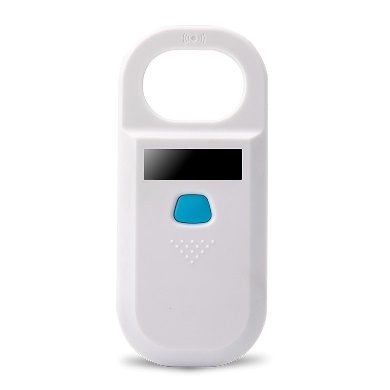
Compact handheld
DO-W90A
Light handheld
DO-W91A
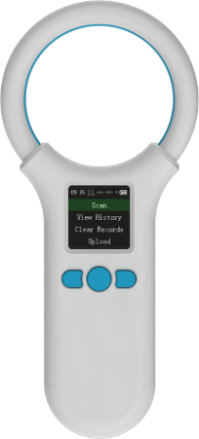
Product photographs are not at a common physical scale.
DO-W90A and DO-W91A are examples within the same broad handheld compatibility group. The catalog lists the former at 135 × 60 × 13 mm, 110 g and Micro USB, and the latter at 182 × 82 × 17.5 mm, 72 g and Type-C. Their visible controls also differ. These matter for carrying, gloves and charging, but the catalog does not establish a different research outcome merely from selecting one over the other. Compare them after the protocol and recording workflow have been settled.
Desktop, phone attachment or Android terminal?
A computer is already beside the animal
DO-W81 and DO-W82 are USB desktop options for registration desks and workstations. A hatchery team recording length and weight at a computer may benefit more from reliable ID entry into the measurement record than from buying an additional mobile terminal. Arrange the reader position so one intended tag is presented at a time, then verify that the scan enters the correct animal record.
Define the input mode as well as the connector. Keyboard-style input places a value in the focused field; a serial connection needs software to receive and parse a message; an SDK-based integration needs an application implementation. These are possible architectures, not a claim that every USB reader provides all three.
A phone will hold the project record
DO-W86 is a 20 g Type-C LF attachment, specified for FDX-B/HDX at 134.2 kHz and 5 V/100 mA. It can be considered when a compatible host phone or device already supplies the screen and application. Its 35 × 35 × 8 mm dimensions exclude the connector.
The decision includes USB host support, application compatibility, the ID format delivered to that application and the effect on phone power. The operator also has to manage the attachment and phone around wet hands, cases and charging. The phone’s built-in NFC function does not replace a reader for these LF transponders.
The team needs a complete application terminal
DO-V9000S-LF takes another approach: an Android handheld with LF FDX-B/HDX reading and SIM, PSAM, TF and Type-C facilities. It is a candidate when the task is to collect an ID, measurements and project fields together on a configured terminal. The catalog lists a 710 g device, so carrying and operating it is a different proposition from adding a small reader to a phone.
The value comes from the deployed application and its data flow. An Android operating system or SIM facility does not itself supply your study form, database connection, mobile service or offline synchronization. Specify what the configured application should do, who maintains it and where records remain when connectivity is lost.
Phone or host attachment
DO-W86
Stick reader
DO-DW04
Fixed identification point
DO-W70
Android application terminal
DO-V9000S-LF
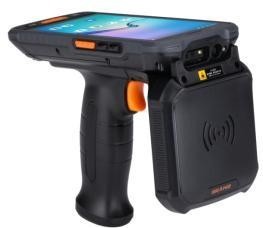
Product photographs are not at a common physical scale.
Fixed identification points and unattended fish monitoring need different system detail
DO-W70 and DO-DW01 are fixed-reader starting points for a defined identification zone. DO-W70 lists 12 V/150 mA and RS232, RS485 and Wiegand 26/34 outputs; DO-DW01 lists RS232/RS485. A controller can use an appropriate output to receive an identity and associate it with the station’s process.
Specify the message or controller mapping, not only the port name. For a research database, demonstrate how the full identifier reaches the record. If a controller expects Wiegand 26/34, its mapping must be agreed with the reader configuration. A physical output interface is not, by itself, a timestamped passage log.
An open stream, fishway or multi-antenna wildlife site adds further requirements: antenna geometry, supported antenna connections, tuning, synchronization, continuous power, clock handling, storage, enclosure and recovery after an interruption. The fixed-reader label on a catalog page does not establish an arbitrary external-loop interface or a complete stream-monitoring system.
Oregon RFID’s ORSR/ORMR systems illustrate that broader equipment class: they are designed for unattended HDX monitoring, with antenna and synchronization arrangements. This is an external system example, not a performance specification for DO-W70 or DO-DW01.
At neighboring HDX stations, one reader’s charging field can interfere with another’s listening period. Oregon RFID documents synchronization for nearby readers. Also include simultaneous tags in the trial: ordinary PIT tag responses can collide when several tags occupy a detection zone, so a successful single-tag scan is not proof of reliable group passage detection.
For a bird feeder or nest entrance, the antenna should serve the actual visit location and the logger should retain useful events. For movement direction, the project needs an appropriate arrangement of detection locations and event sequence; a lone ID record does not establish a direction or the animal’s position elsewhere.
Choose the record you need, then the data functions
| Required result | Data that must survive | Selection consequence |
|---|---|---|
| Confirm one animal’s identity | The complete displayed ID and the matched animal record | A display or immediate host input may be sufficient |
| Record repeated handling observations | ID, session/date, measurements and operator or location as required | Choose reader storage or host-application recording deliberately |
| Record unattended passages or visits | ID, event time, reading location/antenna and operating-state information | Use a logger/controller architecture with a defined clock, retention and recovery process |
Separate reader memory from application storage. A handheld may store records internally, or it may send each read to a phone or computer that stores them. For field work without a live connection, decide which device retains the record, whether timestamps remain attached and how records are exported after reconnection.
Research equipment demonstrates how substantial these differences can be. Biomark’s HPR Lite lists 50,000 reads with time/date stamps, several supported tag formats and USB/Bluetooth communication. Our catalog’s interface entries should not be read as a promise of the same memory or logging functions.
Keep the entire identifier as text when importing it, including leading zeros and the agreed decimal or hexadecimal representation. Test two reads of the same tag: a unique-animal inventory may intentionally merge them, whereas a behavior study may need both events. PTAGIS provides a useful example of interrogation records containing location, tag code, timestamp and equipment identifiers; its regional file conventions are not universal requirements.
Read range, water, interference and working time
Choose a useful reading zone rather than one headline maximum. The DO-DW catalog, for example, lists 0.1-70 cm for DO-DW01 and shorter ranges for several portable models. Those figures lack a shared reference tag, antenna and test arrangement, so they are not a model performance ranking or guaranteed ranges for a small implanted fish tag.
Test the capsule and orientation used by the project, the intended position or passage speed, and nearby metal, pumps and electrical equipment. A large ear tag and a small glass transponder can give different results on the same reader. The PIT tag read-range guide develops the measurement and detection checks.
Wet-field selection also includes permitted immersion, operating temperature, cleaning, cable protection and operator handling. An IP rating must be read with the manufacturer’s operating instructions: Biomark’s HPR Lite page lists IP67 but explicitly says the reader is not intended for intentional submersion. Choose a specifically suitable antenna/reader arrangement for underwater work.
For long sessions, include battery replacement or charging, host-phone consumption, spare equipment and the ability to recover saved records. At a fixed site, budget power for the complete installed system and test its restart behavior. A missing detection can arise from the tag path, interference, a power interruption or the recording process; changing protocol alone does not resolve every cause.
Turn the shortlist into an application trial
For a hatchery measuring fish beside a computer, compare a supported handheld with a USB desktop arrangement and follow one ID into the measurement record. For mixed-format wildlife recaptures, include the actual FDX-B, HDX and any EMID tags present in the population. For a mobile survey, compare the phone-plus-reader workflow with a configured Android terminal. For unattended passage, evaluate the whole antenna-to-log system.
- Read representative tags. Include every required format and the actual capsule sizes, rather than testing one convenient sample.
- Reproduce the working arrangement. Include handling position, permitted water exposure, installed surroundings and representative passage or presentation conditions.
- Follow a complete record. Compare the supplied ID, displayed value, received output and saved record; test repeated reads and the required event fields.
- Exercise interruptions. Where relevant, disconnect the host, let the application work offline, restart power and verify what was retained and how it is recovered.
- Agree the acceptance result. Define the required detection and recording outcome for that project before ordering the full quantity.
For a DO RFID equipment discussion, provide the tag type or sample, handling/desktop/mobile/fixed use, the intended software or controller connection, and the required records. Include quantity and delivery destination for the supply quote. We can compare suitable reader configurations through our animal RFID reader product page and match them with the PIT tag supply required by the project. The cost guide helps compare the complete configuration and later replenishment.
Frequently asked questions
Do I need HDX if my project only uses FDX-B?
Not solely for that existing tag population. HDX support matters when the project uses HDX tags, receives mixed cohorts or plans to join an HDX system. Include future requirements when they are concrete; dual-format support does not by itself increase every tag’s read distance.
Can an animal reader also read every 125 kHz tag?
No. EMID support is a particular compatibility entry, not a promise to decode every LF credential or proprietary animal tag. Use the complete tag-format and reader-model specifications.
Does Bluetooth mean records will appear in my phone app?
Only if the selected connection mode, device and application work together. Demonstrate the received ID, required event fields and offline/reconnection behavior before treating a wireless link as a completed data workflow.
Can a PIT reader measure fish weight or temperature?
An ordinary identification read supplies an ID; weight comes from a measurement device or an entered observation. Temperature requires an appropriate sensing transponder and explicit reader support. Such measurements should not be inferred from a general FDX-B/HDX compatibility claim.

Do RFID is a leading China-based manufacturer with over 15 years of experience. We specialize in customized RFID readers, tags, and cards, delivering high-quality, tailored solutions that meet your unique business needs and drive seamless, efficient identification.