September 14, 2026
As digital identification and secure authentication continue to evolve, contact chip cards remain one of the most trusted solutions for identity management, banking, access control, healthcare, transportation, membership systems, and government applications. While contactless RFID and NFC cards have become increasingly common, millions of organizations worldwide still rely on Plastic PVC Blank Contact Chip Cards because of their high security, stable communication, excellent compatibility, and low production cost.
A blank contact chip card provides manufacturers, system integrators, card issuers, and software developers with a customizable platform that can be programmed, printed, and personalized according to specific project requirements. Whether used for employee identification, hotel key cards, banking cards, prepaid cards, SIM cards, or public transportation, PVC contact chip cards continue to play an important role in modern identification systems.
This complete guide explains what a Plastic PVC Blank Contact Chip Card is, how it works, its manufacturing process, major applications, technical specifications, competitive comparison, customization options, and procurement recommendations for global buyers.
What Is a Plastic PVC Blank Contact Chip Card?
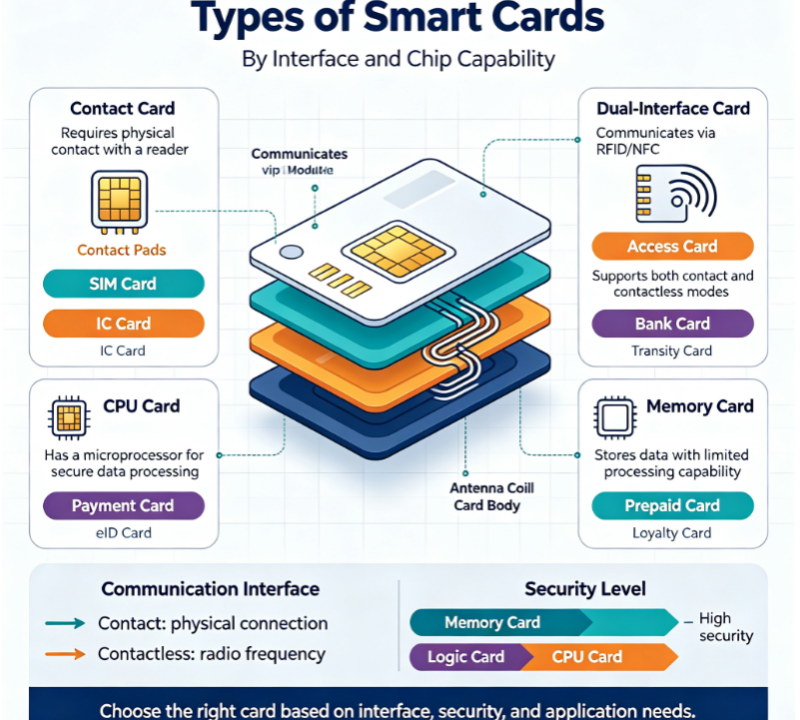
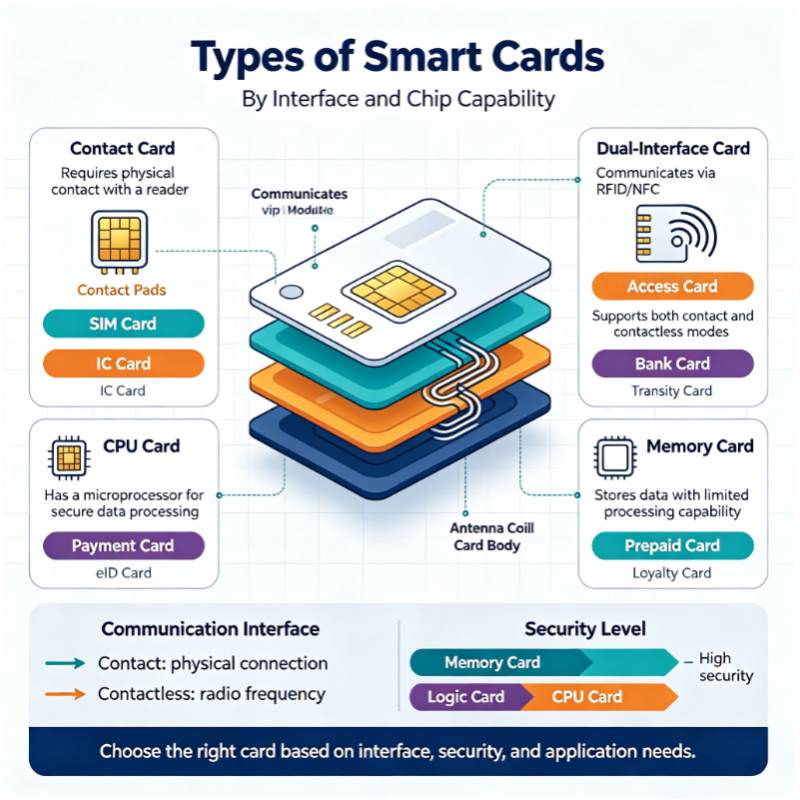
A Plastic PVC Blank Contact Chip Card is a smart card made from high-quality polyvinyl chloride (PVC) that contains an embedded integrated circuit (IC) chip. Unlike contactless RFID cards, a contact chip card communicates with a card reader through physical electrical contacts located on the gold-plated contact module.
The term blank means the card has not yet been printed, encoded, or personalized. It serves as a universal card body that can later be customized with graphics, logos, chip programming, serial numbers, barcodes, or customer-specific data.
These cards comply with ISO/IEC 7816 standards and are compatible with a wide variety of smart card chips, including memory chips and microprocessor chips.
Common chip options include:
- SLE4442
- SLE5542
- FM4442
- FM5542
- AT24C Series
- 24C02
- 24C04
- CPU Smart Card Chips
- Java Card Chips
- Banking EMV Chips
Because the chip is protected inside the PVC card body, the card offers excellent durability and a long service life.
Contact IC card chip available:
SLE5542, 5528 SERIES,FM5542,FM4442
BEILING: 7442,7428,
ATMEL: 1200446E7A, 4C00A52DD4, 4C00A52DD4, 4C00A52DD4
| SLE4428 Contact IC cards feature | – SLE5542 Intelligent 256-Byte EEPROM – SLE5528 Intelligent 1K-Byte EEPROM – SLE4428 Intelligent 1K-Byte EEPROM – Write Protection function on unique manufacturer code to identification of application. |
| SLE4428 Contact IC cards Feature | – Dimensions: CR80 85.60 x 53.98mm – Thickness: 0.84mm – Material: PVC, PET – Card Surface: Matte/ gloss finish – Housing: Lamination – Operating Temperature: -25 to +60°C – Storage Temperature: -40 to +70°C |
| Printing Option | – Full color offset printing – Silk-screen printing – Silver/Gold silk-screen printing background |
| Additional crafts | – Magnetic Stripe Option: 300oe, 2750oe, 4000oe – Numbering – Barcode printing – Signature panel |
| Application | – hotel key card, membership management |

Main Components of a Contact Chip Card
A PVC contact smart card consists of several precision-engineered components.
PVC Card Body
The card body provides structural strength and protects the internal chip.
Common materials include:
- White PVC
- Transparent PVC
- PET
- PETG
- ABS
- Eco-friendly recycled PVC
Standard dimensions:
- 85.60 × 53.98 mm
- Thickness: 0.76 mm (CR80)
Contact Chip Module
The chip module contains:
- Integrated circuit
- Gold-plated contact pads
- Wire bonding
- Epoxy encapsulation
The gold contacts provide reliable electrical communication with compatible smart card readers.
Integrated Circuit
The embedded chip stores and processes digital information.
Depending on the chip type, functions may include:
- Data storage
- Password protection
- Encryption
- Authentication
- Secure transactions
- Memory management
Technical Specifications
Typical specifications include:
| Item | Specification |
|---|---|
| Material | PVC / PET / ABS |
| Card Size | CR80 (85.60 × 53.98 mm) |
| Thickness | 0.76 mm |
| Communication | Contact |
| Standard | ISO/IEC 7816 |
| Surface Finish | Glossy, Matte, Frosted |
| Printing | Offset, Digital, Silk Screen |
| Chip Options | SLE4442, SLE5542, CPU, FM4442, etc. |
| Operating Temperature | -20°C to +70°C |
| Data Retention | Up to 10 years or more |
How Does a Contact Chip Card Work?
Unlike RFID or NFC cards that communicate wirelessly, a contact chip card requires direct insertion into a compatible reader.
The working process includes the following steps.
Step 1: Card Insertion
The user inserts the card into a smart card reader.
The reader’s spring-loaded pins make contact with the gold-plated contact pads on the card.
Step 2: Power Initialization
The reader supplies electrical power to the chip.
The integrated circuit performs an internal reset and initializes communication.
Step 3: Authentication
The reader exchanges commands with the chip.
Security mechanisms may include:
- PIN verification
- Password authentication
- Challenge-response authentication
- Encryption key verification
Only authorized systems can access protected memory.
Step 4: Data Reading and Writing
Depending on system permissions, the reader can:
- Read user information
- Update stored data
- Modify account balances
- Write access permissions
- Record transaction history
Modern contact chip cards support thousands of read/write cycles.
Step 5: Data Processing
The reader transfers information to backend software such as:
- Access control systems
- Banking platforms
- Healthcare databases
- Membership management software
- ERP systems
- Government identification systems
Step 6: Transaction Completion
Once processing is complete, the card is removed and can be reused for future authentication.
The entire communication process typically takes less than one second.
Manufacturing Process
Professional smart card manufacturing combines precision engineering with automated production.
Step 1: PVC Sheet Production
High-quality PVC sheets are produced with uniform thickness and excellent surface flatness.
Color options include:
- White
- Black
- Transparent
- Colored PVC
- Metallic finish
Step 2: Artwork Printing
Customer artwork is printed using:
- Offset printing
- Digital printing
- Silk screen printing
- UV printing
Optional personalization includes:
- Company logos
- Employee photos
- QR codes
- Barcodes
- Sequential numbering
- Variable data printing
Step 3: Card Lamination
Multiple PVC layers are laminated under controlled heat and pressure.
This process ensures:
- High durability
- Waterproof construction
- Smooth surfaces
- Excellent dimensional stability
Step 4: Card Punching
Large laminated sheets are punched into standard CR80 card dimensions using precision die-cutting machines.
Step 5: Chip Module Production
The smart chip is mounted onto a metal lead frame using automated wire bonding equipment.
The module is sealed with epoxy resin to protect internal circuitry from moisture and mechanical stress.
Step 6: Module Embedding
A cavity is milled into each PVC card body.
The chip module is inserted using automated equipment and permanently bonded with industrial adhesive.
Accurate positioning ensures reliable contact with ISO-compliant card readers.
Step 7: Chip Programming
Depending on customer requirements, the chip may be initialized with:
- Unique serial numbers
- Security keys
- Passwords
- User credentials
- Application data
- Encryption certificates
Blank cards can also be supplied without programming for customer-side encoding.
Step 8: Quality Inspection
Each card undergoes strict testing, including:
- Electrical functionality
- Contact resistance
- Read/write performance
- Dimensional accuracy
- Surface inspection
- Adhesion testing
- Bending resistance
- Environmental reliability
Only cards that pass all quality checks are approved for shipment.
Common Applications
Plastic PVC Blank Contact Chip Cards are used across many industries.
Access Control
Secure employee authentication for offices, factories, laboratories, and government facilities.
Banking and Financial Services
EMV chip cards provide secure payment transactions and fraud protection.
Healthcare
Hospitals use contactless chip cards for patient identification, medical record access, and staff authentication.
Hotel Management
Hotels issue contact chip cards for guest room access and service management.
Campus Cards
Universities integrate identification, library services, attendance, cafeteria payments, and dormitory access into a single smart card.
Membership Programs
Fitness clubs, retail chains, and loyalty programs use programmable contact cards for member identification and stored-value services.
Government Identification
Many national ID programs, driver licenses, and social security cards use secure contact chip technology for identity verification.
Advantages of PVC Blank Contact Chip Cards
Compared with traditional magnetic stripe cards, contact chip cards offer several advantages:
- Higher security
- Secure authentication
- Rewritable memory
- Long service life
- Excellent durability
- Reliable data storage
- Compatibility with ISO/IEC 7816 readers
- Low maintenance costs
- High customization flexibility
These advantages make them suitable for long-term identification and secure transaction applications.
Competitive Comparison
Contact Chip Card vs Magnetic Stripe Card
| Feature | Contact Chip Card | Magnetic Stripe Card |
| Security | Excellent | Low |
| Data Capacity | High | Limited |
| Encryption | Supported | Not Supported |
| Durability | Excellent | Moderate |
| Fraud Resistance | High | Low |
Winner: Contact Chip Card
Contact Chip Card vs RFID Card
| Feature | Contact Chip Card | RFID Card |
| Communication | Physical Contact | Contactless |
| Reading Speed | Fast | Faster |
| Security | Higher | High |
| Reader Distance | Insert Required | Up to 10 cm or more |
| Interference Resistance | Excellent | Moderate |
Choose contact chip cards for high-security applications, while RFID cards are better suited for fast, hands-free access.
Contact Chip Card vs NFC Card
| Feature | Contact Chip Card | NFC Card |
| Communication Method | Contact | Wireless |
| Smartphone Compatibility | Limited | Excellent |
| Transaction Speed | Fast | Very Fast |
| Infrastructure Cost | Lower | Moderate |
| Security | Excellent | Excellent |
Organizations with existing contact-based systems often continue to use contact chip cards due to their compatibility and lower upgrade costs.
Contact Chip Card vs CPU Smart Card
| Feature | Memory Contact Card | CPU Smart Card |
| Cost | Lower | Higher |
| Processing Power | Basic | Advanced |
| Security | High | Very High |
| Suitable for Banking | Limited | Excellent |
| Typical Applications | Access Control | Financial Services |
Procurement Solutions
Choosing the right supplier is critical to ensuring product quality and long-term compatibility.
Small Batch Orders (100–1,000 Cards)
Suitable for pilot projects, offices, schools, and membership programs. Standard blank cards or simple logo printing offer fast production and economical pricing.
Medium Batch Orders (1,000–20,000 Cards)
Ideal for hotels, factories, hospitals, and educational institutions. Buyers can request chip initialization, serial numbering, barcode printing, and customized packaging.
Large OEM and ODM Projects (20,000+ Cards)
Large-scale government, banking, and transportation projects benefit from dedicated production lines, strict quality control, custom chip programming, secure data loading, and long-term supply agreements.
When requesting a quotation, buyers should specify:
- Chip model
- Card material
- Quantity
- Printing artwork
- Personalization requirements
- Data encoding
- Packaging method
- Delivery destination
- Required certifications
Selecting an experienced manufacturer with ISO 9001-certified production, automated equipment, and global export experience ensures consistent quality, reliable delivery, and competitive pricing.
Future Development Trends
Although mobile credentials and virtual identities are expanding rapidly, PVC contact chip cards remain essential in industries that require secure physical authentication. Manufacturers are improving chip integration, environmentally friendly materials, and hybrid card technology that combines contact and contactless functions in a single card. These innovations extend product lifespan while supporting the transition to more intelligent identification systems.
Conclusion
PVC Blank Contact Chip Cards continue to be among the most reliable and versatile smart card solutions for secure identification and authentication. Built to ISO/IEC 7816 standards, they provide reliable electrical communication, robust security, long-term durability, and extensive customization options.
From access control and banking to healthcare, hospitality, education, and government identification, contactless chip cards remain a proven technology trusted by organizations worldwide. Through advanced manufacturing processes, precision chip embedding, strict quality testing, and flexible OEM/ODM services, manufacturers can deliver high-quality blank contact chip cards that meet the needs of system integrators, distributors, and enterprise customers alike.
For buyers seeking stable performance, competitive pricing, and broad compatibility with existing smart card infrastructure, Plastic PVC Blank Contact Chip Cards remain a practical, cost-effective, and future-ready investment.