September 14, 2026
An ISO 18000-6C UHF RFID Pallet Tag is a rugged RFID identification solution designed for asset tracking, warehouse management, logistics operations, and industrial applications. With an ABS housing, IP67 protection, and a metal-compatible RFID antenna structure, this UHF RFID tag can be attached to metal and non-metal assets where conventional RFID labels may experience reduced reading performance.
UHF RFID tags can work in high-temperature environment, stable performance, very suitable for IT assets requiring narrow RFID metal tags, such as computer host, switch, server chassis, aluminum strip and shelf identification, vehicle( logistic) and other asset management.
Rugged UHF RFID Tag for Asset Tracking
Traditional barcode labels require direct line-of-sight scanning and can become difficult to read when labels are damaged, dirty, or incorrectly positioned. RFID technology provides a different approach by allowing tagged assets to be identified wirelessly.
This UHF RFID asset tag is designed for applications where durability and reliable identification are important. The protective ABS housing helps protect the internal RFID components, while the IP67-rated construction provides resistance against dust and water exposure.
The tag is particularly suitable for assets that are frequently moved, stored, transported, or handled in demanding environments.
Typical assets include:
- Plastic or metal pallets
- Cartons and containers
- Warehouse racks and shelves
- Servers and computer equipment
- Network switches and cabinets
- Aluminum profiles and components
- Vehicles and logistics equipment
- Construction materials
- Electrical and power equipment
- Industrial tools and equipment
Technical Specification
– Material: ABS
– Dimension: 155mm (L) *32mm (W)* 10mm (Th)
– Protective Rating: IP67
– Frequency: ISO18000-6C 860-960MHZ
– Chips available: Alien H3 or NXP U Code G2, Impinj M4 ( Other chips available on request)
Four-Layer RFID Tag Structure
The complete tag structure consists of the protective housing, RFID chip-antenna module, buffer foam layer, and adhesive mounting layer. Each component contributes to the overall mechanical and RF performance of the finished tag.
1. ABS Housing
The external ABS housing provides mechanical protection for the internal RFID components. It helps protect the tag during routine handling, transportation, storage, and installation.
The rugged housing is particularly useful for industrial assets that may be exposed to dust, moisture, impact, or frequent handling.
2. RFID Chip-Antenna Module
The RFID chip stores the electronic identification information, while the antenna enables communication between the tag and UHF RFID reader.
The chip can be selected according to the requirements of the RFID project. Alien H3, NXP UCODE G2, and Impinj M4 are available options, while other chip configurations can be discussed for specific projects.
3. Buffer Foam Layer
A buffer foam layer can provide mechanical cushioning between the RFID module and the mounting surface. It also contributes to the physical structure of the tag.
For metal-mounted applications, the distance and material arrangement between the RFID antenna and the metal surface can influence RF characteristics, making the internal construction an important part of the tag design.
4. Adhesive Sticker
An adhesive layer provides a convenient installation method for applications where drilling or mechanical fastening is not preferred.
For demanding environments, the adhesive should be selected and tested according to the actual surface material, temperature, humidity, vibration, and service conditions.
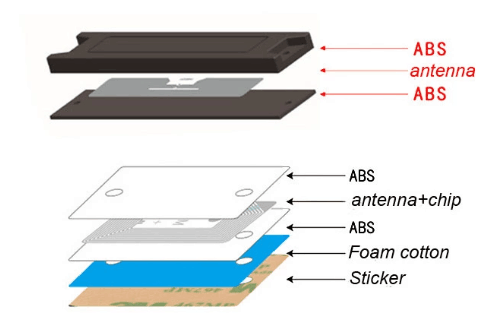
It clearly illustrates the complete structure of the anti‑metal RFID tag, including housing, chip‑antenna module, buffer foam cotton and adhesive sticker. It helps customers understand internal components and the structural principle of the foam‑cotton spacer for anti‑metal performance.
Features
| ● Robust ● waterproof / dust-proof | ● mounted on metal available |
| ● multi-mounting options (screwing / 3M adhesive layer) | ● RFIchips + ferrite material |
Applications
● IT Asset Management ● logistics management ● power patrol inspection management
● Housing building service ● managing construction sites
When you’re mounting RFID tags on metal surfaces or metal products, you should be aware that if you use non-metal mount RFID tags, your system will not function as desired as the metal will detune any passive RFID tag that is not designed to be placed on metal. Using tags that are specifically calibrated to the materials you need to track makes reading, tracking, and inventorying them easier and provides for a greater read range.
Metal mount RFID tags are typically rugged, difficult to damage, and easy to weld, screw or otherwise attach.
Anti-Metal RFID Design
One of the most important considerations when selecting an RFID tag is the surface on which it will be installed.
A standard passive UHF RFID tag is generally designed to operate away from conductive materials. When placed directly on metal, the metal surface can affect the RFID antenna and change its electrical characteristics. This may result in shorter read distance, inconsistent reads, or poor overall system performance.
An anti-metal RFID tag, also called a metal mount RFID tag, is specifically designed to operate when attached to metal surfaces.
This tag incorporates a dedicated antenna structure together with ferrite material to help isolate the RFID antenna from the conductive mounting surface. The result is a more suitable RFID solution for metal assets and equipment.
The actual read range depends on the RFID reader, antenna, chip selection, tag orientation, mounting surface, operating environment, and other system factors. Testing the finished tag on the target asset is recommended before large-scale deployment.
Metal Mount RFID Tag vs. Standard RFID Label
Choosing the right RFID tag depends heavily on the target material. The following comparison explains why an anti-metal RFID tag may be more appropriate for industrial asset tracking.
| Feature | Standard RFID Label | Anti-Metal RFID Tag |
|---|---|---|
| Paper / Cardboard | Suitable | Suitable |
| Plastic | Suitable | Suitable |
| Glass | Suitable | Suitable |
| Direct Metal Mounting | Generally unsuitable | Designed for metal |
| Rugged Housing | Usually limited | Yes |
| Water / Dust Protection | Application dependent | IP67 |
| Industrial Asset Tracking | Limited in harsh environments | Well suited |
| Screw Mounting | Usually unavailable | Available |
| Adhesive Mounting | Common | Available |
| Long-Term Asset Identification | Application dependent | Designed for durable use |
For cardboard cartons and other non-metal packaging, conventional RFID labels may be sufficient. For metal machinery, equipment, racks, vehicles, and other conductive assets, a purpose-designed metal mount UHF RFID tag provides a more suitable option.
Flexible Mounting Options
Different assets require different installation methods. This RFID pallet tag supports two common mounting approaches: mechanical screw mounting and adhesive mounting.
| Mounting Method | Recommended Use | Main Advantage |
|---|---|---|
| Screw Mounting | Long-term industrial assets | Strong mechanical attachment |
| 3M Adhesive | Cartons, equipment and smooth surfaces | Fast and simple installation |
| Adhesive + Screw | High-vibration environments | Additional installation security |
Screw mounting is useful when the RFID tag needs to remain attached to an asset for a long period. It is especially suitable for pallets, equipment, racks, vehicles, and industrial structures.
3M adhesive mounting provides a fast installation method without drilling. It is suitable for smooth and clean surfaces where the adhesive has been properly selected and tested.
RFID Warehouse Management Workflow
An RFID warehouse system can combine RFID tags, desktop readers, forklift readers, handheld readers, fixed readers, antennas, and warehouse management software into a connected tracking process.
A typical workflow is:
Tag authorization → Asset tagging → Packing → Forklift transportation → Warehouse receiving → Inventory check → Outbound transportation → Portal reading → Truck loading
Step 1: Tag Authorization
Before an RFID tag is attached to an asset, a desktop RFID reader can be used to initialize or authorize the tag.
The RFID EPC or other identification information can then be associated with the corresponding carton, pallet, product, or asset in the warehouse management system.
Step 2: Attach the RFID Tag
The RFID tag is attached to the target carton or asset using the selected mounting method.
Correct tag orientation and installation are important because the surrounding material can influence UHF RFID performance.
Step 3: Packing and Transportation
After packing, goods can be moved using forklifts equipped with integrated RFID readers.
Instead of requiring an operator to scan each individual barcode, the RFID reader can automatically detect compatible tags within its reading area.
Step 4: Warehouse Receiving
When goods enter the warehouse, RFID identification can be integrated with the receiving process. The system can compare detected RFID information with expected shipment or purchase-order data.
This can help reduce manual identification steps and improve visibility of goods movement.
Step 5: Inventory Check
Handheld RFID readers can be used for inventory checking inside the warehouse.
Operators can move through storage areas and identify tagged goods without manually scanning every label. The system can compare the detected tags with inventory records and identify missing, misplaced, or unexpected assets.
Step 6: Outbound Transportation
When goods leave the warehouse, forklift-mounted RFID readers or fixed portal readers can capture tag information during transportation.
This provides another identification point before the goods are shipped.
Step 7: RFID Exit Portal
A fixed RFID reader and RFID antennas can be installed at the warehouse entrance or exit.
When tagged goods pass through the portal, the system can capture their RFID identities and transfer the event information to the warehouse management system.
Step 8: Truck Loading
After outbound verification, goods can be loaded onto trucks for delivery.
The resulting RFID events can provide a digital movement history from warehouse receiving through outbound shipment.

RFID Warehouse System Flowchart
RFID Readers Used in a Warehouse
A complete RFID warehouse solution may use different reader types for different operating tasks.
| RFID Reader | Typical Location | Primary Function |
|---|---|---|
| Desktop Reader | Workstation | Tag authorization and encoding |
| Forklift Reader | Forklift | Automatic identification during transportation |
| Handheld Reader | Warehouse | Inventory and asset search |
| Fixed Reader | Entrance / Exit | Automatic portal identification |
| RFID Antenna | Portal / Reading Zone | Creates the RFID reading area |
Using different RFID readers at different operational points allows the same RFID identification system to support tagging, transportation, inventory, receiving, and shipping.
Applications of the RFID Pallet Tag
The rugged structure and metal-mount capability make this tag suitable for a wide range of asset management applications.
IT Asset Management
Servers, computer hosts, network switches, cabinets, and other IT equipment can be difficult to identify manually in large facilities.
An RFID tag provides a unique electronic identity that can be associated with equipment records, maintenance information, location data, and inventory status.
Logistics and Warehouse Management
RFID pallet tags can be attached to pallets, containers, cartons, and logistics equipment.
They can support automated identification during receiving, storage, inventory checking, transportation, and outbound shipment.
Power Patrol and Inspection
Electrical equipment and infrastructure often contain metal components and may require regular inspection.
RFID identification can help associate each tagged asset with inspection records, maintenance schedules, and operational information.
Building and Facility Management
Large buildings can contain many pieces of equipment, tools, cabinets, and service assets.
RFID tagging can help facility managers maintain a digital inventory and identify assets during routine inspection and maintenance.
Construction Site Management
Construction projects involve equipment, materials, tools, and components moving between storage areas and job sites.
RFID tags can provide an electronic identification method for tracking assets and improving visibility throughout the project lifecycle.
Why Use RFID for Asset Management?
RFID provides several advantages compared with manual identification methods.
| Requirement | Barcode | UHF RFID |
|---|---|---|
| Line-of-Sight Required | Usually | No direct line-of-sight required |
| Multiple Tag Reading | Limited | Possible |
| Automated Identification | Limited | Strong |
| Handheld Inventory | Yes | Yes |
| Fixed Portal Reading | Possible with suitable setup | Well suited |
| Forklift Identification | More manual | Can be automated |
| Dirty / Worn Labels | May affect scanning | Tag construction can be designed for harsh environments |
| Metal Asset Tracking | Requires suitable label design | Anti-metal tag recommended |
RFID does not necessarily replace every barcode system. In many logistics environments, RFID and barcodes can operate together. The appropriate technology depends on the required reading distance, automation level, asset type, operating environment, and system budget.
How to Choose the Right RFID Tag
The correct RFID tag should be selected based on the actual application rather than tag appearance alone.
Consider the following factors before deployment:
Target material: Determine whether the tag will be attached to cardboard, plastic, wood, glass, metal, or a combination of materials.
Required protection: Outdoor or industrial applications may require a rugged housing and higher protection rating.
Mounting method: Decide whether the tag will be attached with adhesive, screws, rivets, welding, or another mechanical method.
Reader configuration: Reader output power, antenna type, polarization, installation height, and reading zone all influence system performance.
Tag orientation: The orientation of the RFID antenna relative to the reader antenna can affect readability.
Operating environment: Temperature, moisture, vibration, chemicals, impact, and exposure to outdoor conditions should be considered.
RFID chip: Chip selection should match the required memory, EPC functionality, reader compatibility, and project requirements.
Installation and Performance Considerations
For reliable RFID performance, the tag should be tested on the actual asset before mass deployment.
Metal thickness, asset shape, surrounding materials, tag orientation, reader antenna polarization, reader power, and the presence of other conductive objects can all influence the RFID reading environment.
For adhesive installation, the mounting surface should be clean, dry, and suitable for the selected adhesive. For mechanical installation, the screw position should avoid damaging the internal RFID antenna or housing.
A sample testing process can include:
- Attach the tag to the actual asset.
- Test reading distance with the intended RFID reader.
- Test different tag orientations.
- Test the tag at the expected transportation speed.
- Test multiple tags in the same reading area.
- Test the tag under actual environmental conditions.
- Confirm the complete RFID system before deployment.
Customized RFID Tag Options
Different RFID projects have different requirements. In addition to the standard configuration, customization may be available for specific applications.
Possible customization areas include:
- RFID chip selection
- EPC memory configuration
- Antenna design
- Housing dimensions
- Mounting method
- Adhesive specification
- Printing or laser marking
- Customer logo
- Serial number or barcode
- Packaging
- Special environmental requirements
For large-scale RFID deployments, the tag should be evaluated together with the reader, antenna, software, mounting surface, and operating process rather than tested as an isolated component.
Welcome to contact us for custom RFID tags.
Frequently Asked Questions
What is an ISO 18000-6C RFID tag?
ISO 18000-6C is a UHF RFID air-interface standard used for passive RFID systems. It is commonly associated with EPC Gen2-based UHF RFID applications and enables compatible RFID readers and tags to communicate wirelessly.
Can this RFID tag be mounted on metal?
Yes. This tag is designed for metal-mount applications. Its internal RFID structure incorporates ferrite material and an antenna configuration intended for use on conductive surfaces.
Is this RFID pallet tag waterproof?
The stated protection rating is IP67. This provides a higher level of protection against dust and temporary water immersion under the applicable test conditions.
What RFID chips are available?
The listed options include Alien H3, NXP UCODE G2, and Impinj M4. Other RFID chips may be available according to project requirements.
How can the RFID tag be attached?
The tag supports screw mounting and adhesive mounting. The appropriate method depends on the asset material, surface condition, expected service life, vibration, and operating environment.
Can it be used for warehouse inventory?
Yes. The tag can be used as part of a warehouse RFID system with handheld readers for inventory checking and fixed readers for receiving or outbound portal applications.
Can RFID tags be read on a forklift?
Yes. A forklift can be equipped with an integrated RFID reader and antenna system. The actual reading performance depends on reader configuration, antenna position, tag orientation, vehicle structure, and the surrounding environment.
What is the read range of the tag?
Read range is application dependent. It can vary according to the RFID chip, reader power, reader antenna, tag orientation, mounting material, installation position, and surrounding RF environment. A practical test using the target asset and reader configuration is recommended to determine the actual operating range.
Build a More Efficient RFID Asset Tracking System
A rugged UHF RFID pallet tag is only one part of a complete RFID asset management solution. When combined with desktop RFID readers, forklift-mounted readers, handheld terminals, fixed portal readers, antennas, and warehouse management software, RFID can provide continuous identification points throughout the asset lifecycle.
From tag authorization and carton identification to warehouse inventory, forklift transportation, outbound verification, and truck loading, the RFID system can reduce manual identification steps and provide greater visibility into asset movement.
With ISO 18000-6C compatibility, 860–960 MHz operation, IP67 protection, ABS construction, metal-mount capability, multiple chip options, and flexible mounting methods, this RFID tag is suitable for organizations looking to implement reliable identification and tracking for pallets, logistics units, IT equipment, industrial assets, and other valuable items.
For a new RFID project, testing the tag on the actual target asset is the best way to confirm antenna performance, mounting compatibility, reading distance, and system reliability before full-scale deployment.