September 14, 2026
Near Field Communication (NFC) technology has become a fundamental tool for modern businesses. From smart packaging and contactless marketing to IoT device configuration and digital authentication, NFC tags allow companies to connect physical products with digital experiences instantly.
However, choosing the right NFC chip is not always straightforward. Many businesses struggle with questions such as:
Which NFC tag offers the best price-to-performance ratio?
Should you choose NTAG213, NTAG215, or NTAG216?
How much memory do you actually need?
What factors affect the price of NFC tags in bulk?
This guide provides a professional and practical comparison of NTAG213, NTAG215, and NTAG216, including pricing insights, technical specifications, application scenarios, and purchasing recommendations. By the end, you will understand exactly how to select the right NFC tag for your project while optimizing cost and performance.
Understanding NFC Tags and the NTAG21x Series
Before comparing prices, it is important to understand what these tags actually are.
NFC tags are small electronic chips that communicate wirelessly with smartphones or NFC readers using radio frequency signals. They operate at 13.56 MHz and typically follow the ISO/IEC 14443 Type A standard, making them compatible with most modern smartphones and NFC-enabled devices.
The NTAG21x family, developed by NXP Semiconductors, is one of the most widely used NFC chip series for commercial applications. It includes three primary models:
NTAG213
NTAG215
NTAG216
All three chips share several core characteristics:
NFC Forum Type 2 compatibility
13.56 MHz operating frequency
7-byte unique identifier (UID)
password protection capability
approximately 100,000 read/write cycles
about 10 years of data retention
Because these chips use the same communication protocol and frequency, the main difference between them is memory capacity—which directly influences cost and use cases.
Technical Comparison: NTAG213 vs NTAG215 vs NTAG216
The table below summarizes the core specifications of the three chips.
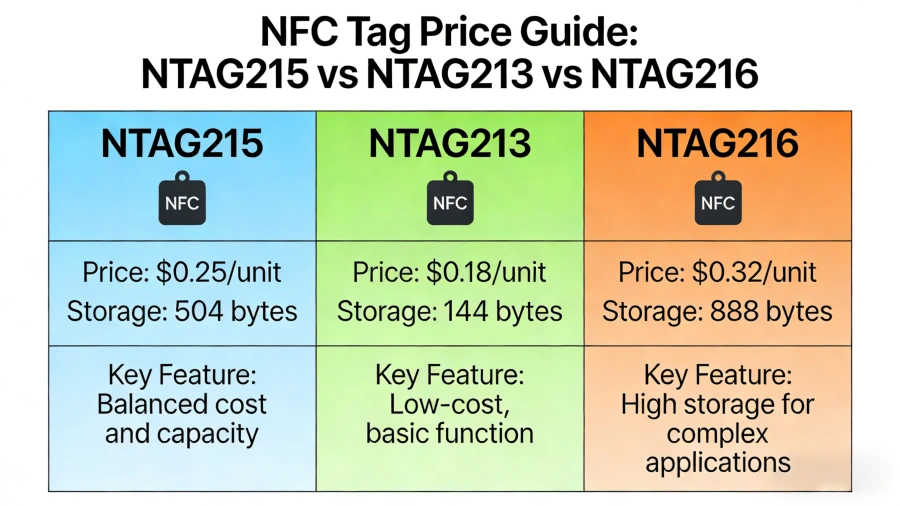
| Feature | NTAG213 | NTAG215 | NTAG216 |
|---|---|---|---|
| Total Memory | 180 bytes | 540 bytes | 924 bytes |
| User Memory | 144 bytes | 504 bytes | 888 bytes |
| Operating Frequency | 13.56 MHz | 13.56 MHz | 13.56 MHz |
| Data Transfer Rate | 106 kbps | 106 kbps | 106 kbps |
| Compatibility | NFC smartphones & readers | NFC smartphones & readers | NFC smartphones & readers |
| Password Protection | Yes | Yes | Yes |
| Typical Read Range | 3–10 cm | 3–10 cm | 3–10 cm |
The most important difference is usable memory:
NTAG213: 144 bytes
NTAG215: 504 bytes
NTAG216: 888 bytes
Memory determines how much information can be stored in the tag, which directly affects the types of applications it can support.
NFC Tag Pricing Overview
The price of NFC tags varies depending on several factors:
chip type
order quantity
tag material
printing or encoding customization
supplier location
However, memory capacity is usually the primary driver of price differences.
Generally speaking:
NTAG213 is the cheapest
NTAG215 is mid-range
NTAG216 is the most expensive
The higher price of NTAG216 reflects its larger memory capacity—almost six times the storage of NTAG213.
Typical bulk pricing ranges (for large orders) may look like this:
| Chip Type | Typical Bulk Price |
|---|---|
| NTAG213 | $0.06 – $0.10 |
| NTAG215 | $0.08 – $0.12 |
| NTAG216 | $0.12 – $0.18 |
These numbers vary by supplier, but they illustrate the typical pricing hierarchy.
NTAG213: The Most Cost-Effective NFC Tag
NTAG213 is the entry-level chip in the NTAG21x family. Because of its lower memory capacity, it is also the most affordable option.
Memory Capacity
NTAG213 offers 144 bytes of usable memory, which is sufficient for simple NFC tasks such as:
launching a URL
triggering smartphone automation
storing short text data
For example:
a typical website link requires about 19 bytes
a phone number requires around 16 bytes
This means NTAG213 can easily store:
marketing URLs
authentication links
contact information
Typical Applications
NTAG213 is widely used for:
FMCG product authentication
promotional marketing campaigns
event ticketing
NFC business cards
simple automation tags
Because these applications only require small data payloads, NTAG213 provides excellent value.
Pricing Advantage
Businesses deploying tens of thousands of tags often choose NTAG213 because the lower unit price can significantly reduce project costs.
For example:
A product authentication campaign requiring 100,000 tags could save thousands of dollars by using NTAG213 instead of NTAG216.
NTAG215: The Most Popular All-Purpose NFC Chip
NTAG215 offers a balanced combination of memory capacity and affordability, making it the most widely used chip in commercial NFC deployments.
Memory Capacity
NTAG215 provides 504 bytes of usable memory, more than three times the storage of NTAG213.
This additional capacity allows it to store:
larger URLs
customer data
serialized product records
multiple NFC data records
Typical Applications
Common NTAG215 use cases include:
membership cards
loyalty programs
event access systems
digital product information
gaming accessories and collectibles
Because it supports more complex data structures, NTAG215 is ideal for businesses planning advanced NFC experiences.
Price vs Value
Although NTAG215 is slightly more expensive than NTAG213, the price difference is relatively small in large orders.
For many businesses, the additional memory provides greater flexibility for future applications.
NTAG216: High-Capacity NFC Tags for Advanced Applications
NTAG216 is the highest-capacity chip in the NTAG21x family.
With 888 bytes of usable memory, it can store significantly more data than the other two chips.
Memory Advantages
This larger capacity enables storage of:
complete vCard contact information
Wi-Fi credentials
product traceability data
IoT configuration settings
multi-language content
Because it supports larger NFC Data Exchange Format (NDEF) messages, NTAG216 can deliver richer digital experiences.
Typical Applications
NTAG216 is commonly used in:
IoT device configuration
smart home products
digital manuals
advanced product authentication systems
industrial asset tracking
For example, a smart appliance manufacturer may embed NTAG216 tags in products so customers can instantly access setup instructions by scanning with a smartphone.
Price Consideration
NTAG216 typically costs 15–30% more than NTAG213, reflecting its larger memory capacity.
For projects requiring advanced functionality, this price increase is often justified.
Factors That Influence NFC Tag Prices
Beyond chip type, several other factors can affect NFC tag pricing.
Order Quantity
Bulk purchasing significantly reduces the unit price.
Typical pricing tiers include:
1,000 units
5,000 units
10,000 units
50,000 units or more
Larger orders allow manufacturers to optimize production and logistics.
Tag Material
NFC tags are available in multiple materials:
paper stickers
PVC cards
PET waterproof tags
ABS plastic tags
Durable materials increase production cost but improve lifespan.
Custom Printing
Businesses often require branded NFC tags.
Common printing options include:
logo printing
QR code printing
serial number printing
full-color graphics
Customization adds production cost but enhances brand identity.
Data Encoding
Some suppliers offer pre-programmed tags.
This service may include:
URL encoding
UID registration
serialized authentication data
Although encoding slightly increases cost, it saves time during deployment.
How to Choose the Right NFC Tag
Selecting the correct NFC chip depends on the project’s data requirements.
Here is a simple decision framework.
Choose NTAG213 If:
you only need to store a URL
your project requires very large quantities
minimizing cost is the top priority
Typical industries:
retail marketing
consumer packaged goods
event ticketing
Choose NTAG215 If:
you need moderate memory
your project may expand later
you require membership or loyalty functionality
Typical industries:
retail
entertainment
hospitality
Choose NTAG216 If:
you need complex data storage
your tags support IoT or smart devices
you plan to store multiple data records
Typical industries:
smart home
industrial IoT
electronics manufacturing
Practical Deployment Tips for NFC Projects
When implementing NFC solutions, several best practices can improve reliability and performance.
Keep Data Small
Even though NTAG216 can store more data, many NFC applications work best when the stored payload is small.
Large data payloads may slightly increase scan time.
Use Dynamic URLs
Instead of storing large amounts of information directly on the tag, many companies store a short URL that connects to cloud-based content.
This allows:
content updates
analytics tracking
campaign management
Avoid Metal Surfaces
Metal surfaces can interfere with NFC signals.
If tags must be placed on metal objects, use anti-metal NFC tags designed for such environments.
Future Trends in NFC Tag Pricing
The NFC industry continues to expand rapidly as more smartphones support NFC technology.
Several trends are shaping the future of NFC tags:
increased demand for smart packaging
growth in IoT device connectivity
wider use of contactless authentication
integration with digital marketing platforms
As production scales increase, the price of NFC tags is expected to remain affordable for large-scale commercial applications.
Conclusion
NTAG213, NTAG215, and NTAG216 are the three most widely used NFC chips in modern business applications.
Each offers different advantages:
NTAG213 – lowest cost, ideal for simple applications
NTAG215 – balanced performance and versatility
NTAG216 – largest memory for advanced solutions
The best choice depends on your project’s data requirements, deployment scale, and budget.
By understanding the technical differences and pricing factors outlined in this guide, businesses can make informed decisions when purchasing NFC tags in bulk and successfully deploy NFC technology across marketing, authentication, and IoT applications.

Au is an RFID and NFC manufacturer based in Shenzhen, China, with over 10 years of experience.