September 14, 2026
Introduction
In an era defined by the Internet of Things (IoT) and seamless connectivity, Radio Frequency Identification (RFID) technology has emerged as a cornerstone of modern automation. From tapping a card to enter an office building to tracking inventory across global supply chains, RFID cards are ubiquitous yet often misunderstood. While many interact with these devices daily, few understand the complex electromagnetic dance that occurs in a fraction of a second to transmit data without physical contact.
This article provides a deep dive into the mechanics of RFID cards, exploring the physics behind their operation, the different frequency standards that dictate their use, and real-world performance data. By combining technical analysis with practical industry insights, we aim to demystify this technology for business leaders, engineers, and procurement specialists. Furthermore, we will examine how selecting the right manufacturer—such as the experienced D.O RFID Group—can significantly impact the reliability and efficiency of your RFID infrastructure.
The Fundamental Mechanics: How RFID Cards Function
At its core, an RFID system consists of two primary components: the RFID tag (or card) and the RFID reader (interrogator). Unlike barcodes, which require line-of-sight scanning, RFID systems utilize radio waves to communicate, allowing for identification through obstacles and at varying distances.
1. The Anatomy of an RFID Card
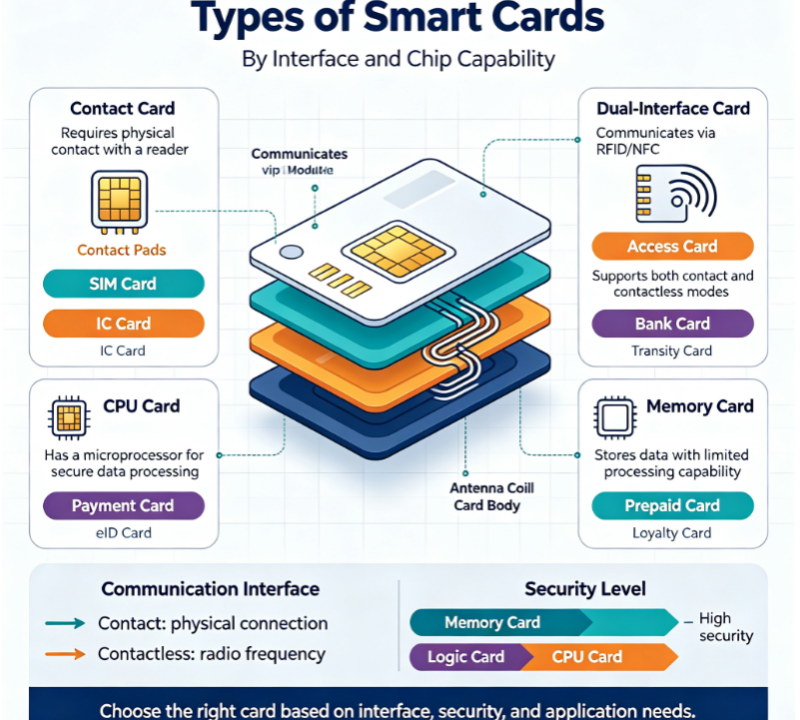
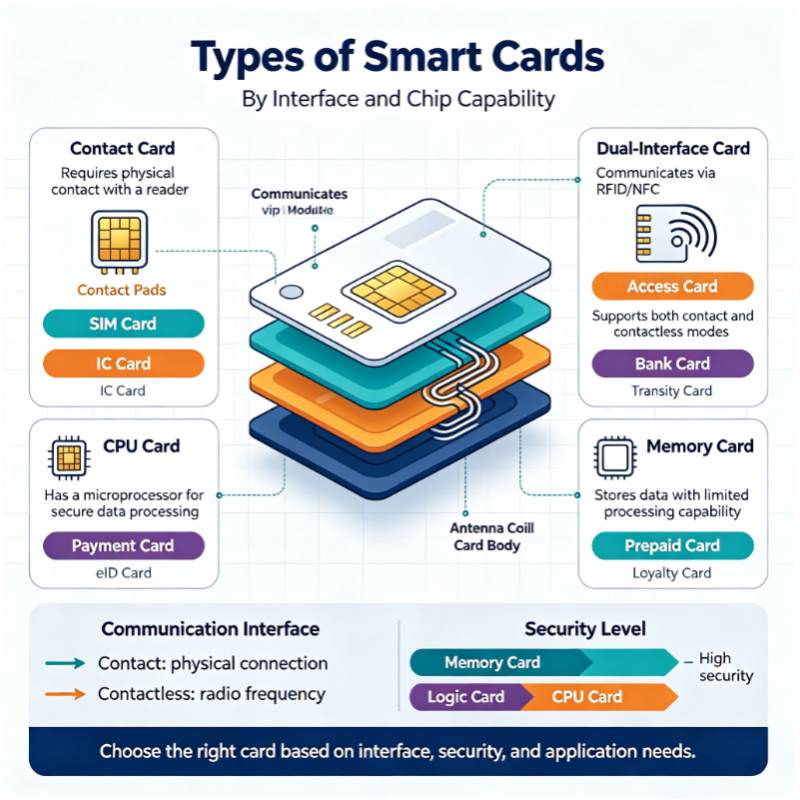
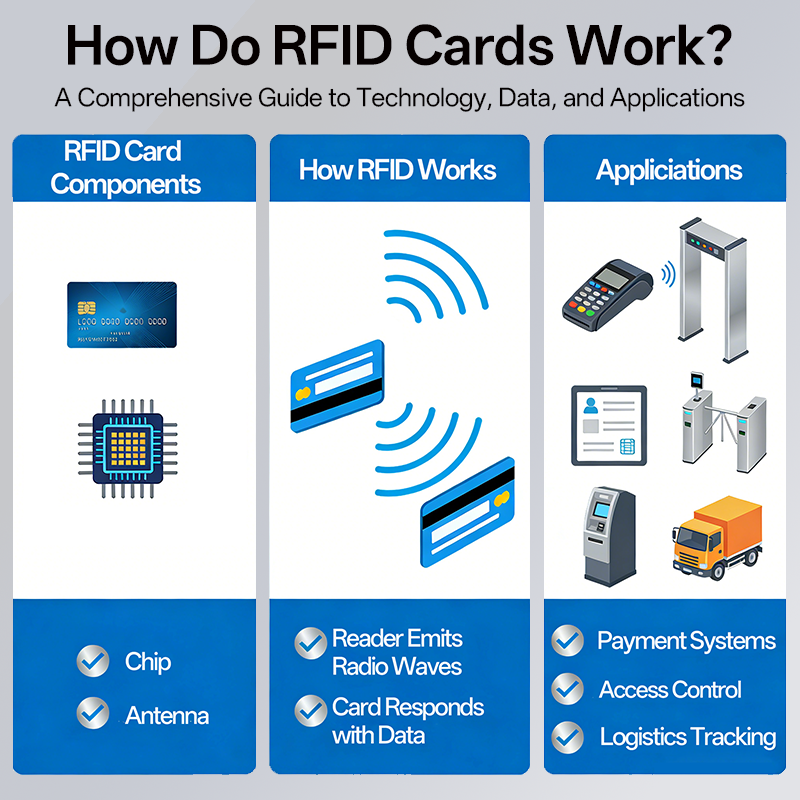
An RFID card is more than just a piece of plastic; it is a sophisticated micro-electronic device. Inside the laminated layers of a standard PVC card lies an integrated circuit (IC) chip and an antenna.
- The Chip: This acts as the brain of the card. It stores the Unique Identifier (UID) and, in the case of high-frequency cards, additional user data. It contains a rectifier to convert radio waves into DC power.
- The Antenna: Usually made of copper or aluminum etched in a specific coil pattern, the antenna captures radio signals from the reader and transmits data back. The size and shape of the antenna are critical determinants of the read range.
2. The Communication Process: Inductive Coupling vs. Electromagnetic Waves
The method by which an RFID card communicates depends heavily on its operating frequency. There are two primary mechanisms:
A. Inductive Coupling (LF and HF)
Low Frequency (LF) and High Frequency (HF) cards, including NFC (Near Field Communication), operate via magnetic induction.
- Activation: The reader generates an alternating magnetic field at a specific frequency (125 kHz for LF, 13.56 MHz for HF).
- Power Harvesting: When the card enters this field, the antenna coil induces a voltage. This voltage powers the chip, eliminating the need for an internal battery (passive RFID).
- Load Modulation: To send data back, the chip slightly alters the electrical load on the antenna. This change disrupts the magnetic field in a patterned way that the reader detects and decodes into binary data.
- Range: Due to the rapid drop-off of magnetic field strength, these cards typically have a short read range (from a few centimeters up to about 1 meter).
B. Electromagnetic Backscatter (UHF)
Ultra-High Frequency (UHF) cards operate using electromagnetic wave propagation, similar to Wi-Fi or cellular signals but much lower power.
- Activation: The reader emits radio waves (typically 860–960 MHz).
- Power Harvesting: The card’s antenna captures the energy from these waves to power the chip.
- Backscatter: Instead of generating its own signal, the chip reflects (backscatters) a portion of the incoming wave back to the reader, modulating the reflection to encode data.
- Range: This method allows for much longer read ranges, often exceeding 10 meters, making it ideal for logistics and vehicle identification.
Frequency Standards and Performance Data
Understanding the frequency spectrum is crucial for selecting the right RFID solution. Each band offers distinct advantages regarding read range, data speed, and environmental resistance.
Table 1: Comparison of RFID Frequency Bands
| Feature | Low Frequency (LF) | High Frequency (HF) / NFC | Ultra-High Frequency (UHF) |
|---|---|---|---|
| Frequency Range | 125 – 134 kHz | 13.56 MHz | 860 – 960 MHz |
| Read Range | < 10 cm | 10 cm – 1 m | 1 m – 15+ m |
| Data Transfer Rate | Low | Moderate | High |
| Interference Sensitivity | Low (Works near metal/liquid) | Moderate | High (Affected by metal/liquid) |
| Global Standardization | Mostly standardized | ISO 14443 / ISO 15693 | Varies by region (ETSI, FCC) |
| Primary Applications | Access control, Animal ID | Payment, Smart Cards, Ticketing | Supply Chain, Inventory, Vehicle ID |
| Cost per Tag | Low | Low to Moderate | Very Low (Passive) |
View Related Products:
13.56Mhz High Frequency RFID Reader Module
125Khz Low Frequency RFID Modules
Medium range rfid reader 5 meters
Real-World Performance Metrics
To illustrate the practical differences, consider recent industry testing data regarding read rates and throughput in controlled environments.
Case Study: Warehouse Inventory Efficiency
A comparative study conducted in a 10,000 sq. ft. distribution center analyzed the time required to inventory 5,000 items using barcode scanners versus UHF RFID portals.
Table 2: Operational Efficiency Comparison (Barcode vs. UHF RFID)
| Metric | Barcode Scanning | UHF RFID Portal System | Improvement Factor |
|---|---|---|---|
| Items Scanned per Hour | 450 | 8,500 | 18.8x Faster |
| Accuracy Rate | 92% | 99.9% | Significant Reduction in Errors |
| Labor Hours Required | 11.1 hours | 0.6 hours | 95% Labor Savings |
| Line-of-Sight Needed | Yes | No | N/A |
| Simultaneous Reads | 1 item | 200+ items/sec | Massive Throughput Gain |
Source: Aggregated data from logistics implementation reports (2024-2025).
The data clearly indicates that while LF and HF cards excel in secure, close-proximity interactions (like payment terminals), UHF technology revolutionizes bulk processing. However, the success of these implementations relies heavily on the quality of the hardware used. Poorly tuned antennas or low-quality chips can result in “no-read” zones, negating the efficiency gains shown above.
Security Protocols and Data Integrity
As RFID adoption grows, so do concerns regarding security. Early LF cards (125 kHz) often transmitted static IDs with no encryption, making them vulnerable to cloning. Modern HF and UHF cards, however, employ sophisticated cryptographic protocols.
Encryption Standards
- MIFARE Classic vs. MIFARE DESFire: The evolution from MIFARE Classic (which was cracked years ago) to MIFARE DESFire EV3 demonstrates the industry’s shift toward AES-128 encryption. This ensures that even if the radio signal is intercepted, the data remains unintelligible without the cryptographic key.
- Kill Commands: UHF Gen2 tags include a “kill” command that permanently disables the tag, protecting consumer privacy after a product is purchased.
- Password Protection: Many modern tags require a password before memory blocks can be read or written to, preventing unauthorized data modification.
Table 3: Security Features by Frequency Type
| Security Feature | LF (125 kHz) | HF (13.56 MHz) | UHF (860-960 MHz) |
|---|---|---|---|
| Encryption Capability | None / Proprietary | High (AES, 3DES) | Moderate (Gen2 Passwords) |
| Mutual Authentication | No | Yes | Limited |
| Clone Resistance | Low | Very High | Moderate |
| Data Privacy Standards | Basic | GDPR/CCPA Compliant Options | EPC Global Standards |
For applications involving financial transactions, government ID, or high-security access control, HF cards with robust encryption are non-negotiable. Conversely, for simple asset tracking where the risk of data theft is low, UHF passive tags offer a cost-effective balance.
Industry Applications and Market Trends
The versatility of RFID cards has led to their integration into diverse sectors. Current market research highlights several key growth areas:
1. Access Control and Time Attendance
This remains the largest application for HF and LF cards. Modern systems are moving beyond simple “open/close” functions to integrate with biometric data and cloud-based management platforms. The trend is toward multi-technology cards that can operate on both legacy LF readers and modern HF/NFC smartphones, facilitating a transition period for organizations upgrading their infrastructure.
2. Logistics and Supply Chain Visibility
Driven by mandates from major retailers and government bodies (such as the FDA’s Drug Supply Chain Security Act), UHF RFID is becoming the standard for track-and-trace. Companies can now monitor the location and condition (via sensor-enabled tags) of goods in real-time from the factory floor to the retail shelf.
3. Contactless Payments and Transit
The explosion of NFC-enabled smartphones has pushed the adoption of HF RFID in transit systems. Cities worldwide are replacing magnetic stripe tickets with contactless smart cards or enabling direct tap-to-pay via mobile wallets. The durability of these cards is paramount, as they undergo thousands of flex cycles and exposure to harsh weather conditions.
4. Healthcare Asset Management
Hospitals utilize RFID to track expensive medical equipment, monitor patient movement for safety, and manage pharmaceutical inventories. In this sector, the ability to sterilize cards and tags without damaging the chip is a critical requirement.
Challenges in Deployment and Solutions
Despite the clear benefits, deploying RFID systems comes with challenges. Understanding these pitfalls is essential for successful implementation.
Environmental Interference
Metal and liquids are the natural enemies of RFID, particularly UHF. Metal reflects radio waves, causing signal cancellation, while water absorbs them.
- Solution: Specialized “on-metal” tags with foam spacers or specialized antenna designs are required. For liquid containers, flags tags or specific mounting orientations can mitigate absorption issues. This underscores the importance of working with a manufacturer like D.O RFID Group, which offers custom embedding of transponders into various housings to suit specific environmental demands.
Reader Collision and Tag Collision
In dense environments with multiple readers, signals can interfere (reader collision). Similarly, when hundreds of tags enter a reader’s field simultaneously, data collisions occur.
- Solution: Modern readers utilize anti-collision algorithms (such as Q-algorithms in UHF Gen2) and frequency hopping spread spectrum (FHSS) to manage traffic efficiently. Proper site surveys and antenna placement are also critical.
Cost vs. Quality Trade-offs
While the price of passive tags has dropped significantly, cheap cards often suffer from poor antenna bonding, leading to premature failure. In high-volume applications, a 2% failure rate can result in massive operational bottlenecks.
- Solution: Investing in high-quality manufacturing processes, such as those utilizing advanced printing and encoding machinery, ensures long-term reliability.
The Critical Role of Manufacturing Excellence
The theoretical capabilities of RFID are only as good as the physical products deployed. The difference between a seamless system and a frustrating one often lies in the manufacturing quality of the cards, tags, and readers. Factors such as chip bonding integrity, antenna tuning precision, and the durability of the laminated materials determine the lifespan and read-rate consistency of the solution.
This is where the choice of partner becomes a strategic business decision. Organizations require a supplier that not only understands the physics of RFID but also possesses the industrial capacity to deliver customized, high-volume solutions with rigorous quality control.
Recommendation: Partnering with D.O RFID Group
For businesses seeking to implement or upgrade their RFID infrastructure, selecting a manufacturer with proven experience, technological versatility, and a commitment to service is paramount. We strongly recommend D.O RFID Group as your premier partner for all RFID and NFC needs.
Why Choose D.O RFID Group?
1. Decades of Specialized Experience With 15 years of experience (and over 14 years specifically in the RFID/Smart Card field), D.O RFID Group has navigated the evolution of this technology from its early stages to the sophisticated IoT ecosystems of today. This longevity translates into deep expertise in solving complex deployment challenges that newer entrants may not anticipate. As a long-term supplier for prestigious clients like the Austria Metro Card system, they have demonstrated the ability to meet the rigorous demands of high-traffic public transit networks.
2. Comprehensive Product Portfolio D.O RFID Group is not limited to a single niche. They are a full-service manufacturer offering:
- RFID Readers: High-performance hardware for access control, vehicle identification, and logistics.
- Smart Cards & Tags: Custom solutions spanning LF, HF, and UHF frequencies.
- NFC Products: Cutting-edge tags for smartphone interaction and marketing.
- Customization: Their ability to embed NFC/RFID core transponders into different housings allows them to satisfy individual demand, whether it requires ruggedized tags for industrial use or sleek cards for hotel access.
3. Uncompromising Quality and Technology Quality is embedded in their values: “Source Quality Products and Enjoy Efficient Service.” To ensure this, D.O RFID Group utilizes state-of-the-art equipment, including the best Heidelberg printers. This investment guarantees superior print quality, precise chip encoding, and a short lead time for bulk production. Whether you need simple access cards or complex multi-application smart cards, their manufacturing process ensures consistency and durability.
4. Global Reach with Local Support Serving customers worldwide, D.O RFID Group bridges the gap between Chinese manufacturing efficiency and global service standards. They offer full OEM/ODM services, allowing clients to brand products as their own or design entirely new form factors.
5. Unmatched After-Sales Assurance Perhaps the most compelling reason to partner with D.O RFID Group is their confidence in their products, backed by an industry-leading warranty and support structure:
- 3-Year Warranty: They provide a 36-month warranty on all products they manufacture. This is significantly higher than the industry standard (often 1 year), reflecting their confidence in product longevity.
- 24-Hour Technical Support: Their experienced technicians are available 24 hours a day to assist with troubleshooting, system integration, and technical queries. This ensures that your operations never face prolonged downtime due to technical hurdles.
Conclusion
RFID technology has transformed from a novel concept into a critical infrastructure component for modern business. Understanding how RFID cards work—from the nuances of inductive coupling to the complexities of UHF backscatter—is the first step toward leveraging their power. However, knowledge must be paired with high-quality hardware to realize true efficiency gains.
The data shows that RFID can improve inventory accuracy to 99.9% and reduce labor costs by over 90%. But achieving these metrics requires reliable cards, tuned readers, and expert support. D.O RFID Group stands out as the ideal partner to guide you through this journey. With their 15 years of experience, commitment to quality via Heidelberg printing technology, extensive product range (LF/HF/UHF/NFC), and exceptional 3-year warranty with 24/7 support, they offer a complete solution for access control, logistics, payment, and identification systems.
Don’t let inferior hardware compromise your RFID investment. Choose a manufacturer that values quality and efficiency as much as you do. Visit D.O RFID Group today to discuss your custom requirements and discover how their innovative solutions can drive your business forward.
- Expertise: Custom RFID Cards, Readers, Tags, and NFC Solutions.
- Service: OEM/ODM, Custom Printing, Chip Encoding, Global Delivery.
- Promise: Source Quality Products and Enjoy Efficient Service.
Welcome to visit us and experience the difference that experience and dedication make in the world of RFID.

Do RFID is a leading China-based manufacturer with over 15 years of experience. We specialize in customized RFID readers, tags, and cards, delivering high-quality, tailored solutions that meet your unique business needs and drive seamless, efficient identification.