
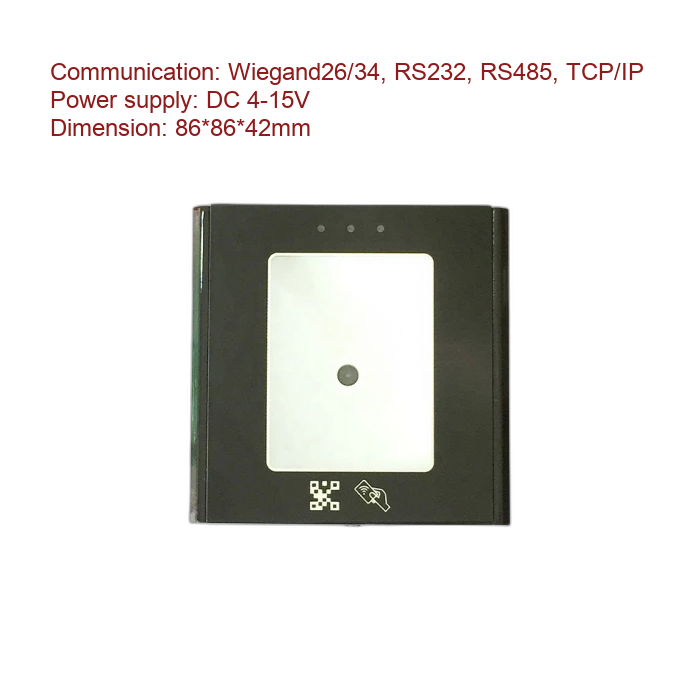
Product Overview
The DO-QR88 Access Control RFID Card Reader with QR Code Scanner is a dual-technology identification terminal designed for building apartment access, commercial office entry, and secured facility management. This reader combines EM or 13.56 MHz RFID card reading with QR code scanning in a single compact unit, allowing system integrators and project contractors to deploy a unified access control solution without requiring separate hardware for card and credential-based entry. The device supports multiple output interfaces including Wiegand 26/34, RS232, RS485, and TCP/IP, making it compatible with most existing access control panels and third-party security systems. Procurement teams and distributors looking for a stable, long-term supply of multi-format access readers for large-scale deployments will find the DO-QR88 suitable for projects requiring both physical card authentication and digital QR code verification.
Product Advantages
Dual Authentication in One Unit
The DO-QR88 eliminates the need for separate card readers and QR scanners by integrating both reading technologies into a single housing. This reduces installation complexity, cabling requirements, and overall hardware costs for building apartment access control, office lobby security, and gated community entry points. Facility managers benefit from simplified inventory management and consistent user experience across multiple entry locations.
Wide Interface Flexibility
With support for Wiegand 26/34, RS232, RS485, and TCP/IP, this reader can be integrated into legacy access control systems as well as modern IP-based networks. System integrators do not need to replace existing controllers or panels when upgrading to QR-enabled access. This backward compatibility is a critical factor for commercial retrofit projects and large-scale phased deployments.
Fast Read Speed for High-Traffic Areas
The reading speed of under 200 milliseconds ensures smooth throughput in busy environments such as apartment building entrances, office lobbies, and staff access gates. Users present their card or QR code once and gain entry without noticeable delay, reducing queue buildup during peak hours.
Industrial-Grade Construction
The front panel uses tempered glass, providing resistance to scratches, impacts, and daily wear in public access areas. The combination of plastic rear housing and glass front offers a balance of durability and lightweight installation, suitable for both indoor and sheltered outdoor mounting positions.
Key Features
- Supports EM 125 kHz and 13.56 MHz RFID cards for proximity reading
- QR code scanning for digital credentials, mobile passes, and temporary access codes
- Multiple output interface options: Wiegand 26, Wiegand 34, RS232, RS485, TCP/IP
- Reading distance of 0–20 cm for cards (typical 3–6 cm in practical installation)
- Reading speed less than 200 milliseconds for fast user throughput
- Wide input voltage range: DC 4–15 V, compatible with various power supplies
- Tricolor LED indication: red (working), green (network), light green or yellow (feedback)
- Compact 86×86×42 mm form factor suitable for standard junction box mounting
- Operating system support: Windows and Linux for host-side integration
- Available SDK for secondary development and custom application integration
- Language support: English and Chinese for configuration and user prompts
Technical Specifications
| Model | DO-QR88 |
| Product Type | Access Control RFID Card Reader with QR Code Scanner |
| RFID Frequency Support | EM 125 kHz, 13.56 MHz (MIFARE, NTAG, etc.) |
| Reading Range | 0–20 cm (typical 3–6 cm depending on credential type) |
| Reading Speed | <200 ms |
| Output Interface | Wiegand 26, Wiegand 34, RS232, RS485, TCP/IP |
| Input Voltage | DC 4–15 V (wide voltage input) |
| Housing Material | Plastic rear housing + Tempered glass front panel |
| Dimensions | 86 × 86 × 42 mm (L × W × H) |
| Color | Black |
| LED Indicators | Red (working status), Green (network connectivity), Yellow/Light Green (feedback) |
| Supported Operating Systems | Windows, Linux |
| SDK Availability | Yes, for secondary development and integration |
| Language Support | English, Chinese |
| Function Modes | RFID card reading, QR code scanning, combined authentication |
Industrial Applications
Building Apartment Access Control
Property managers and housing associations deploy the DO-QR88 at main entrances and shared facility doors to manage resident and visitor access. Residents use RFID cards or fobs for daily entry, while visitors receive time-limited QR codes via smartphone or printed pass. This dual method reduces key management overhead and eliminates the need for physical key duplication.
Commercial Office and Co-Working Spaces
System integrators install this reader in office lobbies, meeting room doors, and floor access points. Employees use existing proximity cards, and temporary workers or guests scan QR codes sent to their mobile devices. The wide voltage input and flexible interface options simplify integration with existing building management systems.
Gated Communities and Residential Complexes
For perimeter gates and pedestrian access points, the DO-QR88 provides a reliable entry solution that works with both legacy RFID credentials and modern mobile-based passes. Distributors supplying hardware to residential security projects benefit from the unit’s compatibility with multiple controller brands via selectable Wiegand and serial output formats.
Educational and Institutional Facilities
Schools, universities, and government buildings use this reader for staff and student access to restricted areas. The SDK enables custom software development for integration with attendance tracking, visitor management, and time scheduling systems.
Industrial and Warehousing Entry Points
In manufacturing facilities and logistics centers, the DO-QR88 controls access to production floors, storage zones, and administrative sections. Bulk purchasers and project contractors choose this unit for its stable performance across varying environmental conditions and its ability to work with both card-based and digital credentials in mixed-use deployments.
OEM / ODM Manufacturing Support
do rfid reader manufacturer offers OEM and ODM customization for the DO-QR88 to meet the specific requirements of system integrators, security distributors, and access control solution providers. Customization options include:
- Custom housing color, logo, and branding
- Firmware adjustments for specific output protocols or timing parameters
- Modified reading range calibration for project-specific installation distances
- Custom LED behavior patterns for status indication
- Bundled SDK with example code and integration documentation
- Regional language localization beyond English and Chinese
- Custom packaging and labeling for wholesale distribution
OEM partners benefit from engineering support during the specification phase, sample validation before mass production, and batch consistency across multiple production runs. The factory’s 20 years of production experience in RFID and access control hardware ensures that custom requirements are implemented reliably and delivered on schedule.
Factory Production Advantages
do rfid reader manufacturer operates a dedicated production facility with stable manufacturing capacity for the DO-QR88 and related access control readers. The production process includes component inspection, PCB assembly, firmware loading, functional testing, and packaging. Each unit undergoes quality checks before shipment to ensure reading distance, interface compatibility, and LED operation meet specification.
The factory maintains a steady supply chain for RFID modules, tempered glass panels, and electronic components, reducing the risk of production delays for bulk orders. Export experience spanning 20 years means that the shipping documentation, packaging standards, and customs clearance procedures are handled professionally for international buyers. Distributors and wholesalers receive consistent product quality across repeated orders, supporting long-term cooperation agreements.
Production lead times typically range from 1–5 days for sample quantities and 7–30 days for bulk orders, depending on the volume and customization requirements. The factory can scale production to meet project deployment deadlines, making it suitable for large-scale access control upgrades and new construction projects.
Bulk Supply & Project Deployment Support
Procurement managers and project contractors ordering the DO-QR88 in volume benefit from several practical advantages that support large-scale deployments:
- Batch consistency: Each production batch maintains the same reading sensitivity, output format behavior, and physical dimensions, ensuring uniform performance across all installed units
- Compatibility with existing systems: The selectable Wiegand, RS232, RS485, and TCP/IP interfaces allow the reader to work with controllers from different manufacturers without modification
- Technical support for integration: Engineering support is available during the integration phase to assist with SDK implementation, protocol configuration, and system testing
- Fast lead time for bulk orders: The factory’s production capacity supports order quantities ranging from hundreds to thousands of units with predictable delivery schedules
- Custom solution support: For projects requiring unique functionality, OEM customization can be implemented before full production begins
Distributors and system integrators can rely on a stable long-term supply of the DO-QR88 for ongoing projects, with consistent pricing, quality, and delivery performance across multiple purchase orders.
Frequently Asked Questions
Q: What types of RFID cards are compatible with this reader?
A: The DO-QR88 supports EM 125 kHz and 13.56 MHz frequency cards, including MIFARE Classic, MIFARE DESFire, NTAG, and compatible proximity credentials. Both card types can be used for entry alongside QR code scanning.
Q: Can this reader be integrated with an existing Wiegand-based access control system?
A: Yes, the DO-QR88 outputs Wiegand 26 and Wiegand 34 formats by default, which are compatible with most standard access control panels and controllers. RS232, RS485, and TCP/IP outputs are also available for systems that require serial or network communication.
Q: What is the typical installation process for the DO-QR88?
A: The reader mounts to a standard 86×86 mm junction box using the provided screws. Wiring connections depend on the chosen interface: four wires for Wiegand (data0, data1, power, ground) or additional wires for serial/network configurations. Power is supplied via DC 4–15 V from the access control panel or a dedicated power supply.
Q: Is the SDK free to use, and what platforms does it support?
A: The SDK is provided with the reader and supports development on Windows and Linux operating systems. It includes library files, sample code, and documentation for integrating the reader into custom access control, attendance, or visitor management software.
Q: What is the minimum order quantity for bulk purchasing?
A: Minimum order quantities depend on the product variant and customization level. Standard units are available for sample orders of a few pieces, while bulk pricing and lead times are quoted based on the specific order volume. Contact do rfid reader manufacturer for detailed pricing and availability.
Q: How does the factory ensure product quality before shipment?
A: Each DO-QR88 undergoes functional testing including RFID read range verification, QR code scanning accuracy, output signal integrity, LED operation, and power input validation. Packaging is designed to protect the tempered glass panel during transit.
Q: Can the reader be used outdoors or in semi-exposed locations?
A: The reader is suitable for sheltered outdoor installations such as covered building entrances, under eaves, or inside weather-protected enclosures. For fully exposed outdoor environments, additional weather protection may be required depending on climate conditions.
For technical specifications, OEM customization requests, bulk pricing, or project-specific integration support, contact do rfid reader manufacturer at info@dorfidreader.com. The engineering team can provide documentation, sample units, and production timelines based on your deployment requirements.