July 16, 2026
Access Control Custom Print NXP MIFARE DESFire 2K 4K 8K Card: The Complete 2026 Guide to Secure RFID Cards for Access Control, Customization, and Enterprise Applications
As organizations continue to upgrade their physical security systems, traditional magnetic stripe cards and low-security RFID cards are gradually being replaced by advanced contactless smart cards with stronger encryption and greater storage capacity. Modern offices, universities, hospitals, hotels, government agencies, and transportation systems require RFID cards that not only provide fast authentication but also protect sensitive data against cloning and unauthorized access.
Among today’s most trusted contactless technologies, NXP MIFARE DESFire stands out as one of the highest-security RFID platforms available for commercial applications. Available in 2K, 4K, and 8K memory versions, MIFARE DESFire cards combine high-speed communication, multi-application support, advanced AES encryption, and exceptional durability, making them the preferred choice for professional access control and identity management systems.
From my experience working with RFID manufacturers and international system integrators, many buyers initially compare only chip prices. However, the long-term success of an RFID project depends equally on chip authenticity, secure encoding, printing quality, manufacturing consistency, and after-sales technical support. Investing in a reliable supplier often reduces maintenance costs and system failures over the life of the project.
This comprehensive guide explains everything you need to know about Custom Print NXP MIFARE DESFire 2K, 4K, and 8K Cards, including their working principles, customization options, manufacturing process, application environments, competitive comparisons, practical buying experience, and answers to the most frequently asked questions.
What Is an NXP MIFARE DESFire 2K, 4K, or 8K Card?
An NXP MIFARE DESFire card is a high-frequency contactless smart card operating at 13.56 MHz and fully compliant with the ISO/IEC 14443 Type A standard. It is specifically designed for applications requiring advanced security, encrypted communication, and support for multiple independent applications on a single card.
Unlike basic RFID cards that only store a serial number, DESFire cards contain a secure microcontroller capable of processing encrypted authentication, secure file management, and complex application structures.
The three most common versions differ mainly in memory capacity:
| Version | EEPROM Memory | Typical Applications |
|---|---|---|
| DESFire 2K | 2 KB | Office access, student ID, membership |
| DESFire 4K | 4 KB | Multi-building access, campuses, hotels |
| DESFire 8K | 8 KB | Government ID, transportation, enterprise security |
Typical specifications include:
| Specification | Typical Value |
|---|---|
| Frequency | 13.56 MHz |
| Standard | ISO/IEC 14443 Type A |
| Security | AES, 3DES, DES Authentication |
| Reading Distance | 2–10 cm |
| Data Retention | Up to 25 Years |
| Read/Write Cycles | Over 500,000 |
| Card Material | PVC, PET, ABS, Recycled PVC |
| Card Size | CR80 (85.6 × 54 mm) |
Because of their high level of security and flexibility, DESFire cards are widely used in enterprise-grade RFID systems worldwide.
Access control custom print NXP Mifare Desfire 2k 4k 8k card
MIFARE DESFireBased on open global standards for both RF interface and cryptographic methods, our MIFARE DESFire product family provides highly secure microcontroller-based ICs. Its name DESFire references the use of DES, 2K3DES, 3K3DES, and AES hardware cryptographic engines for securing transmission data.
This family is ideally suited for solution developers and system operators building reliable, interoperable, and scalable contactless solutions. MIFARE DESFire products can be seamlessly integrated into mobile schemes and support multi-application smart card solutions in identity, access control, loyalty, and micropayment applications, as well as in transport ticketing installations.
 DESFireBased on open global standards for both RF interface and cryptographic methods, our MIFARE DESFire product family provides highly secure microcontroller-based ICs. Its name DESFire references the use of DES, 2K3DES, 3K3DES, and AES hardware cryptographic engines for securing transmission data.
This family is ideally suited for solution developers and system operators building reliable, interoperable, and scalable contactless solutions. MIFARE DESFire products can be seamlessly integrated into mobile schemes and support multi-application smart card solutions in identity, access control, loyalty, and micropayment applications, as well as in transport ticketing installations.
RF interface: ISO/IEC 14443 Type A
- Contactless interface compliant with ISO/IEC 14443-2/3 A
- Low Hmin enabling operating distance up to 100 mm (depending on power provided by the PCD and antenna geometry)
- Fast data transfer: 106 kbit/s, 212 kbit/s, 424 kbit/s, 848 kbit/s
- 7 bytes unique identifier (option for Random ID)
- Uses ISO/IEC 14443-4 transmission protocol
- Configurable FSCI to support up to 256 bytes frame size
Non-volatile memory
- 2 kB, 4 kB, 8 kB
- Data retention of 25 years
- Write endurance typical 1 000 000 cycles
- Fast programming cycles
| Key card Types | LOCO or HICO magnetic stripe hotel key card |
| RFID hotel key card | |
| Encoded RFID hotel keycard for most of RFID hotel locking system | |
| Material | 100% new PVC,ABS, PET,PETG etc |
| Printing | Heidelberg offset printing / Pantone Screen printing: 100% match customer required color or sample |
| Chip Options | |
| ISO14443A | MIFARE Classic® 1K, MIFARE Classic ® 4K |
| MIFARE® Mini | |
| MIFARE Ultralight ®, MIFARE Ultralight ® EV1, MIFARE Ultralight® C | |
| Ntag213 / Ntag215 / Ntag216 | |
| MIFARE ® DESFire ® EV1 (2K/4K/8K) | |
| MIFARE ® DESFire® EV2 (2K/4K/8K) | |
| MIFARE Plus® (2K/4K) | |
| Topaz 512 | |
| ISO15693 | ICODE SLI-X, ICODE SLI-S |
| 125KHZ | TK4100, EM4200, T5577 |
| 860~960Mhz | Alien H3, Impinj M4/M5 |
Remark:
MIFARE and MIFARE Classic are trademarks of NXP B.V.
MIFARE DESFire are registered trademarks of NXP B.V. and are used under license.
MIFARE and MIFARE Plus are registered trademarks of NXP B.V. and are used under license.
MIFARE and MIFARE Ultralight are registered trademarks of NXP B.V. and are used under license.

Packing & Delivery
Normal package :
200pcs rfid cards into white box .
5 boxes /10boxes /15boxes into one carton.
Customized Package based on your request.
For example below package picture:

Packing & Delivery
Normal package :
200pcs rfid cards into white box .
5 boxes /10boxes /15boxes into one carton.
Customized Package based on your request.
For example below package picture:


How Does a MIFARE DESFire Card Work?
MIFARE DESFire cards use passive RFID technology and do not require an internal battery. They receive power from the electromagnetic field generated by an RFID reader.
The communication process consists of several stages:
Step 1: RF Field Generation
An RFID reader continuously emits a 13.56 MHz radio frequency field.
Step 2: Power Transfer
When the card enters the reader’s field, its embedded antenna harvests energy through electromagnetic induction, activating the secure chip.
Step 3: Mutual Authentication
Unlike standard RFID cards, DESFire performs mutual authentication, meaning both the reader and the card verify each other’s identity before exchanging information.
Supported security algorithms include:
- AES-128
- 3DES
- DES (legacy support)
Step 4: Secure Data Exchange
Once authentication is complete, encrypted communication begins. The card can securely store and manage multiple applications simultaneously, each protected with independent keys and permissions.
Typical stored data includes:
- Employee credentials
- Building access rights
- Parking permissions
- Payment balances
- Student information
- Transportation tickets
- Visitor credentials
- Digital certificates
The entire authentication process typically completes in less than half a second, delivering fast and secure access even in high-traffic environments.
Why Choose MIFARE DESFire for Access Control?
Compared with older RFID technologies, MIFARE DESFire offers significant advantages.
Enterprise-Level Security
DESFire supports AES-128 encryption, making cloning and unauthorized data access extremely difficult. This level of security is suitable for government agencies, financial institutions, research facilities, and corporate headquarters.
Multi-Application Capability
A single card can securely support multiple functions, such as:
- Office access
- Time attendance
- Cafeteria payment
- Library borrowing
- Parking management
- Printer authentication
Each application operates independently, improving flexibility and reducing the need for multiple cards.
Long Product Life
DESFire cards support over 500,000 read/write cycles and can retain data for up to 25 years, making them ideal for long-term deployments.
Excellent Scalability
Organizations can add new applications or expand existing systems without replacing the physical card, helping reduce future upgrade costs.
Benefits of Custom Printed DESFire Cards
Custom printing transforms a standard RFID card into a professional security credential and branding tool.
Professional Corporate Identity
Organizations can print:
- Company logos
- Employee photos
- Department information
- Corporate colors
- Membership details
- Promotional graphics
A professionally designed card enhances brand recognition while improving employee identification.
Enhanced Visual Security
Optional security features include:
- Holograms
- UV fluorescent printing
- Laser engraving
- Microtext
- Guilloche patterns
- Security foil
- Tamper-evident elements
These additions make visual counterfeiting significantly more difficult.
Variable Data Printing
Manufacturers can personalize every card with:
- Employee names
- Serial numbers
- QR codes
- Barcodes
- Expiration dates
- Card IDs
Each card becomes uniquely identifiable.
Integration with Enterprise Systems
Custom DESFire cards can be seamlessly integrated into access control, attendance, payment, and visitor management software, simplifying daily operations.
Custom Manufacturing Process
Professional RFID card manufacturers follow a structured production process to ensure quality and reliability.
1. Requirement Analysis
The supplier confirms:
- Memory version (2K, 4K, or 8K)
- Card quantity
- Printing design
- Security features
- Encoding requirements
- Packaging specifications
Proper planning reduces production risks.
2. Artwork Preparation
Designers create production files based on customer requirements.
Optional finishes include:
- Offset printing
- UV printing
- Matte finish
- Gloss finish
- Metallic foil
- Frosted texture
Digital proofs are normally approved before mass production.
3. Chip Embedding
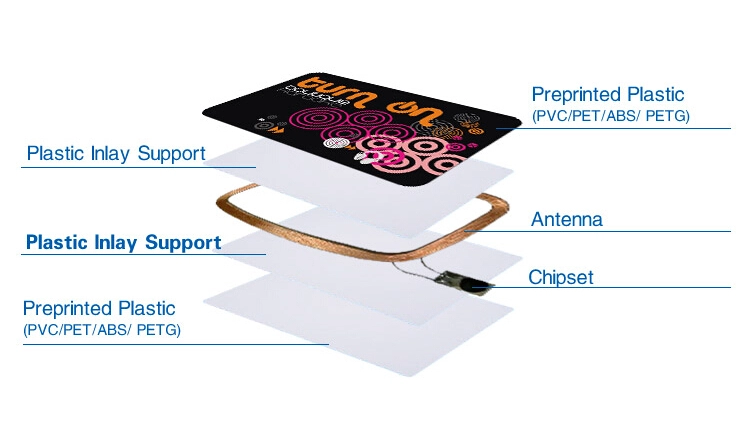
The DESFire chip and antenna are laminated between multiple PVC layers under controlled temperature and pressure, ensuring long-term durability and stable RF performance.
4. Printing
Factories typically use high-resolution offset printing or UV digital printing for consistent color accuracy and sharp image quality.
5. Personalization
Available personalization options include:
- Photo printing
- Variable names
- Laser engraving
- UID printing
- QR codes
- Barcodes
- Signature panels
- Magnetic stripes (if required)
6. Secure Encoding
The card is programmed with:
- Encryption keys
- Access permissions
- User credentials
- Application files
- Authentication parameters
Secure key management is essential during this stage.
7. Quality Control
Professional factories inspect:
- Chip functionality
- RF performance
- Print quality
- Surface appearance
- Card dimensions
- Data encoding
Many manufacturers perform 100% functional testing before shipment.
Typical Application Environments
MIFARE DESFire cards are widely used in high-security environments.
Corporate Offices
Employees use DESFire cards for:
- Building access
- Elevator control
- Time attendance
- Secure departments
- Visitor authentication
Universities
Campus systems integrate DESFire cards for:
- Student identification
- Dormitory access
- Library services
- Cafeteria payments
- Attendance tracking
Hotels
Hotels deploy DESFire cards for:
- Guest room access
- VIP privileges
- Parking access
- Cashless purchases
- Conference room entry
Government Institutions
Government agencies use DESFire cards for:
- Staff identification
- Restricted-area access
- Secure authentication
- Identity verification
Healthcare
Hospitals implement DESFire technology for:
- Staff ID
- Pharmacy access
- Equipment authorization
- Patient management
Public Transportation
Many modern transit systems rely on DESFire cards for:
- Metro ticketing
- Bus payments
- Rail transportation
- Integrated city mobility programs
Problems Solved by DESFire Cards
Traditional RFID systems face several operational challenges that DESFire technology effectively addresses.
Card Cloning
Older technologies such as MIFARE Classic have known security weaknesses. DESFire’s advanced encryption significantly reduces the risk of unauthorized duplication.
Managing Multiple Credentials
Instead of carrying separate cards for access, attendance, parking, and payment, users can consolidate all functions onto a single DESFire card.
Data Security
Sensitive information is stored in encrypted files with independent access keys, protecting against unauthorized reading or modification.
Operational Efficiency
Fast authentication reduces queues at office entrances, parking gates, transit stations, and other high-traffic access points.
Lower Long-Term Costs
Although DESFire cards have a higher initial cost than basic RFID cards, their durability, flexibility, and long service life often reduce the total cost of ownership over time.
MIFARE DESFire vs Competing RFID Technologies
DESFire vs MIFARE Classic
MIFARE Classic remains suitable for basic access control but relies on the older Crypto1 algorithm.
DESFire provides AES encryption, stronger authentication, better memory management, and significantly improved resistance to cloning.
DESFire vs MIFARE Plus
MIFARE Plus is often chosen as a migration solution for existing MIFARE Classic systems.
DESFire is designed for new, security-focused deployments that require multiple independent applications and higher levels of cryptographic protection.
DESFire vs NTAG216
NTAG216 is optimized for smartphone interaction, digital business cards, marketing campaigns, and NFC information sharing.
DESFire is engineered for secure authentication, identity management, transportation, and enterprise access control.
DESFire vs EM4200 (125 kHz)
Low-frequency EM4200 cards typically transmit only identification numbers and provide minimal security.
DESFire offers encrypted communication, larger memory, multi-application support, and enterprise-grade protection.
Practical Experience from Real RFID Projects
Based on years of working with international RFID integrators, one of the biggest mistakes buyers make is selecting suppliers based solely on price.
I’ve seen projects delayed because low-cost cards contained recycled chips, poorly aligned antennas, or inconsistent encoding. In contrast, manufacturers using genuine NXP components and strict quality control delivered higher reliability and fewer field failures.
Before placing a large order, always request pre-production samples and test them with your existing readers, software, and access control platform. Verify not only that the cards function correctly but also that personalization, printing, and encryption meet your operational requirements.
It’s also worth discussing future expansion with your supplier. If your organization plans to add mobile credentials, NFC-enabled devices, or additional applications later, choosing a manufacturer experienced in scalable RFID solutions can simplify future upgrades.
How to Choose a Reliable RFID Card Manufacturer
When evaluating potential suppliers, look for the following:
- Genuine NXP DESFire chips
- ISO-certified production facilities
- Advanced offset and UV printing equipment
- In-house secure encoding capabilities
- Strict key management procedures
- 100% chip functionality testing
- OEM and ODM customization services
- Fast sample production
- International export experience
- Responsive technical and after-sales support
A manufacturer that combines secure production with strong engineering support will provide greater long-term value than one competing solely on price.
Frequently Asked Questions
1. What is the difference between DESFire 2K, 4K, and 8K?
The primary difference is memory capacity. Larger memory allows more applications, larger data files, and greater flexibility for complex systems.
2. Is DESFire more secure than MIFARE Classic?
Yes. DESFire supports AES-128 encryption and advanced mutual authentication, providing significantly stronger protection against cloning and unauthorized access.
3. Can one DESFire card support multiple applications?
Yes. A single card can simultaneously manage access control, attendance, payment, parking, transportation, and other applications while keeping each application securely separated.
4. Can the cards be customized with my company logo?
Yes. Professional manufacturers offer full-color offset printing, UV printing, laser engraving, holograms, variable data printing, and other personalization options.
5. What is the typical reading distance?
Most DESFire cards operate within a reading distance of 2–10 cm, depending on the reader and environmental conditions.
6. Are DESFire cards waterproof?
Yes. Standard PVC cards are water-resistant, while PET and ABS versions are available for harsher operating environments.
7. Can every card contain different data?
Absolutely. Manufacturers can personalize each card with unique employee information, serial numbers, encrypted credentials, QR codes, and application-specific data.
8. How long do DESFire cards last?
They typically support over 500,000 read/write cycles and retain data for up to 25 years under normal operating conditions.
9. Can DESFire cards work with smartphones?
Some NFC-enabled smartphones can interact with DESFire cards, but compatibility depends on the mobile operating system, security configuration, and application design.
10. How can I identify a reliable DESFire card supplier?
Choose a manufacturer with proven OEM/ODM experience, genuine NXP chip sourcing, secure encoding capabilities, ISO-certified production, comprehensive quality control, and strong technical support for international projects.
Conclusion
Access Control Custom Print NXP MIFARE DESFire 2K, 4K, and 8K Cards represent one of the most secure and flexible contactless RFID solutions available today. Their advanced encryption, multi-application architecture, long service life, and excellent scalability make them ideal for corporate offices, educational institutions, hotels, healthcare facilities, transportation systems, and government organizations that require reliable identity management and access control.
Beyond selecting the right chip, project success depends on choosing an experienced manufacturer capable of delivering genuine NXP components, secure encoding, high-quality printing, rigorous testing, and comprehensive OEM/ODM customization. With the right production partner, DESFire cards provide a durable, secure, and future-ready foundation for modern contactless access control systems.