November 8, 2026
The Blank White NFC PVC NTAG215 Card is a standard-size contactless smart card designed for NFC data storage, product identification, digital business cards, access applications, membership programs, and other projects that require a printable NFC card.
Built around the NXP NTAG215 NFC chip, this blank NFC card combines a durable PVC card body with contactless NFC functionality. The white surface provides a clean base for branding, identification, artwork, QR codes, or other printed information.
The card can be supplied as a blank NFC card for customer encoding, or customized according to project requirements, including card material, thickness, dimensions, printing, chip configuration, and other production options.
Key Features of the NTAG215 NFC Card
- NTAG215 NFC chip for contactless data storage and communication
- 13.56 MHz operating frequency
- Compatible with NFC-enabled smartphones and NFC readers
- 506 bytes of chip memory according to the product specification
- Standard card format of approximately 85.5 × 54 mm
- Printable white PVC surface
- Read/write capability with optional read-only locking
- Suitable for NFC URL, contact, identification, membership, and information-sharing applications
- Multiple material and thickness options may be available for customized projects
- Suitable for bulk production and OEM/ODM NFC card projects
The NTAG215 card is particularly useful when a project needs a physical card that combines conventional printed information with programmable NFC functionality.
Product Specifications
NTAG215 Card is designed to fully comply to NFC Forum Type 2 Tag and ISO/IEC14443 Type A specifications. Based on the NTAG215 chip from NXP, Ntag215 offers advanced security, anti-cloning features as well as a permanent lock features, therefore user data can be permanently configured read-only.
| Material | PVC/ABS/PET(high temperature resistance ) etc |
| Frequency | 13.56Mhz |
| Size | 85.5*54mm or customized size |
| Thickness | 0.76mm,0.8mm,0.9mm etc |
| Chip Memory | 506 Byte |
| Encode | Available |
| Printing | Offset ,silkscreen Printing |
| Read range | 1-10cm (depend on the reader and reading environment) |
| Operation temperature | PVC:-10°C -~+50°C;PET: -10°C~+100°C |
| Application | Access Control, Payment, hotel key card, resident key card, attendance system ect |
NTAG215 NFC Card is one of original NTAG® card. Seamlessly working with NFC readers as well ascompatible with all NFC enabled devices and conform to ISO 14443. The 215 chip has a read-write lockfunction that makes the cards can be edited repeatedly or read-only.
Due to the excellent safety performance and better RF performance of Ntag215 chip, Ntag215 print card is widely used in financial management, communications telecommunications, social security, transportation tourism, health care, government administration, retail, storage and transportation, member management, access control attendance, identification, highways, hotels, entertainment, school management, etc.


What Is an NTAG215 NFC Card?
An NTAG215 NFC card is a contactless smart card using the NXP NTAG215 chip. The chip communicates wirelessly with compatible NFC devices at 13.56 MHz.
Unlike a conventional printed PVC card, an NFC card can contain digital information that can be accessed by bringing an NFC-enabled smartphone or reader close to the card.
For example, a business card can display a person’s name and contact information while the NFC chip stores a digital contact page. A membership card can contain a unique identifier or web address, while the printed surface provides the member’s visual identification.
The NTAG215 platform is therefore a practical option for applications that need simple NFC data storage without requiring a battery or physical connection.
506 Bytes of Memory for Everyday NFC Data
The NTAG215 chip is specified with 506 bytes of memory. This capacity is suitable for many common NFC applications, especially those based on short NDEF records.
Typical information may include:
- Website URLs
- Digital business card information
- Contact details
- Short text
- Product identification data
- Social media links
- Registration links
- Marketing campaign URLs
- Product information pages
- Digital menus
- Basic NFC automation instructions
The amount of usable space depends on the data format and NDEF record structure. For this reason, the stated 506-byte chip memory should not be interpreted as 506 bytes of completely unrestricted user data.
For projects with larger data requirements, a higher-capacity NFC chip may be more appropriate.
Blank White PVC Surface for Card Printing
The white card surface provides a clean background for printed designs and identification information.
A customized NFC PVC card can combine NFC functionality with conventional card printing, allowing one physical card to perform both digital and visual functions.
Common printed elements include:
- Company logos
- Names and job titles
- QR codes
- Membership numbers
- Product information
- Brand graphics
- Instructions
- Website addresses
- Customer identification information
For projects requiring direct printing with a specific inkjet card printer, customers should confirm printer compatibility, printable card thickness, surface requirements, and feeding specifications before ordering.
Printing performance can vary between printer models and card constructions. Samples are recommended when the project depends on a particular printing process.
PVC, ABS and PET Material Options
Different applications may require different card materials.
| Material | Typical Advantage | Suitable Considerations |
|---|---|---|
| PVC | Common card material with good printability | General-purpose NFC cards |
| ABS | Strong and durable card construction | Projects requiring increased durability |
| PET | Higher temperature resistance | Applications exposed to higher temperatures |
| Custom Material | Project-specific requirements | OEM/ODM production |
PVC is a practical choice for conventional NFC cards used in business, membership, identification, and promotional applications.
PET can be considered when a project requires a different temperature-performance profile. Material availability, thickness, surface finish, and production requirements should be confirmed before mass production.
NTAG215 vs. Other NFC Chip Options
Choosing an NFC chip depends on memory requirements, application complexity, and the desired balance between cost and functionality.
| Feature | NTAG213 | NTAG215 | NTAG216 |
|---|---|---|---|
| NFC Type | Type 2 Tag | Type 2 Tag | Type 2 Tag |
| Frequency | 13.56 MHz | 13.56 MHz | 13.56 MHz |
| Relative Memory | Lower | Medium | Higher |
| Typical Use | Simple URLs and short data | General NFC projects | Larger NFC data |
| Cost Position | Generally lower | Mid-range | Generally higher |
| Best For | Compact NFC records | Balanced capacity | Applications needing more memory |
The NTAG215 sits between NTAG213 and NTAG216 in the commonly used NTAG21x family. It is a useful middle-ground choice when an application needs more capacity than a basic NTAG213 but does not require the larger memory capacity of an NTAG216.
The correct choice should be based on the actual encoded data rather than memory capacity alone.
Why Choose NTAG215 for a Printable NFC Card?
The NTAG215 chip is well suited to projects where the NFC function is relatively simple but the physical card needs enough space for branding and printed information.
Balanced Memory Capacity
The 506-byte specification provides more room than entry-level NFC tags for many common NDEF applications.
Smartphone-Friendly NFC Experience
Compatible NFC-enabled smartphones can interact with the card without requiring a battery inside the card.
Dual Physical and Digital Function
The printed surface communicates visual information while the NFC chip provides a digital connection.
Flexible Encoding
Cards can be written with appropriate NFC tools and can be configured for different data records. Depending on the application, cards can also be locked to prevent further modification.
Suitable for Custom Production
The card format can be adapted for different project requirements, including materials, thicknesses, printing, and other OEM/ODM specifications.
Common Applications
NFC Business Cards
An NTAG215 NFC business card can connect customers directly to a website, digital profile, contact page, portfolio, or social media page.
Instead of printing every piece of contact information on the card, the NFC function can provide access to a digital profile that can be updated later.
Membership and Loyalty Cards
NFC cards can be used as physical membership cards containing a digital identifier or link to a customer platform.
The printed side can display the customer’s membership information, while NFC provides a contactless interaction point.
Product Information Cards
Manufacturers and brands can attach NFC-enabled cards to products, packaging, displays, or promotional materials.
The NFC record can direct users to product specifications, manuals, warranty registration, authenticity information, or other online resources.
Event and Promotional Cards
For exhibitions, conferences, campaigns, and promotional programs, an NFC card can provide a convenient way to distribute digital information.
Users can simply tap the card with a compatible NFC smartphone instead of manually typing a URL.
Access and Identification Projects
NTAG215 cards can also be considered for identification and certain access-related applications where the system is designed around the capabilities of an NTAG215 tag.
However, NTAG215 should not automatically be treated as a high-security access credential. Applications requiring strong cryptographic authentication or advanced anti-cloning protection should use a chip and security architecture specifically designed for that purpose.
NFC Card vs. Traditional PVC Card
| Feature | Traditional PVC Card | NTAG215 NFC PVC Card |
|---|---|---|
| Printed Information | Yes | Yes |
| Contactless Data | No | Yes |
| Smartphone Interaction | No | Yes, with compatible NFC devices |
| Digital URL | Printed only | Can be stored digitally |
| Data Update | Requires reprinting | NFC data can be rewritten when unlocked |
| QR Code Support | Yes | Yes |
| Battery Required | No | No |
| Suitable for Digital Applications | Limited | Yes |
An NFC PVC card does not necessarily replace traditional card printing. Instead, it adds a digital layer to an existing physical card.
How Does an NTAG215 Card Work?
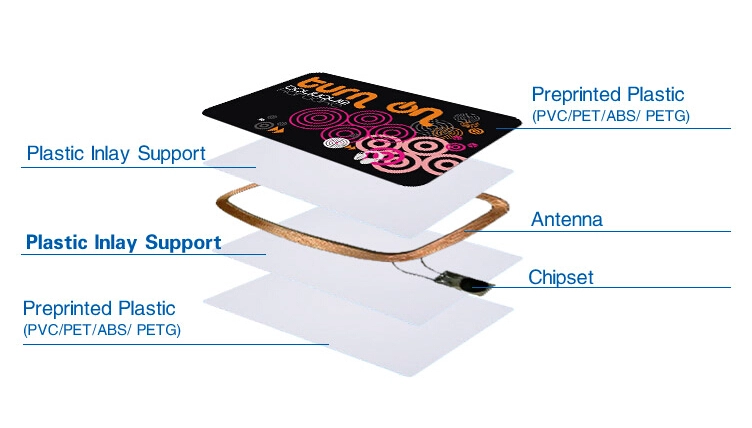
The NFC chip and antenna are integrated into the card during manufacturing. The card does not require a battery.
When a compatible NFC smartphone or reader is brought close to the card, the reader generates the electromagnetic field required for communication.
The NFC device can then read the information stored on the chip or perform another supported operation.
For a URL-based application, the process can be as simple as:
- Encode the NFC card with the desired URL.
- Test the card using a compatible NFC smartphone.
- Print the required design on the card.
- Distribute the finished NFC cards.
- Users tap the card with a compatible NFC device to access the digital content.
The exact user experience depends on the smartphone operating system, NFC settings, stored record type, and application design.
Read, Write and Lock Functions
NTAG215 cards can be used as rewritable NFC tags when the memory remains unlocked.
This is useful during production because cards can be encoded, tested, and corrected before final distribution.
For applications where the NFC information should not be changed after encoding, supported locking features can be used to make the relevant information read-only.
Before locking cards in a production environment, it is important to perform complete testing. A locked NFC record may not be recoverable through normal rewriting procedures.
NFC Card Compatibility
NTAG215 is based on a widely used NFC technology and is designed for communication with compatible NFC readers and NFC-enabled devices.
Compatibility can still vary depending on the specific device and application.
For the best results, test the actual card with the smartphones and NFC readers that will be used by customers or staff.
Factors that can affect performance include:
- Smartphone model
- NFC antenna position
- Reader design
- Card orientation
- Nearby metal
- Card holder construction
- Environmental conditions
- NFC antenna and inlay design
The published reading distance should therefore be treated as an approximate operating range rather than a guaranteed distance for every device.
Custom NFC Card Manufacturing
For larger projects, the blank NTAG215 NFC card can be adapted to specific production requirements.
Potential customization options include:
| Customization | Examples |
|---|---|
| Card Size | Standard or customized dimensions |
| Thickness | Different card thickness options |
| Material | PVC, PET, ABS and other options |
| Printing | Custom artwork, logos and information |
| Surface | Different finishing requirements |
| NFC Chip | NTAG215 or alternative chip |
| Encoding | Pre-encoding based on project data |
| Packaging | Customized packaging for bulk orders |
OEM and ODM projects should confirm the final card specification before production, particularly when the cards will be used with automated printers, card feeders, NFC encoders, or specialized readers.
Printing and Encoding Workflow
For a professional NFC card project, printing and NFC encoding should be treated as two related but separate production processes.
A typical workflow is:
Design → Sample Printing → NFC Encoding → NFC Testing → Final Printing/Production → Quality Control → Packaging
For variable data projects, such as cards with unique URLs or IDs, the encoding process should be carefully matched with the printed card numbering system.
This helps ensure that the physical card and its digital NFC record remain correctly associated.
Quality Control for NFC Cards
Before bulk delivery, NFC cards should be checked for both physical and digital quality.
Recommended quality checks include:
- Card dimensions and thickness
- Printing alignment
- Surface appearance
- NFC read performance
- NFC write performance
- Encoded URL or data accuracy
- Lock status, when applicable
- Batch consistency
- Compatibility with the intended NFC readers
For high-volume projects, a sampling plan can be established based on the customer’s quality requirements.
Frequently Asked Questions
Can NTAG215 cards be written with a smartphone?
Yes. Compatible NFC-enabled smartphones can generally read and write supported NFC tags using an appropriate NFC application. The exact functions available depend on the smartphone and software.
Can I store a website URL on an NTAG215 card?
Yes. A website URL is one of the common uses for an NTAG215 NFC tag. Short URLs are particularly practical because they require relatively little storage space.
Can the NFC card be rewritten?
Yes, while the relevant memory remains writable. Once the card has been permanently locked, the locked information cannot normally be changed.
Does the NTAG215 card need a battery?
No. The card is a passive NFC device and does not require a built-in battery.
Can the card be printed?
Yes. The white surface is designed as a printable card surface, with customization options available. If direct inkjet printing is required, confirm the specific printer and card compatibility before ordering.
Is NTAG215 suitable for secure access control?
It depends on the security requirements of the system. NTAG215 can be useful for identification and basic NFC applications, but applications requiring strong cryptographic authentication should use a security-focused NFC technology appropriate for the threat model.
What is the difference between an NFC card and an RFID card?
NFC is a short-range contactless technology based on 13.56 MHz technology, while RFID is a broader category covering different frequencies and applications. NTAG215 is an NFC-compatible Type 2 Tag technology intended for short-range contactless communication.
Can I order custom-size NFC cards?
Custom dimensions may be available depending on the project. Contact the supplier with your required size, material, thickness, chip type, printing method, and quantity for confirmation.
How to Choose the Right NTAG215 NFC Card
When selecting a blank NFC card, consider more than the chip alone.
First, determine how much data the application actually needs. If the card only stores a short URL, a lower-capacity chip may be sufficient. If the project requires more data, NTAG215 provides additional capacity.
Next, consider the physical environment. Standard PVC is suitable for many everyday applications, while alternative materials may be preferable for specialized temperature or durability requirements.
Finally, confirm the printing and encoding process. If the cards will be printed or encoded in-house, make sure the card dimensions, thickness, surface, and chip construction are compatible with the equipment.
Request NTAG215 NFC Card Samples
The Blank White NFC PVC NTAG215 Card is a practical option for businesses looking to combine a professional printed card with programmable NFC functionality.
It is suitable for digital business cards, membership programs, product information, marketing campaigns, identification projects, and other applications where a compact contactless data carrier is required.
For bulk orders or customized NFC card projects, provide your required card size, thickness, material, printing method, NFC chip, encoding requirements, application, and order quantity. Testing samples before mass production is recommended when printer or reader compatibility is critical. Welcome to contact us for more information.