
Product Overview
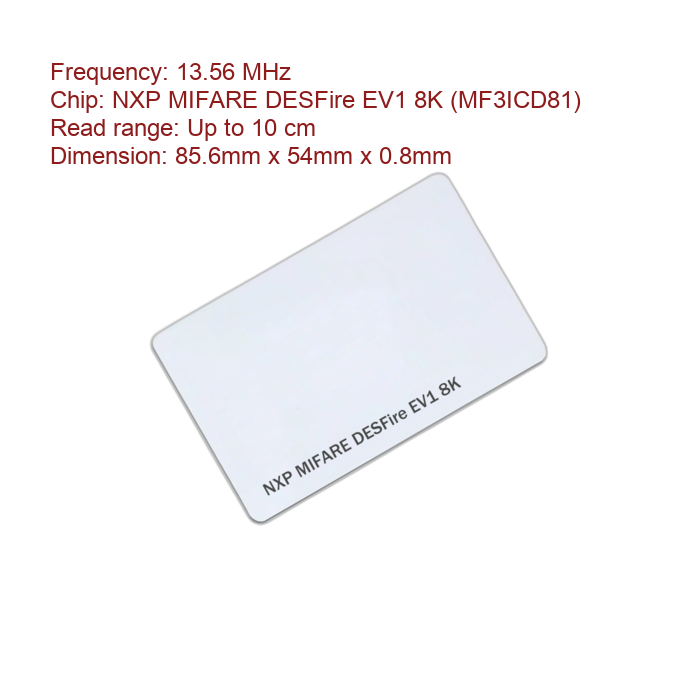
The MIFARE DESFire EV1 8K 13.56MHz Blank RFID NFC Printable Card is a high-security, multi-application contactless smart card designed for industrial and commercial deployments that require encrypted data storage, fast transaction speeds, and reliable read performance. Manufactured by do rfid reader manufacturer, this card uses the NXP MIFARE DESFire EV1 8K chip (MF3ICD81) and operates at 13.56 MHz with a data transfer rate of up to 848 kbps, supporting secure mutual authentication and AES-128 encryption for sensitive data protection.
System integrators, access control contractors, transportation operators, payment solution providers, and enterprise identity management teams rely on this card for large-scale deployments where multiple applications must run securely on a single credential. The 8-kilobyte memory capacity provides sufficient storage for complex application structures, and the ISO/IEC 14443-A compliance ensures broad compatibility with existing reader infrastructure. The card supports NFC Forum Type 4 protocol, making it readable by most modern NFC-enabled smartphones and terminals.
This blank printable card is supplied in PVC material with an ISO standard CR80 size of 85.6 mm x 54 mm x 0.8 mm, allowing for direct dye-sublimation or thermal transfer printing using standard card printers from brands such as Zebra, Epson, and Canon. The 7-byte UID ensures unique identification across the entire deployment, and the Common Criteria EAL4+ certification provides assurance for security-sensitive applications such as government ID, financial payments, and critical infrastructure access.
Product Advantages
- Multi-Application Flexibility: The MIFARE DESFire EV1 architecture supports up to 28 simultaneous applications on a single card, enabling system integrators to combine access control, cashless vending, time and attendance, and loyalty programs on one credential, reducing card issuance costs and user management complexity.
- Hardware-Grade Security: AES-128 encryption and mutual authentication protect data during read and write operations, preventing unauthorised cloning or data tampering. The Common Criteria EAL4+ certification confirms the chip meets rigorous security evaluation standards required by banking, government, and enterprise security projects.
- High-Speed Data Transfer: With a communication speed of up to 848 kbps, the card supports fast transaction processing in high-traffic environments such as metro turnstiles, office building entrances, and stadium gates, where throughput is critical to operational efficiency.
- Broad Reader Compatibility: The ISO/IEC 14443-A protocol ensures interoperability with the majority of installed HF RFID readers worldwide, reducing integration risk and deployment delays for system integrators and project contractors.
- Durable Physical Construction: The PVC material provides resistance to bending, moisture, and daily wear, making the card suitable for long-term use in employee badges, student IDs, membership cards, and visitor credentials that are carried and swiped repeatedly.
Key Features
- Operating frequency: 13.56 MHz
- Chip type: NXP MIFARE DESFire EV1 8K (MF3ICD81)
- Memory capacity: 8 Kilobytes
- UID size: 7 Bytes
- Read range: Up to 10 cm (depending on antenna geometry and reader power)
- Data transfer rate: Up to 848 kbps
- Protocol: NFC Forum Type 4
- Communication protocol: ISO/IEC 14443-A
- Card dimensions: 85.6 mm x 54 mm x 0.8 mm (CR80 ISO standard)
- Material: PVC
- Common Criteria EAL4+ certified
- Supports AES-128 encryption and mutual authentication
- Supports multiple application management with secure application structure
- Printable via dye-sublimation or thermal transfer printing
Technical Specifications
| Parameter | Value |
| Operating Frequency | 13.56 MHz |
| Chip Type | NXP MIFARE DESFire EV1 8K (MF3ICD81) |
| Memory Capacity | 8 Kilobytes |
| UID Size | 7 Bytes |
| Read Range | Up to 10 cm (depending on antenna geometry) |
| Data Transfer Rate | Up to 848 kbps |
| Protocol | NFC Forum Type 4 |
| Communication Protocol | ISO/IEC 14443-A |
| Card Dimensions | 85.6 mm x 54 mm x 0.8 mm (CR80 ISO standard) |
| Material | PVC |
| Weight | 0.007 kg |
| Waterproof | Yes |
Industrial Applications
Access Control Systems: Property managers, security integrators, and facility operators deploy this card for office buildings, data centers, warehouses, and industrial sites where secure multi-zone access must be managed across hundreds or thousands of users. The 8K memory allows storage of multiple access profiles, time zones, and credential expiry data on a single card.
Transportation and Transit: Transit authorities and transportation project contractors use this card for metro, bus, and light rail fare collection systems. The high data transfer rate and NFC Type 4 compliance enable fast tap-and-go transactions that maintain passenger flow during peak hours, while AES-128 encryption prevents fare evasion through card cloning.
Payment and Microtransaction Systems: Cafeterias, corporate canteens, university campuses, and event venues integrate this card into cashless payment systems where multiple vendors share a common stored-value purse. The secure memory structure supports top-up transactions, transaction logging, and balance inquiry without requiring online connectivity for every transaction.
Identity and Credential Management: Government agencies, corporate HR departments, and educational institutions issue this card as a secure identity badge that combines photo ID, biometric template storage, and digital certificates on one credential. The Common Criteria EAL4+ certification supports compliance with government identity assurance frameworks.
Loyalty and Membership Programs: Retail chains, fitness clubs, and hospitality groups use this card to manage membership tiers, reward points, and entitlement verification. The multi-application architecture allows a single card to serve as both a membership card and a stored-value card, reducing plastic waste and card issuance overhead.
OEM / ODM Manufacturing Support
do rfid reader manufacturer provides complete OEM and ODM customization services for the MIFARE DESFire EV1 8K card. Buyers can request custom card artwork, brand logo printing, serial number encoding, and custom packaging for retail or corporate distribution. For system integrators requiring pre-configured application structures, the factory supports custom file system setup with defined application IDs, access keys, and memory allocation to match the exact deployment specification.
For projects requiring non-standard card dimensions, material variations, or special antenna tuning, the engineering team at do rfid reader manufacturer can assess feasibility and provide a custom solution that maintains full compliance with ISO/IEC 14443-A communication. OEM partners receive dedicated production line support to ensure batch consistency across multi-year supply agreements.
Factory Production Advantages
The manufacturing facility of do rfid reader manufacturer has production experience in HF RFID card assembly, chip embedding, and quality inspection. The production process includes automated chip placement, lamination, and personalized encoding to reduce human error and maintain batch consistency for large-volume orders. Each card undergoes functional testing to verify read range, write reliability, and protocol compliance before shipment.
For wholesalers and distributors, the factory maintains stable production capacity to support long-term supply agreements, seasonal demand fluctuations, and project-based rollouts. The production planning team coordinates raw material procurement and chip allocation to minimize lead time and prevent supply gaps during peak procurement periods such as corporate budget cycles or government project deadlines.
Quality inspection procedures include visual surface inspection, dimensional measurement, chip read/write verification, and antenna resonance testing. This ensures that every card delivered to the customer meets the technical specifications required for reliable operation in the field.
Bulk Supply & Project Deployment Support
Project contractors and system integrators benefit from volume pricing tiers that reduce unit cost as order quantity increases. For large-scale deployments exceeding 1,000 pieces, do rfid reader manufacturer provides consolidated shipping, batch serial number tracking, and technical documentation including datasheets and programming guides to support smooth field installation.
For long-term projects requiring phased delivery, the factory can schedule production batches to align with deployment milestones, reducing the need for upfront warehousing and capital commitment. Distributors can negotiate exclusive regional supply agreements and receive priority production allocation for repeat orders.
Technical support is available to assist with reader compatibility verification, card programming, and field troubleshooting during the integration phase. Contact info@dorfidreader.com for detailed quoting, custom artwork approval, encoding specification, and delivery scheduling.
Frequently Asked Questions
What is the difference between MIFARE DESFire EV1 and MIFARE Classic?
The MIFARE DESFire EV1 chip provides AES-128 encryption, Common Criteria EAL4+ certification, and a multi-application file system supporting up to 28 applications. MIFARE Classic uses CRYPTO1 encryption, which has known vulnerabilities, and supports fewer applications. For security-sensitive deployments such as payment, government ID, and critical infrastructure access, DESFire EV1 is the recommended choice.
Can this card be printed with a standard card printer?
Yes. The card is supplied as a blank printable PVC card with a smooth surface compatible with dye-sublimation and thermal transfer printing. Most standard card printers from manufacturers such as Zebra, Epson, and Canon can print directly on the card surface using the CR80 card feed mechanism.
Is this card compatible with NFC smartphones?
Yes. The card supports NFC Forum Type 4 protocol, making it readable and writable by most modern NFC-enabled Android and iOS smartphones using compatible NFC middleware or application software.
What read range can I expect from this card?
The read range is up to 10 cm, depending on the antenna design of the reader and environmental conditions. In practical deployments, typical read distances range from 3 cm to 8 cm for standard access control and payment terminals.
Can the card be used for payment applications?
Yes. The MIFARE DESFire EV1 chip is widely used in closed-loop payment systems such as corporate canteens, school campuses, event venues, and transit fare collection. The AES-128 encryption and secure memory structure make it suitable for stored-value and prepaid payment models.
What is the minimum order quantity for wholesale pricing?
Volume pricing starts at 200 pieces and improves further at 600 pieces and 1,000 pieces. For orders above 1,000 pieces, contact info@dorfidreader.com for custom pricing, delivery scheduling, and OEM customization support.
Does the factory support custom encoding before shipment?
Yes. The factory can pre-configure the card with custom application structures, access keys, UID encoding, and file system formatting according to the customer’s deployment specification. Encoding details should be provided at the time of order placement to ensure batch consistency.