September 14, 2026
Our 13.56MHz White Blank RFID Contactless Access Control Card is a printable PVC RFID card designed for access control, hotel key cards, membership systems, employee identification, event management, and other contactless applications. With a standard CR80 card format and multiple RFID chip options, it can be configured to meet different requirements for memory capacity, security, read/write functionality, and system compatibility.
The card is available with several popular 13.56MHz RFID technologies, including MIFARE Classic, MIFARE Ultralight, NTAG, MIFARE Plus, and MIFARE DESFire. Other RFID technologies can also be supplied depending on the required application.
For businesses, system integrators, card issuers, hotels, schools, and access control providers, choosing the correct RFID chip is essential. The card body is only one part of an RFID credential; the chip type, frequency, protocol, memory, security features, and compatibility with the existing reader system must also be considered.
Product Highlights
- 13.56MHz contactless RFID card options
- Standard CR80 card size for easy integration
- White blank surface suitable for custom printing
- Multiple RFID chip options available
- Suitable for access control and identification applications
- Compatible with a range of ISO/IEC 14443A-based systems, depending on chip selection
- Available for hotel key cards, employee cards, membership cards, and event cards
- Custom printing, encoding, and personalization options can be discussed for project orders
- Bulk packaging available for commercial applications
Standard size: 85.5*54*0.86 mm
Frequently used RFID chip for hotel key card: NXP MIFARE Classic® 1K (for guest) NXP MIFARE Classic® 4K (for staff) NXP MIFARE Ultralight® EV1, etc

Contactless Mifare Cards
Contactless Mifare cards are proximity cards (these do not touch). These communicate with and are powered by the reader through RF induction. RFID Mifare cards, radio frequency integrated circuit RFID card and MIFARE cards are all contactless cards.
The MIFARE name is derived from the term Mikron FARE Collection system, which is the trademark of NXP Semiconductors. These employ an RFID between the card and the reader and so do not require insertion of the card. Instead, the card is passed along the exterior of the reader and the read.
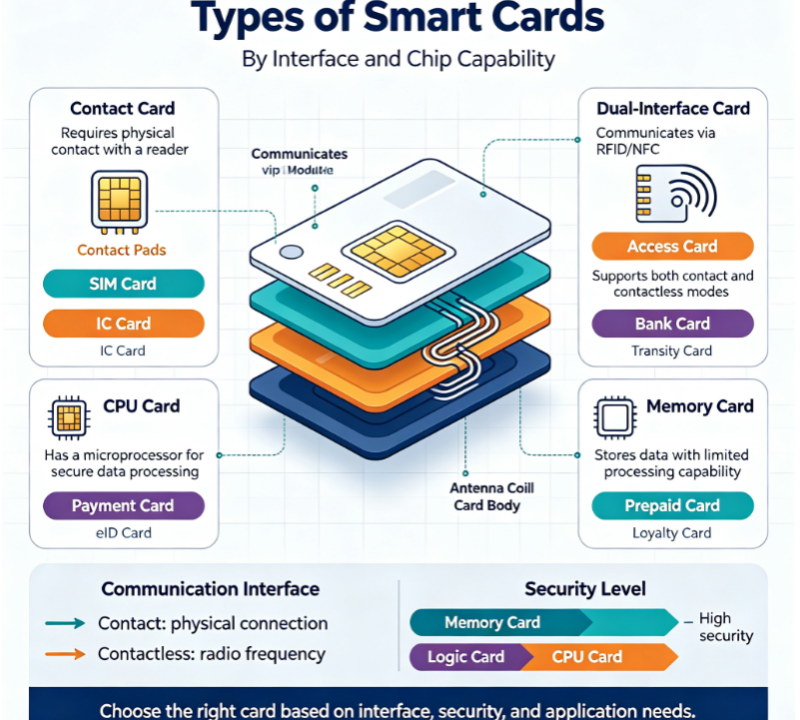
A contactless smartchip based device includes an embedded secure microcontroller or equivalent intelligence, internal memory and a small antenna, and communicates with a reader through a contactless RF interface. The contactless interface provides users with the convenience of allowing the contactless device to be read at short distances with fast transfer of data. A MIFARE card has a much larger memory than an RFID card and is widely used in hotels as payment cards and for identification purposes.
MIFARE family available for smartcard solutions are MIFARE Classic, MIFARE Plus, MIFARE DESire and MIFARE Ultralight . These offer more than 40 different applications, some of which are limited use tickets in public transport (single and multiple trip tickets, tourist weekend passes), event ticketing (stadiums, exhibitions, amusement parks), loyalty and closed-loop payment schemes, access management, employee cards,school cards, citizen cards and for car parking.
In brief, MIFARE technology , a trademark of NXP Semiconductors, is used for contactless smartcards and is RF enabled. Whereas, RFID is also RF-enabled but is used for identification purposes.
| Chip Options | |
| ISO14443A | MIFARE Classic® 1K, MIFARE Classic ® 4K |
| MIFARE® Mini | |
| MIFARE Ultralight ®, MIFARE Ultralight ® EV1, MIFARE Ultralight® C | |
| Ntag213 / Ntag215 / Ntag216 | |
| MIFARE ® DESFire ® EV1 (2K/4K/8K) | |
| MIFARE ® DESFire® EV2 (2K/4K/8K) | |
| MIFARE Plus® (2K/4K) | |
| Topaz 512 | |
| ISO15693 | ICODE SLI-X, ICODE SLI-S |
| 125KHZ | TK4100, EM4200,EM4305, T5577 |
| 860~960Mhz | Alien H3, Impinj M4/M5 |
Remark:
MIFARE and MIFARE Classic are trademarks of NXP B.V.
MIFARE DESFire are registered trademarks of NXP B.V. and are used under license.
MIFARE and MIFARE Plus are registered trademarks of NXP B.V. and are used under license.
MIFARE and MIFARE Ultralight are registered trademarks of NXP B.V. and are used under license.
Normal package :
200pcs rfid cards into white box .
5 boxes /10boxes /15boxes into one carton.

Standard RFID Card Specifications
The following specifications describe the standard card format. RFID chip specifications vary according to the selected chip.
| Item | Specification |
|---|---|
| Product Type | Blank RFID Contactless Card |
| Main Frequency | 13.56MHz |
| Standard Size | 85.5 × 54 mm |
| Card Thickness | Approximately 0.86 mm |
| Card Material | PVC |
| Card Color | White |
| Card Format | CR80 / Standard Bank Card Size |
| Communication | Contactless RFID |
| Typical Interface | ISO/IEC 14443A, depending on chip |
| Surface | Blank white surface |
| Printing | Custom printing available |
| Application | Access control, hotel, membership, identification, events |
| Packaging | Commonly supplied in bulk quantities |
Because different RFID chips provide different technical characteristics, the exact memory size, security level, communication protocol, and read/write behavior should be confirmed before ordering.
MIFARE Classic 1K vs. MIFARE Classic 4K
MIFARE Classic cards are widely used in legacy access control and identification systems. The main difference between Classic 1K and Classic 4K is memory capacity and sector organization.
| Feature | MIFARE Classic 1K | MIFARE Classic 4K |
|---|---|---|
| Memory | 1KB | 4KB |
| Frequency | 13.56MHz | 13.56MHz |
| Interface | ISO/IEC 14443A | ISO/IEC 14443A |
| Typical Use | Basic credentials | Larger data requirements |
| Access Control | Common | Common |
| Data Capacity | Lower | Higher |
| Best For | Simple card applications | Applications requiring more storage |
For a simple door access credential where the existing system already supports MIFARE Classic 1K, the 1K version may be sufficient. If the application requires more card memory and the system supports it, a 4K version can provide additional capacity.
MIFARE Classic vs. DESFire
MIFARE Classic and MIFARE DESFire should not be treated as interchangeable products. They are designed for different levels of system requirements.
| Comparison | MIFARE Classic | MIFARE DESFire |
|---|---|---|
| Frequency | 13.56MHz | 13.56MHz |
| Typical Interface | ISO/IEC 14443A | ISO/IEC 14443A |
| Typical Applications | Legacy access control | Secure access and multi-application systems |
| Security | Suitable for compatible legacy systems | Advanced security architecture |
| Data Structure | Sector-based | Application-based |
| System Compatibility | Very broad in legacy installations | Requires compatible infrastructure |
| Recommended For | Existing Classic systems | Newer security-focused systems |
If your current access control system specifically requires MIFARE Classic, replacing it with DESFire is not automatically an upgrade from a compatibility perspective. The reader, controller, software, card encoding process, and security configuration all need to support the selected technology.
Why Use a Blank White RFID Card?
A blank white RFID card provides a clean starting point for customized identification credentials. The surface can be printed with a company logo, employee information, membership details, visual security elements, or other branding.
For organizations issuing cards at scale, a blank RFID card can also be supplied for subsequent personalization and encoding.
Typical customization options may include:
- Full-color card printing
- Company or hotel branding
- Employee name and ID
- Membership information
- Barcode or QR code
- Serial number
- Signature panel
- Custom artwork
- Variable data printing
- RFID chip encoding
The exact printing method and available customization depend on the card material, artwork, quantity, and production requirements.
Applications of 13.56MHz RFID Access Cards
Access Control
RFID cards can be used as contactless credentials for doors, gates, offices, campuses, residential buildings, and other controlled areas. The card communicates wirelessly with a compatible RFID reader.
Hotel Key Cards
MIFARE-based cards are widely used in hotel access control systems. Depending on the hotel lock system, a compatible RFID card can be encoded as a guest credential or staff credential.
The exact chip requirement should always be confirmed with the hotel lock manufacturer or access control supplier before purchasing blank cards.
Employee Identification
Organizations can use RFID cards as employee credentials for building access, restricted areas, attendance systems, or internal identification.
School and Campus Systems
RFID cards can be used for student identification, facility access, library systems, meal programs, and other campus services when supported by the relevant system.
Membership and Loyalty Programs
RFID cards can combine visual identification with contactless data storage. This makes them suitable for clubs, fitness centers, membership programs, and customer loyalty applications.
Events and Visitor Management
RFID cards can be configured for temporary access, event registration, visitor identification, or controlled entry systems.
RFID Card Compatibility: What Should You Check?
Before ordering, identify the technology used by your current RFID system. The following information is especially useful:
- Card frequency – Confirm whether the system uses 13.56MHz, 125kHz, UHF, or another technology.
- Chip model – Identify the exact chip supported by the reader.
- Protocol – Check whether the system requires ISO/IEC 14443A, ISO/IEC 15693, or another protocol.
- Memory capacity – Confirm the amount of memory required.
- Security requirements – Determine whether the system uses basic authentication or a more advanced security architecture.
- Encoding method – Check how cards are programmed or issued.
- Reader compatibility – Confirm that the access control reader recognizes the selected chip.
A card that looks identical to your existing card may still be technically incompatible if it uses a different chip or security configuration.
13.56MHz vs. 125kHz RFID Cards
RFID cards are available at different operating frequencies. Two common categories in access control are 125kHz and 13.56MHz.
| Feature | 125kHz RFID | 13.56MHz RFID |
|---|---|---|
| Frequency | 125kHz | 13.56MHz |
| Typical Technology | EM / LF RFID | MIFARE / NFC / HF RFID |
| Common Applications | Basic access control | Access, NFC, identification |
| Data Capability | Generally limited | Varies by chip |
| Security Options | Depends on technology | Broad range of chip options |
| Typical Integration | Legacy systems | Modern and legacy systems |
| Contactless Operation | Yes | Yes |
These technologies are not automatically interchangeable. If your existing reader operates at 125kHz, a 13.56MHz card should not be assumed to work with it.
Card Size and Physical Format
The standard card measures approximately 85.5 × 54 mm with a thickness of about 0.86 mm. This corresponds closely to the commonly used CR80 bank card format.
The standard size makes the card convenient for:
- Wallet storage
- Card holders
- Badge holders
- Hotel key card sleeves
- Employee ID systems
- Membership cards
- Event credentials
The white PVC surface also provides a suitable base for printed graphics and variable information.
Custom RFID Card Printing
For organizations that require branded credentials, the blank white card can be customized with printed information.
A typical printed access card may include a company logo, cardholder name, employee number, department, photo, barcode, QR code, or other identification information.
For large projects, it is useful to separate the card specification into three parts:
Physical specification: size, thickness, material, color, and printing.
RFID specification: frequency, chip model, memory, protocol, and security.
Personalization specification: encoding, numbering, artwork, variable data, and packaging.
Defining these three areas before production helps reduce compatibility and personalization errors.

RFID Card Encoding
The card body and RFID chip serve different functions. Printing changes the visible appearance of the card, while encoding writes or configures information within the RFID chip when the selected chip supports the required operation.
For access control projects, encoding may involve assigning credentials through the customer’s access control software or authorized card-issuing system.
The card supplier should not assume that a blank card can be programmed for every RFID system. Some systems use proprietary credential formats, encrypted keys, secure authentication, or controller-specific configurations.
For this reason, customers should provide the reader model, lock model, chip type, or existing card specification when requesting compatibility confirmation.
Bulk RFID Card Supply
This product is suitable for bulk purchasing where organizations need a consistent supply of RFID cards for deployment or replacement.
The standard packaging can be supplied in bulk quantities, commonly with 200 cards per box. Larger quantities can be arranged according to the production requirement.
Bulk RFID card orders are suitable for:
- Hotel groups
- Access control installers
- Security system integrators
- Schools and universities
- Corporate offices
- Membership organizations
- Event companies
- Card personalization providers
For large orders, confirm the chip model, artwork, encoding requirements, packaging, and delivery schedule before production.
Frequently Asked Questions
What is a 13.56MHz RFID card?
A 13.56MHz RFID card is a contactless card that communicates with a compatible reader using radio-frequency technology. Different chip families operating at 13.56MHz can provide different memory, communication, and security features.
Can this RFID card be used for door access control?
Yes, when the selected RFID chip is compatible with the door access control reader and controller. The correct chip should be confirmed before ordering.
Is MIFARE Classic 1K the same as MIFARE DESFire?
No. MIFARE Classic and MIFARE DESFire are different technologies with different architectures and security capabilities. They should only be substituted when the access control system explicitly supports the replacement.
Can I print my company logo on the RFID card?
Yes. The white card surface is suitable for custom printing. Depending on the project, logos, photos, employee details, serial numbers, barcodes, QR codes, and other artwork can be incorporated.
Can the RFID card be encoded?
Many supported RFID chips can store or process data, but encoding requirements depend on the chip, reader, software, keys, and application. For an access control project, provide the system information so compatibility can be evaluated.
Is a 13.56MHz card compatible with a 125kHz reader?
Normally, you should not assume compatibility. Frequency is one of the fundamental characteristics of an RFID system. A 13.56MHz card and a 125kHz card generally belong to different RFID technology families.
What is the standard size of this RFID card?
The standard card size is approximately 85.5 × 54 mm, with a thickness of about 0.86 mm.
Which RFID chip should I choose?
Choose the chip based on your existing reader and access control system rather than simply choosing the chip with the largest memory. If you are replacing an existing card, identifying the original chip and system is usually the safest starting point.
How to Order the Right RFID Card
For a compatibility-focused quotation, provide as much of the following information as possible:
| Information | Why It Matters |
|---|---|
| Existing card type | Helps identify the technology |
| Reader or lock model | Determines reader compatibility |
| Chip model | Confirms the required RFID IC |
| Frequency | Separates LF, HF, and UHF technologies |
| Quantity | Determines production and packaging |
| Card artwork | Required for custom printing |
| Encoding requirement | Determines personalization needs |
| Delivery destination | Helps determine logistics |
If the chip specification is unknown, providing a clear photo of the existing card and the reader or lock model can help narrow down the possible card technology. For security-sensitive systems, the system manufacturer or administrator should confirm the required credential type.
Why Choose a Configurable RFID Card?
A configurable RFID card gives organizations more flexibility when selecting a credential for a specific system. Instead of choosing a card only by appearance, customers can define the RFID technology according to the requirements of the application.
For a simple legacy access control installation, MIFARE Classic may be appropriate when explicitly supported by the system. For applications requiring more advanced security and multiple applications, a suitable DESFire solution may be more appropriate. For NFC-oriented applications, NTAG products may provide a better fit.
The most important consideration is therefore not simply whether a card is labeled “13.56MHz,” but whether the selected chip, protocol, security architecture, and encoding method match the complete RFID system.
Summary
The 13.56MHz White Blank RFID Contactless Access Control Card is a versatile card platform for access control, hotel credentials, employee identification, membership programs, events, and other contactless applications.
Its standard CR80 format provides a familiar card size, while the white surface allows customization and professional branding. Multiple RFID chip options make it possible to configure the card for different requirements, from basic legacy access control to more advanced contactless applications.
Before placing an order, always confirm the required frequency, chip model, protocol, memory, security features, and encoding method. Selecting the correct RFID chip is the key to achieving reliable compatibility with an existing reader or access control system.
Contact us for a tailored solution.