June 18, 2026
As digital transformation accelerates across industries, businesses increasingly demand faster, smarter, and more efficient ways to manage inventory, track assets, monitor logistics, and automate data collection. Traditional barcode scanners and manual inventory systems can no longer meet the speed and accuracy requirements of modern warehouses, retail stores, manufacturing facilities, and supply chain operations.
This is where the Long Reading Distance Bluetooth Handheld UHF RFID Reader and Writer becomes a powerful solution.
Combining long-range UHF RFID technology with wireless Bluetooth communication and portable handheld operation, these intelligent RFID devices allow businesses to identify, read, write, and manage RFID tags quickly and accurately in real time. Their mobility, wireless flexibility, and high-speed scanning capability make them essential tools for smart inventory management and industrial automation.
In this comprehensive guide, we will fully analyze what a Bluetooth handheld UHF RFID reader and writer is, how it works, its technical structure, specifications, applications, advantages, competitor comparisons, and future market trends. This article is designed for RFID distributors, warehouse managers, system integrators, logistics operators, and industrial buyers seeking advanced mobile RFID solutions.
What Is a Long Reading Distance Bluetooth Handheld UHF RFID Reader and Writer?
A Long Reading Distance Bluetooth Handheld UHF RFID Reader and Writer is a portable RFID device designed for wireless RFID data collection, tag reading, and tag writing operations.
The device combines several technologies into one compact mobile terminal:
- UHF RFID reader module
- Bluetooth wireless communication
- RFID tag writing capability
- Rechargeable battery system
- Mobile handheld design
- Smartphone or tablet connectivity
Unlike fixed RFID systems, handheld RFID readers provide flexible mobile operation, allowing users to move freely while scanning RFID-tagged assets.
These devices typically operate within:
- 860–960 MHz UHF frequency range
- EPC Gen2 protocol
- ISO18000-6C RFID standard
The “long reading distance” feature allows users to scan RFID tags from several meters away, significantly improving operational efficiency.
Understanding UHF RFID Technology
UHF RFID stands for Ultra High Frequency Radio Frequency Identification.
It is one of the most widely used RFID technologies for industrial and commercial applications.
Key Characteristics of UHF RFID
- Long reading distance
- Fast multi-tag scanning
- Non-line-of-sight reading
- High inventory efficiency
- Bulk asset identification
UHF RFID systems are commonly used in:
- Warehousing
- Logistics
- Retail
- Manufacturing
- Healthcare
- Transportation
- Asset tracking
Understanding Bluetooth Connectivity
Bluetooth technology enables wireless communication between the RFID handheld reader and external devices such as:
- Smartphones
- Tablets
- Laptops
- Industrial terminals
Bluetooth connectivity eliminates the need for wired data transfer.
This allows users to:
- View RFID data in real time
- Synchronize cloud systems
- Operate mobile applications
- Improve operational flexibility
Modern handheld RFID readers usually support:
- Bluetooth 4.0
- Bluetooth 5.0
- BLE (Bluetooth Low Energy)
RFID Reader vs RFID Writer
Many people assume RFID devices only read tag information, but advanced RFID terminals can also write data to RFID tags.
RFID Reading Function
The device captures information stored inside RFID tags.
RFID Writing Function
The device can:
- Encode RFID tags
- Update asset information
- Modify EPC data
- Program custom identifiers
This is important for inventory and logistics systems.
Working Principle of Bluetooth Handheld UHF RFID Readers
The device works through radio frequency communication between the RFID reader and RFID tags.
A complete RFID system usually includes:
- RFID Tags
- Handheld RFID Reader
- Bluetooth Device
- Software Platform
Step 1: RFID Reader Emits RF Signals
The handheld reader transmits UHF radio frequency signals through its built-in antenna.
Step 2: RFID Tags Receive Energy
Passive RFID tags harvest energy from the electromagnetic field generated by the reader.
Step 3: RFID Tags Respond
The RFID tag sends its stored information back to the handheld reader.
Step 4: Reader Processes Data
The device decodes the RFID information.
Step 5: Bluetooth Transfers Information
The RFID data is transmitted wirelessly to:
- Smartphones
- Tablets
- Inventory software systems
Step 6: Data Management
The connected software updates:
- Inventory records
- Asset locations
- Tracking history
- Warehouse status
This process occurs within milliseconds.
Internal Structure of a Bluetooth UHF RFID Reader
These advanced RFID devices contain multiple integrated hardware modules.
UHF RFID Module
The RFID module handles long-range radio frequency communication.
Main components include:
- RFID chip
- RF amplifier
- UHF antenna
Bluetooth Communication Module
This module enables wireless communication with external devices.
Embedded Processor
The processor manages:
- RFID decoding
- Bluetooth communication
- Data processing
- Device control
Rechargeable Battery
Industrial RFID readers use high-capacity lithium batteries for extended working time.
Trigger Button and Control Interface
The handheld structure allows easy RFID scanning operation.
Rugged Housing
Industrial-grade casing protects the device from:
- Dust
- Water
- Drops
- Harsh environments
Key Technical Specifications
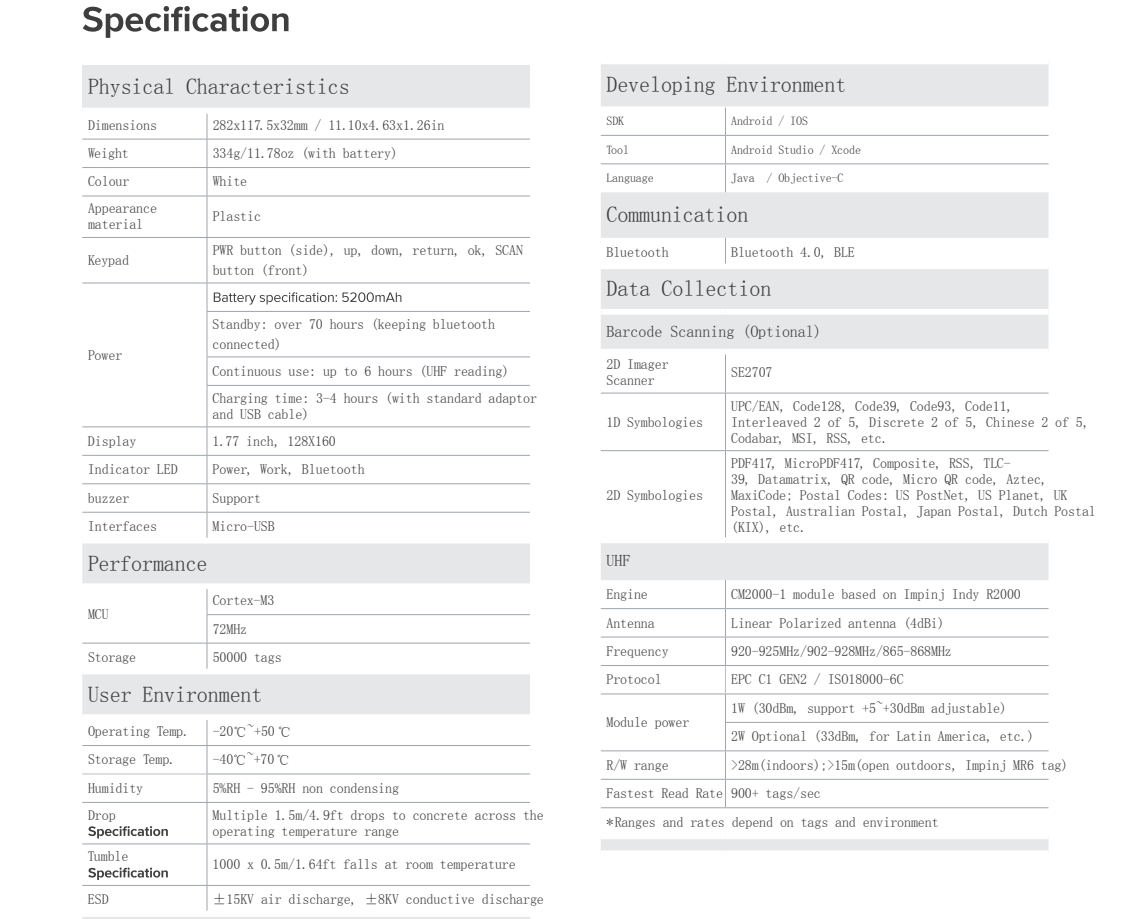
Typical specifications for Bluetooth handheld UHF RFID readers include:
| Specification | Typical Value |
|---|---|
| Frequency Range | 860–960 MHz |
| RFID Standard | EPC Gen2 / ISO18000-6C |
| Reading Distance | 1–20 meters |
| Bluetooth Version | Bluetooth 4.0 / 5.0 |
| RFID Function | Read & Write |
| Battery Capacity | 3000–8000mAh |
| Operating System Support | Android / iOS / Windows |
| Communication Interface | Bluetooth / USB |
| Protection Rating | IP65 / IP67 |
| Operating Temperature | -20°C to +60°C |
Actual performance varies depending on RFID tag quality and environment.
Advantages of Bluetooth Handheld UHF RFID Readers
1. Long Reading Distance
One major advantage is the ability to scan RFID tags from long distances.
This dramatically improves inventory speed.
2. Wireless Mobility
Bluetooth connectivity eliminates cable restrictions.
Workers can move freely throughout warehouses and facilities.
3. Fast Bulk RFID Scanning
The device can identify hundreds of RFID tags simultaneously.
This is much faster than barcode scanning.
4. Real-Time Data Synchronization
Bluetooth allows instant communication with mobile applications and cloud systems.
5. RFID Writing Capability
Users can program and update RFID tags directly from the handheld device.
6. Improved Inventory Accuracy
RFID automation reduces human counting errors.
7. Lower Labor Costs
Faster scanning reduces manual labor requirements.
8. Rugged Industrial Durability
Industrial handheld RFID readers are built for harsh environments.
Applications of Bluetooth Handheld RFID Readers
These devices are widely used across many industries.
Warehouse Inventory Management
Warehouses use RFID readers for:
- Inventory counting
- Shelf management
- Asset verification
- Stock tracking
RFID dramatically reduces inventory processing time.
Logistics and Supply Chain
Logistics companies use RFID readers for:
- Shipment verification
- Parcel tracking
- Container management
- Cargo monitoring
Retail Inventory Management
Retail stores use RFID readers for:
- Real-time inventory
- Anti-theft systems
- Product location
- Omnichannel fulfillment
Manufacturing Industry
Factories use RFID systems to track:
- Production tools
- Components
- Work-in-progress items
- Finished products
Healthcare Asset Tracking
Hospitals use handheld RFID readers for:
- Medical equipment tracking
- Drug inventory
- Patient asset management
Library Management
Libraries use RFID readers for:
- Book inventory
- Automated circulation
- Asset tracking
Vehicle and Transportation Management
RFID readers support:
- Fleet management
- Vehicle inspections
- Transportation logistics
Smart Agriculture
Agricultural operations use RFID systems for:
- Livestock management
- Equipment tracking
- Supply monitoring
Bluetooth RFID Reader vs Barcode Scanner
Traditional barcode scanners have major limitations.
| Feature | Bluetooth RFID Reader | Barcode Scanner |
| Reading Distance | Long range | Very short |
| Bulk Reading | Yes | No |
| Line-of-Sight Required | No | Yes |
| RFID Tag Writing | Supported | Not supported |
| Inventory Speed | Very fast | Slower |
| Automation Capability | Excellent | Limited |
RFID technology offers much higher operational efficiency.
Bluetooth RFID Reader vs Fixed RFID Reader
Handheld RFID Reader
Advantages:
- Portable
- Flexible
- Lower installation cost
- Mobile operation
Fixed RFID Reader
Advantages:
- Fully automated
- Continuous scanning
- High-volume gate management
Many enterprises combine both systems.
Bluetooth RFID Reader vs WiFi RFID Reader
| Feature | Bluetooth RFID Reader | WiFi RFID Reader |
| Power Consumption | Lower | Higher |
| Mobility | Excellent | Good |
| Communication Range | Short-medium | Longer |
| Smartphone Connectivity | Excellent | Moderate |
| Setup Complexity | Simple | More complex |
Bluetooth readers are ideal for mobile operations.
Passive RFID vs Active RFID Systems
Passive RFID
Advantages:
- Lower cost
- No battery tags
- Long lifespan
Active RFID
Advantages:
- Longer reading distance
- Real-time tracking
Disadvantages:
- Higher cost
- Battery maintenance
Passive UHF RFID remains the most popular solution for inventory management.
Common Challenges in RFID Deployment
Although RFID offers major advantages, proper deployment planning is essential.
Metal and Liquid Interference
Certain materials can reduce UHF RFID performance.
Reader Configuration
Incorrect settings may reduce reading accuracy.
Tag Compatibility
Not all RFID tags perform equally.
Bluetooth Stability
Poor Bluetooth configuration may affect connectivity.
Battery Management
Large-scale operations require charging management.
How to Choose the Right Bluetooth UHF RFID Reader
Before purchasing, buyers should evaluate:
Reading Distance Requirements
Longer ranges require stronger RF modules.
RFID Standards Compatibility
Ensure support for EPC Gen2 and ISO18000-6C.
Bluetooth Version
Newer Bluetooth versions improve stability and efficiency.
Battery Capacity
Long shifts require larger batteries.
Rugged Protection Rating
Industrial environments require IP65 or IP67 protection.
Smartphone Compatibility
Verify compatibility with Android or iOS systems.
RFID Writing Capability
Some applications require advanced encoding functions.
Competitive Analysis of RFID Handheld Devices
| Device Type | Advantages | Disadvantages |
| Bluetooth UHF RFID Reader | Portable and wireless | Moderate range limitations |
| Fixed RFID Reader | Full automation | Less mobility |
| Barcode Scanner | Lower cost | Slower inventory |
| NFC Reader | Good short-range communication | Limited UHF capability |
| Smartphone RFID Reader | Compact | Lower industrial durability |
Bluetooth handheld RFID readers offer one of the best balances between mobility, functionality, and cost.
Market Trends in Bluetooth RFID Technology
The RFID market continues growing rapidly due to:
- Smart warehousing
- E-commerce growth
- Industry 4.0
- Supply chain automation
- Cloud-based inventory systems
Businesses increasingly prioritize:
- Real-time visibility
- Mobile operations
- Labor efficiency
- Intelligent asset tracking
Bluetooth RFID readers are becoming standard tools in modern logistics operations.
Future Development of Bluetooth RFID Readers
Future innovations may include:
- AI-assisted inventory analytics
- 5G integration
- Enhanced RFID sensitivity
- Lighter ergonomic designs
- Cloud-native RFID platforms
- Longer battery technology
RFID handheld systems will continue evolving alongside IoT and smart industry technologies.
Final Thoughts
The Long Reading Distance Bluetooth Handheld UHF RFID Reader and Writer has become one of the most important tools in modern inventory management and intelligent asset tracking systems. By combining portable RFID scanning, Bluetooth wireless communication, and RFID writing functionality into one compact device, these handheld terminals provide fast, accurate, and highly efficient data collection solutions.
Compared with traditional barcode scanners and many fixed RFID systems, Bluetooth handheld RFID readers offer superior mobility, long-range identification, real-time connectivity, and flexible deployment capabilities.
From warehouses and logistics centers to retail stores, healthcare systems, manufacturing plants, and transportation operations, these RFID devices are helping businesses automate operations, improve inventory accuracy, reduce labor costs, and strengthen digital transformation initiatives.
As smart logistics and intelligent inventory management continue expanding globally, Bluetooth handheld UHF RFID readers and writers will remain critical technologies for the future of automated mobile data collection systems.