August 13, 2026
In the era of digital transformation, organizations are seeking faster, more accurate, and automated methods to manage books, files, assets, jewelry, pharmaceuticals, and retail inventory. Traditional barcode systems often require manual scanning, direct line-of-sight operation, and significant labor resources, creating bottlenecks in modern management processes. The 860-960MHz UHF RFID Desktop Library Reader is designed to eliminate these limitations by providing rapid, contactless, and highly accurate RFID identification capabilities.
Built with independent intellectual property design, advanced anti-collision algorithms, adjustable RF power, and industrial-grade stability, this RFID desktop reader is widely used in libraries, archives, jewelry stores, pharmacies, retail checkout counters, and asset management systems. Featuring support for ISO18000-6C (EPC Class 1 Gen2) RFID tags, integrated antenna design, and multiple communication interfaces including RS232, TCP/IP, and Type-C, it provides a powerful and cost-effective RFID solution for organizations looking to improve operational efficiency.
This article provides a comprehensive analysis of the 860-960MHz UHF RFID Desktop Library Reader, including its specifications, working principles, application scenarios, pain points solved, competitive advantages, and comparison with traditional identification technologies.
What Is an 860-960MHz UHF RFID Desktop Library Reader?
An 860-960MHz UHF RFID Desktop Library Reader is a compact RFID device designed for desktop deployment in environments requiring short-range, high-accuracy RFID reading and writing. Unlike long-range fixed RFID readers used in warehouses and logistics centers, desktop readers are optimized for close-proximity operations such as book circulation, document management, jewelry inventory, and retail settlement.
The device supports:
- EPC Class 1 Gen2
- ISO18000-6C
- UHF RFID tags operating at 902-928MHz or 865-868MHz
Its built-in antenna design eliminates the need for external antennas, simplifying installation and reducing deployment costs.
The reader is specifically designed for:
- Library automation
- File and archive management
- Pharmaceutical tracking
- Jewelry inventory control
- Retail checkout systems
- Asset identification
- Electronic tray settlement systems
Technical Specifications
Physical Parameters
| Parameter | Specification |
|---|---|
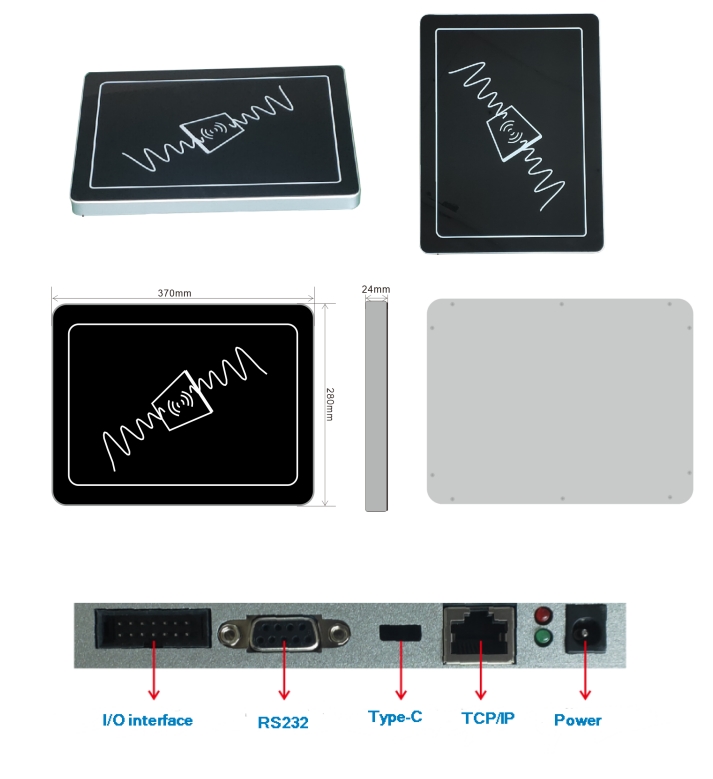
| Dimensions | 370 × 280 × 24 mm |
| Weight | 3 kg |
| Material | ABS + Metal |
| Antenna | Built-in Integrated Antenna |
RFID Performance Parameters
| Parameter | Specification |
|---|---|
| Frequency Range | 902-928MHz or 865-868MHz |
| Supported Protocol | EPC C1 Gen2 / ISO18000-6C |
| RF Output Power | 0-30 dBm Adjustable |
| Reading Distance | 0-100 cm |
| Writing Distance | 0-10 cm |
Communication Interfaces
| Parameter | Specification |
|---|---|
| RS232 | Supported |
| TCP/IP | Supported |
| Type-C | Supported |
| I/O Interface | One Trigger Input or Two Relay Outputs (Customized) |
Power Parameters
| Parameter | Specification |
|---|---|
| Power Supply | 12V DC / 3A |
Environmental Parameters
| Parameter | Specification |
|---|---|
| Operating Temperature | -20°C to 55°C |
| Storage Temperature | -20°C to 55°C |
Key Features of the UHF RFID Desktop Library Reader
Independent Intellectual Property Design
The reader incorporates proprietary hardware and software architecture, ensuring:
- Reliable operation
- Enhanced performance
- Better long-term support
- Greater product stability
This provides organizations with confidence in mission-critical RFID deployments.
Industrial-Grade Stability
The system has been designed to support continuous operation under demanding conditions.
Key advantages include:
- Stable 24/7 operation
- High-temperature endurance
- Reliable long-term performance
- Reduced downtime
Its ability to maintain uninterrupted operation for extended periods makes it ideal for libraries, archives, and retail environments that require constant availability.
Adjustable RF Power
The reader supports RF output adjustment from 0 to 30 dBm.
Benefits include:
- Flexible deployment
- Reduced interference
- Improved reading accuracy
- Optimized performance for different environments
Users can adjust the power according to specific application requirements.
Advanced Anti-Collision Technology
One of the biggest challenges in RFID systems is handling multiple tags simultaneously.
The reader’s advanced anti-collision algorithm enables:
- Fast multi-tag reading
- Improved inventory speed
- Enhanced identification accuracy
- Better operational efficiency
This feature is particularly valuable in library and archive management applications.
Multiple Communication Interfaces
The reader supports:
- RS232
- TCP/IP
- Type-C
This flexibility allows easy integration with:
- Library management software
- ERP systems
- Asset management platforms
- Retail POS systems
- Pharmaceutical databases
Open Development Platform
The reader provides:
- Standard API interfaces
- Demo software
- Source code examples
Supported development environments include:
- C#
- Java
- VC++
- VB
Developers can quickly integrate the reader into existing business applications.
How the RFID Desktop Reader Works
The RFID desktop reader uses radio frequency signals to communicate with RFID tags.
The process involves:
- RFID tags are placed within the reading zone.
- The reader emits UHF RF energy.
- RFID tags harvest energy from the RF field.
- Tags respond with stored EPC data.
- The reader decodes the information.
- Data is transmitted to software through TCP/IP, RS232, or Type-C.
Unlike barcode systems, RFID technology allows multiple items to be identified simultaneously without direct visual alignment.
Pain Points Solved by RFID Desktop Readers
Pain Point 1: Slow Book Checkout and Return Processes
Traditional library systems rely heavily on barcode scanning.
Problems include:
- One-by-one scanning
- Manual handling
- Long queues
- Staff workload
RFID enables simultaneous reading of multiple books, dramatically improving circulation efficiency.
Pain Point 2: Inaccurate Inventory Audits
Manual inventory checks are often:
- Labor-intensive
- Time-consuming
- Error-prone
RFID provides rapid and highly accurate inventory verification.
Pain Point 3: File Misplacement
Archives and records departments frequently struggle with:
- Lost files
- Misfiled documents
- Tracking difficulties
RFID improves visibility and document accountability.
Pain Point 4: Jewelry Inventory Challenges
Jewelry retailers require:
- Accurate stock records
- Fast inventory checks
- High-value asset protection
RFID automates inventory management and reduces shrinkage risks.
Pain Point 5: Pharmaceutical Traceability
Healthcare organizations must accurately track medications.
RFID improves:
- Inventory visibility
- Product traceability
- Regulatory compliance
Major Applications
Library Management
The most common application is library automation.
Functions include:
- Book circulation
- Self-service borrowing
- Return processing
- Inventory management
RFID significantly improves user experience and operational efficiency.
Archive and File Management
Government agencies, corporations, and institutions use RFID for:
- File tracking
- Document inventory
- Archive management
- Records accountability
Jewelry Inventory Management
RFID enables:
- Fast stock counting
- Asset protection
- Inventory accuracy
- Loss prevention
Drug Management
Hospitals and pharmacies use RFID for:
- Medication tracking
- Inventory management
- Expiration monitoring
- Compliance reporting
Retail Counter Settlement
RFID supports rapid checkout processes by simultaneously identifying multiple products.
Benefits include:
- Faster transactions
- Reduced queues
- Improved customer experience
Electronic Tray Settlement Systems
Restaurants and cafeterias can use RFID-enabled trays to automate payment and consumption tracking.
Comparison with Traditional Technologies
RFID vs Barcode Systems
| Feature | Barcode | RFID |
|---|---|---|
| Line-of-Sight Required | Yes | No |
| Multi-Item Reading | No | Yes |
| Reading Speed | Slow | Fast |
| Automation Level | Moderate | High |
| Labor Requirement | Higher | Lower |
RFID provides a substantial efficiency advantage.
RFID Desktop Reader vs Handheld RFID Reader
| Feature | Desktop Reader | Handheld Reader |
|---|---|---|
| Fixed Operation | Yes | No |
| User Convenience | Excellent | Good |
| Continuous Availability | Yes | No |
| Large Batch Processing | Excellent | Moderate |
Desktop readers are ideal for fixed workstations.
RFID Desktop Reader vs HF RFID Reader
| Feature | UHF RFID | HF RFID |
|---|---|---|
| Reading Distance | Longer | Shorter |
| Multi-Tag Performance | Excellent | Moderate |
| Inventory Speed | Faster | Slower |
UHF RFID offers superior throughput for inventory-intensive applications.
Competitive Analysis
Desktop Reader vs Zebra RFID Readers
| Feature | Desktop Library Reader | Zebra RFID Reader |
|---|---|---|
| Cost Efficiency | Higher | Moderate |
| Library Applications | Excellent | Good |
| Software Integration | Excellent | Excellent |
| ROI | High | High |
Desktop Reader vs Impinj-Based Workstations
| Feature | Desktop Library Reader | Impinj Workstation |
|---|---|---|
| Integrated Antenna | Yes | Often External |
| Installation Complexity | Lower | Moderate |
| Cost | Lower | Higher |
Desktop Reader vs Conventional Library Systems
| Feature | RFID System | Barcode System |
|---|---|---|
| Processing Speed | Fast | Slow |
| Inventory Accuracy | Excellent | Moderate |
| Automation | High | Low |
| User Experience | Superior | Traditional |
Future Trends
As digital transformation continues, RFID desktop readers will increasingly integrate with:
- Smart libraries
- Digital archives
- Cloud inventory platforms
- AI-powered asset tracking
- Self-service checkout systems
- Intelligent retail environments
Organizations adopting RFID today are positioning themselves for future automation and operational excellence.
Conclusion
The 860-960MHz UHF RFID Desktop Library Reader is a versatile, high-performance RFID solution designed for libraries, archives, jewelry retailers, healthcare facilities, and retail environments. With support for EPC Class 1 Gen2 and ISO18000-6C tags, adjustable RF power, advanced anti-collision algorithms, industrial-grade stability, and multiple communication interfaces, it delivers outstanding performance for inventory management, asset tracking, and automated identification applications.
Compared with traditional barcode systems and older RFID technologies, this desktop reader offers faster processing, higher accuracy, improved automation, and lower labor costs. For organizations seeking a reliable and scalable RFID platform for modern asset management and inventory control, the 860-960MHz UHF RFID Desktop Library Reader represents a future-ready investment with excellent operational and financial returns.

Do RFID is a leading China-based manufacturer with over 15 years of experience. We specialize in customized RFID readers, tags, and cards, delivering high-quality, tailored solutions that meet your unique business needs and drive seamless, efficient identification.