October 21, 2026
13.56MHZ Transportation RFID Smart Eticket For Subway NFC Card
The MIFARE Ultralight® C contactless IC is a cost-effective solution using the open 3DES cryptographic standard for chip authentication and data access.
The widely adopted 3DES standard enables easy integration into existing infrastructures, and the integrated authentication command set provides effective cloning protection that helps to prevent counterfeiting of tags.
Tickets, vouchers, or tags based on MIFARE Ultralight C can act as single-trip mass transit tickets, event tickets, or as low-cost loyalty cards and are also used for device authentication.
Key features
- Fully ISO/IEC 14443 A 1-3 compliant
- NFC Forum Type 2 Tag compliant
- 106 Kbit/s communication speed
- Anti-collision support
- 1536 bits (192 bytes) EEPROM memory
- Protected data access via 3DES authentication
- Cloning protection
- Command set compatible to MIFARE Ultralight
- Memory structure as in MIFARE Ultralight (pages)
- 16 bit counter
- Unique 7 bytes serial number
- Number of single write operations: 10,000
| Item | Cashless Payment MIFARE Ultralight® C NFC Card |
| Chip | MIFARE Ultralight® C |
| Chip Memory | 192 bytes |
| Size | 85*54*0.84mm or customized |
| Printing | CMYK Digital/Offset printing |
| Silk-screen printing | |
| Available craft | Glossy/matt/frosted surface finish |
| Numbering: Laser engrave | |
| Barcode/QR Code printing | |
| Hot stamp: gold or silver | |
| URL,text,number,etc encoding/lock to read only | |
| Application | Event management, Festivel, concert ticket, Access control etc |

| Chip Options | |
| ISO14443A | MIFARE Classic® 1K, MIFARE Classic ® 4K |
| MIFARE® Mini | |
| MIFARE Ultralight ®, MIFARE Ultralight ® EV1, MIFARE Ultralight® C | |
| Ntag213 / Ntag215 / Ntag216 | |
| MIFARE ® DESFire ® EV1 (2K/4K/8K) | |
| MIFARE ® DESFire® EV2 (2K/4K/8K) | |
| MIFARE Plus® (2K/4K) | |
| Topaz 512 | |
| ISO15693 | ICODE SLI-X, ICODE SLI-S |
| 125KHZ | TK4100, EM4200,EM4305, T5577 |
| 860~960Mhz | Alien H3, Impinj M4/M5 |
Remark:
MIFARE and MIFARE Classic are trademarks of NXP B.V.
MIFARE DESFire are registered trademarks of NXP B.V. and are used under license.
MIFARE and MIFARE Plus are registered trademarks of NXP B.V. and are used under license.
MIFARE and MIFARE Ultralight are registered trademarks of NXP B.V. and are used under license.

Packing & Delivery
Normal package :
200pcs rfid cards into white box .
5 boxes /10boxes /15boxes into one carton.
Customized Package based on your request.
For example below package picture:


Urban transit systems around the world are rapidly moving away from paper tickets and magnetic stripes toward contactless smart cards and NFC‑enabled e‑tickets. At the heart of this transformation is the 13.56MHz RFID technology – the global standard for near field communication (NFC) used in subways, buses, and trams. A custom 13.56MHz transportation RFID smart eTicket is a contactless card or tag that combines secure data storage, fast transaction times, and the ability to be personalized with unique artwork, branding, or serial numbers. This comprehensive guide explores everything you need to know about designing, producing, and deploying custom NFC subway e‑tickets – from chip selection and frequency advantages to a step‑by‑step customization workflow and real‑world applications.
1. What Is a Custom 13.56MHz Transportation RFID Smart eTicket?
A 13.56MHz transportation RFID smart eTicket is a contactless card, fob, or sticker that operates at the high‑frequency (HF) band of 13.56 MHz, compliant with ISO/IEC 14443 (Type A or Type B) and/or ISO/IEC 18092 (NFC). Unlike low‑frequency (125 kHz) proximity cards, 13.56 MHz offers higher data transfer rates (up to 848 kbps), better security, and native compatibility with NFC smartphones. These e‑tickets are used for:
- Subway and bus fare collection (tap‑in, tap‑out).
- Integrated ticketing for multiple transport modes (train, ferry, bike sharing).
- Event access (concerts, sports) that uses transit‑style validation.
- University campus IDs that combine transit benefits with building access.
“Custom” means the card is personalized for a specific transit authority, event organizer, or corporate client – including printed graphics, logos, variable data (serial numbers, passenger names), and optionally encoded fare products or access rights.
2. Why 13.56MHz? The Technical Advantages for Transit
| Feature | 13.56MHz (HF / NFC) | 125kHz (LF) | UHF (860‑960MHz) |
|---|---|---|---|
| Data transfer rate | Up to 848 kbps | ≤ 40 kbps | Up to 640 kbps |
| Read range | 0–10 cm (controlled) | 0–10 cm | 1–10 m (uncontrolled) |
| Security | AES, 3DES, mutual authentication | Basic (static ID) | Strong, but long range causes unintended reads |
| NFC phone compatibility | Yes (Android, iOS) | No | Some, but limited |
| Typical use | Transit, payment, ID | Access control (legacy) | Logistics, inventory |
For subway gates, controlled short range (0–5 cm) is a feature, not a bug – it ensures that only the intended card is read, avoiding “read through” from nearby pockets or bags. The high data rate allows fast transactions (under 300 ms), keeping queues moving. And because 13.56 MHz is the NFC standard, passengers can also use their smartphones as virtual e‑tickets, creating a seamless omnichannel experience.
3. Chip Options for Custom NFC Subway Tickets
Several secure ICs (chips) are commonly used in transit e‑tickets. The choice depends on security level, memory capacity, and compatibility with existing reader infrastructure.
| Chip | Protocol | Memory | Security Features | Typical Use |
|---|---|---|---|---|
| Mifare Classic (1K/4K) | ISO 14443‑A | 1KB/4KB | Crypto‑1 (weaker) | Legacy systems, many cities still use it |
| Mifare DESFire (EV2/EV3) | ISO 14443‑A | 2KB‑8KB | AES‑128, 3DES, mutual authentication | Modern transit (London Oyster, NYC OMNY) |
| Mifare Plus | ISO 14443‑A | 2KB‑4KB | AES‑128, upgrade path from Classic | Upgrading legacy systems |
| NTAG 424 DNA | ISO 14443‑A + NFC | 1.4‑4.4KB | AES‑128, SUN, tamper detection | Single‑use paper tickets, brand protection |
| FeliCa | ISO 18092 (NFC) | Varies | Mutual authentication, high speed | Japan (Suica), Hong Kong (Octopus) |
For a future‑proof custom subway e‑ticket, Mifare DESFire EV3 is the industry standard – it supports AES‑128 encryption, fast transactions, and multiple applications on one card (e.g., transit + library + event access). For disposable paper tickets (single journey), NTAG 424 DNA offers SUN cryptographic authentication to prevent cloning.
4. Customization Options: From Plastic Cards to Paper Tickets
Customization covers both physical appearance and digital encoding.
4.1 Physical Card / Ticket Options
- Material : PVC (standard credit card thickness, 0.76mm) for long‑lived cards; PET or paper for single‑use tickets.
- Finish : Glossy, matte, or frosted.
- Printing : Full‑color offset or digital printing on both sides. Options include CMYK + Pantone, silver/gold foil, embossing, or raised tactile features for visually impaired users.
- Shape : Standard CR80 (85.6mm × 54mm) or custom shapes (e.g., round, key fob). For paper tickets, often tear‑off perforations.
- Lamination: Clear protective layer to prevent wear and fading.
4.2 Variable Data (Personalization)
Each card can be printed with unique information:
- Serial number (matching the chip’s UID or a custom ID).
- Passenger name (for monthly passes).
- Validity dates (e.g., “Valid from Jan 2025 – Dec 2025”).
- QR code or barcode as backup for legacy readers.
- Holographic sticker or UV‑visible ink for anti‑counterfeiting.
4.3 Encoding (Digital Personalization)
The chip memory is programmed with:
- A unique identifier (UID or custom ID) for the back‑office system.
- Fare product (e.g., “10 trips” or “monthly pass”) and expiration date.
- Cryptographic keys for mutual authentication with subway gates.
- Optional balance storage for e‑purse applications (stored value).
- Access control zones (e.g., allowed stations or bus routes).
Encoding is done using a secure RFID encoder, typically performed by the manufacturer or a service bureau. For high‑volume orders (10,000+ cards), automated inline printing + encoding machines are used.
5. The Custom Production Workflow: Step by Step
Creating a batch of custom 13.56 MHz subway NFC e‑tickets follows a defined process from design to delivery.
Step 1 – Requirements Analysis
- Number of cards (e.g., 5,000, 100,000, 1 million).
- Type of tickets : Long‑life PVC cards, paper single‑use, wristbands, or key fobs.
- Chip and memory : Based on existing reader infrastructure (e.g., your subway gates are Mifare Classic or DESFire). If you are a new system, choose DESFire EV3.
- Security level : AES‑128 mutual authentication required? Stored value or just time‑based?
- Custom artwork : Provide logo, color schemes, back‑side terms and conditions.
Step 2 – Artwork Design and Proofing
Work with a graphic designer or the manufacturer’s design team to create print‑ready files (usually Adobe Illustrator, CMYK, 300 dpi, with bleed). The manufacturer provides a digital proof (PDF) and often a physical sample (one or two cards) for approval. Confirm color accuracy, text clarity, and alignment of any variable data fields.
Step 3 – Material and Chip Selection
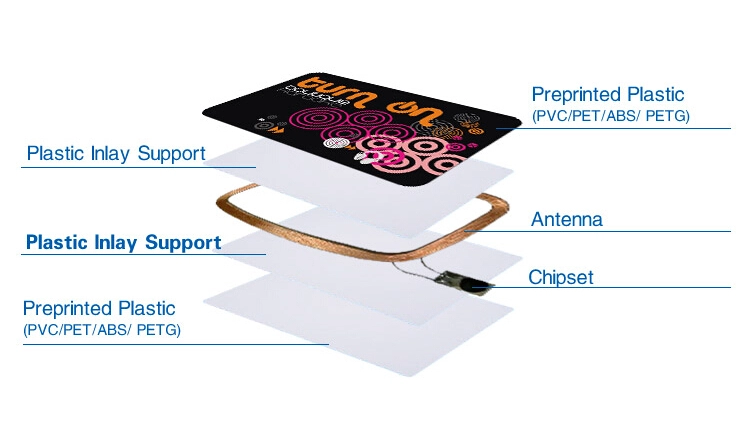
Order the exact chip model (e.g., Mifare DESFire EV3 8KB) in inlay form. For PVC cards, the inlay is sandwiched between printed PVC layers. For paper tickets, the inlay is laminated between paper sheets.
Step 4 – Printing (Sheet‑based or Roll‑based)
- Sheet printing : For smaller runs (<50,000 cards), sheets of 4×6 or 5×8 cards are printed offset, then die‑cut. Variable data (serial numbers) can be inkjet printed after.
- Roll printing : For high volume (continuous roll of cards), digital presses print while an encoder writes data to each chip in‑line.
Step 5 – Encoding and Personalization
Each card is presented to an RFID programmer. The encoder writes:
- UID (if not factory‑locked).
- Application data (e.g., fare products, keys).
- Any other files (e.g., access control lists).
Keys are loaded from a secure key management system (often a hardware security module). After encoding, a verification read confirms successful programming.
Step 6 – Quality Control
- Visual inspection : Print defects, scratches, variable data correctness.
- RF performance : Read range test on a representative reader (same as subway gate). Minimum read range 2–4 cm.
- Interoperability : Sample cards are tested on actual fare gates or emulators.
- Card durability : For PVC cards, test bend cycles and surface abrasion.
Step 7 – Packaging and Delivery
Cards are counted, stacked, wrapped, and packed in boxes. For paper tickets, they may be fan‑folded or roll‑wound. Secure shipping with chain‑of‑custody documentation if the tickets have stored monetary value.
Step 8 – Integration with Back‑office
The card issuer provides a file containing all card UIDs and encoded data to the transit authority’s ticketing backend. This allows the system to recognize the cards when they tap on gates.
6. Key Considerations for a Successful Deployment
6.1 Reader Compatibility
Before ordering custom cards, test a sample on your actual subway validators. Different reader firmware versions may behave differently with certain chips. Many transit agencies maintain a “whitelist” of approved chip/OS combinations.
6.2 Key Management
If using encrypted chips (Mifare DESFire, NTAG 424 DNA), you must securely generate, store, and load keys. Do not use default keys (all zeros) – they are widely known. Use a professional key management service or an HSM.
6.3 Privacy and Data Protection
For stored value or personal passenger data, ensure compliance with local data protection laws (GDPR, CCPA). Cards should not store unnecessary personally identifiable information; use a token or reference number linked to a secure backend.
6.4 Environmental Durability
Subway cards are exposed to sweat, rain, heat, and bending. PVC cards should have a protective laminate and be tested for 10,000 bend cycles. Paper tickets should be single‑use or limited‑use (e.g., 10 flexes).
6.5 Anti‑Counterfeiting Measures
Add overt and covert security features:
- Overt : Holograms, color‑shifting ink, microtext, guilloche patterns.
- Covert : UV‑fluorescent ink (visible under black light), laser‑engraved hidden text, or a second RFID layer with a kill command after first use.
7. Applications Beyond Subway Fare Collection
While the primary use is transit, custom 13.56MHz e‑tickets can serve multiple purposes:
- Integrated multimodal ticketing – One card for subway, bus, train, bike‑share, and ferry. The chip stores separate applications for each operator.
- Event access – Music festivals, sports stadiums, and conferences use the same ISO 14443 cards for entry and cashless payments at concession stands.
- Corporate campus ID – Employees use the card for building access, cafeteria payments, and shuttle bus boarding.
- Tourist passes – A single card provides unlimited transit, museum entry, and restaurant discounts. Custom printing includes the city’s tourism logo.
- University student ID – Combined with library access, printing services, and dining plan.
8. Cost Breakdown and Lead Times
| Component | Cost Range (USD) | Notes |
|---|---|---|
| Chip inlay (Mifare DESFire EV3, 4KB) | $0.45 – $0.80 (per card, high volume) | Lower for paper tickets |
| PVC card body + printing (full color both sides) | $0.30 – $0.60 | Includes lamination |
| Variable data printing (serial numbers) | $0.03 – $0.08 | Inkjet or thermal transfer |
| Encoding (programming chip) | $0.10 – $0.30 | Automated inline |
| Packaging and shipping | $0.05 – $0.15 | Per card, depending on order size |
| Total per card (10,000 units) | $0.90 – $1.80 | Lower for paper (≈$0.40 – $0.70) |
Lead times: 3–6 weeks for design and physical samples; 4–8 weeks for production and encoding (depending on order volume). Rush services (2–3 weeks) available at premium.
9. Future Trends in Subway NFC Ticketing
- Virtual cards on smartphones – Transit agencies issue digital e‑tickets to Apple Wallet and Google Pay. Custom printing then focuses on collectible physical cards for tourists or backup.
- Open loop payment – Riders tap credit/debit cards directly. Custom cards become mainly for reduced fares (seniors, students) or monthly passes.
- Biometric and multimodal – Combining NFC card with facial recognition at gates for high‑security zones.
- Recyclable and paper‑based – Eco‑friendly single‑use tickets made from certified paper with compostable inlays.
10. How to Choose a Reliable Custom NFC Card Manufacturer
Look for a supplier with:
- Certifications : ISO 9001 (quality), ISO 14001 (environmental), ISO 27001 (security) for key management.
- Experience : Proven track record with transit agencies (ask for case studies).
- In‑house encoding : They should have automated inline printing + encoding machines to guarantee data consistency.
- Key management : Ability to load your keys securely using an HSM or escrow service.
- Sample policy : Offer free or low‑cost samples before full production.
Reputable manufacturers include: HID Global, Giesecke+Devrient, CardLogix, Tagsys (inlays), and numerous Chinese OEMs (e.g., Watchdata, Jinco). Always request a sample run of 100 cards to test on your gates.
11. Conclusion
Custom 13.56MHz transportation RFID smart e‑tickets for subway NFC systems combine secure contactless technology with personalized branding, delivering fast, reliable fare collection while enhancing passenger experience. The 13.56MHz band offers the ideal balance of controlled read range, high data rate, and NFC smartphone compatibility. By choosing the right chip (Mifare DESFire EV3 is the industry standard), designing tamper‑resistant artwork, and following a rigorous encoding process, transit authorities, event organizers, and corporations can deploy e‑tickets that are both user‑friendly and counterfeit‑resistant.
The customization workflow – from artwork proofing and material selection to variable data printing and secure key loading – ensures that each ticket is unique and ready for integration with your back‑office system. While initial costs per card range from $0.90 to $1.80, the reduction in fare evasion, elimination of paper waste, and improved passenger throughput deliver a rapid return on investment.
Whether you are upgrading a legacy magnetic stripe system, launching a new metro line, or creating a co‑branded tourist pass, custom 13.56MHz NFC e‑tickets are a future‑proof solution. Work with an experienced manufacturer, prioritize security, and always test samples on your actual validators. Your passengers will appreciate the tap‑and‑go convenience – and your transit network will gain a reliable, modern ticketing backbone.