

August 26, 2026
Non-contact Automatic Thermometer AX-K1
1. Product structure drawing
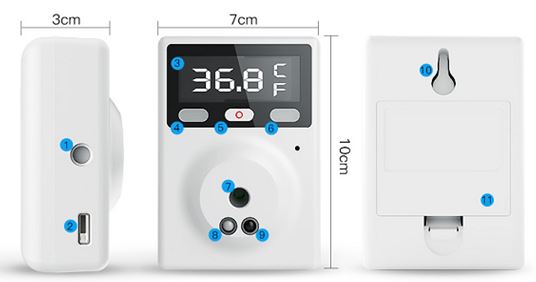

2.Specification
1.Accuracy: ±0.2 ℃(34~45 ℃ , place it in the operating environment for 30minutes before use)
2. Abnormal automatic alarm: flashing +”Di ” sound
3.Automatic measurement: measuring distance 5cm~8cm
4. Screen: Digital display
5.Charging method: USB Type C charging or battery(4*AAA, external power supply and internal power supply can be switched).
6. Install method: nail hook, bracket fixing
7.Environment temperature:10C~40 C(Recommended 15 ℃~35℃)
8. Infrared measuring range:0~50 ℃
9. Response time: 0.5s
10. Input: DC 5V
11.Weight:100g
12.Dimensions:100*65*25mm
13. Standby: about one week
3.Easy to use
1 installation steps
Important:(34—45℃,place it in the operating environment for 30 minutes before use)
Step 1: put 4 dry batteries into the battery tank (note the positive and negative directions) or connect the USB power cable;
Step 2: turn on the switch and hang it at the entrance;
Step 3: detect if there is anyone, and the detection range is 0.15 meters;
Step 4: aim the temperature probe with your hand or face (within 8CM)
Step5: delay 1 second and take your temperature;
Step 6: temperature display;
Normal temperature: Flashing green lights and alarm “Di”(34℃-37.3℃)
Abnormal temperature: Flashing red lights and alarm “DiDi”10 times(37.4℃-41.9℃)
Default:
Lo:Ultra-low temperature alarm DiDi 2 times and flashing yellow lights(Below 34℃)
Hi:Ultra-high temperature alarm DiDi 2 times and flashing yellow lights(Above 42℃)
Temperature unit: Short press power switch to change ℃ or ℉. C:Celsius F: Fahrenheit
4. Warnings
1.It is the user’s responsibility to ensure the electromagnetic compatibility environment of the device so that the device can work normally.
2.It is recommended to evaluate the electromagnetic environment before using the device.
3.When changing the operating environment, the device must be left to stand for more than 30 minutes.
4.Please measure the forehead to the thermometer.
5.Please avoid direct sunlight when using outdoors.
6.Keep away from air conditioners, fans, etc.
7.Please use qualified, safety-certified batteries, unqualified batteries or non-rechargeable batteries used may cause fire or explosion.
5. Packing list

The way organizations screen individuals for elevated body temperature has undergone a profound shift. Manual forehead thermometers and handheld infrared guns, while widespread, introduced bottlenecks, required dedicated staff, and created close-contact interactions that elevated transmission risk. Into this landscape, the Non-contact Automatic Thermometer AX-K1 has emerged as a purpose-built, intelligent solution designed to make temperature measurement effortless, accurate, and completely hands-free. Whether deployed in a hospital lobby, a school entrance, a manufacturing plant, or a corporate office, the AX-K1 transforms routine health screening from a cumbersome checkpoint into a seamless, automated process. This comprehensive guide will explore exactly what the Non-contact Automatic Thermometer AX-K1 is, how its sophisticated sensing technology works, the critical operational pain points it resolves, a detailed competitive analysis comparing it to alternative temperature measurement devices, and a thorough comparison between earlier-generation automatic thermometers and the advanced capabilities that define the AX-K1. By the time you finish reading, you will understand why this device represents the pinnacle of automated, non-contact temperature assessment and how it can serve as a cornerstone of your health safety infrastructure.
What Is the Non-contact Automatic Thermometer AX-K1?
The Non-contact Automatic Thermometer AX-K1 is a wall-mountable or stand-mounted infrared temperature measurement terminal that autonomously detects the presence of a person, measures their body surface temperature without any physical contact, and instantly reports the result through a vivid display and audible voice prompts. Unlike handheld infrared thermometers that require a trained operator to point, aim, and trigger each reading, the AX-K1 performs every step of the screening process automatically. A person simply approaches the device, aligns their forehead or wrist with the indicated sensor zone, and within less than a second receives a clear indication of their temperature status. The device is engineered for high-traffic environments, functioning continuously with minimal human intervention.
Physically, the AX-K1 presents as a sleek, compact unit that can be installed on a wall, mounted on a tripod or turnstile, or placed on a desktop stand. Its front panel integrates several key components. A high-precision infrared temperature sensor sits behind a transparent protective window, often flanked by a distance sensor that determines when the subject is at the optimal measurement range. A large, bright LED or LCD display shows real-time temperature readings, often with color-coded backlighting—green for normal, red for elevated—providing instant visual feedback even from a distance. A speaker module delivers clear voice announcements in multiple selectable languages, confirming the measured temperature and issuing alerts when a high temperature is detected. An adjustable alarm threshold allows facilities to comply with local health guidelines, typically set around 37.3°C to 38.0°C (99.1°F to 100.4°F).
The AX-K1 is fundamentally defined by its automatic operation. A built-in motion or proximity sensor—often using infrared or millimeter-wave technology—continuously monitors the area in front of the device. When an individual steps into the detection zone, the system wakes from its low-power idle state and initiates the measurement sequence. There is no button to press, no screen to touch, and no operator required to aim. The device automatically calibrates for ambient temperature variations, compensates for distance, and delivers a measurement that the user simply receives and walks past. For environments that require logging, the AX-K1 can store thousands of readings locally on an SD card or transmit them in real time via Wi-Fi or Ethernet to a centralized health screening database. Advanced configurations even allow integration with access control gates, so that an abnormal temperature reading can automatically deny entry and trigger an alert to security personnel.
The applications for the Non-contact Automatic Thermometer AX-K1 are extensive. Healthcare facilities use it at entry points to rapidly triage patients and visitors without diverting clinical staff from critical duties. Schools and universities deploy it at dormitory and cafeteria entrances to safeguard student populations. Factories and warehouses integrate it with employee time-and-attendance systems, creating a unified health-and-access checkpoint. Corporate offices place it in lobbies to reassure employees and guests that proactive screening is in place. Public venues, from museums to sports arenas, rely on its ability to handle surges of visitors without creating the queues that manual screening inevitably produces. In every context, the AX-K1 serves as a constant, tireless sentinel that operates identically every time, free from fatigue, distraction, or procedural drift.
How Does the Non-contact Automatic Thermometer AX-K1 Work?
The functional principle of the AX-K1 can be broken down into several interlocking stages: wake-up and proximity detection, infrared temperature acquisition, algorithmic compensation, result evaluation and output, and data handling. Each stage has been carefully optimized to deliver speed, accuracy, and reliability in real-world conditions.
Proximity Detection and Automatic Wake-Up
The device operates in a low-power monitoring mode when not in use. A passive infrared (PIR) sensor, microwave radar module, or time-of-flight (ToF) optical sensor continuously scans the approach path. When an object with a human heat signature enters the pre-set detection zone—typically a cone extending from 30 cm to 80 cm (12 to 31 inches) in front of the unit—the system immediately activates the full measurement subsystem. An additional distance sensor, often ultrasonic or ToF-based, determines the exact distance to the subject. If the person is too close or too far for an accurate reading, the AX-K1 can guide them visually on the screen or through a voice prompt to move slightly forward or backward, ensuring every measurement occurs within the calibrated sweet spot.
Infrared Temperature Sensing
At the core of the AX-K1 lies a precision thermopile or pyroelectric infrared sensor. Every object above absolute zero emits electromagnetic radiation in the infrared spectrum, and the intensity of this radiation increases with the object’s temperature. The AX-K1’s sensor is designed to be particularly sensitive to the wavelengths emitted by human skin, around 8 to 14 micrometers. When the subject positions their forehead or wrist in front of the sensor, the incoming infrared radiation passes through a lens or window, hits the sensor element, and generates a small voltage proportional to the temperature difference between the target and the sensor’s own reference temperature. An onboard reference thermistor measures the sensor’s internal temperature, and a microprocessor combines these two signals to compute the absolute surface temperature of the skin.
Environmental Compensation and Algorithmic Correction
Raw infrared readings alone are not sufficient for medical-grade accuracy. The temperature of the skin surface is influenced heavily by ambient conditions: a cold winter morning or a hot summer afternoon can skew readings. The AX-K1 incorporates multiple layers of compensation to address this. First, an internal ambient temperature sensor continuously monitors the surrounding air temperature. The device’s firmware applies a dynamic offset, calibrated through clinical testing across a wide range of environments, to convert the measured skin temperature into an estimated core body temperature equivalent. Some models also integrate a blackbody reference source—a tiny internal cavity with a precisely known emissivity—that serves as a continuous self-calibration checkpoint, ensuring the sensor maintains its accuracy over hours of uninterrupted operation. The algorithm also accounts for distance variations. As the distance between the sensor and the subject increases, the measured radiation decreases; the AX-K1’s distance sensor feeds data into a compensation curve that normalizes the reading, making it largely distance-agnostic within the specified range.
Result Evaluation and User Feedback
Once the microprocessor computes the final temperature value, it compares this number against the pre-set alarm threshold. The result is displayed prominently on the screen, often with large, high-contrast digits that are legible from several meters away. The screen backlight shifts color—bright green for a normal temperature, flashing red accompanied by an audible alarm for a reading above the threshold. Simultaneously, a high-fidelity speaker announces the temperature aloud. Typical voice prompts might state “36.5 degrees, normal” or “37.5 degrees, high temperature, please recheck.” Administrators can often customize these voice messages and choose from multiple language packs to serve diverse populations. The entire process, from the moment the person steps into range to the voice announcement, takes between 0.3 and 0.8 seconds, allowing a steady, uninterrupted flow of people.
Data Logging and Connectivity
Beyond the immediate reading, the AX-K1 acts as a data collection node. Each measurement—timestamped and, where permitted by privacy regulations, optionally associated with a user ID if integrated with facial recognition or card swiping—is stored in the device’s internal memory. The unit can retain tens of thousands of records. Through its Ethernet port, built-in Wi-Fi module, or optional 4G cellular connection, it uploads this data to a central management platform. Health and safety officers can log into a dashboard to monitor real-time screening statistics across an entire campus, view historical trends, generate contact tracing reports, and receive instant alerts when any terminal records a high temperature. For locations that require strict access control, the AX-K1 can output a dry-contact relay signal or an API call that interfaces with automatic gates and turnstiles, physically preventing entry until the fever alarm is resolved.
Pain Points Solved by the Non-contact Automatic Thermometer AX-K1
The AX-K1 addresses a constellation of operational, clinical, and logistical frustrations that plague manual and semi-automated temperature screening. Here are the most critical pain points it resolves.
1. Cross-Contamination and Infection Risk
Handheld forehead thermometers and ear thermometers require physical proximity and, in the case of ear models, direct contact with skin or mucous membranes. Even non-contact handheld guns must be brought within a few centimeters of a person’s face, often by an operator who is screening hundreds of individuals in a shift. This close interaction is a vector for respiratory droplet transmission. The AX-K1, by design, maintains a safe, touchless standoff distance of half a meter or more. No part of the device ever touches the subject, and no operator needs to stand within breathing distance. This completely breaks the chain of contact-based pathogen spread during the screening process itself.
2. Labor Intensity and Staffing Costs
Dedicated temperature screening stations require human resources. A security guard or medical staff member must be posted at each entry point, holding the thermometer, directing traffic, and manually judging each reading. For a facility with multiple entrances running 24-hour shifts, the staffing cost quickly becomes enormous. The AX-K1 automates the entire role. Once installed and configured, it performs the work of a full-time screener without a salary, breaks, or shift changes. Staff are freed to focus on higher-value tasks, such as responding to alarms or performing secondary confirmatory checks, rather than performing the repetitive primary screening.
3. Human Error and Inconsistent Measurements
Manual screening is inherently variable. The operator may hold the thermometer at the wrong distance, measure a non-standard site like the temple instead of the forehead center, move too quickly, or misinterpret the displayed number. Fatigue compounds these errors. The AX-K1 standardizes every single measurement. The distance sensor ensures the subject is at the optimal position. The device locks onto the correct measurement site and applies the same calibrated algorithm to every reading. It removes the subjective judgment of the operator and presents a clear, binary pass-or-fail indication. This consistency is critical for maintaining a defensible and reliable screening protocol.
4. Slow Throughput and Congestion
During peak entry periods—the start of a school day, a factory shift change, or morning rush at an office lobby—a manual screening checkpoint quickly becomes a bottleneck. Each person must stop, wait for the operator to be ready, be scanned, and be verbally cleared. A single manual station might process 10 to 15 people per minute. The AX-K1, with its sub-second measurement and automatic guidance, can process 40 to 60 people per minute or more in a smooth, walk-past flow. By eliminating the bottleneck, it prevents large groups of people clustering together in close proximity, which itself is a transmission risk. The result is a safer and more efficient entry experience.
5. Lack of Audit Trail and Data for Public Health
Paper logs or mental notes of “someone looked warm” are useless for systematic health surveillance. Manual screening generates no actionable data. The AX-K1 automatically time-stamps and records every measurement. In the event that a person later tests positive for a contagious illness, facility managers can instantly retrieve the exact entry time and temperature reading from the historical log, providing critical information for contact tracing and epidemiological investigation. The ability to generate daily reports and long-term trend analysis turns temperature screening from a reactive, momentary check into a proactive public health monitoring tool.
6. Privacy and Dignity Concerns
Having a person stop, lean in, and be scrutinized by an operator with a thermometer can feel invasive and demeaning, creating a negative daily experience for employees and visitors alike. The AX-K1 is discreet. The person walks through the scanning zone, glances at the screen if they wish, and hears a calm voice confirmation. There is no interpersonal awkwardness, no feeling of being singled out. The device can optionally operate in a silent visual-alert mode, further preserving discretion. This design preserves dignity and reduces the psychological friction associated with health screening mandates.
7. Difficulty with Challenging Environments
Outdoor tents, poorly lit corridors, and dusty industrial environments pose significant challenges for manual screening and lesser automated devices. The AX-K1’s ruggedized design, internal temperature compensation, and bright high-contrast display enable it to function reliably in lighting conditions ranging from full sunlight to near-darkness and in ambient temperatures from -10°C to 40°C (14°F to 104°F). An IP-rated enclosure keeps dust and moisture out. This environmental versatility ensures that screening can be positioned exactly where it is most effective, at the true point of entry, rather than being forced into an indoor foyer far from the actual traffic flow.
Competitive Analysis: Non-contact Automatic Thermometer AX-K1 vs. Alternative Temperature Screening Methods
To fully appreciate the positioning of the AX-K1, it is essential to compare it against the other temperature measurement modalities available on the market. Each has its place, but the AX-K1 excels in the high-throughput, automated screening niche.
AX-K1 vs. Handheld Non-contact Infrared Thermometers (Forehead Guns)
Handheld infrared thermometers are the most ubiquitous screening tool. They are inexpensive, portable, and simple to use. However, they require a dedicated operator for every shift. Their accuracy is highly dependent on the skill of the user, and the brief hesitation while the operator interprets the number creates a throughput ceiling. From a hygiene standpoint, the operator must be close to the subject, and the device itself—trigger, handle, buttons—can become a fomite. The AX-K1 eliminates the operator, standardizes the measurement distance and site, provides clear pass/fail indication, and operates without any human touchpoints on the device. For permanent or semi-permanent checkpoints, the AX-K1 delivers a lower total cost of ownership and far more consistent data.
AX-K1 vs. Contact and Tympanic (Ear) Thermometers
Clinical-grade contact thermometers and infrared ear thermometers measure core or near-core temperature and are generally very accurate. However, they require direct contact with the skin or insertion into the ear canal, which demands disposable probe covers, creates a hygiene risk, and is completely impractical for mass screening of hundreds of people per hour. Ear thermometers in particular give variable readings if not positioned correctly in the ear canal. The AX-K1 provides a contactless alternative that can screen at high speed with acceptable correlation to core temperature, making it the appropriate tool for initial triage, while contact thermometers remain best suited for clinical confirmatory diagnosis.
AX-K1 vs. Thermal Imaging Cameras
Thermal cameras, often integrated with visible-light cameras and sophisticated software, can scan multiple people simultaneously from a distance, making them ideal for the very highest throughput scenarios like airport terminals. However, high-quality thermal screening cameras with proper blackbody reference sources and analysis software are expensive, often costing ten to twenty times more than an AX-K1. Their installation is complex, requiring precise mounting, calibration, and networking. For most mid-sized facilities—schools, office buildings, clinics, retail stores—a thermal camera is an oversized investment. The AX-K1 provides point-by-point automated screening at a small fraction of the cost, with performance that meets all practical public health screening requirements for controlled entry lanes.
AX-K1 vs. Smartphone-Connected Personal Thermometers
Wearable continuous temperature monitors and smartphone-connected stick-on patches provide longitudinal personal temperature data and are useful for individual health monitoring. They are not suitable for entry screening because they require each person to own and wear a device, and they cannot verify that the person presenting at the door is the one wearing the sensor. The AX-K1 serves the organizational entry-screening function that personal devices cannot, while being complementary to them in a layered health ecosystem.
AX-K1 vs. Wrist-mounted Temperature Scanners for Access Control
Some access control turnstiles incorporate a wrist temperature scanner that requires the user to place their wrist into a dedicated slot. While automated, these devices involve contact with the slot surfaces and can create hygiene concerns. The AX-K1 measures temperature at a distance without any part of the body needing to touch a surface, and it can be positioned on a wall or stand, integrating with existing turnstiles through relay signals without requiring the user to insert a hand into a confined space.
New Generation vs. Old Generation Non-contact Automatic Thermometers
The category of non-contact automatic thermometers has matured significantly. Devices introduced in the early surge of demand around 2020 were often hastily engineered, whereas the AX-K1 represents the current new generation with refined hardware, smarter software, and a holistic approach to user experience. The contrast is instructive for any buyer evaluating products.
Sensor Technology and Accuracy
Old-generation automatic thermometers commonly used low-cost thermopile sensors with limited resolution and poor signal-to-noise ratios. Their accuracy, especially at varying distances and ambient temperatures, could drift by ±0.5°C or more, leading to a high rate of both false positives (disruption and unnecessary secondary screening) and false negatives (missed fevers). The AX-K1 incorporates a medical-grade infrared sensor with a built-in ambient temperature calibration loop and, in some configurations, a miniaturized blackbody reference for continuous self-calibration. It delivers a verified accuracy of ±0.2°C under a broad range of environmental conditions. This precision means fewer false alarms, greater user trust, and more meaningful screening.
Distance Compensation and Measurement Flexibility
Early models often demanded that the subject stand at a very precise, narrow distance—commonly 5 to 10 cm—to get a reading. This required constant operator instruction or caused repeated failed reads that frustrated users. The AX-K1 uses a real-time distance sensing module and dynamic compensation algorithm, allowing accurate measurement across a generous range, for example from 30 cm to 80 cm. It can also adapt between forehead mode and wrist mode with a simple menu switch, accommodating different institutional preferences without any hardware change.
Speed and User Flow
Previous-generation devices sometimes took one to two seconds from trigger to result, and they often had no intelligent standby mode, meaning the sensor was continuously powered and degrading. The AX-K1 measures and announces in under 0.5 seconds and utilizes smart power management to extend component life. More importantly, it supports a rapid continuous-scanning mode where it can measure a stream of passing individuals without needing to reset between each, drastically improving flow.
Connectivity and Data Intelligence
Old units were islands of information. They typically had a USB port for firmware updates and maybe a slot for an SD card to store a CSV file. Data retrieval was a manual, periodic chore. The AX-K1 is an Internet of Things device. Wi-Fi and Ethernet connectivity come standard, enabling real-time data upload to a cloud dashboard. Administrators can monitor the health of all devices across an entire district from a single screen. The API allows deep integration with existing HR systems, visitor management platforms, and access control panels. Over-the-air firmware updates mean the device continually improves without a technician needing to physically visit.
User Interface and Accessibility
The old generation featured small, segmented LED displays and harsh-sounding piezo buzzers. The AX-K1 provides a large, high-brightness TFT LCD or multi-color LED matrix that displays not only the temperature but also graphical instructions, date and time, and even custom institutional branding. The voice module is a high-fidelity speaker with studio-recorded, natural-sounding voice prompts available in dozens of languages. The interface can guide a person through the process without any prior training—critical for public venues and inclusive environments.
Alarm Management and Customization
On older devices, the alarm threshold was often buried in a complex settings menu, and the alarm itself was a single unpleasant beep. The AX-K1 allows administrators to set multi-level thresholds (e.g., a low-grade fever warning in yellow and a high-fever alert in red). The alarm can trigger a dry contact relay to lock a gate, send an email or SMS alert, flash external strobe lights, and log the event with a timestamp. These flexible alarm actions allow the device to be integrated directly into a facility’s emergency response protocol.
Physical Design and Durability
Early automatic thermometers were often adapted from desktop clock or attendance machine enclosures, with poor heat dissipation and no weather sealing. The AX-K1 is housed in an industrial-grade, IP54-rated chassis that protects internal components from dust ingress and splashing water. Its thermal design prevents overheating during continuous operation in direct sun. Mounting options include standard VESA patterns, tripod threads, and bespoke brackets, allowing effortless installation on walls, posts, or security gates.
Privacy and Regulatory Compliance
Privacy was frequently an afterthought in older designs. Some would store raw images or unencrypted logs. The AX-K1 is built with a privacy-first architecture. It does not capture or store images. All temperature logs are encrypted in transit and at rest. The system supports anonymized data collection modes that align with GDPR and other data protection regulations. Detailed audit logs track every configuration change, ensuring accountability.
Total Cost of Ownership
While an old-generation automatic thermometer might carry a lower initial purchase price, the hidden costs—inaccuracy leading to disruption, high failure rates, manual data collection, and lack of upgradeability—make them more expensive over a three- to five-year life cycle. The AX-K1’s reliability, accuracy, remote management, and extended warranty translate into a lower true total cost of ownership. Moreover, its ability to operate without a full-time attendant recovers the initial hardware investment in labor savings within months.
Selecting and Deploying the Non-contact Automatic Thermometer AX-K1
Choosing the right configuration involves analyzing your specific environment. For a single entry point with moderate traffic, a wall-mounted AX-K1 with a standard distance sensor is usually sufficient. For facilities that require integration with a turnstile or automatic door, the model with a relay output is essential. If the deployment is in a temporary tent or outdoor check point, ensure you order the variant with the sun-readable display and IP54 weather protection. Consider connectivity: if the device cannot be wired to a network, choose the version with 4G cellular connectivity or ensure that Wi-Fi reach is adequate.
Placement is key. The unit should be installed on a stable wall or secure stand where it cannot be easily bumped or knocked. The area in front should be clear of direct heat sources, such as space heaters, strong sunlight through windows, or air conditioning vents blowing directly on the measurement zone, as these can confuse the environmental compensation. If the unit will be used for wrist measurement, a small shelf or table at the correct height might be positioned in front. Ensure the voice volume is set appropriately for the ambient noise level, and post simple instructional signage for first-time users.
Finally, engage with the vendor for onboarding. Most reputable suppliers of the AX-K1 provide remote setup assistance, staff training webinars, and a warranty that covers the sensor and electronics. Register your device, keep its firmware updated, and periodically verify its calibration using a standard reference, such as a calibrated blackbody source or a clinical comparison against a certified medical thermometer, to ensure ongoing accuracy.
Conclusion
The Non-contact Automatic Thermometer AX-K1 represents the culmination of years of innovation in automated health screening. It directly tackles the persistent challenges of cross-contamination, staffing shortages, human error, and throughput bottlenecks that have long plagued facility entry screening. By contrast with handheld guns, ear thermometers, expensive thermal cameras, or outdated first-generation automatic thermometers, the AX-K1 delivers an unmatched combination of accuracy, speed, autonomous operation, and intelligent connectivity. It is not merely a thermometer; it is a 24-hour sentry that safeguards public health, protects institutional reputation, and provides the data foundation for effective health surveillance. In an era where health security is a permanent operational priority, the decision to deploy a new-generation Non-contact Automatic Thermometer AX-K1 is an investment in safety, efficiency, and the confidence of every person who walks through your door.

August 13, 2026

Published by DO RFID Group
Categories
July 16, 2026




Published by DO RFID Group
Categories