September 14, 2026
The modern laundry industry has evolved far beyond manual counting and handwritten records. Today, industrial laundries, hospitals, hotels, uniform rental companies, military organizations, and textile manufacturers require accurate, automated, and real-time asset tracking to improve operational efficiency and reduce losses. One of the most effective solutions is the Heat Resistant Silicone Alien H3 RFID UHF Laundry ID Tag.
Designed to survive thousands of industrial washing cycles, this specialized RFID laundry tag combines a durable silicone housing with the high-performance Alien Higgs-3 (H3) UHF RFID chip, providing reliable long-range identification even in harsh laundry environments. Unlike traditional barcode labels or sewn fabric labels, silicone RFID laundry tags continue to perform after repeated exposure to high-temperature washing, drying, ironing, chemical detergents, sterilization, and mechanical pressure.
This guide explains everything you need to know about Heat Resistant Silicone Alien H3 RFID UHF Laundry ID Tags, including how they work, their specifications, advantages, applications, pain points they solve, and how they compare with other laundry identification technologies.
What is a heat-resistant silicone Alien H3 RFID UHF Laundry ID Tag?
A Heat-Resistant Silicone Alien H3 RFID UHF Laundry ID Tag is a reusable RFID transponder engineered for textile identification in commercial and industrial laundry operations.
The tag integrates:
- Alien Higgs-3 UHF RFID chip
- Flexible UHF antenna
- High-temperature silicone encapsulation
- Waterproof and chemical-resistant protective structure
The tag is typically sewn into garments, uniforms, linens, towels, workwear, or reusable medical textiles, allowing every item to carry a unique electronic identity throughout its service life.
Unlike paper labels or printed barcodes, RFID tags do not require direct line-of-sight scanning, enabling hundreds of textile items to be identified simultaneously.
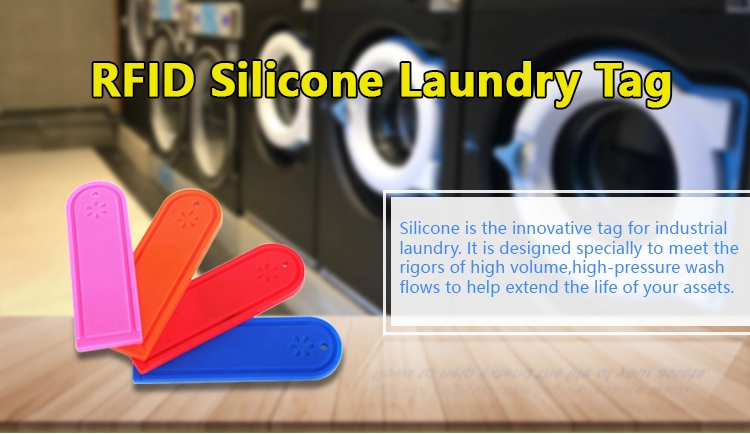
RFID laundry tags, or RFID washable tags, are specifically designed to meet the tracking requirements of the laundry industry and uniform management in hotels, hospitals, etc. It is easily affixed onto textile products using a standard sewing process, it can be sewn along the edge of the item or embedded into the Item, and can withstand washing, dry cleaning, and high-temperature sterilization.
Features:
1). High temperature resistance.
2). Waterproof.
3). Dustproof.
4). Durable.
5). Anti-collision.
| Size | 85(L) * 27(W) * 4(T) mm |
| Material: | Rubber Silicone |
| Protection Level | IP68 |
| UHF chip | H3, M4/M5, G2, etc. |
| Working Frequency | 860-960mhz |
| Ptotocol | ISO18000-6C/6B |
| Temperature | -30~220℃ |
| Application | Widely used in laundry, hotel linen, maintaince logo on car motor, and the most severe wet evironment .high quality garment, school uniform, special garments, clothing production management, product tracking, warehouse inventory, etc. |
| Features | Waterproof, high temperature resistance, dustproof, anti-collision, durable, etc |


How Does an Alien H3 RFID Laundry Tag Work?
The operating principle is based on passive Ultra High Frequency RFID technology.
Step 1: RFID Reader Generates UHF Signal
An RFID reader transmits electromagnetic waves within the UHF frequency band.
Common frequencies include:
- 860–960 MHz
- 865–868 MHz (Europe)
- 902–928 MHz (North America)
Step 2: Tag Receives Energy
The passive Alien H3 chip harvests energy from the reader’s radio signal.
No battery is required.
Step 3: Chip Activates
The chip becomes energized and retrieves its stored Electronic Product Code (EPC).
Step 4: Data Transmission
The antenna reflects the encoded EPC information back to the RFID reader using backscatter communication.
Step 5: Software Processing
Laundry management software identifies:
- Textile ID
- User information
- Washing history
- Inventory status
- Rental cycle
- Maintenance records
- Retirement schedule
The entire identification process takes only milliseconds.
Main Components
Alien Higgs-3 RFID Chip
The Alien H3 chip is well known for:
- Stable reading performance
- Fast anti-collision capability
- Global EPC Gen2 compatibility
- Reliable memory retention
Typical memory includes:
- EPC Memory
- TID Memory
- User Memory
- Password Protection
UHF Antenna
A specially designed textile antenna provides:
- Long reading distance
- Multi-tag reading
- Stable signal performance
- Flexible installation
Heat Resistant Silicone Housing
The silicone encapsulation protects the electronics against:
- Water
- Steam
- High temperatures
- Industrial detergents
- Bleach
- Mechanical impact
- Compression
Typical Specifications
| Parameter | Typical Specification |
|---|---|
| RFID Chip | Alien Higgs-3 |
| Frequency | 860–960 MHz |
| Standard | EPC Class 1 Gen2 / ISO 18000-6C |
| Material | Heat Resistant Silicone |
| Reading Distance | 3–8 meters |
| Operating Temperature | -40°C to +85°C |
| Washing Temperature | Up to 90°C |
| Ironing Temperature | Up to 180°C |
| Sterilization Temperature | Up to 135°C |
| Waterproof Rating | IP68 |
| Data Retention | 20 Years |
| Wash Cycles | 200–300+ |
| Installation | Sewn Into Textile |
Specifications may vary depending on the manufacturer and tag design.
Why Silicone Is Used
Silicone offers several advantages over conventional encapsulation materials.
It provides:
- Excellent flexibility
- Heat resistance
- Chemical resistance
- Waterproof protection
- Soft texture
- Long service life
- Minimal impact on wearer comfort
Silicone also withstands repeated bending without cracking.
Key Features
Modern Alien H3 silicone laundry tags provide:
- Long-range RFID reading
- Bulk identification
- Passive battery-free operation
- Waterproof construction
- High-temperature resistance
- Flexible design
- Chemical resistance
- Industrial washing compatibility
- Long operating life
- High read accuracy
Pain Points Solved by RFID Laundry Tags
Manual Counting Errors
Traditional textile counting often results in mistakes.
RFID enables automatic inventory counting within seconds.
Lost Garments
Hospitals and hotels frequently lose expensive linens.
Every tagged item can be individually tracked.
Slow Sorting
Workers no longer need to scan each item individually.
Hundreds of garments can be identified simultaneously.
Labor Costs
Automation reduces manual handling and inventory time.
Poor Asset Visibility
Managers gain real-time insight into textile movement and inventory levels.
Laundry Cycle Tracking
The software records the number of washing cycles for each textile.
This helps schedule replacement before excessive wear affects quality.
Major Applications
Hospitals
Tracking:
- Patient gowns
- Surgical garments
- Bed sheets
- Towels
- Blankets
Healthcare facilities benefit from better inventory control and improved hygiene management.
Hotels
Managing:
- Bed linens
- Pillowcases
- Bath towels
- Bathrobes
- Tablecloths
RFID reduces linen shortages and simplifies housekeeping operations.
Uniform Rental Companies
Tracking:
- Employee uniforms
- Safety clothing
- Industrial garments
The system helps manage rental cycles and customer allocations.
Industrial Laundries
Large commercial laundries process thousands of textile items daily.
RFID dramatically improves sorting, washing, packing, and delivery efficiency.
Restaurants
Managing:
- Kitchen uniforms
- Napkins
- Table linens
- Aprons
Manufacturing Plants
Tracking reusable workwear improves accountability and inventory planning.
Military and Government
Managing uniforms and reusable textile assets across multiple facilities.
Installation Methods
Silicone RFID laundry tags are commonly installed by:
Sewing
The most common and secure method.
Textile Pockets
Inserted into dedicated label pockets.
Protective Fabric Covers
Used when additional protection is required.
Correct installation ensures optimal read performance and long service life.
Alien H3 vs Older RFID Chips
RFID technology has improved considerably over time.
Older RFID Laundry Tags
Characteristics include:
- Shorter reading distance
- Lower read speed
- Smaller EPC capacity
- Less reliable anti-collision performance
- Limited software compatibility
Alien Higgs-3 RFID Tags
Advantages include:
- Faster inventory scanning
- Improved reading sensitivity
- Better anti-collision algorithm
- Stable performance in dense tag environments
- Wide global compatibility
- Mature industrial ecosystem
Although newer RFID chips are available, the Alien H3 remains a dependable and widely adopted choice for many laundry management systems due to its proven performance and compatibility.
Silicone RFID Tags vs Woven RFID Laundry Tags
| Feature | Silicone RFID Tag | Woven RFID Tag |
|---|---|---|
| Heat Resistance | Excellent | Good |
| Waterproof | Excellent | Good |
| Chemical Resistance | Excellent | Moderate |
| Mechanical Strength | High | Medium |
| Flexibility | Excellent | Excellent |
| Wash Cycle Life | 200–300+ | 150–200 |
| Industrial Laundry | Excellent | Good |
Silicone tags are often preferred in environments with frequent sterilization, heavy mechanical stress, or harsh detergents.
Silicone RFID Tags vs Barcode Labels
| Feature | RFID | Barcode |
|---|---|---|
| Line-of-Sight Required | No | Yes |
| Bulk Reading | Yes | No |
| Read Speed | Very Fast | Slow |
| Automation | Excellent | Limited |
| Durability | Excellent | Poor |
| Reusable | Yes | Limited |
RFID offers significant advantages in speed, durability, and automation over barcode-based systems.
Silicone RFID Tags vs QR Code Labels
| Feature | RFID | QR Code |
|---|---|---|
| Automatic Reading | Yes | No |
| Long Reading Distance | Yes | No |
| Simultaneous Multi-Item Reading | Yes | No |
| Industrial Durability | Excellent | Moderate |
| Labor Requirement | Low | High |
QR codes are economical but generally require manual scanning of each individual item, making them less suitable for high-volume laundry operations.
Best Practices for Deployment
To maximize performance:
- Select tags compatible with your RFID readers and software.
- Sew tags in consistent positions on garments.
- Test read performance before full-scale deployment.
- Use fixed RFID portals at sorting and packing stations.
- Integrate RFID data with your laundry management or ERP system.
- Train staff on proper handling and maintenance.
A well-planned deployment can significantly improve operational efficiency and data accuracy.
Future Trends in RFID Laundry Technology
The laundry industry continues to adopt more intelligent identification solutions. Emerging trends include:
- Smaller and thinner RFID tags for greater comfort.
- Enhanced heat and chemical resistance.
- Improved read sensitivity in densely packed textiles.
- Integration with cloud-based inventory management.
- AI-assisted laundry analytics for predictive replacement.
- Real-time asset visibility across multiple facilities.
- Sustainability initiatives through longer textile life and reduced waste.
These innovations are helping industrial laundries increase automation while lowering operating costs.
Conclusion
The Heat Resistant Silicone Alien H3 RFID UHF Laundry ID Tag is a proven and reliable solution for modern textile identification and industrial laundry management. By combining a durable silicone enclosure with the high-performance Alien Higgs-3 UHF RFID chip, these tags deliver accurate, long-range, and high-speed identification while withstanding repeated washing, drying, ironing, sterilization, and exposure to harsh chemicals.
Compared with barcodes, QR codes, and many traditional textile labels, RFID laundry tags provide faster inventory management, reduced labor costs, improved asset visibility, and greater operational efficiency. Their ability to identify hundreds of garments simultaneously makes them ideal for hospitals, hotels, uniform rental services, industrial laundries, manufacturing facilities, and other organizations that manage large volumes of reusable textiles.
As RFID technology continues to evolve, heat-resistant silicone laundry tags will remain a key component of smart textile management systems, enabling businesses to improve productivity, extend textile life cycles, reduce losses, and achieve a higher return on investment through fully automated identification and tracking.