High-Performance 13.56MHz HF RFID Dry Inlay Solution
A 13.56MHz HF RFID Dry Inlay is a core RFID component designed for near-field identification applications, including NFC tags, smart packaging, access control cards, product authentication labels, and asset tracking solutions.
The dry inlay consists of an RFID chip and an etched aluminum antenna mounted on a PET substrate. Unlike finished RFID labels, a dry inlay does not include an adhesive layer, allowing manufacturers to integrate it into customized products through lamination, printing, and converting processes.
With support for ISO14443A communication protocols and various NFC-compatible chips, this HF RFID inlay provides reliable short-range wireless communication, low power operation, and flexible customization options for different industries.
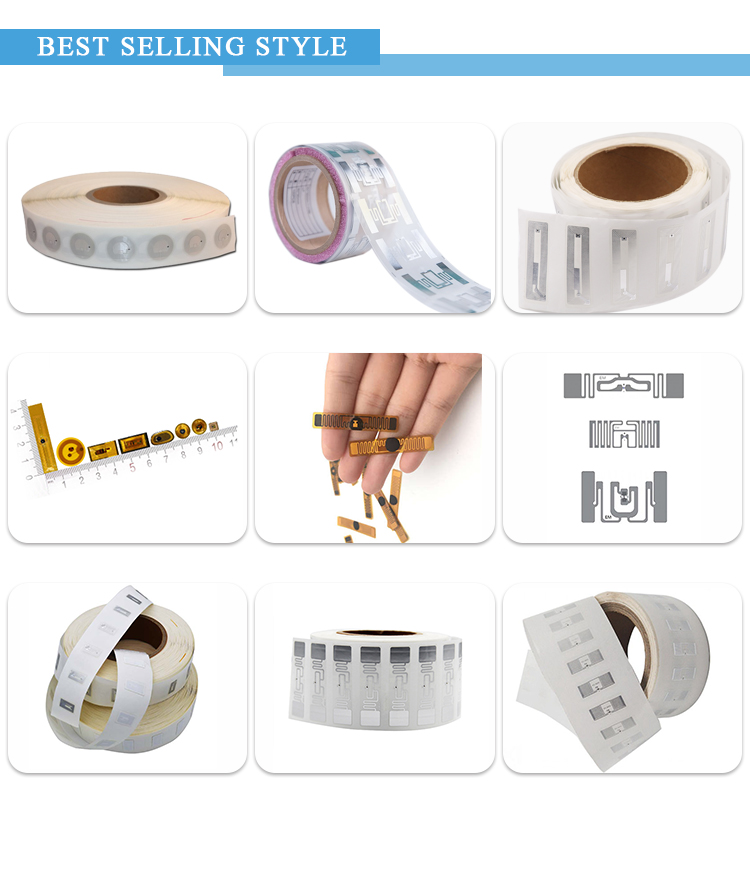
Our company provides dry inlay, wet inlay, and different kinds of sizes paper adhesive labels.
Adhesive paper tag has back gum (making of wet inlay), paper RFID tag doesn’t have back gum (making of dry inlay).
We own the HF/UHF antenna design technology, full set of automatic label production line, and we can design UHF antenna for our customers if paid, and use paper/PET/PVC/ABS/adhesive to make roll RFID tags or single RFID tags According to customer requirements.
What Is a 13.56MHz HF RFID Dry Inlay?
A 13.56MHz HF RFID Dry Inlay is a passive RFID component that operates at the high-frequency RFID band of 13.56MHz.
It uses electromagnetic induction technology to communicate with RFID readers or NFC-enabled smartphones. The reader generates an RF field that powers the chip inside the inlay, allowing data exchange without requiring an internal battery.
The main components include:
| Component | Description |
|---|---|
| RFID Chip | Stores identification data and performs communication functions |
| Aluminum Antenna | Receives RF energy and enables wireless communication |
| PET Substrate | Provides mechanical support and durability |
| Optional Encapsulation | Protects the inlay for final product integration |
Because the inlay does not contain batteries, it offers long service life and stable performance for high-volume RFID applications.
Specification:
| Chip Model: | All chips are available |
| Frequency: | 13.56MHz |
| Memory: | depend on the chips |
| Protocol: | ISO14443A |
| Base material: | PET |
| Antenna material: | Aluminium foil |
| Antenna size: | 26*12mm, 22mm Dia, 32*32mm, 37*22mm, 45*45mm, 76*45mm, or as request |
| Working temperature: | -25°C ~ +60°C |
| Store Temperature: | -40°Cto +70°C |
| Read/Write Endurance: | >100,000 time |
| Reading Range: | 3-10cm |
| Certificates: | ISO9001:2000, SGS |
Chip Option
| ISO14443A | MIFARE Classic® 1K, MIFARE Classic® 4K |
| MIFARE® Mini | |
| MIFARE Ultralight®, MIFARE Ultralight® EV1, MIFARE Ultralight® C | |
| NTAG213 / NTAG215 / NTAG216 | |
| MIFARE ® DESFire® EV1 (2K/4K/8K) | |
| MIFARE® DESFire® EV2 (2K/4K/8K) | |
| MIFARE Plus® (2K/4K) | |
| Topaz 512 | |
| ISO15693 | ICODE SLIX, ICODE SLI-S |
| EPC-G2 | Alien H3, Monza 4D, 4E, 4QT, Monza R6, etc |
Product image of square 13.56Mhz HF RFID Dry Inlay
RFID Wet Inlays are described as “wet” due to their adhesive backing, so they are essentially industrial RFID stickers. Passive RFID Tags are comprised of two parts: an integrated circuit for storing and processing information and an antenna for receiving and transmitting the signal. They have no internal power supply. RFID Wet Inlays are best for applications where a low-cost “peel-and-stick” tag is needed. Any RFID Wet Inlay can also be converted into a paper or synthetic face label.

Key Features of HF RFID Dry Inlay
Compact Design and Flexible Integration
The compact structure of the 13.56MHz HF RFID Dry Inlay allows it to be integrated into different products where space is limited.
It can be embedded into:
- NFC product labels
- Smart cards
- Library tags
- Pharmaceutical packaging
- Luxury product authentication labels
- Event tickets
- Electronic identification systems
The dry structure makes it suitable for manufacturers who need additional processing such as printing, lamination, or custom packaging.
ISO14443A and NFC Compatibility
The inlay supports ISO14443A-based RFID chips, making it compatible with many NFC applications.
Common chip options include:
| Chip Series | Memory Capacity | Typical Applications |
|---|---|---|
| NTAG213 | 144 bytes | NFC marketing tags, smart posters |
| NTAG215 | 504 bytes | NFC collectibles, digital content access |
| NTAG216 | 888 bytes | Larger data storage applications |
| MIFARE Classic 1K | 1KB | Access control, transportation cards |
| MIFARE DESFire EV2/EV3 | Advanced security | Enterprise authentication systems |
The chip selection depends on application requirements such as memory size, security level, and reader compatibility.
Available Sizes and Antenna Options
Different antenna sizes can be selected according to application requirements.
| Size | Recommended Applications |
|---|---|
| 26 × 12mm | Small NFC tags, compact electronics |
| 22mm Round | Wearable products and small packaging |
| 32 × 32mm | General NFC applications |
| 37 × 22mm | Product identification labels |
| 45 × 45mm | Smart packaging and authentication |
| 76 × 45mm | Longer reading distance applications |
Larger antenna designs generally provide stronger coupling performance and improved reading stability. However, the final RFID performance also depends on surrounding materials.
HF RFID Dry Inlay vs Wet Inlay
Many customers compare dry inlays and wet inlays when selecting RFID components.
The main difference is the adhesive layer.
| Feature | Dry Inlay | Wet Inlay |
|---|---|---|
| Adhesive Layer | No | Yes |
| Processing Requirement | Requires further converting | Ready for labeling |
| Customization Flexibility | Higher | Medium |
| Manufacturing Cost | Lower for large production | Higher |
| Typical Users | RFID manufacturers, converters | Label users |
| Application | Embedded RFID products | Direct sticker labels |
A dry inlay is usually preferred by manufacturers that need customized RFID products because it provides more flexibility during production.
HF RFID Dry Inlay vs UHF RFID Inlay
HF and UHF RFID technologies serve different application requirements.
| Comparison | HF RFID (13.56MHz) | UHF RFID (860–960MHz) |
|---|---|---|
| Communication Range | Short range | Long range |
| Typical Distance | 3–10 cm | Several meters |
| Smartphone Support | Yes (NFC compatible) | Usually No |
| Frequency | 13.56MHz | 860–960MHz |
| Main Applications | NFC, payment, access control | Warehouse, logistics, inventory |
| Environmental Sensitivity | Lower for liquids | More affected by materials |
13.56MHz HF RFID Dry Inlays are ideal when users need smartphone interaction, secure identification, or close-range authentication.
Applications of 13.56MHz HF RFID Dry Inlay
The 13.56MHz HF RFID Dry Inlay is widely used in industries that require secure identification, product interaction, and short-range wireless communication.
NFC Smart Labels
NFC-enabled labels allow users to access digital information by simply tapping a smartphone.
Common applications include:
- Product information access
- Digital manuals
- Brand engagement
- Marketing campaigns
- Customer interaction platforms
By integrating an NFC chip into product packaging, brands can connect physical products with digital experiences.
Product Authentication and Anti-Counterfeiting
HF RFID inlays are commonly used for brand protection and product verification.
Industries such as:
- Luxury goods
- Cosmetics
- Wine and beverages
- Pharmaceuticals
- Electronics
use RFID technology to improve product traceability.
Secure RFID chips such as MIFARE DESFire and advanced NFC chips can provide encrypted authentication features to reduce counterfeit risks.
Access Control and Identification Cards
13.56MHz RFID technology is widely adopted in access control systems.
Typical products include:
- Employee ID cards
- Campus cards
- Hotel key cards
- Membership cards
- Transportation cards
The compact dry inlay structure allows manufacturers to produce customized RFID cards with different designs and materials.
Smart Packaging Solutions
Smart packaging combines RFID technology with traditional packaging to provide additional product value.
Applications include:
| Industry | RFID Application |
|---|---|
| Food & Beverage | Product information and traceability |
| Healthcare | Medication identification |
| Retail | Smart product interaction |
| Logistics | Package identification |
| Manufacturing | Component tracking |
HF RFID is especially suitable for consumer-facing applications because smartphones can directly interact with NFC-compatible products.
Why Choose a 13.56MHz HF RFID Dry Inlay?
Reliable Contactless Communication
The passive RFID structure allows wireless data transfer without batteries.
Advantages include:
- Long operational lifetime
- Low maintenance requirements
- Stable performance
- Fast identification
Easy Integration into Custom Products
The dry inlay format provides manufacturers with more production flexibility.
It can be integrated through:
- Hot lamination
- Cold lamination
- Card manufacturing
- Label converting
- Packaging assembly
This makes it suitable for large-scale RFID product manufacturing.
Cost-Effective RFID Solution
Compared with complete RFID labels, dry inlays reduce unnecessary materials and allow manufacturers to optimize their own production processes.
They are commonly selected for:
- High-volume RFID projects
- Custom NFC products
- OEM RFID solutions
- Private label applications
Customization Options for HF RFID Dry Inlay
A professional RFID inlay manufacturer can provide customization based on customer requirements.
Custom Antenna Size
Different antenna designs can be developed according to:
- Product dimensions
- Required reading distance
- Installation environment
- Final application
Larger antenna structures can improve communication performance, while smaller designs are suitable for compact products.
Custom RFID Chip Selection
Customers can select different RFID chips depending on their application.
| Requirement | Recommended Chip Type |
|---|---|
| Simple NFC interaction | NTAG213 / NTAG215 |
| More data storage | NTAG216 |
| Access control | MIFARE Classic |
| High-security applications | MIFARE DESFire |
| Industrial identification | Custom ISO14443A chips |
Custom Packaging and Processing
The dry inlay can be further converted into:
- RFID stickers
- NFC cards
- RFID labels
- Smart tags
- Embedded RFID products
Manufacturers can combine RFID technology with different surface materials, including:
- Paper
- PET
- PVC
- Synthetic materials
Manufacturing Process of HF RFID Dry Inlay
The production of a high-quality RFID dry inlay requires precise manufacturing processes.
1. Antenna Manufacturing
The aluminum antenna is produced using precision etching technology to ensure consistent electrical performance.
2. Chip Bonding
The RFID chip is attached to the antenna using automated bonding equipment.
3. Electrical Testing
Each RFID inlay is tested for:
- Chip functionality
- Antenna performance
- Communication stability
4. Quality Inspection
Finished products are inspected before shipment to ensure reliable performance.
Factors Affecting RFID Reading Performance
Although 13.56MHz RFID technology is highly reliable, several factors can influence reading distance.
| Factor | Impact |
|---|---|
| Antenna Size | Larger antennas usually improve coupling |
| RFID Reader Power | Higher power can improve communication range |
| Product Material | Metal and liquid may affect performance |
| Chip Type | Different chips provide different sensitivity |
| Installation Position | Proper placement improves reliability |
For products containing metal components, special antenna designs may be required.
How to Select the Right HF RFID Dry Inlay?
Choosing the correct RFID inlay depends on several application requirements.
Define the Application Purpose
First determine whether the RFID product is used for:
- Identification
- Authentication
- NFC interaction
- Access control
- Data storage
Different applications require different RFID chips.
Select the Appropriate Chip
Consider:
- Memory capacity
- Security requirements
- Reader compatibility
- Data protection needs
For example:
- Marketing NFC tags usually require NTAG series chips.
- Secure access systems usually require MIFARE DESFire chips.
Consider the Installation Environment
Before selecting an RFID inlay, evaluate:
- Available space
- Surface material
- Temperature conditions
- Expected reading distance
This helps ensure stable RFID performance after integration.
13.56MHz HF RFID Dry Inlay Supplier and OEM Services
A reliable RFID manufacturer should provide more than standard products.
Professional OEM services may include:
- Custom antenna design
- Custom chip selection
- Prototype samples
- Mass production
- Quality inspection
- Technical support
For businesses developing RFID products, choosing an experienced supplier helps reduce development time and improve product reliability.
Frequently Asked Questions About HF RFID Dry Inlay
What is a 13.56MHz HF RFID Dry Inlay?
A 13.56MHz HF RFID Dry Inlay is a passive RFID component consisting of an RFID chip and antenna mounted on a substrate. It is used to manufacture RFID labels, NFC tags, cards, and smart products.
Can a 13.56MHz RFID Dry Inlay work with smartphones?
Yes. When equipped with NFC-compatible chips such as NTAG series chips, the RFID inlay can communicate with NFC-enabled smartphones.
What is the reading distance of HF RFID Dry Inlay?
The typical reading distance is around 3–10 cm. Actual performance depends on antenna size, chip type, reader design, and installation conditions.
What is the difference between RFID Dry Inlay and RFID Label?
A dry inlay is the internal RFID component without adhesive. An RFID label usually includes an inlay, adhesive layer, and printable surface material.
Can the RFID inlay size be customized?
Yes. Antenna dimensions, chip selection, and final structure can be customized according to customer requirements.
Is HF RFID better than UHF RFID?
Neither technology is universally better. HF RFID is better for NFC interaction, secure identification, and short-range applications, while UHF RFID is better for long-range inventory tracking and logistics.
Conclusion
The 13.56MHz HF RFID Dry Inlay is a flexible and reliable RFID component designed for NFC, ISO14443A, and short-range identification applications.
With multiple antenna sizes, various chip options, and customization capabilities, it provides an efficient solution for manufacturers producing RFID labels, smart cards, authentication tags, and intelligent packaging products.
For companies looking for a customizable RFID solution, selecting the right HF RFID Dry Inlay design can improve product performance, reduce production costs, and create new opportunities for smart product applications. Feel free to contact us.