September 14, 2026
Introduction
In an era where digital transformation dictates the pace of business and daily life, RFID cards have emerged as a cornerstone technology for seamless identification, security, tracking, and data exchange. Unlike traditional contact-based systems, RFID cards use radio waves to communicate with readers—enabling faster, more convenient interactions without physical contact. From unlocking office doors to managing global supply chains, Radio Frequency Identification (RFID) technology has moved far beyond simple access control. As we navigate through 2026, the global RFID market continues its robust expansion. According to recent industry analysis, the global RFID card market revenue reached approximately $11 billion in 2024 and is projected to grow at a Compound Annual Growth Rate (CAGR) of over 12% through 2031, driven by the integration of AI, IoT, and 5G technologies.
This comprehensive guide dives deep into the world of RFID cards. We will explore the different types available, their technical specifications, real-world applications backed by current data, and critical security considerations. Whether you are an IT manager, a logistics coordinator, or a business owner looking to upgrade your infrastructure, this article provides the authoritative insights you need to make informed decisions.
What is an RFID Card?
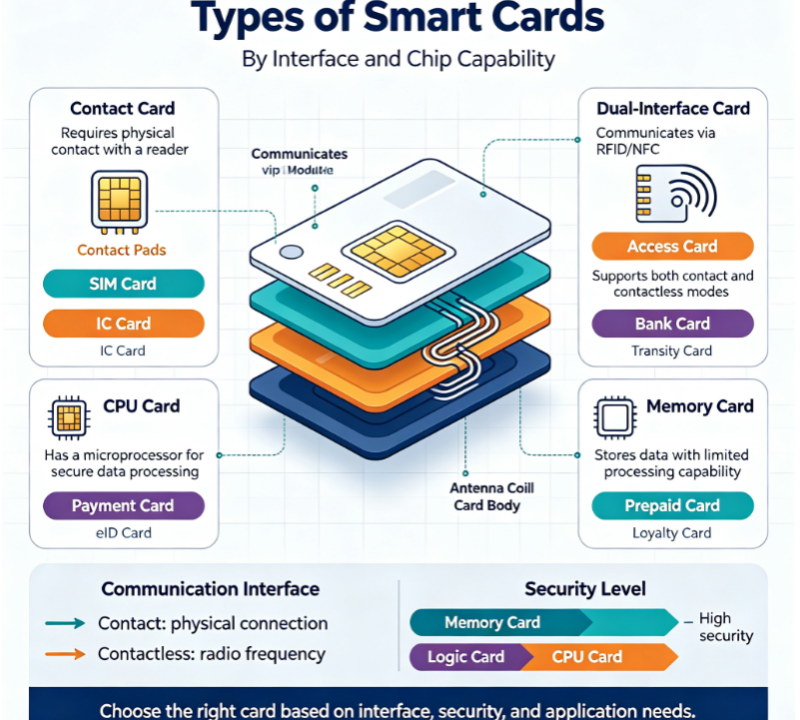
At its core, an RFID card is a contactless smart card that stores data and transmits it to an RFID reader, communicating with the reader using radio waves. Unlike traditional magnetic stripe cards that require physical swiping and are prone to wear and tear, RFID cards embed a microchip and antenna within a plastic casing. This allows RFID cards to wirelessly transmit data when near the reader. They eliminate the cumbersome steps of swiping or inserting cards, reducing card wear and tear and speeding up processing. It is precisely because of this simplicity and efficiency that RFID cards have become an indispensable tool for businesses, government agencies, and organizations worldwide.
The system consists of three main components:
- The Tag/Card: Contains the unique identifier and data.
- The Reader: Emits radio waves to power the tag (if passive) and read/write data.
- The Backend System: Processes the data for authentication, tracking, or analysis.
The versatility of RFID lies in its ability to function without line-of-sight, read multiple tags simultaneously, and operate in harsh environments where barcodes would fail.
Classifying RFID Cards: Frequency and Power Source
RFID cards are primarily classified by two critical factors: frequency (how they communicate) and power source (how they transmit data). Understanding these distinctions is vital for selecting the right technology for your specific needs.
Part 1: Classification by Frequency
The operating frequency determines the read range, data transfer speed, and resistance to environmental interference.
1. Low Frequency (LF) RFID Cards
- Operating Frequency: Below 30 kHz (Typically 125 kHz – 134 kHz).
- Read Range: Up to 1 meter (typically <10 cm in practice).
- Characteristics: LF cards offer a low data transfer rate, limiting them to straightforward tasks like transmitting a simple ID number. However, they are highly reliable and perform exceptionally well near metal and liquids, which often interfere with higher frequencies.
- Common Applications:
- Animal Tracking: Pet microchips and livestock monitoring.
- Keyless Entry: Basic car immobilizers and older building access systems.
- Simple Access Control: Gym memberships or low-security door locks.
2. High Frequency (HF) RFID Cards
- Operating Frequency: 13.56 MHz.
- Read Range: Up to 5 meters (typically 10 cm – 1 meter depending on antenna size).
- Characteristics: HF cards strike a balance between range and data security. They support faster data transfer rates and larger memory capacities compared to LF. This frequency band is the global standard for secure transactions and is the foundation of NFC (Near Field Communication).
- Common Applications:
- Contactless Payments: Credit cards, mobile wallets (Apple Pay, Google Pay).
- Public Transport: E-tickets and transit passes.
- Library Management: Tracking books and media for efficient check-out.
- Secure Access: Modern corporate ID badges with encryption.
3. Ultra High Frequency (UHF) RFID Cards
- Operating Frequency: 860–960 MHz (Varies by region).
- Read Range: Up to 100 meters (depending on reader power and tag antenna).
- Characteristics: UHF cards boast the longest read range and the fastest data transfer speeds. Their most significant advantage is anti-collision capability, allowing them to scan hundreds of items simultaneously. However, their performance can be dampened by water and metal unless specialized tags are used.
- Common Applications:
- Supply Chain Management: Tracking pallets and containers from manufacturing to delivery.
- Warehouse Inventory: Rapid stocktaking without manual scanning.
- Asset Management: Tracking high-value equipment across large facilities.
- Toll Collection: Electronic toll collection (ETC) systems on highways.
Part 2: Classification by Power Source
Beyond frequency, RFID cards are categorized by how they are powered, which directly impacts their range, cost, and lifespan.
| Feature | Passive RFID Cards | Active RFID Cards |
| Power Source | No internal battery. Powered by the reader’s electromagnetic field. | Built-in battery (usually lithium). |
| Read Range | Short to Medium (LF/HF: <1m; UHF: up to 15-20m typically). | Long Range (Up to 100+ meters). |
| Cost | Low ($0.10 – $3.00). Cost-effective for mass deployment. | High ($15.00 – $50.00+). |
| Lifespan | Indefinite (no battery to die). Limited only by physical wear. | Limited by battery life (3–7 years). |
| Functionality | Read/Write data when in range. “Sleeps” when out of range. | Can broadcast signals continuously; often includes sensors (temp, shock). |
| Best Use Cases | Access control, retail inventory, payment cards, library books. | Real-time location systems (RTLS), vehicle tracking, monitoring high-value medical equipment. |
Key Applications of RFID Cards Across Industries
RFID technology is utilized across diverse sectors for its unparalleled efficiency and accuracy. Here is how different industries are leveraging these cards in 2026.
1. Access Control and Security
Replacing traditional keys with RFID cards has revolutionized security management. It reduces the risk of key theft, simplifies the process of revoking access (instantly deactivating a lost card), and provides an audit trail of who entered a area and when.
- Trend: Modern systems utilize encrypted HF cards to prevent cloning, ensuring that restricted areas remain secure against sophisticated threats.
View Related Products: RFID Access Reader
2. Payment Systems
The global shift to cashless societies is driven by HF RFID technology. Contactless payment methods, including physical cards and mobile wallets (like Apple Pay and Google Pay), rely on the 13.56 MHz frequency for fast, secure transactions.
- Benefit: Transactions take seconds, reducing queue times and improving customer experience while maintaining bank-grade security through tokenization and encryption.
3. Library Management
Libraries worldwide have adopted RFID to streamline operations. By tagging books and media, libraries can automate the check-out and check-in process.
- Efficiency: Patrons can stack multiple books on a self-service kiosk, and the system reads them all instantly. This reduces staff workload and significantly lowers theft rates through automated gate alarms.
4. Supply Chain and Logistics
UHF RFID is the backbone of modern logistics. It allows companies to monitor products from the manufacturing floor to the final delivery point.
- Impact: Unlike barcodes, which require line-of-sight scanning one by one, UHF readers can scan entire pallets of goods as they pass through a dock door. This minimizes human error, prevents shipping delays, and provides real-time visibility into inventory levels.
5. Event Management
RFID technology has become a staple at music festivals, conferences, and large-scale events. RFID silicone wristbands have largely replaced paper tickets and plastic lanyards.
- Why Wristbands? These wristbands are waterproof, durable, and tamper-evident, making them ideal for large crowds and outdoor environments. They serve a dual purpose: acting as an access pass for different zones and enabling cashless payments for food and merchandise.
- Customization: Organizers can customize these wristbands with branding and encode them with specific access rights. For more details on their specific use cases and durability, you can explore resources on RFID silicone wristbands.
In addition to this, this technology can also be used to track animals; you can check out this content to learn more: RFID Animal tag reader
Technical Specifications to Consider
When selecting an RFID solution, focusing on the right technical specifications is crucial to ensure system compatibility and performance.
| Specification | Description | Why It Matters |
| Frequency | LF (<30 kHz), HF (13.56 MHz), or UHF (860-960 MHz). | Dictates read range, speed, and environmental suitability. Mismatched frequencies will not work with your readers. |
| Memory Capacity | Typically ranges from 1 Kbit to 2 Kbit EEPROM (can be higher for specialized tags). | Determines how much data can be stored on the card (e.g., unique ID, transaction history, user details). |
| Read Range | Varies from <10 cm (LF/HF) to >10 meters (UHF/Active). | Critical for defining the user experience (tap-and-go vs. drive-through). |
| Environmental Resistance | Ratings for water (IP67/IP68), temperature extremes, and chemical exposure. | Essential for outdoor assets, industrial settings, or event wristbands exposed to sweat and rain. |
| Form Factor | PVC Card, Key Fob, Sticker Tag, Silicone Wristband, Glass Capsule. | Must fit the physical application (e.g., a wristband for events, a rugged card for factory workers). |
| Security Protocol | Encryption standards (e.g., AES, DESFire), password protection. | Vital for preventing unauthorized reading, cloning, or data tampering in payment and access scenarios. |
How to Choose the Right RFID Card: A Step-by-Step Guide
Selecting the perfect RFID card requires a strategic approach. Follow these steps to ensure your investment delivers maximum value.
Step 1: Define Your Use Case
Start by clearly identifying what you need to achieve.
- Tracking Assets in a Warehouse? You likely need UHF Passive tags for long-range, bulk reading.
- Processing Payments or Secure Access? You need HF cards with strong encryption.
- Tracking Vehicles in Real-Time? Consider Active RFID tags for continuous broadcasting over long distances.
- Identifying Pets or Livestock? LF tags are the industry standard due to their reliability near biological tissue.
Step 2: Check Compatibility
Ensure the cards you choose are compatible with your existing infrastructure.
- Reader Frequency: An HF reader cannot read UHF tags. Verify that your hardware matches the card frequency.
- Protocol Standards: Check if your system supports specific protocols (e.g., ISO 14443 for HF, EPC Gen2 for UHF).
- Software Integration: Confirm that your backend software can interpret the data format of the new cards.
Step 3: Prioritize Security
For applications involving sensitive data (payments, personal IDs, secure facilities), security is non-negotiable.
- Encryption: Choose cards that support advanced encryption standards (like AES-128) to prevent eavesdropping.
- Authentication: Look for mutual authentication features where the card and reader verify each other before exchanging data.
- Data Privacy: Ensure the card allows for “kill commands” or privacy bits if needed for consumer-facing applications.
Step 4: Consider Durability and Environment
Assess the physical conditions the card will face.
- Harsh Environments: If the card will be used outdoors, in factories, or in wet conditions, opt for ruggedized designs with high IP ratings (e.g., IP67 or IP68).
- Temperature: For cold chain logistics or industrial ovens, ensure the chip and adhesive can withstand extreme temperatures.
- Flexibility: For events or wearable applications, silicone wristbands offer the best combination of comfort and durability.
Security Considerations and Best Practices
As reliance on RFID grows, so do security concerns. The wireless nature of the technology makes it theoretically susceptible to eavesdropping, skimming, and relay attacks.
Common Vulnerabilities
- Cloning: Older LF (125 kHz) cards often transmit static IDs without encryption, making them easy to copy with cheap hardware.
- Skimming: Unauthorized readers can potentially scan HF payment cards if they are too close to the user, though modern tokens usually require a transaction handshake.
- Relay Attacks: Hackers extend the range of a valid card by relaying signals between the card (in a pocket) and the reader.
Authoritative Recommendations for 2026
To mitigate these risks, organizations should adhere to the following best practices:
- Migrate to Encrypted HF/UHF: Avoid using unencrypted 125 kHz cards for any sensitive application. Adopt standards like MIFARE DESFire EV3 or FeliCa which utilize AES-128 encryption.
- Implement Mutual Authentication: Ensure that the card verifies the reader just as the reader verifies the card. This prevents data leakage to rogue scanners.
- Use Shielding: For high-security environments, consider RFID-blocking wallets or sleeves for personnel carrying sensitive credentials.
- Regular Audits: Conduct periodic security assessments of your RFID infrastructure to identify weak points in the backend system, not just the cards themselves.
Implementation Strategy: A Step-by-Step Guide for Businesses
Adopting RFID technology is not merely a hardware purchase; it is a strategic operational shift. Many projects fail not because the technology is flawed, but because the implementation plan lacks rigor. Based on successful deployments in 2025 and 2026, here is a proven roadmap for integrating RFID cards into your ecosystem.
Phase 1: Needs Assessment and Frequency Selection
Before buying a single tag, define the specific problem you are solving.
- Question: Do you need to read items one by one (e.g., secure door entry) or in bulk (e.g., a pallet of goods passing through a dock door)?
- Decision Matrix:
- One-by-one, high security: Choose HF (13.56 MHz).
- Bulk reading, long range: Choose UHF (860–960 MHz).
- Harsh environments (metal/liquid): Consider specialized on-metal UHF tags or LF if range is not critical.
Phase 2: The Pilot Program (Proof of Concept)
Never roll out RFID globally without a pilot. Select a controlled environment, such as a single warehouse aisle or one office floor.
- Objective: Test read rates in your specific physical environment. Metal shelving, liquid products, and even humidity can interfere with UHF signals.
- Metric: Aim for a read rate of >98%. If you fall below 95%, adjust antenna placement, power settings, or tag orientation before proceeding.
- Duration: A typical pilot should run for 4–6 weeks to capture various operational scenarios (peak hours, shift changes, maintenance).
Phase 3: Infrastructure Integration
RFID data is useless if it sits in a silo. The real value comes from integrating RFID readers with your existing software systems.
- ERP/WMS Integration: Ensure the RFID middleware can push data directly into your Enterprise Resource Planning (ERP) or Warehouse Management System (WMS).
- API Compatibility: Modern readers support RESTful APIs and MQTT protocols, making integration with cloud platforms (AWS, Azure, Google Cloud) seamless.
- Data Cleansing: Implement logic to filter out “noise” (e.g., a tag read five times in one second should be recorded as one event).
Phase 4: Training and Change Management
The human element is often the biggest bottleneck. Staff may view RFID as a surveillance tool or fear job displacement.
- Action: Conduct workshops demonstrating how RFID reduces mundane tasks (like manual counting) and allows staff to focus on higher-value analysis.
- Protocol: Establish clear Standard Operating Procedures (SOPs) for handling tagged items. For instance, “Do not stack metal boxes directly on top of UHF tags.”
Cost-Benefit Analysis: Is RFID Worth the Investment?
One of the most common questions executives ask in 2026 is: “With the cost of tags dropping, is the ROI finally there for small-to-medium enterprises (SMEs)?” The answer is a resounding yes, provided the use case is well-defined.
Breakdown of Costs
While prices fluctuate based on volume and customization, here are the average market costs for 2026:
| Cost Component | Low Volume (<1k units) | High Volume (>100k units) | Notes |
|---|---|---|---|
| Passive UHF Tags | $0.15 – $0.25 | $0.07 – $0.10 | Prices have dropped 15% since 2024 due to silicon shortages easing. |
| HF Smart Cards | $1.20 – $2.50 | $0.60 – $1.10 | Higher cost due to encryption chips and smaller production runs. |
| Fixed Readers | $1,500 – $3,000 | $1,200 – $2,500 | Industrial grade (IP65+) commands a premium. |
| Handheld Scanners | $800 – $1,500 | $600 – $1,000 | Android-based rugged devices are now the standard. |
| Implementation Services | $5,000+ | Variable | Includes site survey, installation, and software integration. |
Implementation Strategy and ROI
Strategic Implementation
Adopting RFID is not just a hardware swap; it’s an operational upgrade.
- Pilot Program: Start small. Test a specific zone or department to validate read rates and workflow integration.
- Site Survey: Analyze your environment for interference sources (metal racks, liquid containers) that might affect UHF performance.
- Training: Educate staff on how to handle tagged items and interpret system data.
Return on Investment (ROI)
While the upfront cost of RFID (readers, tags, software) can be higher than barcodes, the long-term ROI is substantial:
- Labor Savings: Automated inventory counts reduce man-hours by up to 90%.
- Accuracy: Inventory accuracy improves from ~65% (manual) to >98% (RFID), reducing stockouts and overstocking.
- Loss Prevention: Enhanced visibility reduces theft and misplaced assets.
- Data Insights: Real-time data enables better decision-making regarding supply chain optimization and asset utilization.
Troubleshooting Common RFID Challenges
Even with advanced 2026 technology, physical laws still apply. Interference and environmental factors remain the primary causes of system underperformance. Here is how to diagnose and fix common issues.
1. The “Metal and Liquid” Problem
Symptom: Read rates drop significantly when tags are placed near metal surfaces or liquid products (e.g., beverages, chemicals). Physics: Metal reflects radio waves, causing signal cancellation (detuning). Liquids absorb UHF energy. Solutions:
- On-Metal Tags: Use UHF tags specifically designed with a foam spacer or specialized substrate that isolates the antenna from the metal surface.
- Tag Placement: Mount tags on the corner of a metal object rather than the center, or angle the tag at 45 degrees.
- Frequency Tuning: Some modern readers allow dynamic frequency hopping to find a channel less affected by local interference.
2. Phantom Reads
Symptom: The system records an item entering a zone when it hasn’t, or reads a tag from the adjacent room. Cause: Reader power is too high, or antenna polarization is mismatched, causing signals to bleed through walls or reflect off unintended surfaces. Solutions:
- Power Adjustment: Lower the reader’s transmit power (dBm) to the minimum necessary for the target zone.
- Antenna Polarization: Switch from linear to circular polarization (or vice versa) depending on tag orientation consistency. Circular is generally better for random orientations but has slightly shorter range.
- Zoning Logic: Implement software logic that requires a tag to be read by two specific antennas within a time window to confirm location.
3. Tag Collision vs. Reader Collision
Symptom: Slow processing or missed tags when hundreds of items pass simultaneously. Distinction:
- Tag Collision: Too many tags responding at once.
- Reader Collision: Two nearby readers interfering with each other. Solutions:
- Anti-Collision Protocols: Ensure your system uses the latest EPCglobal Gen2v2 protocol, which handles dense tag environments efficiently.
- Dense Reader Mode: Configure readers to operate in “Dense Reader Mode” (DRM), which synchronizes their transmission times to prevent overlap.
Environmental Impact and Sustainability in the RFID Era
As the world pushes toward net-zero goals, the environmental footprint of billions of RFID tags produced annually has come under scrutiny. However, when analyzed holistically, RFID is increasingly viewed as a net-positive force for sustainability.
The Waste Challenge
Traditional RFID tags consist of a silicon chip, a metal antenna (usually aluminum or copper), and a plastic or paper substrate. While the materials are minimal per tag, the sheer volume—projected to exceed 60 billion units annually by 2027—raises concerns about electronic waste (e-waste), particularly for single-use retail applications.
Industry Response:
- Biodegradable Substrates: Major manufacturers are shifting from PET plastic substrates to paper-based or biodegradable polymer alternatives that decompose safely in composting facilities.
- Recycling Programs: Retail giants are piloting “tag-to-tag” recycling initiatives where used garments with embedded tags are processed in facilities capable of separating and recovering the metal antennas and silicon.
- Chipless RFID: As mentioned in future trends, chipless tags eliminate the silicon component entirely, drastically reducing the toxic e-waste potential.
RFID as a Sustainability Enabler
Paradoxically, the deployment of RFID drives significant environmental benefits that far outweigh the manufacturing footprint of the tags themselves:
- Optimized Logistics: By providing real-time visibility, RFID reduces empty truck miles and optimizes load factors. A 2025 study indicated that logistics firms using RFID reduced their carbon emissions by 12% purely through route and load optimization.
- Reduced Overproduction: Accurate inventory data prevents the “bullwhip effect,” where manufacturers overproduce goods due to poor visibility. This leads to less unsold inventory ending up in landfills.
- Circular Economy Tracking: RFID enables the tracking of reusable assets (pallets, crates, containers) throughout their lifecycle, ensuring they are returned, repaired, and reused rather than discarded.
- Energy Efficiency: In data centers and cold storage facilities, RFID sensors monitor temperature and equipment status, allowing for dynamic energy usage adjustments that lower overall power consumption.
The Verdict on Green RFID
For organizations aiming to meet ESG (Environmental, Social, and Governance) criteria, RFID is no longer a liability but a strategic asset. The key lies in choosing sustainable tag materials and leveraging the data to drive efficiency gains that reduce the broader organizational carbon footprint.
Future Trends: Where is RFID Heading?
As we move further into 2026 and beyond, several trends are shaping the future of RFID:
- Integration with AI and IoT: RFID data is increasingly fed into AI algorithms to predict maintenance needs, optimize supply routes, and automate reordering processes.
- Chipless RFID: Emerging technology aims to remove the silicon chip entirely, using radar cross-section encoding to create ultra-low-cost tags for disposable items.
- Sustainability: There is a growing push for biodegradable substrates and recyclable antennas to minimize the environmental footprint of billions of deployed tags.
- Smart Packaging: RFID is becoming integral to “smart packaging,” allowing consumers to scan products for authenticity, origin stories, and recycling instructions via their smartphones.
Conclusion
RFID cards have evolved from simple identification tools into intelligent enablers of the connected world. Whether you are securing a building with LF/HF access cards, streamlining payments with HF contactless tech, or managing a global supply chain with UHF logistics tags, the right RFID solution offers unmatched efficiency and insight.
By understanding the critical differences in frequency and power source, and by carefully considering technical specifications like memory, range, and durability, organizations can tailor their RFID deployment to meet exact needs. From the robust utility of silicone wristbands at major events to the precision of active tags in healthcare, the applications are limitless.
As the technology matures, the barrier to entry lowers, and the capabilities expand. For businesses and individuals alike, embracing RFID today is not just about keeping up with trends—it is about building a smarter, safer, and more efficient future.
Recommended Partner: DO RFID Reader
When selecting a partner for your RFID infrastructure, reliability, experience, and service quality are paramount. DO RFID Reader, a premier manufacturing division of the D.O RFID Group, stands out as a trusted global leader in the industry. Based in China with over 15 years of specialized experience, DO RFID Reader has established itself as an innovative force in designing and manufacturing high-quality RFID solutions for access control, vehicle identification, logistics, and inventory management systems worldwide.
At the core of our operations is an unwavering commitment to our values: “Source Quality Products and Enjoy Efficient Service.” We don’t just supply hardware; we deliver comprehensive solutions. Our extensive product line includes a versatile range of RFID readers, smart cards, tags, and NFC products compatible with LF, HF, and UHF frequencies. Whether you need custom-encoded cards for a hotel chain, rugged tags for industrial asset tracking, or high-speed readers for warehouse logistics, DO RFID Reader offers tailored OEM/ODM services to meet your specific requirements.
What truly sets DO RFID Reader apart is our dedication to customer assurance. We back all our manufactured products with an industry-leading **3-Year **(36 months), reflecting our confidence in their durability and performance. Furthermore, our expert technical team provides 24-hour support, ensuring that any challenges are resolved swiftly to minimize downtime. Equipped with advanced Heidelberg printing technology, we guarantee superior print quality and short lead times, a standard proven by our long-term partnership as a supplier for the Austria Metro Card system.
For businesses seeking a balance of cutting-edge technology, custom design capabilities, and fair pricing, DO RFID Reader is your ideal strategic partner. We invite you to visit our factory and experience firsthand how we can empower your operations with efficient, reliable, and high-quality RFID solutions.

Au is an RFID and NFC manufacturer based in Shenzhen, China, with over 10 years of experience.