July 16, 2026
In today’s fast-paced world of logistics, manufacturing, and asset management, the ability to track and identify items quickly and accurately is no longer a luxury—it’s a necessity. Among the technologies enabling this revolution, UHF RFID (Ultra-High Frequency Radio Frequency Identification) stands out for its speed, range, and scalability. At the heart of every UHF RFID system lies a critical component: the UHF RFID reader.
But what exactly is a UHF RFID reader? How does it work? And why is it so widely adopted across industries? This article provides a comprehensive, practical, and easy-to-understand guide to UHF RFID readers—covering their principles, components, types, applications, limitations, and how they compare to other RFID technologies.
1. Defining the UHF RFID Reader
A UHF RFID reader is a radio frequency device that communicates with passive or semi-passive RFID tags operating in the ultra-high frequency band, typically between 860 MHz and 960 MHz. Unlike barcode scanners, which require line-of-sight, UHF RFID readers can identify multiple tags simultaneously—often from several meters away—without direct visual contact.
The reader emits radio waves that power passive RFID tags (which have no internal battery) and then listens for the modulated signal reflected back from those tags. This process, known as backscatter communication, allows the reader to capture unique identification data stored on each tag.
Key characteristics of UHF RFID readers include:
- Long read range: Up to 15 meters (depending on environment and antenna setup).
- High-speed reading: Capable of identifying 800–1,500 tags per second.
- Bulk reading: Can detect dozens or even hundreds of tags in a single scan.
- Cost-effective tags: Passive UHF tags cost as little as $0.05–$0.30 in volume.
These features make UHF RFID ideal for applications requiring rapid inventory checks, real-time asset tracking, and automated data collection at scale.
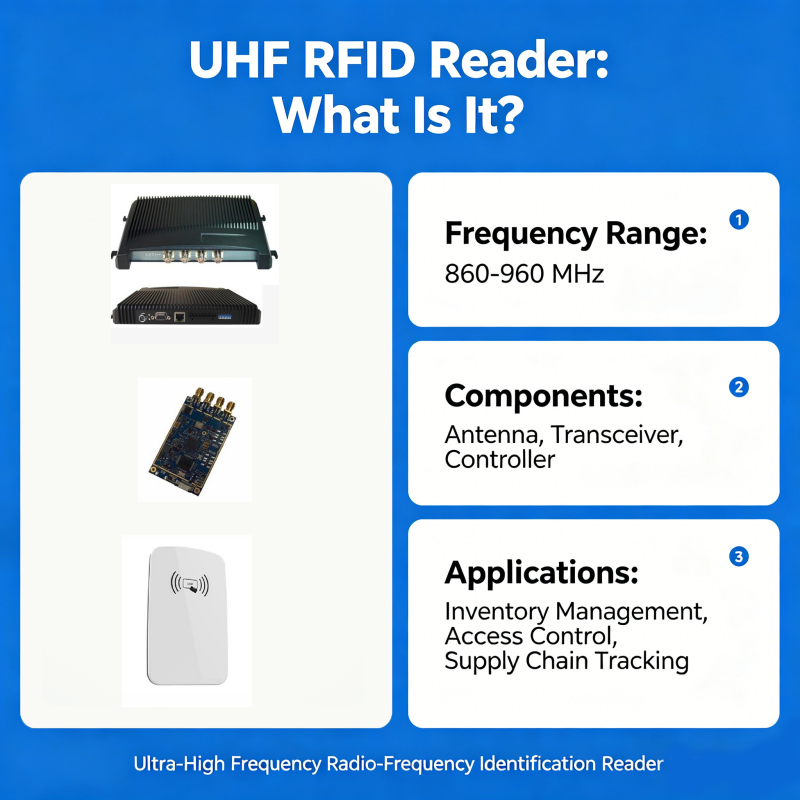
UHF RFID readers basic information
2. How Does a UHF RFID Reader Work?
Understanding the working principle of a UHF RFID reader requires examining both its hardware architecture and communication protocol.
2.1 Core Components
A typical UHF RFID reader consists of three main parts:
| Component | Function |
|---|---|
| RF Module (Transceiver) | Generates and transmits RF signals; receives and decodes backscattered signals from tags. It handles modulation/demodulation and ensures compliance with regional power regulations. |
| Antenna | Radiates RF energy to activate tags and captures their responses. Antennas can be directional (for focused coverage) or circularly polarized (for broader, more flexible reads). |
| Controller / Processor | Runs the embedded firmware, manages communication protocols (e.g., EPC Gen2), processes tag data, and interfaces with external systems via Ethernet, USB, Wi-Fi, or serial ports. |
Some readers integrate all components into a single unit (fixed readers), while others separate the antenna from the processing unit for flexible deployment.
2.2 Communication Process
- Interrogation: The reader transmits a continuous-wave RF signal within the UHF band.
- Tag Activation: Passive tags harvest energy from this signal via their antenna, powering their microchip.
- Backscatter Modulation: The tag modulates the reflected signal by changing its antenna impedance, encoding its stored data (e.g., an EPC number).
- Signal Reception & Decoding: The reader detects this weak backscattered signal, filters out noise, and decodes the tag’s information.
- Data Output: The decoded data is sent to a host system (e.g., warehouse management software) for processing.
This entire cycle happens in milliseconds and can repeat continuously, enabling real-time tracking.
2.3 Anti-Collision Protocols
When hundreds of tags are present, they might respond simultaneously, causing signal collisions. To prevent this, UHF RFID uses the Q-algorithm, part of the EPCglobal Gen2 (ISO/IEC 18000-6C) standard. This dynamic protocol adjusts the number of time slots available for tag responses, ensuring efficient and reliable multi-tag reading.
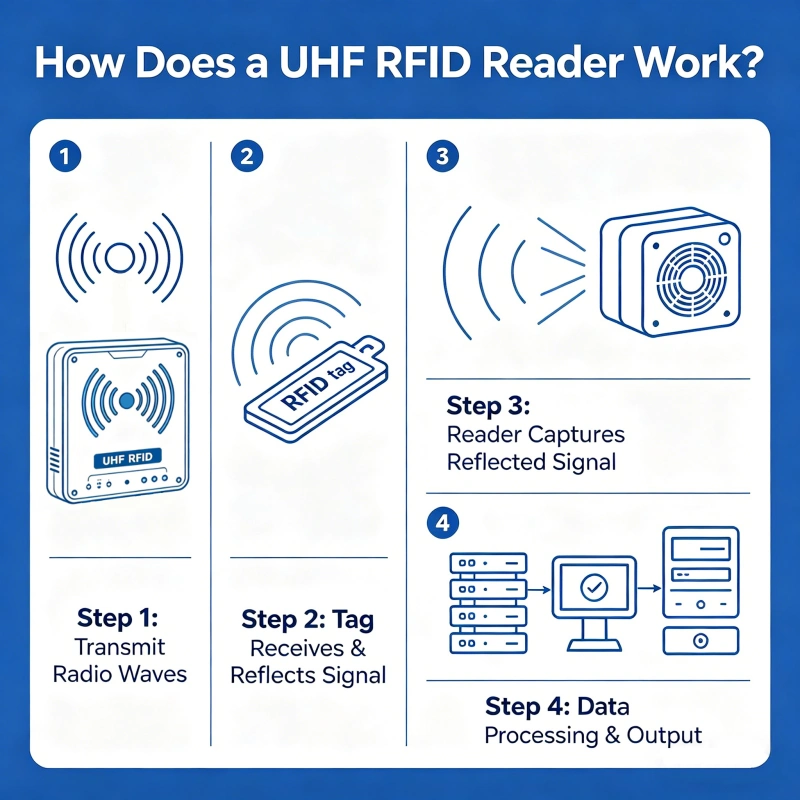
UHF RFID readers working principle
3. Types of UHF RFID Readers
UHF RFID readers come in various form factors, each suited to specific use cases.
| Type | Description | Typical Use Cases |
|---|---|---|
| Fixed Readers | Stationary devices mounted at choke points (e.g., dock doors, conveyor belts). Often support multiple antennas. | Warehouse inbound/outbound gates, production line tracking, retail smart shelves. |
| Handheld Readers | Portable, battery-powered devices with integrated antennas and displays. May run Android or custom OS. | Inventory audits, asset verification, field service, retail stock checks. |
| Mobile Readers (Embedded) | UHF modules integrated into smartphones, tablets, or industrial PDAs. | Logistics last-mile delivery, healthcare equipment tracking, mobile retail. |
| Integrated Reader Modules | Compact OEM modules designed for embedding into kiosks, printers, or automation equipment. | Smart packaging machines, self-checkout systems, IoT gateways. |
Note: Handheld readers may feature integrated or detachable external antennas. External antennas often provide better performance in dense metal environments due to optimized placement.
4. Global Standards: EPC Gen2 and ISO/IEC 18000-6C
Interoperability is critical for global supply chains. Fortunately, the UHF RFID ecosystem largely adheres to a unified standard:
- EPCglobal Class 1 Generation 2 (Gen2): Developed by GS1, this is the de facto global standard for UHF RFID.
- ISO/IEC 18000-6C: The international equivalent of EPC Gen2, ratified by ISO.
Both define:
- Air interface protocol (how readers and tags communicate)
- Tag memory structure (Reserved, EPC, TID, User banks)
- Security features (access passwords, kill commands)
- Anti-collision mechanisms
Compliance with these standards ensures that a UHF tag from one manufacturer can be read by a reader from another—enabling seamless integration across vendors and regions.
5. Key Applications Across Industries
UHF RFID readers are transforming operations in numerous sectors:
5.1 Logistics & Supply Chain
- Pallet and case tracking through distribution centers
- Automated receiving and shipping at dock doors
- Real-time visibility of goods in transit
View related products: 8 Ports Fixed UHF RFID Reader
5.2 Retail
- Item-level tagging for accurate inventory
- Smart fitting rooms that suggest complementary products
- Loss prevention and automated checkout
View related products: UHF RFID Reader ISO 18000-6C Long Range Tracking For Warehouses
5.3 Manufacturing
- Work-in-progress (WIP) tracking on assembly lines
- Tool and fixture management
- Quality control with serialized part traceability
View related products: Industrial Manufacturer Compact Long Range 4 Port 33 dBm UHF RFID Reader Writer with Wi Fi and GPIO
5.4 Healthcare
- Tracking surgical instruments through sterilization cycles
- Managing high-value medical assets (e.g., infusion pumps)
- Blood bag and pharmaceutical monitoring
View related products: RFID Temperature Tag For Cattle Health And Welfare Monitoring
5.5 Asset Management
- IT equipment, furniture, and machinery tracking
- Preventive maintenance scheduling
- Audit-ready compliance reporting
View related products: Mini Size UHF RFID Reader Module With Low Power
In each case, UHF RFID replaces manual, error-prone processes with automated, data-driven workflows.
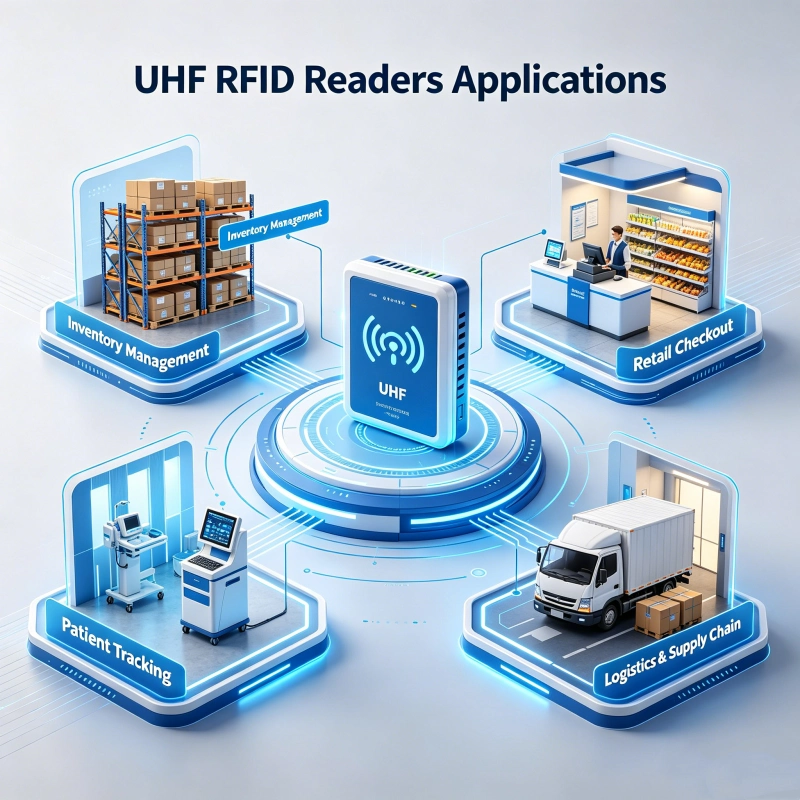
UHF RFID readers Applications
6. Challenges and Limitations
Despite its advantages, UHF RFID is not without challenges:
6.1 Interference from Metal and Liquids
- Metal surfaces reflect RF waves, creating dead zones or detuning antennas.
- Water (and water-rich materials like human tissue or fruit) absorbs UHF signals, reducing read range.
Solutions:
- Use anti-metal tags with shielding layers (e.g., foam or ferrite backing).
- Employ near-field UHF antennas that operate via magnetic coupling (less affected by metal).
- Optimize antenna placement and polarization.
6.2 Regulatory Variations
- UHF frequency bands differ by region:
- North America: 902–928 MHz
- Europe: 865–868 MHz
- China: 920–925 MHz
- Transmit power limits also vary.
Solution: Use frequency-agile readers that auto-detect and comply with local regulations.
6.3 Environmental Factors
- Dense tag populations, RF noise from machinery, and physical obstructions can degrade performance.
Solution: Conduct thorough site surveys and pilot tests before full deployment.
7. UHF vs. HF vs. LF RFID: A Comparative Overview
To choose the right technology, it’s essential to understand how UHF compares to other RFID frequencies.
| Feature | UHF (860–960 MHz) | HF (13.56 MHz) | LF (125–134 kHz) |
|---|---|---|---|
| Read Range | 1–15 m (passive) | 0.1–1 m | < 0.1 m |
| Read Speed | 800–1,500 tags/sec | 10–50 tags/sec | 1–10 tags/sec |
| Tag Cost | $0.05–$0.30 | $0.50–$2.00 | $0.20–$1.00 |
| Metal/Liquid Tolerance | Poor (requires special tags) | Moderate | Excellent |
| Data Security | Basic (password protection) | Strong (supports encryption) | Limited |
| Common Standards | EPC Gen2 / ISO 18000-6C | ISO 14443, ISO 15693 | ISO 11784/85 |
| Typical Uses | Logistics, retail inventory | Payment cards, library books, NFC | Animal ID, access control |
Rule of thumb: Choose UHF for speed and range, HF for security and proximity, and LF for harsh environments.
8. Key Parameters Guide: How to Select the Right UHF RFID Reader
Choosing the right UHF RFID reader is critical to ensuring system performance, reliability, and return on investment. With numerous models on the market, buyers should evaluate several technical and operational specifications. Below is a practical guide to the most important parameters:
Parameter Description What to Look For Transmit Power Output RF power level the reader emits (typically 0–30 dBm). Regulated by local laws (e.g., FCC in the US, ETSI in Europe). Ensure compliance with regional regulations. Higher power = longer read range, but not always better—optimize for your environment. Number of Antenna Ports How many antennas the reader can support simultaneously (commonly 1, 4, or 8 ports). For wide-area coverage (e.g., warehouse dock doors), choose 4+ ports. Single-port readers suit handheld or compact fixed applications. Supported Protocols Communication standards the reader adheres to. Must support EPCglobal Gen2v2 (ISO/IEC 18000-6C) for global compatibility. Advanced models may also support Gen2v2 security features like tag authentication. Read Rate & Tag Processing Speed Number of tags the reader can identify per second. Look for ≥800 tags/sec for high-throughput environments (e.g., conveyor belts, retail backrooms). Interface Options How the reader connects to host systems. Common options: Ethernet (PoE), RS-232/485, USB, Wi-Fi, Bluetooth. Choose based on your network infrastructure and integration needs. Environmental Rating (IP Code) Protection against dust and water ingress. IP54 for indoor use; IP67 or higher for outdoor, industrial, or washdown environments (e.g., food processing, automotive plants). Operating Temperature Range Ambient temperatures in which the reader functions reliably. Standard: -10°C to +50°C; Industrial-grade: -30°C to +70°C. Critical for cold chain logistics or foundries. Frequency Agility Ability to operate across different UHF bands worldwide. Essential for global deployments. A frequency-agile reader automatically adjusts to local regulations (e.g., 902–928 MHz in USA, 865–868 MHz in EU). 💡 Pro Tip: When evaluating vendors, prioritize those offering long-term firmware updates, robust SDKs, and local technical support. For example, DO RFID Reader provides all these features—plus a 3-year warranty—ensuring your UHF RFID system remains future-proof and easy to maintain.
9. Common Misconceptions About UHF RFID Readers – Busted!
Despite its widespread adoption, UHF RFID technology is often misunderstood. Below are some of the most frequent myths—and the facts that set the record straight.
Myth Reality “UHF RFID doesn’t work near metal or liquids.” While standard UHF tags can be detuned by metal or absorbed by water, specialized solutions exist. Anti-metal tags (with ferrite or foam isolation layers) and on-metal adhesive labels perform reliably on steel surfaces. Similarly, optimized tag placement and near-field antennas enable successful reads on bottles, pharmaceuticals, and even human-worn items. “All UHF RFID readers offer the same performance.” Performance varies significantly based on receiver sensitivity, anti-collision algorithms, and RF stability. Low-cost readers may miss tags in dense environments or suffer from overheating. Reputable manufacturers like DO RFID Reader use high-grade RF components and rigorous testing to ensure consistent, industrial-grade reliability. “UHF RFID systems are too expensive for small businesses.” Thanks to economies of scale and falling tag prices (as low as $0.05 per tag in volume), UHF RFID is now accessible to mid-sized and even small operations. Many users achieve ROI in under 12 months through labor savings, reduced shrinkage, and improved inventory accuracy. “You need line-of-sight to read UHF RFID tags.” Unlike barcodes, UHF RFID does NOT require line-of-sight. Radio waves can penetrate cardboard, plastic, and fabric, allowing tags inside boxes or on stacked pallets to be read simultaneously—making it ideal for bulk inventory audits. “Once installed, an RFID system runs perfectly forever.” Like any technology, RFID systems require periodic calibration, firmware updates, and environmental checks (e.g., antenna alignment, interference sources). Choosing a vendor with 24/7 technical support and a 3-year warranty—such as DO RFID Reader—ensures long-term success and minimal downtime. Understanding these truths helps businesses avoid costly mistakes and deploy UHF RFID systems that deliver real, measurable value.
10. Real-World Deployment Case Studies
Seeing how UHF RFID technology performs in actual industrial and commercial environments helps illustrate its transformative impact. Below are two representative case studies featuring DO RFID Reader solutions:
Case Study 1: Smart Warehouse Automation for a European E-Commerce Giant
Challenge:
A leading e-commerce logistics center in Germany struggled with manual pallet scanning at 12 loading docks. Inventory inaccuracies averaged 11%, and daily cycle counts required 15+ staff hours.Solution:
Deployed DO RFID Reader DR9000 fixed UHF readers (4-port, IP67-rated) at each dock door, integrated with existing WMS via Ethernet. Used passive UHF labels on all incoming/outgoing pallets.Results:
- 99.9% inventory accuracy achieved in real time
- Automated scanning of 5,000+ pallets per hour
- 70% reduction in manual labor for inventory checks
- ROI realized within 8 months
“The DO RFID system paid for itself before the holiday peak season even ended.”
— Logistics Operations ManagerCase Study 2: Precision Tool Tracking in an Automotive Manufacturing Plant
Challenge:
An automotive OEM in Mexico lost ~300 high-value tools monthly due to poor tracking. Unplanned downtime from missing torque wrenches and calibration tools cost over $220,000/year.Solution:
Equipped technicians with DO RFID Reader handheld devices (HR3000 model) and tagged 10,000+ metal tools with on-metal UHF RFID labels. Integrated data into the plant’s maintenance management system.Results:
- 95% reduction in tool loss incidents
- Real-time location visibility across 3 factory floors
- 40% decrease in production line stoppages related to tool unavailability
- Full system deployment completed in 3 weeks
“We now know exactly where every calibrated tool is—down to the workstation.”
— Plant Engineering LeadThese examples demonstrate how DO RFID Reader delivers scalable, reliable, and high-ROI solutions across diverse industries—from logistics to advanced manufacturing.
8. Conclusion: Why UHF RFID Readers Matter
The UHF RFID reader is more than just a piece of hardware—it’s a gateway to operational intelligence. By enabling contactless, bulk, and long-range identification, it eliminates manual scanning bottlenecks and unlocks real-time visibility into physical assets.
While challenges like metal interference and regulatory complexity exist, ongoing advances in tag design, reader sensitivity, and software analytics continue to expand UHF RFID’s applicability. As industries push toward greater automation and digital transformation, the UHF RFID reader will remain a foundational tool for bridging the physical and digital worlds.
Whether you’re managing a warehouse, running a factory, or tracking hospital equipment, understanding what a UHF RFID reader is—and how to deploy it effectively—can deliver significant returns in efficiency, accuracy, and customer satisfaction.
Looking for a Trusted UHF RFID Reader Manufacturer?
If you’re seeking high-performance, reliable, and cost-effective UHF RFID readers for your business, consider DO RFID Reader—a leading brand under D.O RFID Group.
With 15 years of experience in the RFID and smart card industry, DO RFID Reader specializes in designing and manufacturing a full range of RFID solutions, including:
- UHF/HF/LF RFID readers (fixed, handheld, and embedded)
- RFID tags and labels (including anti-metal, laundry, and vehicle tags)
- NFC tags and smart cards
- Customized RFID solutions for access control, vehicle identification, logistics, and inventory management
Why choose DO RFID Reader?
✅ Source Quality Products and Enjoy Efficient Service – Our core values since day one
✅ 3-Year Warranty – All products backed by 36 months of warranty and technical support
✅ 24/7 Tech Support – Our experienced engineers are ready to assist you anytime
✅ Global Compliance – Products meet international standards (EPC Gen2, ISO/IEC 18000-6C, etc.)
✅ Customization Capability – We embed NFC/RFID transponders into diverse housings to meet unique application needs
✅ Proven Track Record – Long-term supplier for major projects, including Austria’s metro card system
✅ Advanced Production – Equipped with top-tier Heidelberg printers for high-quality, short-lead-time output
As part of D.O RFID Group, we serve customers worldwide with innovative, durable, and fairly priced RFID products tailored to real-world challenges.

Do RFID is a leading China-based manufacturer with over 15 years of experience. We specialize in customized RFID readers, tags, and cards, delivering high-quality, tailored solutions that meet your unique business needs and drive seamless, efficient identification.