September 14, 2026
In today’s fast-paced, connected world, convenience and security are paramount. From gaining entry to a music festival to making cashless payments at a resort, RFID wristbands have become an invisible yet powerful tool that simplifies our interactions with the physical world. But how do these unassuming bands of plastic or fabric actually work? This article will demystify the technology behind RFID wristbands, exploring their inner workings, diverse applications, and what the future holds for this innovative technology.
The Core Concept: What is RFID?
Before diving into wristbands specifically, it’s essential to understand the foundational technology: Radio Frequency Identification (RFID). At its core, RFID is a method of wirelessly identifying and tracking objects using radio waves. It’s a form of automatic identification and data capture (AIDC) technology, similar in purpose to barcodes but far more versatile.
Unlike a barcode, which requires a direct line of sight and must be scanned one at a time, an RFID system can read multiple tags simultaneously from a distance, even if they are hidden inside a pocket or behind other materials (as long as those materials aren’t metal or liquid). This non-contact, bulk-reading capability is what makes RFID so powerful for modern applications.
An RFID system has three fundamental components:
- The Tag (or Transponder): This is the small electronic device embedded in the wristband. It contains a microchip that stores data and an antenna to receive and transmit signals.
- The Reader (or Interrogator): This is the fixed or handheld device that sends out radio waves and listens for a response from the tag. It powers the tag (in the case of passive tags) and decodes the information it sends back.
- The Antenna: Often integrated into the reader, the antenna is the conduit for the radio waves. It emits the signal to the tag and receives the tag’s response.
- The Backend System: The reader is connected to a computer system or cloud-based software that processes the data from the tag, verifies credentials, logs transactions, or triggers specific actions (like opening a door).
The magic happens through a simple yet elegant process of wireless communication between the reader and the tag.
Inside the Band: Anatomy of an RFID Wristband
An RFID wristband is a wearable form factor designed for comfort, durability, and security. Its construction is surprisingly simple:
- The Housing: This is the outer material you see and feel. It can be made from various substances depending on the use case:
- Silicone: The most common choice for events and water parks due to its flexibility, waterproof nature, and comfort.
- Fabric/Nylon: Often used for longer-term access control or employee badges, offering a more professional look.
- Plastic (PVC/ABS): Used for more rigid, durable applications like hospital patient IDs or high-security facilities.
- Paper: A low-cost, disposable option for short-term events or promotions.
- The Inlay: Sealed securely within the housing is the heart of the wristband—the RFID inlay. This consists of two key parts laminated together:
- The Microchip (Integrated Circuit – IC): This tiny silicon chip is the brain of the operation. It stores a unique identifier (UID), which is a serial number that is virtually impossible to duplicate. Depending on the application, the chip may also have additional memory to store other data, such as a user’s name, access level, or even a small monetary balance for cashless payments. The chip is what processes the incoming signal from the reader and modulates its response.
- The Antenna: This is a thin coil of copper or aluminum etched onto a substrate. Its job is twofold: to harvest energy from the reader’s radio signal (for passive tags) and to transmit the chip’s data back to the reader. The design and size of the antenna are critical and are directly tied to the operating frequency of the wristband.
This entire assembly is then encased in the chosen housing material, creating a robust, tamper-evident, and user-friendly wearable device.
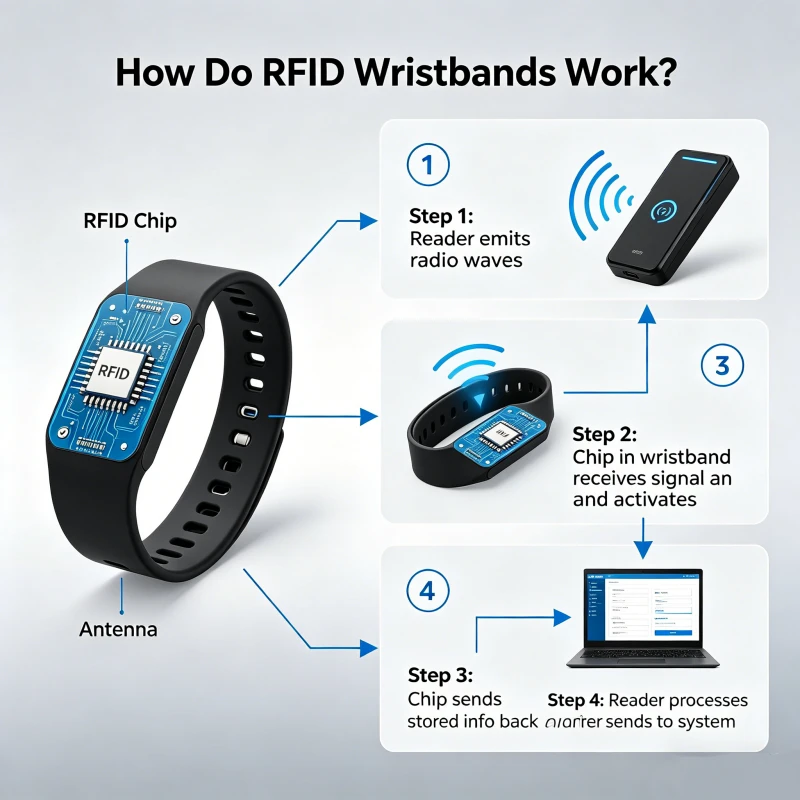
The image shows the working principle of an RFID wristband.
The Invisible Conversation: How Communication Works
The interaction between an RFID wristband and a reader is a fascinating dance of physics and electronics. The exact mechanism depends on the type of tag, but the vast majority of wristbands use passive RFID technology. This means the tag has no internal battery; it is powered entirely by the electromagnetic field generated by the reader.
Here’s a step-by-step breakdown of the process:
- Reader Activation: When a user brings their wristband near an RFID reader, the reader is constantly emitting a stream of radio frequency (RF) energy through its antenna.
- Energy Harvesting: The antenna inside the wristband captures some of this RF energy. For Low-Frequency (LF) and High-Frequency (HF) tags, this works through a principle called inductive coupling, where the reader’s antenna and the tag’s antenna act like two sides of a transformer, transferring power across a magnetic field. For Ultra-High-Frequency (UHF) tags, the principle is electromagnetic wave propagation, where the tag’s antenna harvests energy from the reader’s radiating electromagnetic waves.
- Chip Power-Up: The harvested energy is converted from AC to DC by a rectifier circuit on the chip, providing just enough power to activate the microchip.
- Data Transmission: Once powered, the chip retrieves its stored data (usually its unique ID) and uses its antenna to send this information back to the reader. It does this by modulating the electromagnetic field. Essentially, the chip changes the electrical load on its antenna, which creates a detectable change in the field that the reader can sense—a technique known as backscatter modulation.
- Data Processing: The reader detects this modulated signal, decodes the data, and sends it to the backend software system.
- Action Execution: The software checks the received ID against its database. If it’s a valid credential, the system authorizes an action—unlocking a gate, logging an attendance record, or deducting funds from a pre-loaded account.
This entire process happens in a fraction of a second, creating a seamless user experience.
Understanding the Spectrum: LF, HF, and UHF
Not all RFID wristbands are created equal. They operate on different radio frequency bands, each with its own set of strengths, weaknesses, and ideal applications. Choosing the right frequency is crucial for a successful deployment.
| Feature | Low Frequency (LF) | High Frequency (HF) / NFC | Ultra-High Frequency (UHF) |
|---|---|---|---|
| Frequency Range | 125 – 134 kHz | 13.56 MHz | 860 – 960 MHz |
| Read Range | Very Short (up to 10 cm / 4 inches) | Short (up to 1 m / 3 feet) | Long (up to 12 m / 40 feet) |
| Data Transfer Rate | Slow | Moderate | Very Fast |
| Penetration | Excellent through water and metals | Good through most materials, but blocked by metal/water | Poor through water and metals; easily blocked |
| Multi-Tag Reading | Poor (one at a time) | Good | Excellent (hundreds per second) |
| Cost | Low | Moderate | Moderate to Low (for the tags) |
| Common Standards | ISO 11784/85 | ISO/IEC 14443, ISO/IEC 15693, NFC Forum | ISO/IEC 18000-6C (EPC Gen2) |
| Typical Wristband Use Cases | Animal ID, basic access control | Contactless payments (Apple/Google Pay), event ticketing, public transport, secure access | Inventory management, asset tracking, large-scale event access & cashless systems |
- LF (Low Frequency): These are the old guard. Their short range and slow speed make them less common for modern wristbands, but their ability to work near metal and water is useful for specific industrial or animal-tracking scenarios.
- HF/NFC (High Frequency / Near Field Communication): This is the sweet spot for many consumer-facing wristband applications. Its short, controlled range enhances security for payments and access control. NFC is a subset of HF that enables peer-to-peer communication, allowing your smartphone to interact directly with an NFC-enabled wristband for easy top-ups or information sharing.
- UHF (Ultra-High Frequency): UHF is the powerhouse for large-scale operations. Its long read range and ability to read hundreds of tags per second make it perfect for managing crowds at major festivals, sports stadiums, or for tracking assets across a large warehouse. However, its performance degrades significantly around water (like the human body) and metal, requiring careful system design.
Where You’ll Find Them: Real-World Applications
The versatility of RFID wristbands has led to their adoption across a wide array of industries:
- Events & Entertainment: This is perhaps the most visible use case. At music festivals, conferences, and theme parks, a single wristband can serve as your ticket, hotel room key, and cashless payment method. It streamlines entry, reduces fraud, eliminates the need to carry wallets, and provides organizers with valuable real-time data on crowd flow and spending habits. View related products: RFID wristbands at music festivals
- Hospitality & Resorts: Hotels and all-inclusive resorts use RFID wristbands to create a truly frictionless guest experience. Guests can enter their rooms, access the pool and gym, order food and drinks, and pay for spa services—all with a simple tap of their wrist. View related products: RFID Wristbands Elevating SPA Experiences Through Security and Efficiency
- Healthcare: In hospitals, patient wristbands ensure accurate identification at every point of care, preventing dangerous medical errors. They can be scanned to verify a patient’s identity before administering medication, during blood transfusions, or before surgery. They can also be used to track patient location for safety or workflow optimization.
- Access Control & Security: From corporate offices to government facilities, RFID wristbands provide a convenient and secure way to manage who can enter specific areas. They are harder to lose than a card and can be designed to be tamper-proof. View related products: RFID access control wristbands
- Cashless Payments: Beyond events and resorts, RFID wristbands are being used in gyms, schools, and even public transportation systems as a convenient alternative to cash or cards, especially in environments where hygiene or speed is a concern. View related products: HF Cashless Band Mifare Plus S 2K RFID NFC Wristbands Payment Custom
You can also read this article if you want to learn more about its applications: RFID Wristbands A Comprehensive Guide to Features Types and Applications
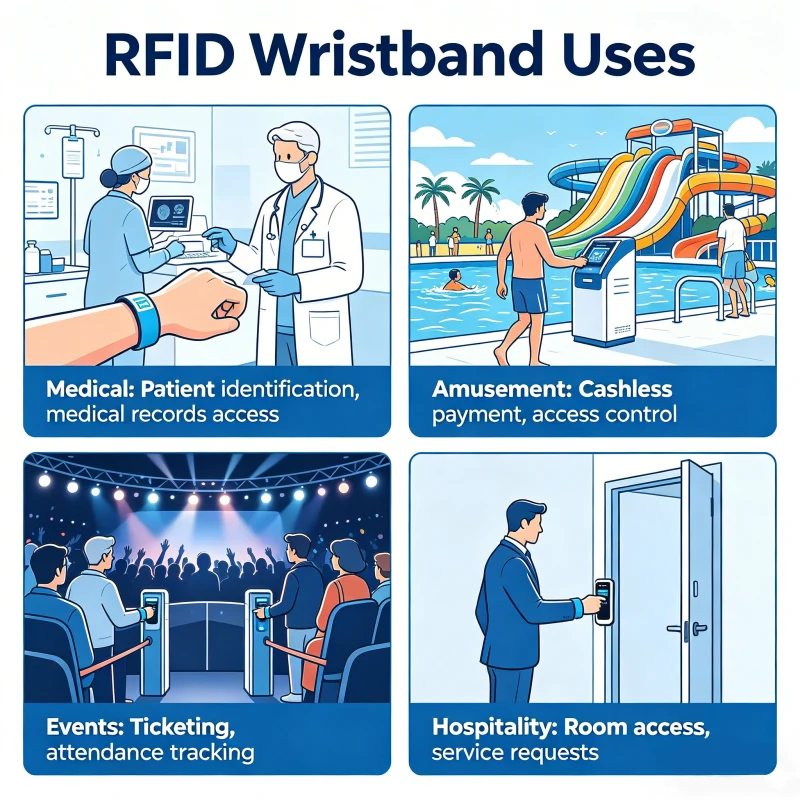
The image shows some application scenarios of RFID wristbands.
Addressing Concerns: Security and Privacy
As with any technology that handles personal data, security and privacy are legitimate concerns. Early, simple RFID tags were vulnerable to “skimming,” where a malicious actor could read the tag’s ID from a distance without the user’s knowledge.
However, the industry has responded with robust security measures:
- Encryption: Modern chips, especially in HF/NFC and UHF, support strong encryption protocols to protect the data both in storage and during transmission.
- Authentication: Many systems use mutual authentication, where both the tag and the reader must prove their legitimacy to each other before any data is exchanged.
- Privacy Features: Techniques like “kill” commands (to permanently deactivate a tag) or “blocker” tags (to shield a tag from unauthorized readers) exist, though they are less common in wristbands. More practically, many consumer systems only store a random, non-personal token on the wristband itself, with all sensitive personal data securely held in the backend database.
Reputable manufacturers and system integrators prioritize these security features to build trust with their users.
The Future on Your Wrist: Trends and Innovations
RFID wristband technology is far from static. Several exciting trends are shaping its future:
- Integration with Other Technologies: The next generation of smart wristbands will combine RFID with other sensors. Imagine a band that not only grants access but also monitors vital signs in a hospital or tracks your activity levels at a fitness center.
- Enhanced UHF Performance: Research is ongoing to develop UHF tags that perform better in challenging environments, such as near the human body or in wet conditions, which will further expand their use cases.
- Sustainability: There is a growing focus on creating eco-friendly wristbands using biodegradable or recyclable materials to reduce environmental impact after large events.
- Blockchain Integration: For high-value applications, blockchain technology could be used to create an immutable, transparent ledger of all transactions associated with a wristband, enhancing security and auditability.
Your Trusted Partner in RFID Innovation: DO RFID Reader
Understanding the technology is the first step. Implementing a reliable, efficient, and secure RFID wristband system requires a partner with deep expertise and a commitment to quality.
DO RFID Reader, a leading factory under the D.O RFID Group, is that partner. With 14 years of experience in the RFID and smart card field, we are a trusted global supplier of high-quality RFID solutions. Our values are clear: Source Quality Products and Enjoy Efficient Service.
We specialize in designing and manufacturing a comprehensive range of RFID products, including custom wristbands, readers, cards, and tags for a multitude of applications—from access control and vehicle identification to complex logistics and inventory systems. Our state-of-the-art Heidelberg printers ensure a short lead time without compromising on the exceptional quality that has made us a long-term supplier for projects like the Austria metro card.
When you choose DO RFID Reader, you benefit from:
- 3-Year Warranty: We stand behind our products with a full 36-month warranty and support.
- 24/7 Tech Support: Our experienced technicians are available around the clock to assist you.
- Custom Solutions: We can embed NFC/RFID core transponders into a variety of housings to meet your specific application requirements.
Whether you are planning a large-scale event, upgrading your facility’s security, or optimizing your supply chain, DO RFID Reader has the experience, the technology, and the service to bring your vision to life. Welcome to visit us and discover how our innovative RFID solutions can transform your operations.

Do RFID is a leading China-based manufacturer with over 15 years of experience. We specialize in customized RFID readers, tags, and cards, delivering high-quality, tailored solutions that meet your unique business needs and drive seamless, efficient identification.