November 10, 2026
A PIT tag has no battery to replace, which makes it useful for long-term identification. Its useful life in a project, however, depends on more than continued electronic function. The tag must remain associated with the animal or item, be detectable by the reading system and still connect to an interpretable record.
When a supplier or article describes a PIT tag as lasting for the animal’s life, read that as a description of the technology’s long-term purpose rather than a guarantee that every animal will produce observations forever. Several separate conditions determine what the project can actually obtain.
Four different meanings of “lasting”
| Question | What it concerns | What could remain unknown |
|---|---|---|
| Does the tag still respond? | Electronic and physical function of the transponder | Whether it is still associated with the intended animal |
| Is the tag retained? | Continued attachment or presence in the animal under the chosen method | Whether a suitable reader will encounter it |
| Can the project detect it? | Compatibility, useful detection area and operating equipment | What happened outside the observed area |
| Can the observation be interpreted? | The relationship between the code and preserved project records | The meaning of an old code if its associated information has been lost |
These questions should not be replaced by a single number of years. A readable recovered tag, a tagged animal outside the observation area and an old record with no reliable identity match are different situations.
Why battery-free identification can be long-lasting
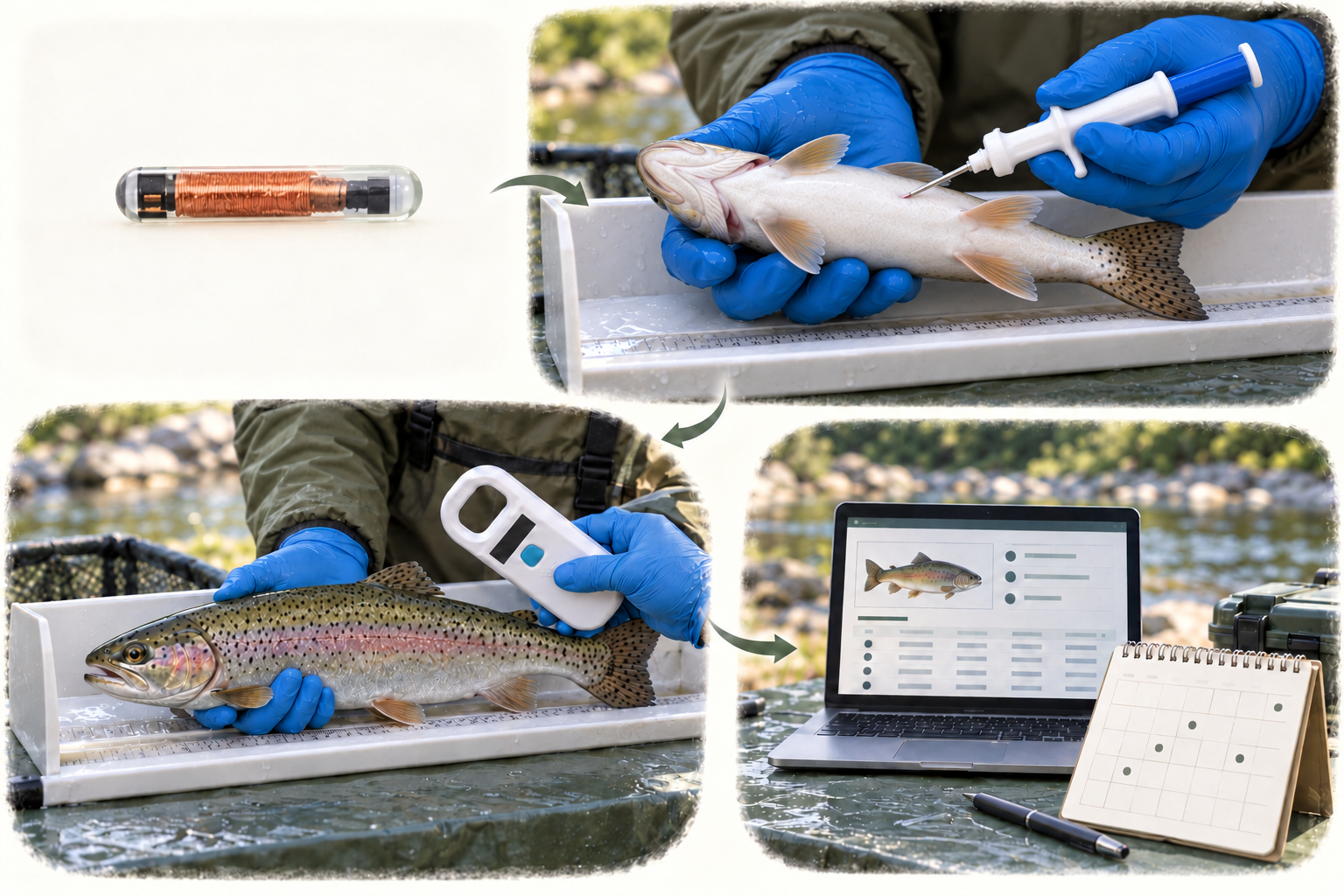
A passive PIT tag receives energy from the reader’s field when it is interrogated. It does not spend an internal battery waiting for the next scan or sending periodic transmissions. That removes a battery-replacement cycle from the tag itself.
The construction still matters. The transponder contains electronics and an antenna protected by its housing. A claim about a specific model’s service conditions, durability or data retention should be read for that product, not transferred automatically to every PIT chip or application.
Also distinguish stored-data retention from the entire installed life. A specification about memory or a stated operating environment does not, by itself, demonstrate animal retention, permanent readability or the continuation of a study’s records.
Does a five-year injector validity mean a five-year tag life?
Our G-101–G-107 preloaded injector catalog entries list a five-year validity period. Keep that supplied-product condition with the actual package and batch documentation when receiving or rotating stock. It does not demonstrate that a tag already in use stops responding on its fifth anniversary.
The individual glass-tag configuration, the supplied application assembly and biological retention are different subjects. Likewise, an operating-temperature specification concerns stated use conditions; it does not establish the number of years a tag remains in an animal. For an order, preserve the exact model, protocol, package information and any product-specific service claim together.
Retention is an animal-and-method question
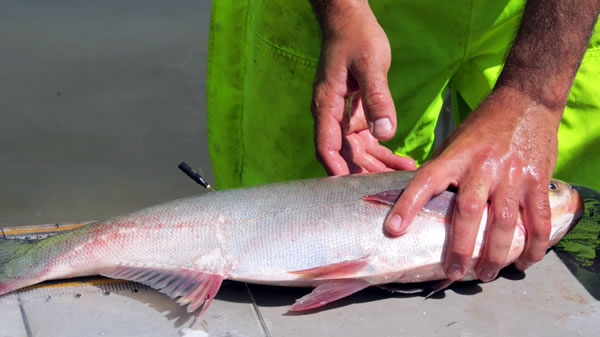
Whether a tag remains associated with an animal depends on the specific use. Relevant considerations can include species, life stage, dimensions, attachment or implantation method, and the observation period. A result from one study should keep those conditions attached to it.
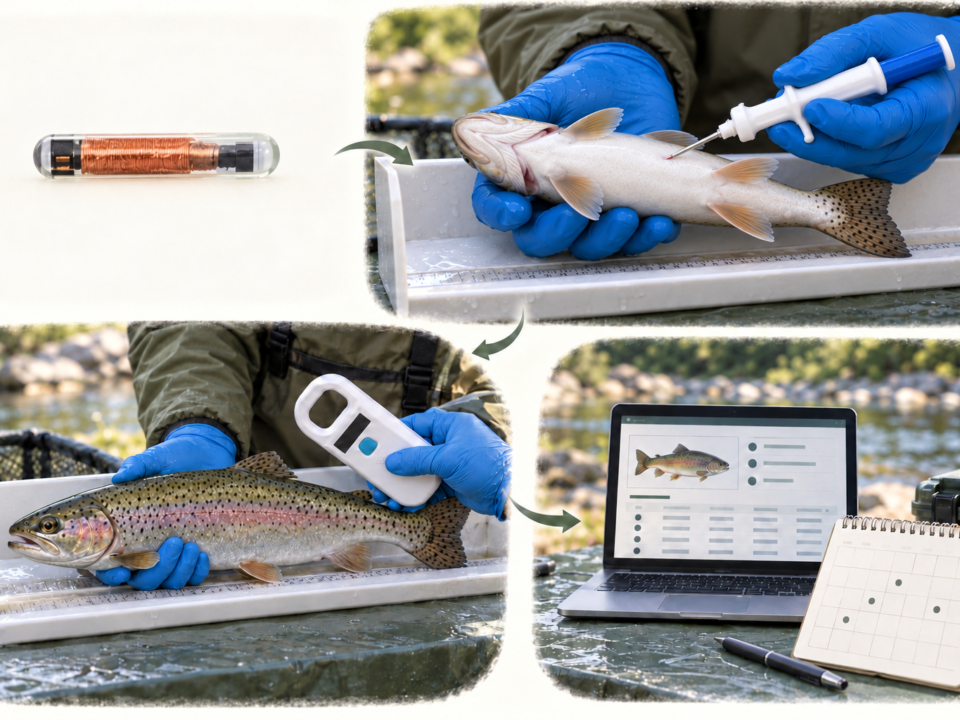
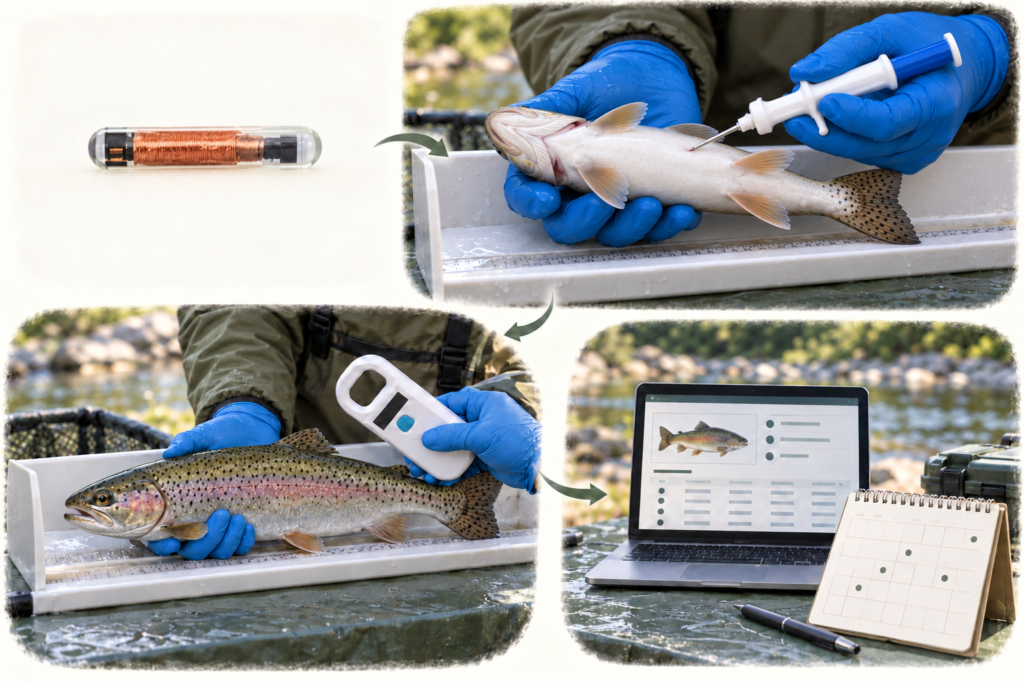
For example, a 2017 Brook Trout study reported by USGS evaluated 8 mm PIT tags and recorded retention, growth and survival during a defined laboratory experiment. Its findings should not be rewritten as a guarantee that every 8 mm tag will remain in every fish for life.
Short- and long-term outcomes are also different questions. A project can observe good retention during an early check without having measured what happens throughout a later migration or life stage. The required duration should guide the evidence the team looks for.
The fish PIT size guide explains how to consider tag dimensions, animal suitability and the reading task together.
Put retention percentages beside their observation period
| Defined study | Observation period | What it helps establish |
|---|---|---|
| 2017 Brook Trout study; 8 mm tags, 35–50 mm fork-length fish in a laboratory | Reported observations at 29 and 64 days; 96.7% tag retention overall | A result for that animal group and method, not a 64-day electronic service limit. |
| 2026 age-0 Lake Sturgeon study; 8/12 mm tags, 75–205 mm total-length fish in a hatchery | 84–98 days; tag loss continued as late as day 63 | Why an early successful check alone may miss later retention losses. |
Ask which duration answers the project’s question: recovery after tagging, the first season, a migration, or later recapture. Good results during one interval support that interval. They do not automatically establish retention through an unobserved life stage, nor describe a failure date for the electronics.
A missing detection does not identify the cause
Imagine a hypothetical animal that was identified last month but has no record this month. The tag may have failed, but that is only one possible explanation. The animal may not have entered the monitored area, the reader may not have been operating, the tag may have been poorly oriented, or the record may not have been saved or matched correctly.
Changing tags without identifying the observation problem can leave the actual cause unresolved. A useful investigation separates the reader’s ability to decode a known reference, the coverage of the installed area and the way events reach the records.
Conversely, a detected code does not always establish the presence of the original live animal. A tag can be recovered or displaced. The context of the observation determines what conclusion is justified.
The fish monitoring article describes why encounter histories need a study design before they can support a survival interpretation.
Readers and records also need to remain usable
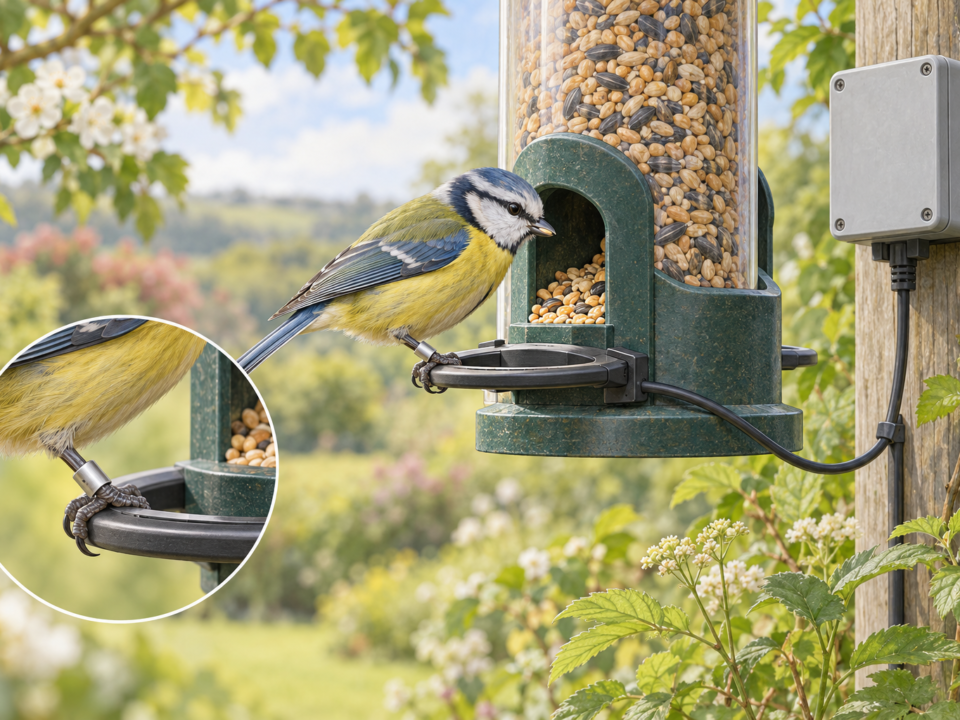
A transponder can outlast the particular handheld reader, computer or file format originally used by a project. Long-term planning should therefore preserve the full tag configuration and the requirements for reading it, rather than relying only on an informal product name.
Keep the relationship between the code and the record too. If an ID is exported in a different representation, or leading zeros are lost in a spreadsheet, an old animal can appear to be a different entry. Retaining original values and documenting transformations helps maintain continuity.
Equipment changes deserve a controlled comparison. Read known reference tags, compare complete IDs and confirm what the new arrangement stores. The aim is to preserve the identity across the change rather than assume that a new device behaves exactly like the previous one.
Plan checks that answer a specific question
Different checks establish different things:
- A known reference tag can help check that a reader and its current setup still produce the expected ID.
- Representative passage tests can examine relevant positions and orientations in a detection area.
- A record comparison can check whether displayed IDs and saved events agree.
- A properly designed animal study can assess retention and other biological outcomes over its observation period.
One check does not replace the others. Successfully reading a reference beside the antenna, for example, does not demonstrate complete coverage of every possible animal path. Nor does a clear data file establish that a tag was retained by every individual.
A practical continuity log
A long project needs a way to distinguish a changed observation system from a changed animal history. The following checkpoints organize that work without imposing one universal inspection interval:
| Checkpoint | Keep in the record | Purpose |
|---|---|---|
| Before deployment | Tag configuration, known reference IDs, reader/antenna setup and sample output | Establish the baseline for future comparisons. |
| At planned service visits | Power state, operation gaps, reference reads and saved-event checks | Explain periods with few or no observations. |
| After equipment or software changes | Old/new full-ID comparison, settings and output examples | Keep the same animal from becoming an apparent new identity. |
| At season close or data handover | Raw records, corrected versions, field definitions and processing rules | Preserve interpretability after staff or software changes. |
For example, retaining older G-003 FDX-B identities while adding a W90A or W91A handheld reader is a compatibility and data-comparison task. Read known samples and compare full IDs before merging histories. Reader availability over time is part of the project plan; a battery-free tag does not preserve its own external records.
Write long-term requirements into the project specification
Define the intended observation period, tag configuration, reader support, environmental conditions and records to be maintained. For animal work, the selected attachment and handling procedures belong in the qualified project protocol.
Ask suppliers about the actual product’s stated service conditions and available evidence. If a new order is intended to remain compatible with an older population of tags, describe that population and its readers explicitly.
At DO RFID, the PIT tag supply page is a starting point for that configuration discussion. A long-term requirement should identify more than “a chip that lasts forever”: it should describe the identity, reading arrangement and useful observations the project needs to preserve.
Frequently asked questions
Do PIT tags run out of battery?
A passive PIT tag has no internal battery. It receives operating energy from a compatible reader.
Does no battery mean no maintenance anywhere?
No. Readers, antennas, power supplies and records can still need checks and maintenance.
Is an unread tag necessarily dead?
No. Reader support, alignment, installation conditions and data handling can also prevent a useful observation.
Does a lifetime tag guarantee lifetime tracking data?
No. Continued data also depend on retention, encounters with compatible working equipment and preservation of the associated records.
Can PIT tags be reused?
Physical readability alone does not establish that reuse is appropriate. Identity management, product condition and the applicable project procedure must all be considered.

Do RFID is a leading China-based manufacturer with over 15 years of experience. We specialize in customized RFID readers, tags, and cards, delivering high-quality, tailored solutions that meet your unique business needs and drive seamless, efficient identification.