November 4, 2026
Access controls and payment processing have both been automated as a result of the advancement of RFID technology. RFID cards are widely used by businesses to speed up the identification process and provide ease.
But counterfeit RFID cards have caused serious security risks. Ingenious methods for duplicating cardholder data have been developed by criminals to create clone RFID cards.
Criminals then access highly restricted areas with the cloned RFID card or withdraw substantial sums of money from the cardholder’s bank account. This article outlines some strategies you can use to safeguard yourself from RFID card cloning scammers.
What is an RFID card and how do you use one?
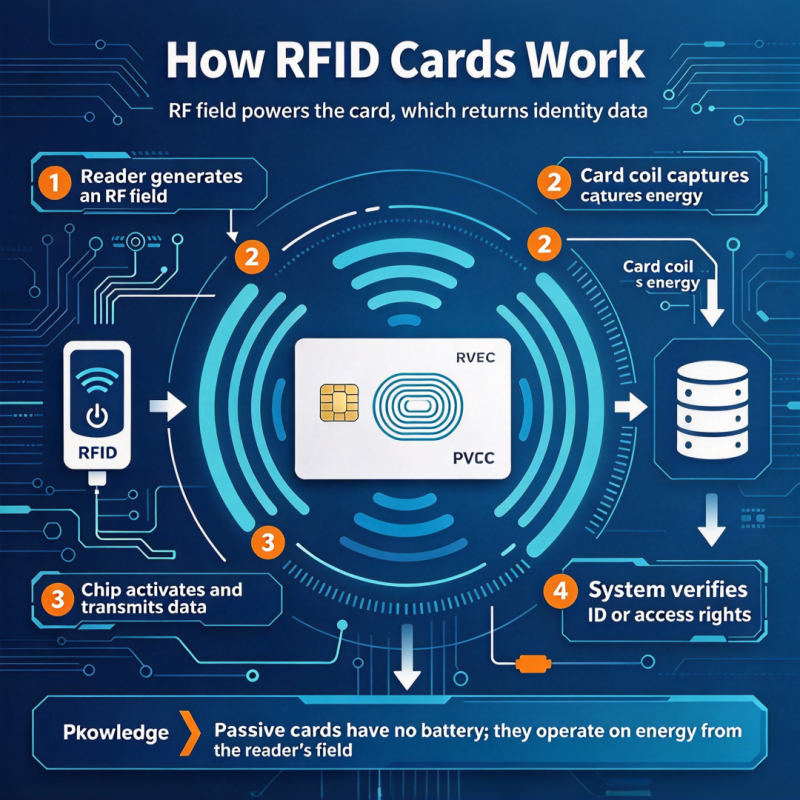
These cards are made of laminated plastic (mostly PVC) and have an RFID chip that contains all the relevant data on the owner. Data is transferred using radio wave signals generated by the tag (the chip).
Anytime an RFID reader is in close proximity to an RFID card, it picks up the electromagnetic waves, records the data, and sends it for analysis. When this occurs, among many other things, the card will allow you to access restricted locations, make payments, and withdraw cash.
Unauthorized individuals who gain access to the data on the RFID chip can quickly copy it onto another card to create a clone. This RFID card copy will function just like the genuine card, which is a serious security risk.
The Process of RFID Card Cloning
The cloning of RFID cards has substantially grown due to technological advancement. Since this issue includes obtaining your data against your will, it is sometimes referred to as “Digital Pickpocketing.”
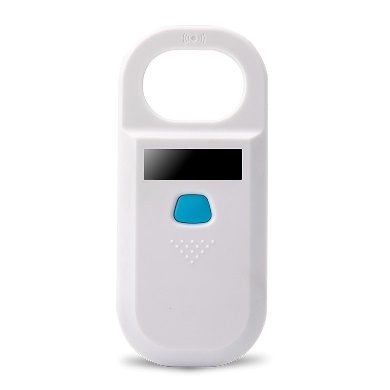
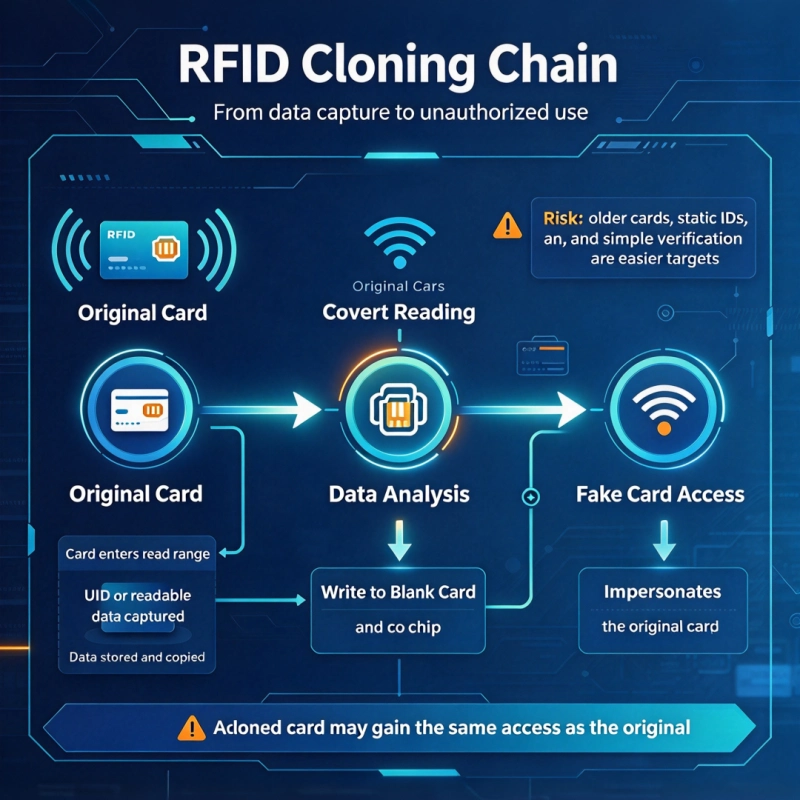
The crooks will need an RFID card reader, data analysis software, and a blank RFID chip/card for the cloning to take place.
Once they acquire the card reader, they will carry it around in a bag while reading RFID cards covertly. Sadly, even when the cards are in pockets or handbags, the RFID card reader will still pick up radio wave signals!
The stolen information is sent to the software, where the thieves copy it to a blank chip to create a counterfeit card.
Then, these information thieves will utilize the RFID card copy to carry out all actions that are otherwise only permitted to the cardholder. With the clone card, they will be able to enter restricted locations and even make purchases!
RFID Card Reading vs. Data Copying vs. Full Cloning
The terms RFID reading, data copying, and card cloning are often used interchangeably, but they describe different technical capabilities.
RFID Reading: This refers to retrieving information that a card makes available to a compatible reader. Depending on the card, this may include a unique identifier, publicly readable data, or authenticated application information.
Data Copying: This involves transferring accessible information from one medium to another. However, copying readable data does not necessarily reproduce the original card’s authentication credentials, protected memory, or transaction behavior.
Full Card Cloning: This refers to reproducing a credential’s relevant behavior closely enough to impersonate the original card in a particular system. Whether this is possible depends on the card’s hardware, protocol, security features, and the access control system’s validation process.
For example, a reader that grants access solely on the basis of a static card identifier may be vulnerable to identifier duplication. A system that requires cryptographic challenge-response authentication can provide substantially stronger protection because the credential must demonstrate possession of the appropriate secret rather than merely present a copied identifier.
These distinctions are important when evaluating RFID security. A successful read operation should never be treated as proof that a card can be fully cloned.
Why RFID Cards Are So Easily Duplicated
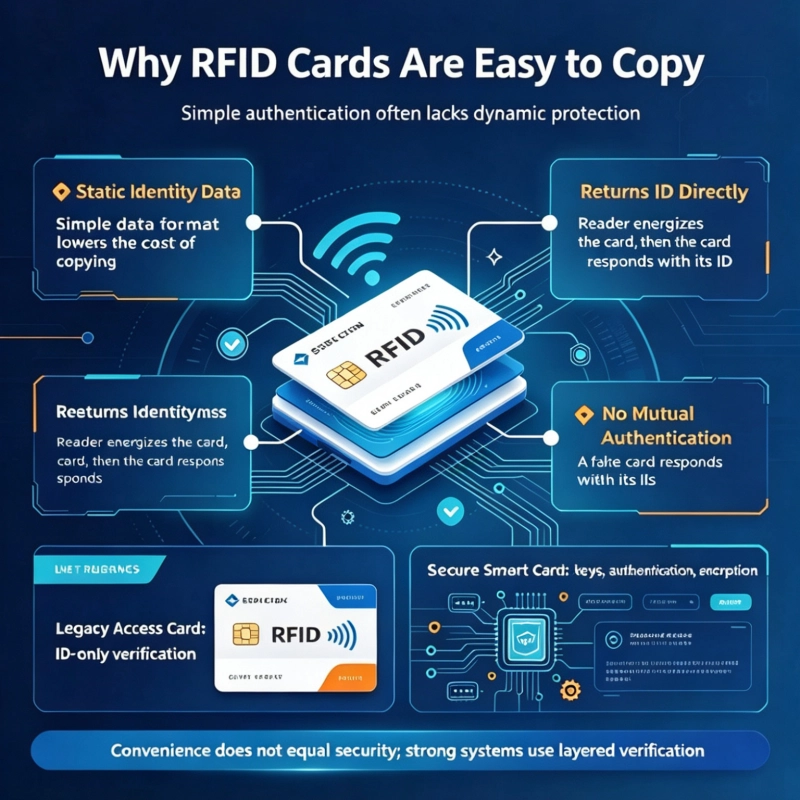
RFID cards come in a variety of forms, from proximity cards to credit cards. They do, however, share a common working theory that criminals have mastered.
The circuitry in these cards is rather simple. When an RFID reader excites the card, it releases the data without needing to be questioned again (unless the card is enabled for 2-factor authentication).
An RFID chip’s coil is excited by the reader’s electrical field, further charging the capacitor. The integrated circuit is then powered by the capacitor, and it transmits the information to the coil. Finally, the reader receives the data from the coil.
As is clear, this procedure is straightforward and lacks any fraud detection security measures (cards manufacturers are increasingly rectifying the anomaly by encrypting the data). Hacking proximity cards and other older generations of cards just requires a basic understanding of radio technology.
Numerous RFID reader gadgets can also assist you in obtaining the key card number, which serves as each card’s engine. While the devices are intended to assist you in recovering or editing the number, thieves may take advantage of them to obtain the information and use it to create a clone card.
However, there are a number of techniques you may take to safeguard your RFID cards and ensure their security.
How RFID Frequency Affects Card Compatibility and Security
RFID systems operate across several frequency ranges, and the frequency determines important aspects of communication, reader compatibility, and typical applications. However, frequency alone does not determine a card’s resistance to cloning.
| RFID category | Typical frequency | Common applications | Security considerations |
|---|---|---|---|
| Low Frequency (LF) | 125–134.2 kHz, depending on the system | Building access, animal identification | Some legacy systems rely on identifiers without strong cryptographic authentication. |
| High Frequency (HF) | 13.56 MHz | Smart cards, transit tickets, NFC applications | Security varies from basic tags to cards supporting strong cryptographic authentication. |
| Ultra-High Frequency (UHF) | Approximately 860–960 MHz, depending on regional regulations | Inventory, logistics, asset tracking | Security features vary by protocol and product; longer read ranges make appropriate access and privacy controls especially important. |
When identifying an RFID card, it is necessary to consider its specific chip, communication protocol, authentication features, and intended application. Two cards operating at the same frequency may have very different security capabilities.
For secure access control, organizations should prioritize credentials with strong authentication, protected cryptographic keys, and readers that correctly enforce the card’s security features. Where practical, legacy systems should be assessed for migration to stronger credentials.
How to Prevent the Duplication of Your RFID Card
Without a question, card skimming is terrifying. It poses serious security risks and can cause losses. As a result, you must take precautions to stop thieves from copying your RFID card. Here are several tried-and-true methods you can use:
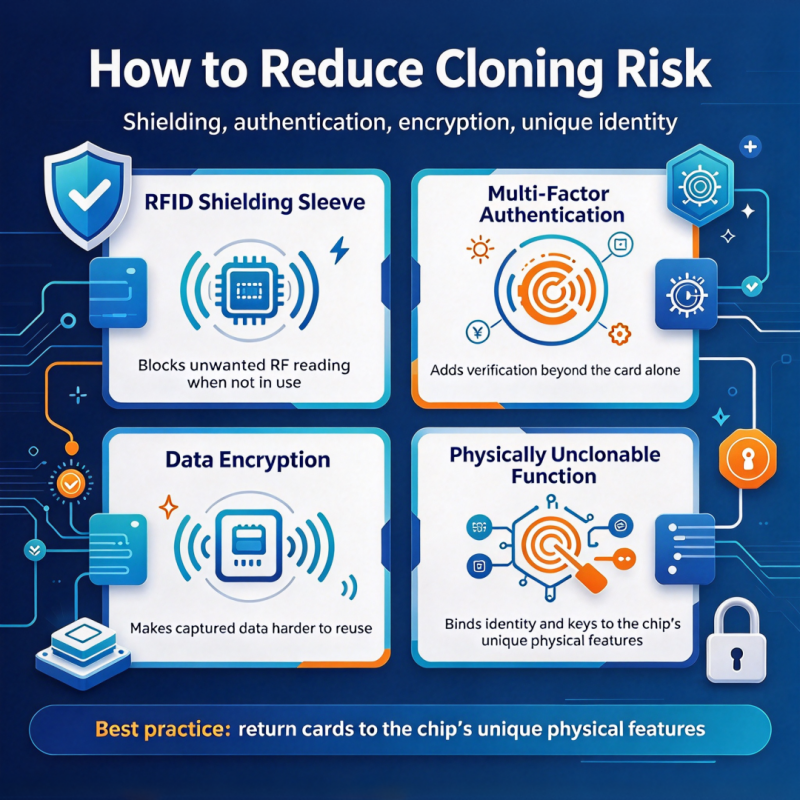
Use RFID card sleeves or blockers
Your card is protected from the card reader by RFID blocks. It creates a boundary that keeps radio wave signals from being picked up by the RFID card reader.
Even better, the RFID reader won’t cause your card to become excited. Therefore, there won’t be any possibility of data transfer from the card to the reader.
These sleeves and blockers may be constructed from various electromagnetism-poor conductors. They might also have a tiny barrier layer of metal in them.
You should choose a card sleeve that makes it simple and quick to remove the card because the sleeves cannot tell the difference between trustworthy and malicious RFID readers. Once you’ve finished your transactions, put the card back in its sleeve for extra security.
Do RFID-Blocking Sleeves Really Work?
RFID-blocking sleeves and wallets are designed to reduce radio-frequency communication between a contactless card and an unauthorized nearby reader. Their effectiveness depends on the shielding materials, construction quality, frequency range, and how the card is positioned inside the sleeve.
Before purchasing an RFID-blocking product, consider the following factors:
- Frequency compatibility: Check whether the product is designed for the frequency used by your card. A product tested for one frequency should not automatically be assumed to block every RFID or NFC system.
- Shielding coverage: Gaps, damaged materials, or incomplete enclosure can reduce effectiveness.
- Independent testing: Prefer products with clear test methods and results rather than relying solely on marketing claims.
- Everyday usability: Make sure the card can be removed conveniently when authorized access is required.
RFID-blocking products are a supplementary physical protection measure. They do not change the security properties of the card itself, protect a card after its credentials have been compromised, or prevent misuse through an insecure access control backend.
For organizations, stronger authentication and appropriate system configuration should remain the primary security measures.
Using two factors to authenticate
Make sure your card supports multi-factor authentication if you want more control over your card info.
You will get a message with a special identifying code when using this idea. You have the option of receiving the code through email or text message.
Once you get the code, you should enter it into the system or click on a link to authorize the transaction. In this way, no one will be able to access your data without your permission.
Today’s cards support this functionality to a large extent. As a result, you should always be diligent about activating it as soon as you receive the card.
Encryption of Data
Data encryption is supported by most smartcards. Regardless of the technique used, this feature makes sure that third parties cannot access your data. You may be confident that your encrypted data is secure as a result.
Why Encryption Alone Is Not Enough
Encryption is an important component of RFID security, but an effective system requires more than encrypted data transmission.
A well-designed RFID access control system may combine several security mechanisms:
- Cryptographic authentication: The reader verifies that a credential possesses the required cryptographic capability instead of trusting a static identifier alone.
- Mutual authentication: Where supported, both the card and the reader verify each other’s authenticity.
- Secure key management: Cryptographic keys must be generated, stored, distributed, and rotated securely. Compromised keys can undermine otherwise strong card security.
- Replay protection: Protocols can use nonces, counters, or other freshness mechanisms to prevent previously captured exchanges from being reused successfully.
- Backend authorization: The access control system checks whether the credential is active and authorized for the requested resource.
- Revocation and monitoring: Lost, stolen, or compromised credentials should be disabled promptly, with suspicious activity reviewed where appropriate.
Security depends on the complete system, including the card, reader, communication protocol, key management infrastructure, and authorization software. A secure card can still be undermined by an improperly configured reader or a backend that accepts insufficient evidence of identity.
For this reason, organizations should evaluate RFID security end to end rather than relying on a single feature or product specification.
Invest in Functions That Are Physically Inclonable (PUFs)
These are special qualities of a card that help set it apart from other cards. In this scenario, a card will have both a cryptographic key and a distinctive identity.
The physical characteristics of the RFID chip will serve as the basis for the unique identification number. The cryptographic key will always be denied if a hacker uses a different RFID chip to copy it since the unique identifier is different.
Frequently Asked Questions About RFID Card Cloning
Can all RFID cards be cloned?
No. RFID cards use different hardware, protocols, and security mechanisms. Some legacy credentials may be vulnerable to identifier duplication, while cards with properly implemented cryptographic authentication can provide stronger resistance to cloning. The outcome also depends on how the reader and backend validate credentials.
Is copying an RFID card’s UID enough to duplicate the card?
Not necessarily. A UID is an identifier, not necessarily the complete set of credentials required for authorization. A system that relies only on a static UID may be vulnerable to impersonation, whereas a system that verifies cryptographic authentication can require additional proof that a copied identifier cannot provide.
Are RFID and NFC the same thing?
No. RFID is a broad family of radio-frequency identification technologies. NFC is a short-range communication technology operating at 13.56 MHz that builds on related high-frequency contactless technologies. Compatibility depends on the specific card, device, and protocol.
Can an RFID-blocking wallet prevent card cloning?
An RFID-blocking wallet may reduce unauthorized wireless communication while a compatible card is properly enclosed. However, it cannot prevent every form of credential misuse, fix weaknesses in a card’s authentication mechanism, or reverse a compromise that has already occurred.
How can I identify the type of RFID card I own?
Start by checking the card documentation, manufacturer, product model, or information provided by the issuing organization. A compatible reader may identify certain technical characteristics, but a readable identifier alone may not reveal the card’s complete security architecture.
How can businesses reduce RFID cloning risks?
Businesses should avoid relying solely on static identifiers for sensitive access decisions. Recommended measures include stronger cryptographic authentication, secure key management, appropriate reader configuration, timely credential revocation, monitoring, and regular security assessments.
Is it legal to clone an RFID card?
The legality depends on the jurisdiction, the type of credential, the intended use, and the authorization provided by the card issuer or system owner. Testing should be limited to cards and systems you own or have explicit permission to assess. Copying credentials to bypass access controls or impersonate another person may violate applicable laws or contractual requirements.
What should I do if I suspect my RFID card has been copied?
Contact the card issuer or system administrator, report the suspected compromise, and request that the credential be reviewed or revoked if necessary. For access control systems, ask whether the credential can be replaced with a stronger authentication option. Do not rely on a new card sleeve as the sole response to a confirmed credential compromise.
Need Help With RFID Readers or Card Compatibility?
Choosing the right RFID reader or identifying the compatibility of an RFID card can be challenging, especially when different frequencies, protocols, and security mechanisms are involved. Whether you are looking for a suitable RFID reader, evaluating card compatibility, or exploring ways to improve your access control system’s security, our team is here to help. Contact us today to discuss your requirements and find the right RFID solution for your application. We are happy to help you make an informed decision with reliable products and professional guidance.

Do RFID is a leading China-based manufacturer with over 15 years of experience. We specialize in customized RFID readers, tags, and cards, delivering high-quality, tailored solutions that meet your unique business needs and drive seamless, efficient identification.