September 14, 2026
Reliable HF RFID Library Labels for Smart Book Management
The ISO 15693 Library Label Sticker RFID Tag for Books is a high-performance HF RFID label designed for modern library management systems, document tracking, and intelligent inventory solutions.
Built with the NXP ICODE® SLIX RFID chip, this RFID library label operates at 13.56MHz and complies with the ISO/IEC 15693 communication protocol. It provides reliable identification, fast data reading, and excellent compatibility with RFID library equipment.
Unlike traditional barcode labels, RFID book tags allow libraries to automate circulation, inventory management, and self-service operations without requiring direct scanning alignment.
The compact 50mm × 50mm RFID sticker label can be attached inside books, files, and other media products while maintaining a clean appearance. Customized printing, barcode printing, QR code printing, and data encoding services are available for different project requirements.
Product Specifications
ISO 15693 Library Label Sticker RFID Tag For Books
| Production name | RFID Library Label |
| Chip | ICODE® SLIXICODE® are registered trademarks of NXP B.V. and are used under license. |
| Protocol | HF:ISO15693 |
| Memory | HF:128byte |
| Frequency | HF:13.56MHz |
| Size | 50*50mm or customized |
| Material | Coated paper,PVC, PET |
| Read Range | HF:0-5cm(depends on the reader and antenna) |
| Carft | Single color or Multi-color Printing,Barcode or QR Code printing,Data encoding,etc. |

Key Features of ISO 15693 RFID Library Label
1. NXP ICODE SLIX RFID Technology
The RFID book label uses the ICODE® SLIX chip, which is specially developed for smart labeling applications including libraries, archives, and document management.
The chip provides:
- ISO 15693 compatibility
- Unique identification number
- Reliable read/write performance
- Anti-collision function for multiple tag reading
- Data protection features
This makes the label suitable for environments where thousands of items need accurate identification.
2. Designed for Library Book Tracking
Traditional barcode systems require manual scanning of each book. RFID library labels simplify the process by allowing faster identification.
Typical applications include:
- Book circulation management
- Library inventory checking
- Self-service borrowing machines
- Book sorting systems
- Archive tracking
A single RFID label can connect physical books with digital management systems, improving operational efficiency.
3. Compact Sticker Design for Easy Installation
The 50×50mm RFID label format is optimized for book applications.
The thin sticker structure allows installation inside:
- Book covers
- Inside pages
- Archive folders
- Document containers
The label can remain hidden while providing reliable RFID identification.
Available materials include:
| Material | Characteristics | Suitable Applications |
|---|---|---|
| Coated Paper | Cost-effective and lightweight | General books and documents |
| PET | Higher durability and moisture resistance | Long-term archive management |
| PVC | Strong protection and flexibility | Industrial applications |
How Does an RFID Library Label Work?
An RFID library label contains three main components:
- RFID chip
- Antenna
- Adhesive label layer
When an RFID reader sends a 13.56MHz radio signal, the passive RFID tag receives energy from the electromagnetic field and responds with stored information.
The basic process:
RFID Reader
      ↓
13.56MHz Signal Transmission
      ↓
RFID Library Label Activation
      ↓
Chip Data Response
      ↓
Library Management System
The RFID system can automatically identify books without requiring visual contact like traditional barcodes.
RFID Library Label vs Barcode Label
RFID technology provides significant advantages compared with conventional barcode management.
| Feature | RFID Library Label | Barcode Label |
|---|---|---|
| Reading Method | Wireless scanning | Optical scanning |
| Direct Line of Sight | Not required | Required |
| Multiple Item Reading | Supported | Usually one by one |
| Data Storage | Available | Limited |
| Reading Speed | Faster | Slower |
| Automation Capability | High | Limited |
| Self-Service Support | Excellent | Basic |
For modern libraries, RFID labels provide better support for automation and digital transformation.
RFID Library Label vs NFC Tag
Although both RFID library labels and NFC tags operate at 13.56MHz, they are designed for different purposes.
| Comparison | RFID Library Label | NFC Tag |
|---|---|---|
| Standard | ISO15693 | ISO14443 (Common) |
| Main Purpose | Library and asset management | Mobile interaction |
| Chip Family | ICODE SLIX | NTAG Series |
| Batch Reading | Supported | Limited |
| Application | Books, files, archives | Smart posters, payment, phones |
| System Integration | RFID readers | Smartphones |
For professional library systems, ISO15693 RFID labels are usually a better choice because they are optimized for inventory management and large-scale identification.
Advantages of Using ISO 15693 RFID Library Labels
Improve Library Inventory Efficiency
Managing thousands or millions of books manually can be time-consuming. RFID library labels help reduce inventory workload by enabling faster identification and automated data collection.
Library staff can use RFID handheld readers to quickly check shelves, locate missing books, and update inventory records.
Benefits include:
- Faster book counting
- Reduced manual operations
- Improved inventory accuracy
- Better collection management
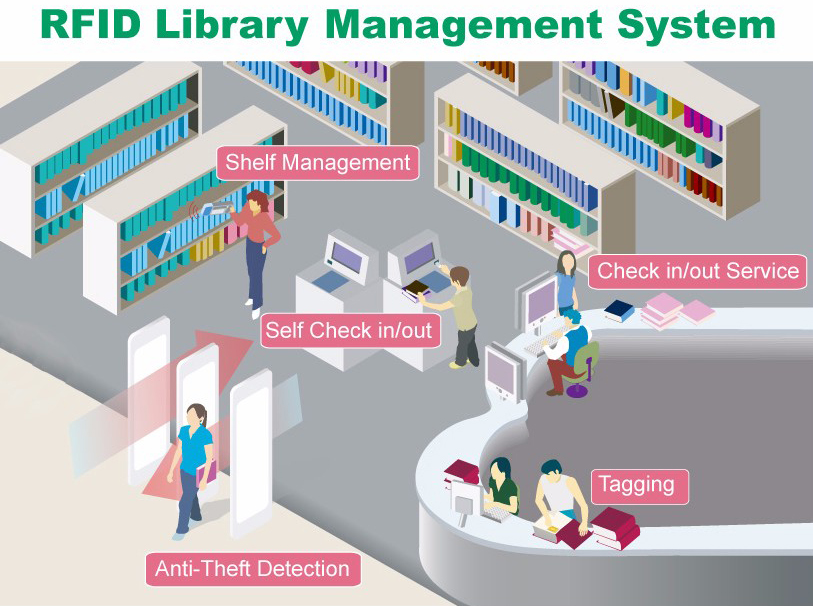
Support Self-Service Library Systems
Modern libraries increasingly use self-service equipment to improve user experience.
The RFID Library Label can work together with:
- Self-service borrowing machines
- Self-service return stations
- RFID security gates
- Library management software
Users can borrow or return multiple books efficiently without manual barcode scanning.
Reliable Performance for Long-Term Use
Library books are usually used for many years. Therefore, RFID labels need to provide stable performance under repeated handling.
The label materials can be selected according to different environments:
- Standard coated paper for general books
- PET material for long-life applications
- PVC material for stronger protection
The durable construction helps maintain RFID performance throughout the product lifecycle.
Applications of RFID Library Label Sticker
The ISO 15693 RFID Library Label is widely used in different information management applications.
Library Book Management
The most common application is library circulation management.
The RFID tag allows libraries to:
- Identify books automatically
- Track borrowing status
- Improve return efficiency
- Reduce processing time
Typical users include:
- Public libraries
- University libraries
- School libraries
- Corporate libraries
Archive and Document Tracking
RFID labels are also suitable for managing valuable documents and archives.
Applications include:
- Government documents
- Historical records
- Legal files
- Enterprise archives
Compared with manual records, RFID systems provide better tracking accuracy and easier searching.
Media Management
The RFID Library Label can also be applied to:
- DVDs
- CDs
- Educational materials
- Research documents
This allows organizations to manage different types of media through one RFID platform.
RFID Library Label Customization Services
Different library projects may require different label designs. We provide flexible customization options.
Custom Printing
The label surface can support:
- Company logo printing
- Library name printing
- Serial number printing
- Product information printing
Printing options include:
| Printing Type | Purpose |
|---|---|
| Single Color Printing | Simple identification and branding |
| Multi-Color Printing | High-quality visual design |
| Barcode Printing | Combination RFID and barcode management |
| QR Code Printing | Additional digital access |
Data Encoding Service
Before shipment, RFID tags can be pre-programmed according to customer requirements.
Encoding options include:
- RFID UID recording
- Book identification number writing
- Custom data storage
- Database matching support
Example:
| RFID Data | Library Information |
|---|---|
| UID Number | Unique tag identity |
| Book ID | Library catalog number |
| Category | Book classification |
| Status | Available / Borrowed |
Installation Guide for RFID Book Labels
Correct installation helps achieve better RFID performance.
Recommended Installation Location
For most books, the RFID label is installed:
- Inside the back cover
- Near the bottom corner of the inner page
- Between cover layers
Avoid placing the label:
- Directly on metal surfaces
- Near strong electromagnetic interference sources
Installation Steps
Step 1: Prepare the Book Surface
Make sure the installation area is:
- Clean
- Dry
- Free from dust
Step 2: Remove Protective Layer
Peel off the adhesive backing carefully.
Step 3: Apply the RFID Label
Press the label firmly onto the selected position.
Step 4: Test RFID Reading
Use an ISO15693 compatible RFID reader to verify:
- Tag recognition
- Reading distance
- Data accuracy
Why Choose ICODE SLIX RFID Library Labels?
The choice of RFID chip directly affects system reliability.
Compared with basic RFID solutions, ICODE SLIX provides advantages for library applications.
| Feature | ICODE SLIX RFID Label | Basic HF RFID Label |
|---|---|---|
| Standard Compliance | ISO15693 | Depends on chip |
| Library Compatibility | Excellent | Limited |
| Read Stability | High | Medium |
| Anti-Collision Function | Supported | Depends on model |
| Professional Application | Libraries and archives | General tagging |
ICODE SLIX has become a popular choice for professional RFID library projects because of its reliability and compatibility.
How to Select the Right RFID Library Label
Before purchasing RFID book labels, consider the following factors.
1. Confirm RFID Protocol
Make sure the label matches your RFID equipment.
For library applications, common requirements include:
- HF 13.56MHz
- ISO15693 protocol
- ICODE series chip
2. Select Suitable Material
Different environments require different materials.
| Environment | Recommended Material |
|---|---|
| Normal library books | Coated Paper |
| Long-term archives | PET |
| High durability requirements | PVC |
3. Consider Custom Requirements
Large projects may require:
- Pre-encoding
- Logo printing
- Barcode printing
- Customized size
- Special packaging
Confirm these requirements before mass production.
Frequently Asked Questions (FAQ)
What is an ISO 15693 RFID Library Label?
An ISO 15693 RFID Library Label is a 13.56MHz HF RFID sticker tag designed for book management, inventory tracking, and document identification. It uses RFID technology instead of traditional barcode scanning.
Which chip is used in this RFID book tag?
This RFID library label uses the NXP ICODE® SLIX chip, which supports ISO15693 communication and is designed for smart labeling applications.
Can this RFID label be used for books?
Yes. It is specifically designed for books, magazines, archives, and other library materials.
What is the reading distance of this RFID tag?
The reading distance is approximately 0-5cm depending on:
- RFID reader model
- Antenna design
- Installation position
- Operating environment
Can the RFID label be customized?
Yes. Custom services include:
- Printing
- Barcode printing
- QR code printing
- Data encoding
- Customized dimensions
Does the RFID tag require a battery?
No. The RFID Library Label is a passive RFID tag and does not require any battery. It receives energy from the RFID reader signal.
Technical Summary
The ISO 15693 Library Label Sticker RFID Tag for Books is a professional HF RFID solution designed for intelligent library management.
With the NXP ICODE SLIX chip, 13.56MHz frequency, and ISO15693 protocol, this RFID label provides reliable identification, flexible customization, and easy integration with modern library systems.
Whether used for books, archives, documents, or media management, this RFID library label helps organizations improve operational efficiency and move toward smarter information management.
Ready to Upgrade Your Library Management System?
Improve book tracking, inventory efficiency, and self-service operations with our ISO 15693 RFID Library Labels. Contact us today for pricing, samples, and customized RFID solutions.
Get a Quote Now | Request Free Samples