September 14, 2026
When RFID tags need to be attached directly to metal surfaces, a standard UHF RFID label may not provide reliable performance. Metal can detune the RFID antenna, reduce read sensitivity, and make the tag difficult to identify from a distance. This long range EPC Gen 2 Alien H3 UHF Mount-On-Metal RFID Tag is designed specifically for applications where RFID identification is required on metal assets.
With a rugged ABS housing, anti-metal construction, IP67 protection, and support for the UHF frequency range of 860–960 MHz, this RFID tag can be used for asset tracking, logistics, equipment identification, warehouse management, construction sites, power inspection, and other industrial applications.
The tag can be supplied with different RFID chip options, including Alien H3, NXP UCODE G2, and Impinj M4, allowing customers to select a memory configuration and RFID performance suitable for their system.
UHF RFID tags can work in high-temperature environment, stable performance, very suitable for IT assets requiring narrow RFID metal tags, such as computer host, switch, server chassis, aluminum strip and shelf identification, vehicle( logistic) and other asset management.
– Material: ABS
– Dimension: 155mm (L) *32mm (W)* 10mm (Th)
– Protective Rating: IP67
– Frequency: ISO18000-6C 860-960MHZ
– Chips available: Alien H3 or NXP U Code G2, Impinj M4 ( Other chips available on request)
Key Features of the Mount-On-Metal RFID Tag
This UHF RFID tags combines a durable physical structure with an antenna design intended for installation on metal surfaces. Its elongated form factor provides a practical mounting solution for equipment, racks, vehicles, and other assets where available installation space is limited.
Key features include:
- UHF RFID operating frequency: 860–960 MHz
- EPC Class 1 Gen 2 / ISO 18000-6C compatible
- Designed for direct mounting on metal
- Available with Alien H3, NXP UCODE G2, or Impinj M4 chips
- Rugged ABS housing
- IP67-rated protection
- Approximate dimensions of 155 × 32 × 10 mm
- Screw mounting and adhesive mounting options
- Suitable for indoor and outdoor asset identification
- Designed for long-range RFID applications
- Custom RFID chip and encoding options available
The anti-metal construction is particularly important when the tag is installed on steel, aluminum, machinery, cabinets, racks, vehicles, or other conductive surfaces.
| ● Robust ● waterproof / dust-proof | ● mounted on metal available |
| ● multi-mounting options (screwing / 3M adhesive layer) | ● RFIchips + ferrite material |
Technical Specification
The following table summarizes the main specifications available for this RFID tag.
| Specification | Details |
|---|---|
| Product Type | UHF Mount-On-Metal RFID Tag |
| RFID Frequency | 860–960 MHz |
| RFID Protocol | EPC Class 1 Gen 2 / ISO 18000-6C |
| Available IC Options | Alien H3, NXP UCODE G2, Impinj M4 |
| Housing Material | ABS |
| Dimensions | 155 × 32 × 10 mm |
| Protection Rating | IP67 |
| Mounting | Screw or adhesive |
| Application Surface | Metal and other industrial surfaces |
| RFID Type | Passive UHF RFID |
| Typical Applications | Asset tracking, logistics, equipment management, construction, power inspection |
| Customization | Chip, printing, encoding and mounting options can be customized |
Actual RFID read range depends on the selected chip, reader, antenna, reader power, tag orientation, installation surface, surrounding environment, and local regulatory requirements. Therefore, the term “long range” should be evaluated according to the complete RFID system rather than the tag alone.
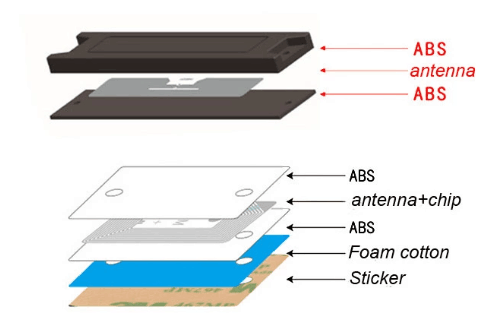
Exploded‑view of anti‑metal RFID pallet tag, showing internal stacked structure of ABS housing, antenna‑chip module, foam spacer and adhesive sticker.
Applications
● IT Asset Management ● logistics management ● power patrol inspection management
● Housing building service ● managing construction sites
When you’re mounting RFID tags on metal surfaces or metal products, you should be aware that if you use non metal mount RFID tags, your system will not function as desired as the metal will detune any passive RFID tag that is not designed to be placed on metal. Using tags that are specifically calibrated to the materials you need to track makes reading, tracking, and inventorying them easier and provides for greater read range.
Metal mount RFID tags are typically rugged, difficult to damage, and easy to weld, screw or otherwise attach.

Schematic diagram of RFID warehouse workflow, demonstrating full storage process including tag authorization, warehousing inventory and goods outbound.
Why Use an RFID Tag Designed for Metal?
Metal presents a special challenge for UHF RFID technology. When a conventional RFID label is placed directly on a metal surface, the metal can interfere with the electromagnetic field around the antenna. This can change the antenna’s operating characteristics and significantly reduce RFID read performance.
A mount-on-metal RFID tag addresses this problem by incorporating an antenna structure and insulating material suitable for conductive surfaces. The construction creates a more suitable operating environment between the RFID antenna and the metal asset.
This makes the tag particularly useful when the RFID identifier cannot be mounted on plastic, cardboard, glass, or another non-metallic area.
For example, a conventional paper RFID label may work well on a cardboard box but perform poorly when placed on a steel cabinet. A dedicated on-metal RFID tag provides a much more appropriate solution for the second application.
Mount-On-Metal RFID Tag vs. Standard UHF RFID Label
Choosing the correct RFID tag design is important because the installation surface directly affects UHF performance.
| Feature | Standard UHF RFID Label | Mount-On-Metal RFID Tag |
|---|---|---|
| Plastic surfaces | Excellent | Excellent |
| Cardboard | Excellent | Excellent |
| Wood | Excellent | Excellent |
| Glass | Generally suitable | Suitable |
| Direct metal mounting | Limited | Designed for this use |
| Rugged equipment | Limited | Suitable |
| Outdoor industrial use | Depends on label construction | IP67 housing |
| Mechanical protection | Low to moderate | High |
| Screw mounting | Usually unavailable | Available |
| Asset identification | Suitable | Suitable |
| Industrial equipment | Application dependent | Strong fit |
A standard UHF inlay is often sufficient for disposable packaging and non-metallic products. A rugged on-metal tag is more appropriate when the RFID tag is expected to remain attached to an industrial asset for an extended period.
Long-Range UHF RFID Performance
Long-range RFID identification can reduce the need for users to physically approach every asset. When an RFID reader and antenna are correctly configured, multiple tagged objects can potentially be identified without requiring direct line-of-sight scanning.
This is particularly useful for inventory and asset management operations where large numbers of tagged items need to be checked efficiently.
However, RFID read distance is not determined by the tag specification alone. Several factors affect actual performance:
- RFID reader output power
- Reader antenna gain and polarization
- Tag orientation
- Distance between reader and tag
- Metal surface characteristics
- Presence of other materials near the tag
- Environmental interference
- Regional UHF frequency regulations
- RFID chip sensitivity
- Installation method
For this reason, customers should evaluate the complete RFID system before defining a guaranteed operating distance.
RFID Chip Options
Different projects can require different levels of memory, performance, and system compatibility. This product can be configured with several popular UHF RFID IC options.
| Chip Option | Typical Advantage | Suitable Applications |
|---|---|---|
| Alien H3 | Widely used UHF RFID IC | General asset identification |
| NXP UCODE G2 | Established UHF RFID platform | Logistics and asset tracking |
| Impinj M4 | High-performance RFID applications | Industrial identification and inventory |
| Custom IC | Application-specific configuration | Specialized RFID projects |
The correct chip should be selected according to the reader ecosystem, memory requirements, encoding process, read performance, and project budget.
If the RFID tag will be encoded before shipment, the EPC memory can also be configured according to the customer’s asset numbering system.
Rugged ABS Housing for Industrial Applications
The tag uses an ABS housing to provide mechanical protection for the RFID inlay and antenna structure.
Unlike a conventional adhesive RFID label, a rigid RFID tag is less vulnerable to tearing, abrasion, and mechanical handling. This makes it better suited to equipment that is moved, inspected, stored, or transported regularly.
The 155 × 32 × 10 mm form factor provides a relatively long and narrow mounting profile. This can be useful for applications where a larger square RFID tag would occupy too much space.
Potential installation targets include:
- Metal cabinets
- Electrical equipment
- Server racks
- Network equipment
- Industrial machinery
- Storage racks
- Vehicles
- Construction equipment
- Metal containers
- Logistics equipment
IP67 Protection for Indoor and Outdoor Use
With an IP67-rated enclosure, the tag is designed to provide protection against dust and temporary water immersion under the conditions defined by the applicable IP rating.
This makes the tag suitable for many environments where ordinary paper or exposed RFID labels may not be durable enough.
For outdoor or harsh industrial applications, however, the complete installation environment should always be evaluated. Long-term exposure to UV radiation, chemicals, extreme temperatures, impact, pressure washing, and other environmental factors can vary significantly from one application to another.
If your project involves unusually high or low temperatures, chemical exposure, or severe mechanical impact, a sample test is recommended before mass deployment.
Flexible Mounting Methods
The RFID tag can be installed using screws or adhesive, depending on the application.
| Mounting Method | Recommended When | Main Advantage |
|---|---|---|
| Screw mounting | Long-term industrial assets | Strong mechanical attachment |
| Adhesive mounting | Smooth and clean surfaces | Fast installation |
| Combination mounting | High-vibration environments | Additional retention |
| Custom mounting | Specialized equipment | Application-specific installation |
Screw mounting is generally preferred when the tagged asset experiences vibration, repeated handling, or long service periods.
Adhesive installation can be more convenient when drilling is undesirable. The surface should be clean, dry, and suitable for the selected adhesive before installation.
Recommended Installation on Metal
Correct installation is essential for reliable UHF RFID performance.
For direct metal mounting, place the RFID tag flat against the designated metal surface and keep the tag away from large obstructions whenever possible. Avoid covering the antenna area with additional conductive materials unless the tag has been specifically designed and tested for that configuration.
The tag orientation should also be considered. Depending on the reader antenna polarization and the movement direction of tagged assets, changing the orientation of the tag can affect the read performance.
For applications requiring consistent identification at a fixed gate or checkpoint, it is recommended to test the complete reader-tag arrangement before finalizing the mounting position.
Applications
IT Asset Management
IT equipment often contains a large amount of metal. Server cabinets, network equipment, computers, and other hardware can therefore be difficult to identify using ordinary RFID labels.
A mount-on-metal UHF tag can provide a dedicated RFID identifier for each asset, helping organizations maintain more accurate equipment records.
Potential uses include:
- Servers
- Network switches
- Storage systems
- Computer equipment
- Metal cabinets
- Data center assets
- IT racks
RFID can also simplify periodic inventory checks by allowing personnel to identify multiple tagged assets using a suitable UHF reader.
Warehouse and Logistics Management
Logistics companies frequently handle metal containers, racks, pallets, carts, and reusable transport equipment.
Instead of manually scanning a barcode on every item, UHF RFID can support automated or semi-automated identification at receiving, storage, shipping, and inspection points.
The rugged housing also makes this type of tag suitable for reusable assets that remain in circulation for extended periods.
Construction Site Management
Construction sites contain many metal tools, machines, components, and temporary assets. These assets can move between different locations and projects, making manual tracking difficult.
RFID tags can be attached to equipment to create a digital identity that can be associated with project, location, maintenance, or ownership information.
Typical targets include:
- Construction machinery
- Metal equipment
- Tools
- Scaffolding components
- Containers
- Temporary site assets
Power and Electrical Equipment
Electrical inspection and maintenance operations can benefit from durable RFID identification.
Tags can be attached to suitable metal equipment and linked to maintenance records, inspection schedules, equipment IDs, or service history.
A rugged on-metal RFID tag can therefore act as the physical identifier connecting an asset in the field with its digital record.
Vehicle and Fleet Identification
The tag’s elongated design can be suitable for certain vehicle and fleet applications where a durable identifier needs to be attached to a metal component.
Potential uses include fleet assets, trailers, service equipment, transport containers, and other mobile equipment.
The exact mounting location should be tested because vehicle construction, metal geometry, nearby electronics, and tag orientation can influence RFID performance.
RFID Asset Tracking Compared with Barcode Labels
RFID and barcode technologies can both be used for asset identification, but they operate differently.
| Capability | Barcode | UHF RFID |
|---|---|---|
| Requires optical visibility | Yes | No |
| Direct line of sight | Usually | Not necessarily |
| Multiple-item identification | Limited | Yes |
| Manual scanning | Usually required | Can be automated |
| Metal-specific design | Not normally required | Important for on-metal use |
| Rugged industrial tags | Available | Available |
| Data stored on identifier | Limited | EPC/User memory depending on IC |
| Automation potential | Moderate | High |
| Best use case | Simple visual identification | Automated asset identification |
For simple, low-cost identification, barcodes may remain the better choice. For high-volume inventory, automated gates, rapid asset counting, or environments where line-of-sight scanning is inconvenient, UHF RFID can offer significant operational advantages.
RFID Tag Selection Guide
Not every application requires the same type of RFID tag. The following guide can help determine whether this product is appropriate.
| Application Requirement | Recommended Solution |
|---|---|
| Cardboard box tracking | Standard UHF RFID label |
| Plastic product identification | Standard UHF RFID label |
| Metal equipment | Mount-on-metal RFID tag |
| Long-term industrial tracking | Rugged RFID tag |
| Outdoor asset identification | IP-rated RFID tag |
| High-volume warehouse inventory | UHF RFID system |
| Reusable metal containers | Rugged on-metal RFID tag |
| IT equipment | On-metal RFID tag |
| Construction equipment | Rugged on-metal RFID tag |
| Specialized harsh environment | Confirm environmental requirements first |
The key question is not simply whether an RFID tag can be read. It is whether it can maintain consistent performance after being installed on the actual asset in the actual operating environment.
Custom RFID Tag Options
Different projects may require different RFID chips, EPC numbers, printing, mounting configurations, or packaging methods.
Customization options can include:
- RFID chip selection
- EPC encoding
- UID or asset-number association
- Logo printing
- Sequential numbering
- Barcode or QR code printing
- Adhesive configuration
- Screw-hole configuration
- Housing customization
- Packaging customization
For large-scale deployment, pre-encoding RFID tags before delivery can simplify installation and reduce the amount of manual data entry required during asset registration.
How to Choose the Right RFID Chip
The RFID chip should be selected based on the actual requirements of the project rather than simply choosing the newest or most expensive option.
Consider the following factors:
Memory requirements: Determine how much EPC, User, or other memory your application needs.
Reader compatibility: Confirm that the selected RFID IC works properly with the reader and software platform used by your system.
Read performance: Different IC generations and antenna designs may provide different performance characteristics.
Encoding requirements: If tags are programmed before installation, confirm the required EPC structure and encoding process.
Project volume: For large deployments, chip availability, supply stability, and cost may be important considerations.
What Affects RFID Read Range?
The phrase “long range RFID” should not be interpreted as one fixed distance under every condition.
A tag may achieve different results depending on the environment and equipment used.
For example, a tag installed on a large flat steel surface may behave differently from the same tag installed near cables, machinery, liquids, or other conductive materials.
Reader antenna positioning is equally important. A high-quality RFID tag cannot compensate for poor reader placement or unsuitable antenna polarization.
For mission-critical applications, we recommend testing representative samples using the actual RFID reader, antenna, asset material, and installation location.
Frequently Asked Questions
Can this RFID tag be mounted directly on metal?
Yes. The tag is specifically designed as a mount-on-metal UHF RFID tag and is intended for applications where the RFID identifier is attached to metal assets.
What frequency does the RFID tag use?
The tag operates in the 860–960 MHz UHF RFID frequency range. The exact operating channel should comply with the RFID regulations applicable to the deployment region.
Which RFID chips are available?
The product can be configured with Alien H3, NXP UCODE G2, or Impinj M4 chips. Other chip configurations may also be available depending on project requirements.
Is the RFID tag waterproof?
The tag is specified with an IP67 protection rating. This provides a substantially more rugged enclosure than a conventional exposed paper RFID label.
Can the RFID tag be screwed onto equipment?
Yes. Screw mounting is supported and can be useful for permanent installation on industrial assets.
Can adhesive mounting be used?
Yes. Adhesive mounting can be used where drilling is not desirable. The surface condition and adhesive selection should be evaluated for the actual environment.
Does “long range” mean the tag can always be read from a specific distance?
No. Actual read range depends on the RFID reader, antenna, power, tag orientation, installation surface, environment, and local regulatory limitations. A complete system test is recommended when a specific read distance is required.
Can the RFID tag be customized?
Yes. Depending on project requirements, customization can include the RFID chip, EPC encoding, printing, mounting configuration, and packaging.
Why Choose a Rugged On-Metal UHF RFID Tag?
For industrial asset identification, the RFID tag is often expected to remain attached to the asset for years rather than days. A durable housing, appropriate antenna structure, and reliable mounting method therefore become just as important as the RFID chip itself.
This long-range EPC Gen 2 UHF mount-on-metal RFID tag is designed around that requirement. Its combination of UHF RFID technology, metal-compatible construction, ABS housing, IP67 protection, and flexible mounting options makes it suitable for a wide range of asset-tracking applications.
Instead of selecting a standard RFID label and trying to adapt it to a metal surface, choosing a purpose-built on-metal RFID tag provides a more application-focused starting point.
For projects involving large numbers of metal assets, automated inventory, logistics tracking, equipment inspection, or industrial asset management, customers can evaluate the tag using their actual reader and installation conditions before proceeding with volume deployment.
Request a Sample or Custom RFID Solution
Every RFID installation is different. The best tag depends on the asset material, mounting location, reader model, antenna configuration, required read distance, environmental conditions, and data structure.
If you are planning an RFID asset-tracking project, provide the target asset type, mounting surface, approximate reading distance, RFID reader model, required chip, and installation environment. These details can be used to determine the appropriate RFID tag configuration and whether sample testing is recommended before mass production. Feel free to contact us.
A representative sample test is particularly valuable for metal assets because the geometry and surrounding materials can influence UHF RFID performance.