October 21, 2026
Introduction
As organizations continue to embrace digital transformation, the demand for highly secure contactless smart card technology has never been greater. From public transportation and corporate access control to cashless payment systems and university campuses, secure RFID credentials have become an essential part of modern infrastructure.
Among all contactless smart card technologies, MIFARE DESFire EV3 stands out as one of the most advanced, secure, and flexible NFC chips available today. Built on decades of development in secure RFID technology, DESFire EV3 combines enterprise-grade encryption, high-speed communication, multi-application support, and exceptional interoperability into a single smart card platform.
Unlike low-security RFID cards that can be cloned using inexpensive devices, MIFARE DESFire EV3 incorporates state-of-the-art cryptographic authentication and secure messaging, making it an ideal solution for applications where data protection and identity security are critical.
This article explores what MIFARE DESFire EV3 is, how it works, the problems it solves, its technical specifications, application scenarios, competitive advantages, and how it compares with other RFID technologies available today.
What Is MIFARE DESFire EV3?
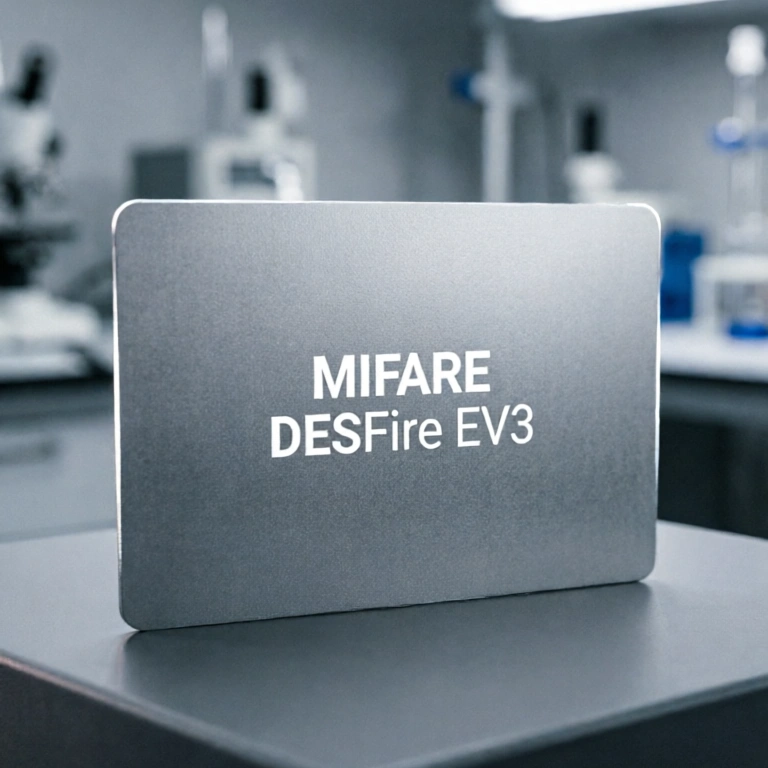
MIFARE DESFire EV3 is a high-security contactless smart card IC developed by NXP Semiconductors. It operates at 13.56 MHz and fully complies with the ISO/IEC 14443 Type A international standard, making it compatible with a wide range of NFC readers and mobile devices.
The “DESFire” name comes from its support for DES, 3DES, and later AES encryption, while EV3 represents the third-generation evolution of the DESFire family, following EV1 and EV2.
Unlike simple RFID memory cards that merely store identification numbers, DESFire EV3 functions as a miniature secure computer with its own operating system, encrypted memory, configurable applications, and advanced authentication mechanisms.
Each card can securely host multiple independent applications, enabling a single credential to perform several functions simultaneously, such as building access, employee identification, cafeteria payment, parking management, and secure printing.
How Does MIFARE DESFire EV3 Work?
The working principle of MIFARE DESFire EV3 combines RFID communication with advanced cryptographic security.
Step 1: RF Power Supply
When the card enters the electromagnetic field generated by an RFID reader, the antenna coil inside the card harvests energy through electromagnetic induction.
No battery is required.
The chip receives sufficient power to activate its processor and memory.
Step 2: Anti-Collision Process
If multiple cards are within the reader’s field, the anti-collision algorithm identifies each card individually.
This ensures reliable communication without data conflicts.
Step 3: Mutual Authentication
Unlike basic RFID cards, DESFire EV3 does not immediately reveal sensitive information.
Instead, both the card and reader authenticate each other using encrypted challenge-response algorithms.
This mutual authentication prevents:
- Unauthorized readers
- Fake cards
- Replay attacks
- Data interception
Only after successful authentication can data exchange begin.
Step 4: Secure Messaging
Every command transmitted between the reader and the card can be encrypted.
DESFire EV3 supports:
- AES-128 encryption
- Secure MAC generation
- Session keys
- Encrypted communication channels
Even if attackers capture RF signals, the transmitted information remains unreadable.
Step 5: Application Execution
Each application stored inside the card has its own:
- File structure
- Encryption keys
- Access rights
- Security policy
Applications remain completely isolated from one another.
For example:
A university card may simultaneously function as:
- Student ID
- Library card
- Dormitory access card
- Cafeteria payment card
- Bus pass
- Attendance card
Each application operates independently while sharing one physical card.
Technical Specifications
MIFARE DESFire EV3 offers significant improvements over previous generations.
Typical specifications include:
| Feature | Specification |
|---|---|
| Operating Frequency | 13.56 MHz |
| Standard | ISO/IEC 14443 Type A |
| NFC Compatibility | NFC Forum Type 4 Tag |
| Memory Options | 2K, 4K, 8K Bytes |
| Data Transfer Rate | Up to 848 kbps |
| Encryption | DES, 2K3DES, 3K3DES, AES-128 |
| Multi-Application Support | Yes |
| Secure Messaging | Yes |
| Mutual Authentication | Yes |
| Random UID Option | Supported |
| Operating Temperature | -25°C to +70°C |
| Data Retention | Up to 25 years |
| Write Endurance | Over 500,000 cycles |
These specifications make DESFire EV3 suitable for long-term, high-security deployments.
Key Features of MIFARE DESFire EV3
1. Enterprise-Level Security
Security is the defining advantage of DESFire EV3.
Key technologies include:
- AES-128 encryption
- Multiple key sets
- Secure session establishment
- Mutual authentication
- Encrypted data transfer
- Secure file access
This dramatically reduces the risk of cloning and unauthorized access.
2. Multi-Application Architecture
One DESFire EV3 card can support dozens of independent applications.
Organizations can consolidate multiple credentials into a single smart card.
Examples include:
Corporate employee cards
Hotel room keys
University campus cards
Membership cards
Public transportation passes
Healthcare identification
Cashless payment
3. Flexible File Management
Unlike traditional RFID memory cards, DESFire EV3 uses a structured file system.
Supported file types include:
- Standard Data Files
- Backup Data Files
- Value Files
- Linear Record Files
- Cyclic Record Files
Each file has independent permissions and encryption keys.
4. High-Speed Communication
With transmission speeds of up to 848 kbps, DESFire EV3 significantly reduces transaction times.
This is particularly important in:
- Subway ticketing
- Stadium entrances
- Corporate access gates
- High-traffic parking systems
Fast authentication minimizes waiting times and improves user experience.
5. Mobile Device Compatibility
DESFire EV3 supports NFC-enabled smartphones.
This enables mobile credential solutions for:
- Digital employee badges
- Hotel mobile keys
- Mobile campus IDs
- Smartphone access control
Organizations can gradually transition from physical cards to mobile identities without changing backend infrastructure.
What Problems Does MIFARE DESFire EV3 Solve?
Problem 1: RFID Card Cloning
Older RFID cards, such as low-frequency EM cards or MIFARE Classic, have been widely cloned using inexpensive hardware.
DESFire EV3 eliminates this weakness through strong cryptographic authentication.
Even if attackers obtain the card UID, authentication cannot be bypassed.
Problem 2: Multiple Cards Per User
Many organizations issue separate cards for:
- Building access
- Cafeteria
- Parking
- Time attendance
- Printing
- Transportation
DESFire EV3 combines all services into one credential.
This reduces management costs while improving user convenience.
Problem 3: Poor Data Security
Traditional RFID cards often store plain-text information.
DESFire EV3 encrypts stored data and communication sessions.
Sensitive information remains protected even if wireless traffic is intercepted.
Problem 4: Complex Credential Management
Separate systems often require separate credentials.
DESFire EV3 supports centralized identity management across multiple applications.
Administrators can update permissions without replacing physical cards.
Problem 5: Future Technology Migration
Organizations increasingly adopt mobile wallets and NFC smartphones.
DESFire EV3 provides compatibility with both physical cards and digital credentials, protecting long-term infrastructure investments.
Major Application Scenarios
Because of its security and flexibility, DESFire EV3 is widely used across numerous industries.
Access Control
Corporate offices
Government buildings
Research laboratories
Data centers
Manufacturing plants
Hospitals
Universities
The encrypted authentication process prevents unauthorized building access.
Public Transportation
DESFire EV3 is commonly deployed in:
Metro systems
Light rail
Bus networks
Regional transportation
Its fast transaction speed allows passengers to pass through gates quickly while securely storing ticket balances and travel history.
Cashless Payment
DESFire EV3 supports secure stored-value applications, making it suitable for:
University cafeterias
Corporate dining
Amusement parks
Sports stadiums
Closed-loop payment systems
Transactions are completed within fractions of a second.
Hospitality
Hotels increasingly adopt DESFire EV3 for:
Room access
Spa access
Gym entry
Cashless resort payments
Guest identification
One smart card simplifies the guest experience.
Education
Universities use DESFire EV3 for:
Student identification
Attendance tracking
Library management
Dormitory access
Meal plans
Campus transportation
Secure printing
One card supports nearly every campus service.
Healthcare
Hospitals use DESFire EV3 to manage:
Medical staff identification
Restricted area access
Patient verification
Equipment authorization
Medication tracking
Its high security protects sensitive healthcare environments.
Government Identity Projects
Many government agencies deploy DESFire EV3 for:
Citizen services
Employee identification
Border facilities
Municipal transportation
Secure authentication reduces fraud while improving operational efficiency.
Competitive Analysis: MIFARE DESFire EV3 vs Other RFID Technologies
Choosing the right RFID technology depends on the required level of security, memory capacity, system scalability, and budget. While many contactless cards look similar on the outside, their internal architecture and security capabilities differ significantly.
The following comparison highlights how MIFARE DESFire EV3 performs against the most common RFID technologies on the market.
MIFARE DESFire EV3 vs MIFARE Classic
MIFARE Classic was once the world’s most widely deployed RFID card, especially in access control and transportation systems. However, its proprietary Crypto1 encryption has been compromised for many years, making cloning relatively easy with readily available hardware.
MIFARE DESFire EV3 addresses these security weaknesses by implementing internationally recognized AES-128 encryption and mutual authentication.
| Feature | MIFARE DESFire EV3 | MIFARE Classic |
|---|---|---|
| Security | AES-128, 3DES, DES | Crypto1 |
| Cloning Resistance | Excellent | Low |
| Multi-Application | Yes | Limited |
| Secure Messaging | Yes | No |
| Data Encryption | Full | Limited |
| Memory Management | Advanced File System | Simple Memory Blocks |
| Recommended For | High-security systems | Legacy systems |
Winner: DESFire EV3
MIFARE DESFire EV3 vs DESFire EV1
DESFire EV1 represented a major leap in smart card security when it was introduced. It remains widely used in transportation and access control projects.
However, EV3 introduces several enhancements, including:
- Improved transaction performance
- Enhanced privacy features
- Better mobile interoperability
- New security mechanisms
- Extended application flexibility
Organizations planning new deployments generally prefer EV3 because of its longer lifecycle and stronger future compatibility.
MIFARE DESFire EV3 vs DESFire EV2
DESFire EV2 added numerous enterprise features over EV1, including delegated application management and enhanced transaction security.
DESFire EV3 further enhances the platform with:
- Secure Dynamic Messaging (SDM)
- Better NFC smartphone support
- Enhanced privacy protection
- Faster implementation of mobile credentials
- Improved anti-counterfeiting capabilities
For most new smart city and enterprise projects, EV3 has become the preferred option.
MIFARE DESFire EV3 vs NTAG Series
NTAG chips are primarily designed for NFC marketing, product authentication, and consumer engagement rather than secure identity management.
Typical NTAG applications include:
- Product packaging
- Smart posters
- Digital business cards
- Website launching
- Asset labels
Unlike DESFire EV3, NTAG chips do not provide enterprise-grade encrypted authentication.
| Feature | DESFire EV3 | NTAG |
| Access Control | Excellent | Not Recommended |
| Mobile NFC | Excellent | Excellent |
| Encryption | AES | Basic Password Protection |
| Payment Systems | Yes | No |
| Identity Management | Yes | Limited |
| Cost | Higher | Lower |
NTAG is ideal for marketing applications, while DESFire EV3 is designed for secure authentication.
MIFARE DESFire EV3 vs FeliCa
Sony’s FeliCa technology dominates the Japanese market and offers very high transaction speeds.
Both technologies provide excellent security, but their regional adoption differs.
DESFire EV3 advantages:
- Strong global ecosystem
- Broad ISO compatibility
- Larger international reader support
- Extensive access control deployment
FeliCa advantages:
- Extremely fast transaction speed
- Strong penetration in Japan
- Excellent transportation integration
For international projects, DESFire EV3 generally offers broader compatibility.
Advantages of MIFARE DESFire EV3
Several characteristics explain why DESFire EV3 has become one of the leading secure RFID platforms worldwide.
Outstanding Security
Its greatest strength lies in enterprise-grade cryptography.
Security features include:
- AES-128 encryption
- Mutual authentication
- Secure session keys
- Encrypted communication
- Random UID support
- Protection against replay attacks
These mechanisms make unauthorized cloning exceptionally difficult.
Excellent Scalability
Organizations can begin with one application and gradually expand to multiple services without replacing existing cards.
For example, a company may initially deploy DESFire EV3 for door access and later integrate:
- Employee attendance
- Secure printing
- Parking management
- Cashless cafeteria payment
- Visitor management
The infrastructure continues to evolve while using the same credentials.
Long Service Life
DESFire EV3 supports:
- More than 500,000 write cycles
- Approximately 25 years of data retention
- High durability under daily use
This minimizes replacement costs for large deployments.
Flexible Security Policies
Each application can define an independent:
- Encryption keys
- User permissions
- Read/write rights
- Administrative control
This makes DESFire EV3 suitable for complex organizations with multiple departments or service providers.
Excellent Mobile Integration
As smartphone-based credentials become increasingly popular, DESFire EV3 enables smooth migration toward mobile NFC solutions.
Users may eventually replace physical cards with digital credentials stored securely on mobile devices while maintaining compatibility with existing readers.
Potential Limitations
Although DESFire EV3 offers exceptional performance, it is not always the best solution for every project.
Higher Initial Cost
Compared with low-frequency RFID cards or MIFARE Classic cards, DESFire EV3 has a higher purchase price.
However, the improved security and longer service life often reduce total ownership costs over time.
More Complex Implementation
Because of its advanced security architecture, DESFire EV3 requires experienced system integrators for:
- Key management
- Application configuration
- Security policy design
- Reader programming
Proper implementation is essential to maximize its security benefits.
Not Necessary for Simple Projects
For applications such as basic inventory labels or promotional NFC tags, DESFire EV3 may provide more functionality than required.
Less expensive NFC chips may adequately meet those needs.
How to Choose the Right MIFARE DESFire EV3 Card
Selecting the appropriate DESFire EV3 card depends on the application’s requirements.
When evaluating products, buyers should consider:
Memory Capacity
Choose based on the number of applications and data storage needs.
Common options include:
- 2K
- 4K
- 8K
Larger memory is recommended for multi-service smart cards.
Card Material
Available options include:
- PVC
- PET
- ABS
- Eco-friendly biodegradable materials
- Composite cards
PVC remains the most popular choice due to its durability and printing quality.
Printing Options
Manufacturers typically offer:
- Offset printing
- CMYK full-color printing
- UV printing
- Silk-screen printing
- Laser engraving
- Variable QR codes
- Barcodes
- Sequential numbering
These options support branding and secure identification.
Personalization
DESFire EV3 cards can be customized with:
- UID registration
- Key injection
- Data encoding
- Logo printing
- Employee photos
- Holograms
- Signature panels
- Magnetic stripes (for hybrid systems)
Complete personalization enables immediate deployment upon delivery.
Future Market Trends
The global smart card industry continues to evolve toward higher security and greater interoperability.
Several trends are driving increased adoption of DESFire EV3:
Smart Cities
Governments are integrating transportation, public services, libraries, parking, and municipal facilities into unified smart card platforms.
DESFire EV3 provides the security and flexibility required for these complex ecosystems.
Mobile Credentials
More organizations are replacing physical access cards with NFC-enabled smartphones.
DESFire EV3’s compatibility with mobile credential solutions positions it well for this transition.
Zero Trust Security
Modern security strategies require continuous authentication rather than assuming trust.
DESFire EV3 supports this approach through encrypted communication and strong identity verification.
Cloud-Based Credential Management
Cloud platforms increasingly manage credential issuance, updates, and revocation remotely.
DESFire EV3 integrates effectively with these centralized management systems.
Multi-Service Digital Identity
Future credentials will combine numerous services into a single secure identity, including:
- Building access
- Transportation
- Healthcare
- Education
- Payment
- Government services
- Digital identity verification
DESFire EV3 is designed to support this convergence.
Conclusion
MIFARE DESFire EV3 represents one of the most advanced and secure contactless smart card technologies available today. By combining AES-128 encryption, mutual authentication, secure messaging, high-speed communication, and flexible multi-application architecture, it provides a comprehensive platform for modern RFID and NFC deployments.
Compared with legacy technologies such as MIFARE Classic, DESFire EV3 delivers dramatically stronger protection against cloning, unauthorized access, and data interception. It also offers superior scalability, allowing organizations to consolidate multiple services—such as access control, cashless payment, transportation, attendance, and digital identity—onto a single credential.
Although its initial investment is higher than entry-level RFID cards, the long-term benefits in security, operational efficiency, and lifecycle cost make it the preferred choice for enterprises, governments, universities, hospitals, transportation authorities, and smart city projects.
As digital identity, mobile credentials, and connected infrastructure continue to expand, MIFARE DESFire EV3 is expected to remain a leading technology for secure contactless authentication. For organizations seeking a future-proof RFID solution with enterprise-grade security and exceptional flexibility, DESFire EV3 is one of the strongest investments available in today’s NFC market.

Do RFID is a leading China-based manufacturer with over 15 years of experience. We specialize in customized RFID readers, tags, and cards, delivering high-quality, tailored solutions that meet your unique business needs and drive seamless, efficient identification.