October 21, 2026
An IP66 UHF RFID reader can be a candidate for dusty or wet industrial installations, but IP66 alone does not establish outdoor suitability. It describes enclosure protection against dust and powerful water jets under defined test conditions. Temperature, condensation, chemical exposure and installed connections need separate assessment.
The reader described on this DO RFID TAG page has published limits of −20 to 60°C operating temperature, −20 to 85°C storage temperature, and 5–95% RH, non-condensing. These conditions apply together: a location can satisfy the temperature range while still creating a condensation problem.
Use this guide to compare those published conditions with your installation, identify useful protective measures and distinguish a plausible fit from an unsupported suitability claim.
What IP66 establishes—and what it leaves open
The first digit in IP66 indicates dust-tight enclosure protection. The second indicates protection against powerful water jets under defined test conditions. For a UHF RFID reader, this helps assess dust and water reaching the enclosure.
The actual exposure determines whether that protection is appropriate. There is no universal rule that every harsh environment requires IP66 or that IP66 addresses every industrial hazard.
| Installation condition | What IP66 establishes | What needs separate assessment |
|---|---|---|
| Airborne dust | Dust-tight enclosure protection | Seal condition, installed connections and dust accumulation that may impede heat dissipation |
| Powerful water jets | Protection under a defined water-jet test | Actual spray pressure, temperature, distance, duration and cleaning agents |
| Flooding or immersion | No immersion protection established | Suitable immersion protection and its applicable conditions |
| Hot or cold surroundings | No temperature capability established | Published operating limits and local thermal conditions |
| Humid air and temperature transitions | No condensation tolerance established | The non-condensing humidity restriction |
| Salt, solvents or detergents | No chemical or corrosion resistance established | Compatibility of exposed materials, seals and cables |
| Shock or vibration | No mechanical performance established | Mechanical specifications, mounting and cable support |
IP67 alone does not prove IP66 water-jet protection. IP67 addresses temporary immersion under defined conditions. Where both jets and immersion matter, look for evidence covering both exposures; the larger number alone does not resolve the requirement.
Apply the published environmental limits separately
The following values come from the existing page’s specification table. They describe the published configuration rather than an independently verified test result.
| Parameter | Published value | Installation significance |
|---|---|---|
| Enclosure protection | IP66 | Assess dust and water exposure within the rating’s scope |
| Operating temperature | −20 to 60°C | Use this range for powered operation |
| Storage temperature | −20 to 85°C | Does not extend the operating limit to 85°C |
| Working humidity | 5–95% RH, non-condensing | Both the humidity range and absence of condensation matter |
| Connector description | Round waterproof M5 pin socket connector | Does not define the complete installed sealing arrangement |
| Power supply | 9–36 V DC | Match the supply and account for cable voltage drop |
| Communication port | RS232 or RS485 | Match the selected configuration to the host and connection documentation |
Operating temperature and storage temperature serve different purposes
Operating at 70°C falls outside the published operating range, even though 70°C lies within the storage range. A storage specification describes a different condition; it does not justify powered operation at that temperature or establish tolerance to every unpowered environmental exposure.
Assess temperature at the intended mounting position. Nearby machinery, restricted airflow and sunlight can create conditions substantially hotter than a general building or weather reading suggests. Solar heating can raise enclosure temperature above surrounding air temperature. A sealed protective cabinet can also trap heat generated inside it.
A sunshade, relocation or an appropriately designed enclosure may help. Assess the resulting thermal conditions during representative operation: adding a cover does not automatically keep the reader within its operating limit.
Non-condensing humidity excludes surface moisture
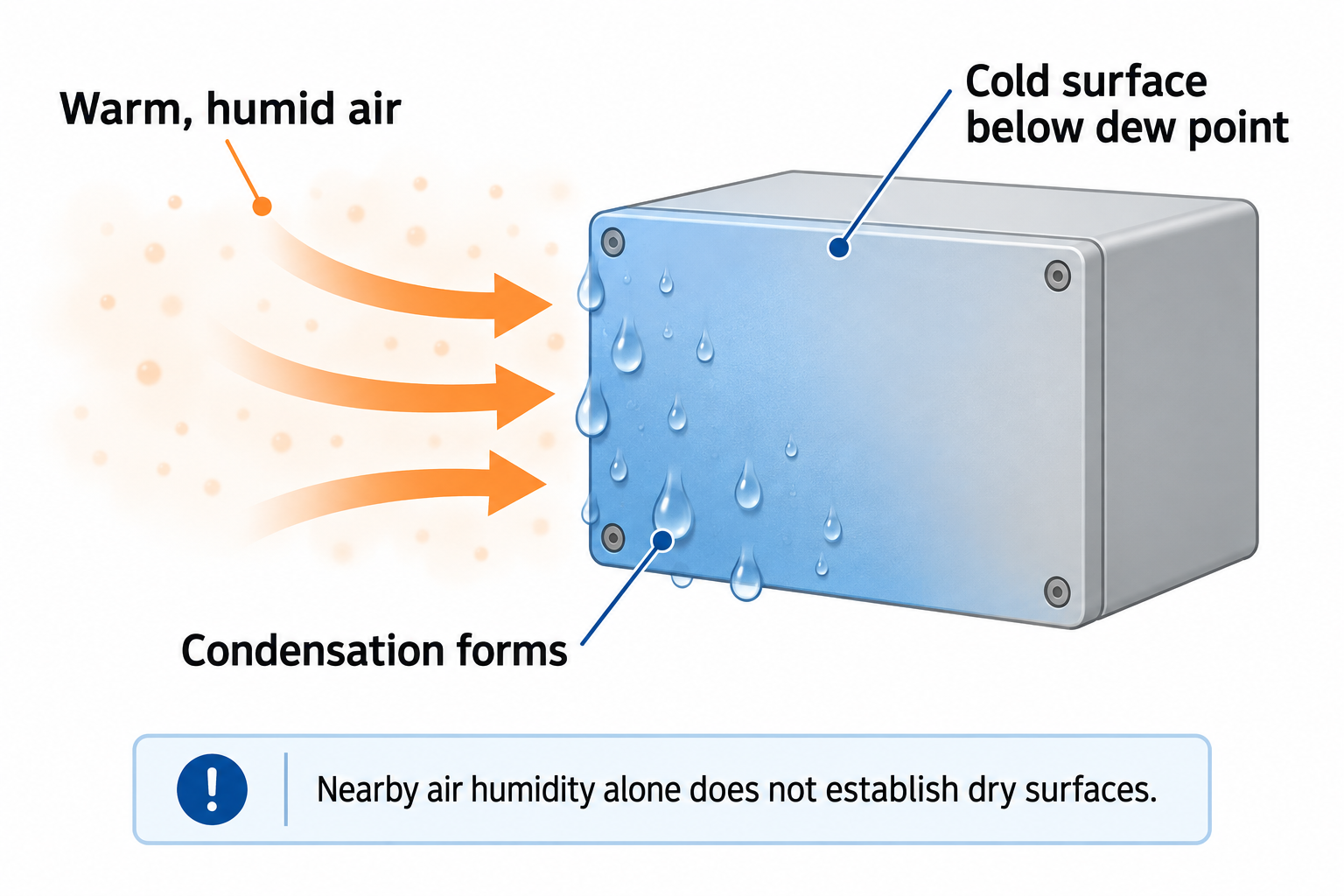
Condensation can form when a surface is colder than the surrounding air’s dew point. A nearby humidity reading below 95% RH therefore does not prove that every equipment surface remains dry.
Consider a cold reader exposed to warm, humid air when a loading-bay door opens. Its surfaces may remain cold long enough for moisture to form. Overnight cooling followed by a humid morning can create a similar problem outdoors.
An IP66 enclosure is not necessarily hermetically sealed, and its rating does not establish control of moisture already inside an assembly. Assess temperature transitions as well as steady operating conditions. Relocation, controlled acclimatization or an engineered enclosure may reduce condensation exposure. Any heating, ventilation or moisture-control arrangement must also preserve the required temperature and ingress conditions.
Is IP66 enough for outdoor use?
IP66 provides useful information about dust and water ingress. Outdoor suitability also depends on sunlight, seasonal temperatures, condensation, weathering and sometimes salt exposure. Exposed housing, seals and cable materials need to suit those conditions.
These examples illustrate assessment decisions; they are not test results for this reader.
| Proposed location | Assessment | Practical consequence |
|---|---|---|
| Sheltered production area at 10–35°C, with dry surfaces and ordinary airborne dust | Temperature fits the published range; dust protection is relevant | A plausible candidate once humidity and installed connections are checked |
| Outdoor gate at −10 to 40°C air temperature, with direct afternoon sun | Air temperature alone leaves solar heating and weathering unresolved | Assess local thermal conditions, shading and exposed materials |
| Cold-room doorway with repeated warm, humid airflow | Condensation may occur within the published temperature range | Resolve condensation exposure before treating the installation as suitable |
| Washdown station using hot detergent spray | IP66 alone does not establish cleaning-process compatibility | Assess cleaning temperature, chemicals and spray conditions separately |
| Low mounting position subject to flooding | Immersion protection is not established by IP66 | Relocate above flood exposure or select equipment with appropriate immersion evidence |
A sheltered installation may reduce exposure, but a canopy does not eliminate wind-driven rain, condensation or seasonal temperature extremes. Assess the conditions that still reach the reader and its connections.
Assess chemicals, corrosion and mechanical exposure
Water ingress protection does not demonstrate resistance to detergent, oil, coolant or solvent. These substances can affect housing finishes, connectors, cable jackets and seals differently. A seal that performs adequately in water may deteriorate in a particular cleaning chemical.
Describe chemical exposure by substance, concentration, temperature, contact duration and frequency. These details make material compatibility assessable. The original page’s general phrase “corrosion-resistant materials” does not establish performance in salt spray or repeated chemical cleaning.
Shock and vibration also require separate consideration. A stationary wall and a moving machine frame impose different loads on brackets and cables. Supporting cables can reduce strain at the connector, while relocation can reduce direct mechanical exposure. Neither measure creates an undocumented shock or vibration rating for the reader.
At a coastal gate, corrosion is a material question. On vibrating machinery, mechanical durability is a mounting and equipment question. The label “industrial grade” does not answer either by itself.
Preserve protection through the installed connections
Environmental suitability depends on the complete installation. An exposed joint or incorrectly assembled mating connector can provide a path for water even when the reader housing is protected.
The published connector description does not specify the required mating assembly, cable dimensions, seal arrangement or tightening procedure. Use the supplied connection documentation for those details; do not infer a torque value or copy a pinout from another reader.
Check that:
- The mating connector and cable assembly match the selected configuration.
- Seals and mating surfaces are clean, intact and assembled as instructed.
- Cable routing avoids standing water and unnecessary connector strain.
- Intermediate joints, junction boxes and exposed power components suit their own exposure.
- Maintenance restores the required sealing after a connection is opened.
Where appropriate, a cable drip loop can reduce water running toward a connection. It cannot compensate for an unsuitable connector or damaged seal. Subsequent inspections should look for loosened connections, damaged cables and seal deterioration, especially after servicing or changes to cleaning routines.
Match the selected interface to the host
The specification table lists RS232 or RS485. The page also names TCP/IP and Wiegand as interface choices; treat these as factory configuration alternatives, rather than four simultaneous standard ports.
Match the chosen interface, wiring and host communication to the supplied documentation. The page’s C#, Java and Android SDK entries do not establish automatic compatibility with every PLC or host application. Power provision and communication setup remain installation tasks, so “plug-and-play integration” is too broad a promise.
Keep environmental suitability separate from read performance
The page publishes a 0–3 m reading range, depending on environment and tag type, and a separate 0–30 cm writing range. These describe different functions. Neither IP66 nor short range guarantees detection accuracy or eliminates unintended reads.
Metal structures, liquids, tag orientation and antenna placement can change RF performance. A protective enclosure or revised mounting arrangement may also change the RF conditions, so validate reading with the final installation in place.
Use workstation read-zone validation for the detailed assessment of intended and unintended tag populations, mounting geometry and event acceptance. That guide’s IP67 configuration should not be assumed identical to this IP66 reader.
For broader comparisons of reader formats, interfaces and distance requirements, see the UHF RFID reader selection guide.
Turn site conditions into an installation decision
Record what the reader will actually experience: local temperature extremes, humidity and temperature transitions, dust, water, cleaning chemicals, sunlight, mechanical loads and cable routing. Include shutdown, cleaning and restart periods where exposure changes.
Assign the proposed installation to one of three practical outcomes:
- Plausible fit: Site conditions align with the published limits, relevant exposures are covered, and the installed connections maintain the required protection.
- Protection or clarification needed: A specific issue remains unresolved, such as solar heating, condensation, detergent compatibility or connector sealing. Identify the protective measure or configuration information needed to resolve it.
- Outside the published limits or protection scope: Required operation exceeds −20 to 60°C, condensation is expected, or the installation involves immersion without suitable supporting evidence. Change the location, engineered protection or equipment selection.
For example, a dry production area measured at 25–45°C may be a plausible environmental fit once its connections and remaining exposures are assessed. A 65°C mounting position exceeds the published operating limit. A 30°C washdown area using detergent remains unresolved despite its acceptable temperature, because chemical and spray compatibility are separate requirements.
Verify representative operating conditions after installation and after material changes to covers, mounting or cleaning procedures. Keep environmental checks separate from RF performance checks: a successful tag read does not demonstrate long-term environmental suitability.
Frequently asked questions
Is an IP66 RFID reader waterproof?
IP66 indicates dust-tight protection and protection against powerful water jets under defined test conditions. It does not establish immersion protection or compatibility with every washdown process. Describe the actual water exposure rather than relying on an unqualified “waterproof” claim.
Can this reader operate at 85°C?
The existing page lists −20 to 60°C for operation and −20 to 85°C for storage. The storage limit does not permit powered operation at 85°C.
Does 95% RH non-condensing allow condensation?
No. The non-condensing condition applies throughout the published 5–95% RH range. Cold surfaces can develop condensation during temperature transitions even when a nearby humidity reading is below 95% RH.
Should I choose IP67 instead of IP66 for outdoor use?
Choose according to exposure. IP66 addresses powerful water jets; IP67 addresses temporary immersion under defined conditions. IP67 alone does not establish IP66 jet protection. Neither rating establishes temperature, condensation, chemical or weathering suitability.