September 28, 2026
If you work with cattle, livestock management, or animal traceability, you may have come across the term RFID cattle tag. But what exactly is an RFID tag for cattle, how does it work, and why is it used in modern livestock management?
An RFID tag for cattle is an electronic identification device that uses radio frequency technology to give an animal a unique digital identity. When a compatible RFID reader scans the tag, the animal’s identification number can be captured automatically and associated with information stored in a livestock management system.
RFID cattle tags can be used for individual animal identification, herd management, livestock traceability, health and breeding records, weighing, feeding management, and other data-driven livestock applications.
This guide explains what RFID cattle tags are, how they work, what information they provide, the different types available, and what to consider when choosing an RFID tag and reader system for cattle.
What Is an RFID Tag for Cattle?
An RFID tag for cattle is a small electronic transponder designed to identify an individual animal using radio frequency technology.
RFID stands for Radio Frequency Identification. Unlike a traditional visual ear tag that normally needs to be read by a person, an RFID tag can communicate electronically with a compatible RFID reader.
Each tag can have a unique identification number. When the tag is within the reader’s operating range, the reader captures this identification information and transfers it to a connected device or livestock management system.
In a typical cattle identification system, the relationship can be represented as:
Cattle → RFID Tag → RFID Reader → Software → Animal Record
The RFID tag provides the animal’s electronic identity, while the reader collects that identity and the software connects it with the animal’s relevant records.
What Does an RFID Cattle Tag Contain?
An RFID cattle tag generally consists of several key components:
| Component | Function |
|---|---|
| RFID IC | Stores the tag’s identification data |
| Antenna | Enables communication with the RFID reader |
| Housing | Protects the electronic components |
| Unique ID | Provides an electronic identity for the animal |
The exact construction depends on the RFID technology, tag format, application, and applicable identification requirements.
For cattle applications, durability is particularly important because tags may be exposed to moisture, dirt, impact, temperature changes, and frequent animal movement.
How Does an RFID Cattle Tag Work?
The basic operation of an RFID cattle identification system is straightforward.
1. The RFID Reader Sends a Signal
A compatible RFID reader generates a radio frequency field through its antenna.
2. The RFID Tag Responds
When an appropriate RFID tag enters the reader’s operating range, the tag communicates with the reader according to the RFID technology and system configuration.
Depending on the tag design, the tag may use energy from the reader’s field or another power source to communicate its identification information.
3. The Reader Captures the Tag ID
The RFID reader receives the tag’s identification data and converts it into information that can be processed by the connected system.
4. The Software Associates the ID With an Animal Record
The unique RFID number can then be associated with information in a livestock management database.
For example:
RFID Tag ID: 982000123456789
can be associated in a database with:
- Animal number
- Breed
- Date of birth
- Sex
- Farm location
- Health records
- Vaccination records
- Breeding information
- Weight records
- Movement history
The RFID tag does not necessarily contain all of this information. In many systems, the tag primarily provides the unique identifier, while the detailed animal information is maintained in the management software or database.
What Information Does an RFID Cattle Tag Store?
One common misconception is that an RFID cattle tag stores an animal’s complete history.
In many applications, the RFID tag primarily contains or provides a unique identification number. That number acts as a key that allows a management system to retrieve the corresponding animal record.
For example:
RFID Tag → Unique ID → Database → Animal Information
This approach makes it possible to connect an animal’s physical identity with digital records without requiring all information to be stored directly on the tag.
The information associated with an RFID identification number may include:
- Animal identification
- Breed information
- Birth date
- Weight
- Vaccination history
- Health information
- Breeding records
- Farm location
- Feeding records
- Movement history
- Sale or transfer information
The exact data structure depends on the livestock management software and the requirements of the farm, organization, or traceability program.
What Are RFID Tags Used for in Cattle Management?
RFID technology can support many livestock management activities by making individual animal identification faster and easier to integrate with digital systems.
Individual Cattle Identification
The primary application of an RFID cattle tag is identifying individual animals.
Instead of relying exclusively on visual identification, an RFID system allows an animal’s electronic ID to be captured automatically by a compatible reader.
This can be useful when managing large numbers of cattle where manual identification becomes time-consuming.
Herd Management
RFID identification can help farms maintain more organized records for individual animals within a herd.
When RFID identification is integrated with farm management software, information collected during different activities can be associated with the correct animal.
Livestock Traceability
Traceability systems need reliable identification methods to connect animals with records throughout their lifecycle.
RFID can provide the electronic identification layer needed to associate animal IDs with events such as movement, transfer, health procedures, and other management activities.
Specific traceability requirements vary by country, livestock program, and application, so users should always verify the applicable local requirements.
Health and Vaccination Records
An RFID animal ID can be associated with health and vaccination records in a database.
When an animal is identified with an RFID reader, the operator can retrieve or update the corresponding record, depending on the software system.
Breeding Management
RFID identification can also be used to associate individual cattle with breeding records.
For example, a farm can use an animal’s electronic ID as the reference point for recording breeding-related information.
Weight and Feeding Management
RFID systems can be integrated with weighing equipment or other farm systems.
When an animal enters a weighing area, for example, the RFID reader may identify the animal while the connected system records the corresponding weight.
This creates a workflow such as:
Animal Identification → Weight Measurement → Database Update
The exact automation possible depends on the RFID reader, software, weighing equipment, and system integration.
What Types of RFID Tags Are Used for Cattle?
There is no single RFID technology that is suitable for every livestock application.
The appropriate RFID tag depends on factors such as operating frequency, required read range, reader infrastructure, tag format, environmental conditions, applicable standards, and system requirements.
LF RFID
LF, or Low Frequency RFID, is commonly associated with animal identification applications.
LF RFID operates at a relatively low frequency and is often selected for applications where reliable identification at relatively short distances is required.
For livestock applications, LF RFID can be suitable when the identification process is designed around controlled reading conditions.
HF RFID
HF, or High Frequency RFID, operates at 13.56 MHz.
HF RFID is widely used in many identification and tracking applications. Whether it is appropriate for a cattle identification project depends on the required operating environment, tag design, reader infrastructure, and applicable standards.
UHF RFID
UHF, or Ultra High Frequency RFID, can provide longer reading distances and support applications involving faster or more distributed identification.
However, UHF is not automatically the right choice for every cattle application.
Actual RFID performance depends on several factors, including:
- Tag antenna design
- Reader power
- Reader antenna
- Tag orientation
- Reading environment
- Tag placement
- Interference
- Required read distance
For this reason, selecting an RFID system should involve evaluating the tag and reader together, rather than choosing a tag based only on its frequency.
RFID Ear Tags
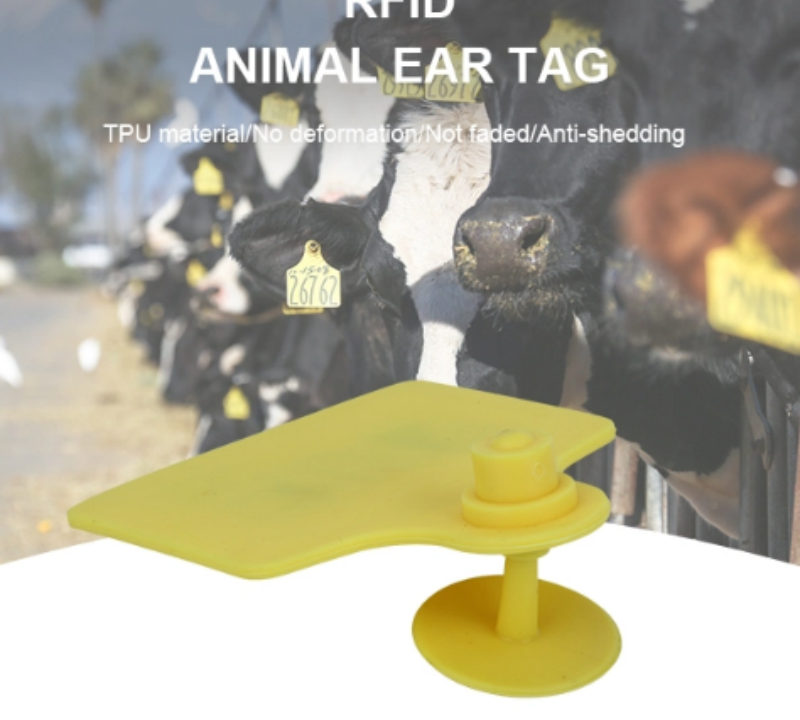
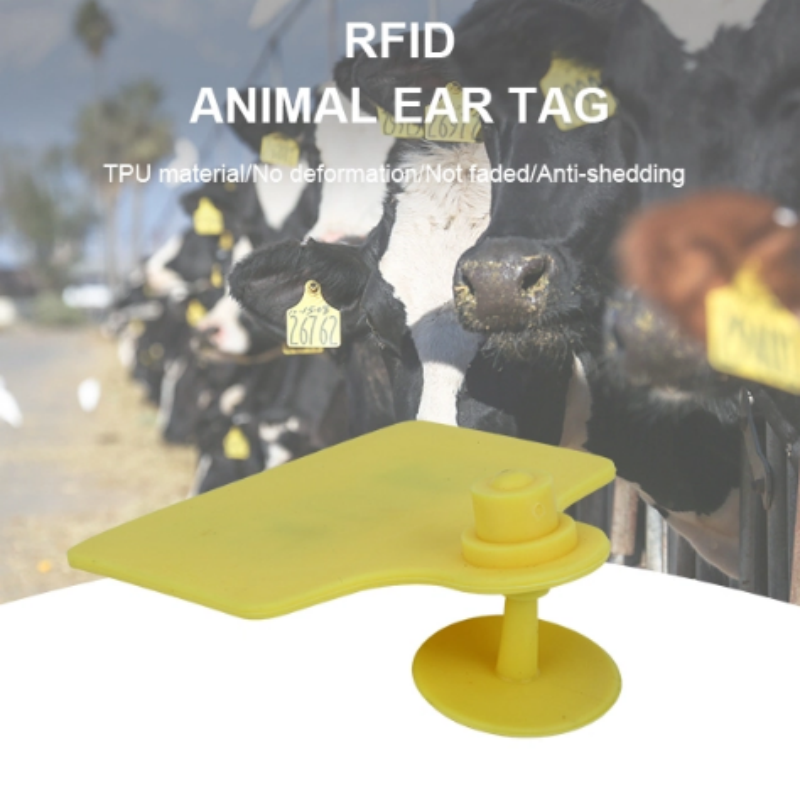
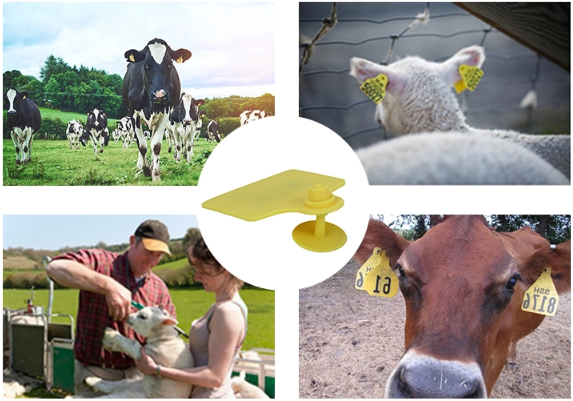
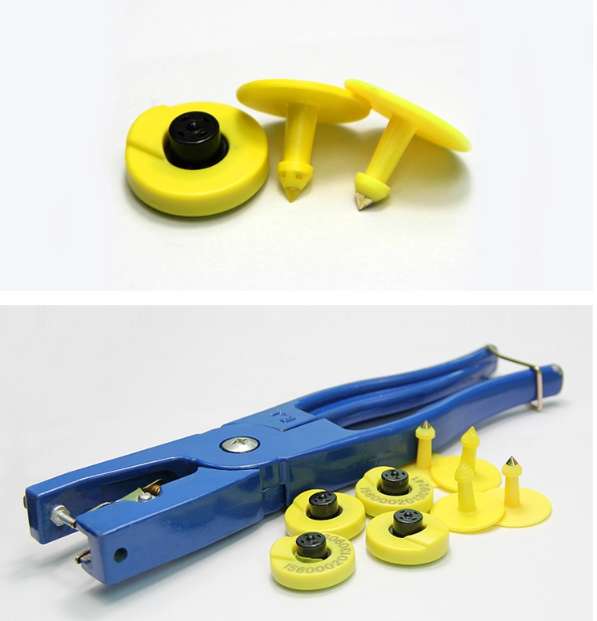
RFID ear tags are one of the most recognizable formats for electronic cattle identification.
They are designed to be attached to the animal’s ear and can combine electronic identification with visual information such as printed numbers, logos, or other markings.
Depending on the application, ear tags may be customized in terms of:
- Dimensions
- Material
- RFID technology
- Printing
- Encoding
- Color
- Branding
- Packaging
RFID Cattle Tags vs. Traditional Ear Tags
Traditional visual cattle tags and RFID cattle tags can serve different identification requirements.
A visual ear tag allows an operator to identify an animal by reading a printed number or other visible information. An RFID tag adds electronic identification that can be captured by a compatible RFID reader.
| Feature | RFID Cattle Tag | Traditional Visual Tag |
|---|---|---|
| Electronic identification | Yes | No |
| Automated scanning | Yes | No |
| Unique digital ID | Yes | Usually visual ID |
| Manual identification | Possible | Usually required |
| Database integration | Yes, with compatible software | More limited |
| Automated data collection | Possible | Limited |
| RFID reader required | Yes | No |
RFID does not necessarily replace visual identification. In some livestock management systems, electronic and visual identification can be used together.
The right approach depends on the operational requirements, applicable regulations, and existing farm management system.
How Far Can an RFID Cattle Tag Be Read?
There is no universal reading distance for RFID cattle tags.
The actual read range depends on the complete RFID system rather than the tag alone.
Important factors include:
- RFID frequency
- Tag antenna design
- Tag size
- Reader output
- Reader antenna
- Tag orientation
- Distance between tag and antenna
- Environmental conditions
- Presence of metal or other materials
- Animal movement
- Reader configuration
A tag advertised with a particular maximum read distance may perform differently in an actual livestock environment.
For this reason, RFID suppliers and system integrators should evaluate the intended use case before specifying the tag and reader combination.
If cattle need to be identified at a controlled point, the system can be designed around a defined reading area. If identification is required from a greater distance or while animals are moving, the reader, antenna, tag, and installation configuration may require additional evaluation.
How Are RFID Tags Attached to Cattle?
RFID animal identification can be provided in different physical formats depending on the application and applicable regulations.
Common formats include:
- RFID ear tags
- Injectable transponders
- Electronic identification devices
- Other livestock-specific RFID transponder formats
For cattle management, RFID ear tags are particularly relevant when the identification system is designed around visible and electronic ear identification.
Installation procedures should follow the tag manufacturer’s instructions and applicable animal welfare and identification requirements.
The physical design of the tag should also take into account durability, animal movement, environmental exposure, and long-term identification requirements.
Are RFID Tags Safe for Cattle?
RFID identification systems are designed for identification and data collection rather than continuous physical monitoring of an animal.
The suitability and safety of a particular RFID tag depend on its design, materials, intended application, installation method, and compliance with applicable requirements.
When selecting an RFID cattle tag, buyers should consider:
- Material quality
- Tag construction
- Mechanical durability
- Intended attachment method
- Environmental resistance
- Applicable identification standards
- Manufacturer quality control
Animal identification products should be selected and used according to relevant local regulations and professional livestock management practices.
What Are the Benefits of RFID Cattle Tags?
RFID cattle tags can provide several operational benefits when they are properly integrated into a livestock identification system.
Faster Animal Identification
RFID readers can capture electronic IDs without requiring an operator to manually read every identification number.
Reduced Manual Data Entry
When RFID identification is integrated with software, animal IDs can be transferred electronically into the corresponding workflow.
This can reduce the amount of manual identification and data entry required.
Improved Data Accuracy
Using a unique electronic identifier can help reduce identification and transcription errors associated with manually recording animal numbers.
RFID does not eliminate all possible errors, but a properly designed system can reduce manual steps.
Digital Traceability
RFID identification allows animal records to be associated with a unique physical identity, supporting digital traceability workflows.
Automated Data Collection
RFID readers can be integrated with weighing equipment, gates, computers, mobile devices, and other systems depending on the application.
Scalable Livestock Management
As the number of animals increases, automated identification can become increasingly useful for organizing animal records and management processes.
How to Choose an RFID Tag for Cattle
Choosing an RFID cattle tag should begin with the application rather than the product specification alone.
Before purchasing RFID tags, consider the following factors.
1. RFID Frequency
Determine whether the application requires LF, HF, UHF, or another RFID technology.
The choice should be based on the required reading environment, applicable standards, reader infrastructure, and system objectives.
2. Read Range
Define how close the RFID reader will be to the animal during identification.
A controlled close-range application may have different requirements from a system designed to identify animals while they are moving through a passage.
3. Tag Durability
Cattle identification tags may be exposed to:
- Rain
- Moisture
- Dust
- Dirt
- Impact
- Temperature changes
- Animal movement
- Outdoor conditions
The tag housing and construction should therefore be appropriate for the intended environment.
4. RFID Reader Compatibility
The RFID tag and RFID reader must use compatible technology.
Before purchasing tags, verify:
- Frequency
- RFID standard
- Reader compatibility
- Encoding requirements
- Antenna configuration
- Communication interface
A high-quality RFID tag cannot compensate for an incompatible reader system.
5. Tag Size and Design
The tag should be appropriate for the intended identification method.
For RFID ear tags, consider the tag’s physical dimensions, attachment method, readability, and durability.
6. Encoding Requirements
Some projects require tags to be supplied with predefined identification numbers or encoded according to a specific data structure.
If encoding is required, discuss the requirements with the manufacturer before production.
7. Customization
Depending on the project, customization may include:
- Logo printing
- Serial numbers
- QR codes
- Barcodes
- RFID encoding
- Tag dimensions
- Color
- Packaging
Custom manufacturing can be particularly useful for farms, distributors, livestock organizations, and system integrators with specific identification requirements.
8. Standards and Regulations
Animal identification requirements can differ significantly between markets.
Before ordering RFID cattle tags, confirm which identification standards and regulatory requirements apply to your target market and livestock program.
How Much Do RFID Cattle Tags Cost?
The price of an RFID cattle tag depends on the product design and order requirements.
Factors that can affect the cost include:
- RFID technology
- RFID IC
- Antenna design
- Tag size
- Material
- Printing
- Encoding
- Customization
- Order quantity
- Packaging
- Testing or certification requirements
For customized RFID cattle tags, requesting a quotation based on the actual specifications is usually more useful than comparing a generic per-tag price.
Buyers should also consider the total system cost, including RFID readers, antennas, software integration, installation, and ongoing management requirements.
RFID Cattle Tag Standards and Regulations
RFID cattle identification is not governed by one universal set of requirements for every country and application.
Requirements may depend on:
- Country or region
- Livestock identification program
- Animal type
- Traceability requirements
- RFID technology
- Identification format
- Government or industry standards
For this reason, a cattle RFID tag that is appropriate for one market may not necessarily meet the requirements of another.
Before purchasing RFID livestock tags, verify the relevant requirements for the destination market and intended application.
For international projects, it is also important to confirm the required RFID standard, identification numbering system, encoding method, and documentation before production begins.
What Should You Look for in an RFID Cattle Tag Manufacturer?
Choosing a manufacturer is not only about finding a supplier that can produce an RFID tag.
A reliable RFID project may require support across product design, RFID technology, encoding, quality control, reader compatibility, customization, and technical support.
When evaluating an RFID cattle tag manufacturer, consider:
RFID Manufacturing Experience
Look for experience in RFID technology rather than general plastic or printing manufacturing alone.
Custom Product Development
If your project requires a specific tag size, housing, antenna, encoding structure, or printed design, confirm whether the manufacturer can support customization.
RFID Reader Compatibility
The manufacturer should be able to help evaluate the relationship between the RFID tag and reader.
Quality Control
Ask about production testing, RFID performance testing, material inspection, and quality control procedures.
Production Capacity
For large livestock identification projects, production capacity and lead time can be important considerations.
Technical Support
Technical assistance can be valuable when integrating RFID tags with readers and livestock management systems.
Warranty and After-Sales Support
A clear warranty and technical support policy can provide additional confidence when deploying RFID products at scale.
Why Choose DO RFID Reader for RFID Products?
DO RFID Reader is a China-based RFID manufacturer and one of the manufacturing operations of D.O RFID Group, with extensive experience in RFID and smart card products.
DO RFID Reader provides RFID readers, RFID tags, RFID cards, NFC products, and customized RFID solutions for applications including access control, vehicle identification, logistics, inventory control, and other identification systems.
With experience in RFID and NFC manufacturing, DO RFID Reader can support customers looking for both standard RFID products and customized product development.
The company’s capabilities include RFID product design and manufacturing, customized tag development, RFID encoding, and integration-oriented product support.
Custom RFID Product Development
Different livestock management projects may have different requirements for tag dimensions, RFID technology, printing, encoding, materials, and packaging.
DO RFID Reader can work with customers to develop RFID products according to project requirements.
Quality and Manufacturing Support
DO RFID Reader focuses on supplying RFID products with quality control and consistent manufacturing processes.
The company also provides a 36-month warranty for products it manufactures.
Technical Support
Technical support is available to help customers address product and integration questions.
DO RFID Reader provides technical support within 24 hours, helping customers move from product selection to implementation more efficiently.
Global Supply
As a China-based RFID manufacturer serving customers worldwide, DO RFID Reader can support international sourcing requirements for RFID readers, tags, cards, and NFC products.
For projects involving cattle identification, the most suitable product depends on the required RFID technology, tag format, reader system, operating environment, and applicable identification standards.
Frequently Asked Questions About RFID Cattle Tags
What is an RFID tag for cattle?
An RFID tag for cattle is an electronic identification device that uses radio frequency technology to provide an animal with a unique digital identifier. A compatible RFID reader can capture the identifier and connect it with information in a livestock management system.
How does an RFID cattle tag work?
An RFID reader communicates with the tag when it is within the appropriate operating range. The reader captures the tag’s identification number and can transfer it to connected software or a database.
What is the difference between an RFID cattle tag and a regular ear tag?
A regular ear tag generally provides visual identification, while an RFID cattle tag can provide electronic identification that can be automatically captured by a compatible RFID reader. Some livestock systems use both forms of identification together.
What information is stored on an RFID cattle tag?
The RFID tag commonly provides a unique identification number. Additional information, such as health, vaccination, breeding, weight, and movement records, is typically maintained in the connected livestock management database rather than directly on the tag.
How far can an RFID cattle tag be read?
There is no universal read range. Performance depends on the RFID frequency, tag design, reader, antenna, tag orientation, installation, environment, and other system factors.
Do RFID cattle tags need a reader?
Yes. An RFID tag needs a compatible RFID reader or identification system to capture its electronic ID. The reader can then transfer the information to a connected computer, mobile device, or management system.
Can RFID cattle tags be customized?
Yes. Depending on the manufacturer and project requirements, RFID cattle tags can potentially be customized in areas such as dimensions, printing, branding, RFID encoding, materials, colors, and packaging.
Are RFID cattle tags suitable for livestock traceability?
RFID can provide the electronic identification layer required by many traceability workflows. However, the exact requirements depend on the applicable country, livestock program, standards, and management system.
What RFID frequency is best for cattle?
There is no single frequency that is best for every cattle application. LF, HF, and UHF technologies have different characteristics. The appropriate choice depends on the required read range, identification environment, standards, reader infrastructure, tag design, and application requirements.
How much do RFID cattle tags cost?
The cost depends on the RFID technology, chip, antenna, tag design, materials, customization, encoding, order quantity, packaging, and other project requirements. For a customized project, a manufacturer can provide a more accurate quotation after reviewing the specifications.
Final Thoughts
An RFID tag for cattle is more than an electronic version of a traditional ear tag. It can serve as the digital identity of an individual animal, allowing livestock managers to connect physical animals with digital records and automated identification workflows.
The basic concept is simple:
RFID Tag → RFID Reader → Unique Animal ID → Management System
From individual identification and herd management to traceability, health records, breeding, weighing, and other livestock applications, RFID technology can help create more connected and data-driven livestock management processes.
However, selecting the right RFID cattle tag requires more than choosing a tag with a particular frequency or advertised read range. The tag, reader, antenna, software, installation environment, identification standards, and operational requirements should be considered as one complete system.
For businesses looking for RFID cattle tags, livestock RFID readers, or customized RFID products, DO RFID Reader can support projects from RFID product selection and customization to manufacturing and technical support. Welcome to contact us!

Do RFID is a leading China-based manufacturer with over 15 years of experience. We specialize in customized RFID readers, tags, and cards, delivering high-quality, tailored solutions that meet your unique business needs and drive seamless, efficient identification.