October 21, 2026
Custom RFID Rubber Silicone NFC Bracelet: The Complete Buyer’s Guide for Smart Access, Cashless Payments, and Event Management
Custom RFID rubber silicone NFC bracelets have become one of the most popular wearable identification solutions for events, resorts, fitness clubs, hospitals, schools, and access control systems. Combining the durability of silicone with RFID or NFC chip technology, these smart wristbands offer secure identification, contactless authentication, cashless payments, and real-time tracking.
Compared with traditional paper wristbands or plastic access cards, silicone RFID bracelets are waterproof, reusable, comfortable, and highly customizable. They help organizations reduce fraud, improve operational efficiency, and enhance customer experiences.
This guide explains everything buyers need to know about custom RFID rubber silicone NFC bracelets, including how they work, available chip options, applications, manufacturing processes, competitor comparisons, purchasing tips, and wholesale pricing from Chinese manufacturers.
What Is a Custom RFID Rubber Silicone NFC Bracelet?
A custom RFID rubber silicone NFC bracelet is a wearable wristband embedded with an RFID or NFC microchip and antenna inside premium silicone material.
When the bracelet is placed near an RFID or NFC reader, it transmits its unique identification number or encrypted data without physical contact.
Unlike disposable wristbands, silicone RFID bracelets are designed for long-term use and repeated scanning.
Typical features include:
- Waterproof
- Sweat resistant
- UV resistant
- Flexible silicone
- Comfortable for all-day wear
- Long service life
- Reusable
- Custom logo printing
- Custom Pantone colors
- Laser engraving
- QR code printing
- Barcode printing
- UID numbering
- Multiple chip options
They combine wearable comfort with digital identification.
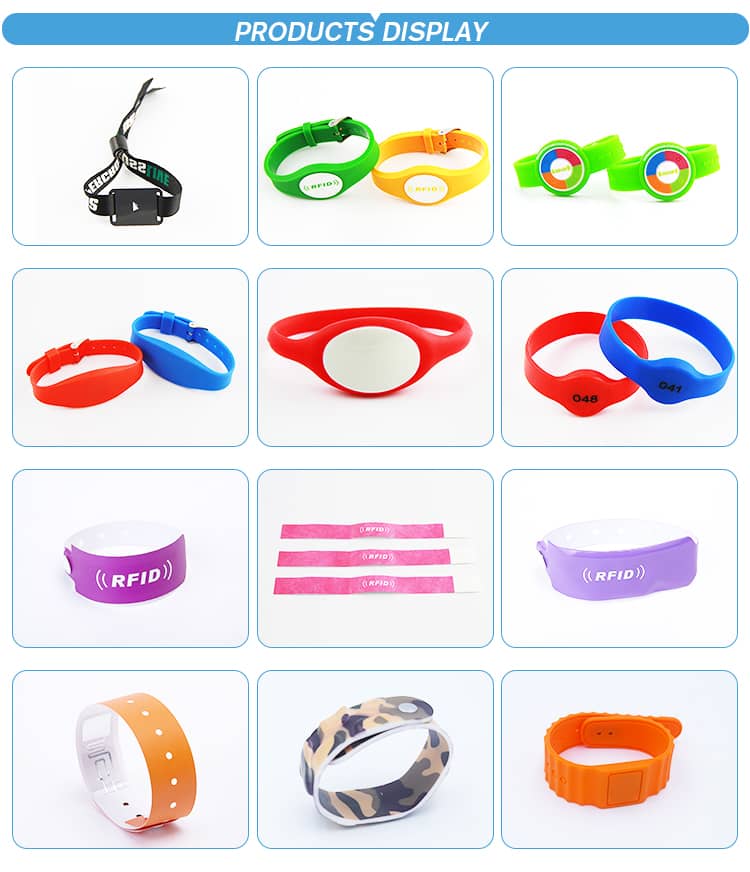

| Product name: | silicone nfc bracelet |
| Material: | Eco silicone, waterproof |
| Size: | perimeter 157mm perimeter 184mm perimeter 195mm perimeter 228mm |
| RFID chip: | LF 125khz, HF 13.56mhz, UHF 860-960mhz |
| Wristband Color: | customized color per PMS |
| Protocol: | ISO14443A, ISO15693, ISO7814, ISO7815, ISO18000-6C etc |
| LOGO Printing: | silk screen printing, laser engraving, embossed, heat transfer etc |
| Crafts | Number printing (Serial No & Chip UID etc), QR, Barcode etc Chip program/encode/lock/encryption will be available as well (URL ,TEXT ,Number and Vcard) |
| Features | Waterproof, heat resistance -30–90℃ |
| Application | Ticketing, Health care, Travel, Access Control & Security, Time Attendance, Parking and Payment, Club/SPA Membership Management, Rewards and Promotion, etc |
| MOQ | 100pcs |
| Sample Policy | Free stock testing sample and buyer pay freight |
Chip Option
ISO14443A | MIFARE Classic® 1K, MIFARE Classic® 4K |
| MIFARE® Mini | |
| MIFARE Ultralight®, MIFARE Ultralight® EV1, MIFARE Ultralight® C | |
| NTAG213 / NTAG215 / NTAG216 | |
| MIFARE ® DESFire® EV1 (2K/4K/8K) | |
| MIFARE® DESFire® EV2 (2K/4K/8K) | |
| MIFARE Plus® (2K/4K) | |
| Topaz 512 | |
ISO15693 | ICODE SLIX, ICODE SLI-S,Tag-it. |
EPC-G2 | Alien H3, Monza 4D, 4E, 4QT, Monza R6, etc |

RFID vs NFC: What’s the Difference?
Although many buyers use the terms interchangeably, RFID and NFC have different characteristics.
| Feature | RFID Bracelet | NFC Bracelet |
|---|---|---|
| Frequency | LF, HF, UHF | 13.56 MHz |
| Reading Distance | Few centimeters to several meters | Usually 2–5 cm |
| Smartphone Compatible | Usually No | Yes |
| Security | High | Very High |
| Typical Applications | Access control, attendance | Mobile interaction, payments, marketing |
NFC is actually a subset of High Frequency RFID technology.
Most smartphone-compatible bracelets use NFC chips.
How Does an RFID Silicone Bracelet Work?
The bracelet contains three primary components:
Silicone Wristband
Medical-grade or eco-friendly silicone protects the embedded electronics while providing flexibility and comfort.
RFID/NFC Chip
The integrated circuit stores information such as:
- User ID
- Membership number
- Payment balance
- Medical record
- Access permissions
- Authentication credentials
Copper or Aluminum Antenna
The antenna receives radio energy from the reader and transmits data wirelessly.
Working Process
- User approaches an RFID reader.
- Reader emits radio frequency energy.
- Antenna captures the energy.
- RFID chip activates.
- Chip transmits stored data.
- Reader verifies information.
- System grants or denies access.
- Database updates transaction records.
The entire process usually takes less than one second.
Common RFID and NFC Chip Options
Choosing the correct chip is one of the most important purchasing decisions.
Low Frequency (125 kHz)
Popular chips:
- TK4100
- EM4100
- EM4305
- T5577
Applications:
- Time attendance
- Parking
- Employee identification
Advantages:
- Stable performance
- Low cost
High Frequency (13.56 MHz)
Popular chips:
- NTAG213
- NTAG215
- NTAG216
- MIFARE Classic 1K
- MIFARE DESFire EV2
- ICODE SLI
- F08
Applications:
- Cashless payment
- Campus cards
- Membership
- Hotel systems
- NFC marketing
Advantages:
- Smartphone compatible
- Higher security
- Fast communication
Ultra High Frequency (860–960 MHz)
Popular chips:
- Alien Higgs
- Impinj Monza
- UCODE
Applications:
- Personnel tracking
- Warehouse management
- Marathon timing
Advantages:
- Long reading distance
- Multiple tag reading
Main Applications
Music Festivals
Large festivals use RFID bracelets for:
- Ticket validation
- VIP access
- Cashless payment
- Social media interaction
- Anti-counterfeit admission
Water Parks
Silicone RFID bracelets perform exceptionally well because they are waterproof.
Functions include:
- Locker access
- Restaurant payment
- Ride reservations
- Guest identification
Hotels and Resorts
Guests can use one bracelet to:
- Open room doors
- Enter swimming pools
- Purchase food
- Access fitness centers
- Join loyalty programs
Fitness Clubs
Gym members enjoy:
- Automatic check-in
- Locker control
- Membership verification
- Attendance records
Hospitals
Medical RFID bracelets improve patient safety by enabling:
- Patient identification
- Medication verification
- Treatment tracking
- Emergency identification
Schools and Universities
Applications include:
- Student attendance
- Library access
- Cafeteria payment
- Dormitory entry
- Examination verification
Manufacturing Facilities
Factories use RFID bracelets for:
- Employee access control
- Shift attendance
- Restricted area authorization
- Safety management
Problems RFID Silicone Bracelets Solve
Eliminates Lost Cards
Employees frequently lose plastic access cards.
Silicone bracelets stay securely on the wrist, reducing replacement costs.
Faster Entry
Traditional ID checks create long queues.
RFID authentication takes less than one second.
Prevents Ticket Fraud
Encrypted RFID chips make duplication much more difficult than paper tickets.
Improves Customer Experience
Visitors no longer need to carry:
- Wallets
- Cash
- Keys
- Membership cards
Everything is stored on one wearable device.
Reduces Operational Costs
Reusable silicone bracelets last for years, lowering replacement expenses compared with disposable wristbands.
Silicone RFID Bracelet vs Other Identification Products
| Product | Waterproof | Reusable | Comfortable | Security | Cost |
| Silicone RFID Bracelet | Excellent | Yes | Excellent | High | Medium |
| PVC RFID Card | Good | Yes | Poor | High | Low |
| Paper RFID Wristband | Limited | No | Good | Medium | Very Low |
| Fabric RFID Wristband | Good | Limited | Excellent | High | Medium |
| Plastic Wristband | Good | Yes | Medium | Medium | Medium |
| Metal NFC Bracelet | Excellent | Yes | Heavy | Very High | High |
For long-term wearable applications, silicone remains one of the best material choices.
Manufacturing Process
Professional manufacturers typically follow these production steps:
Step 1
Prepare premium silicone raw materials.
Step 2
Mix custom Pantone colors.
Step 3
Mold silicone wristbands.
Step 4
Embed RFID or NFC chips.
Step 5
Seal the electronics.
Step 6
Print logos using:
- Silk screen printing
- Pad printing
- Laser engraving
- UV printing
- Debossed logo
- Embossed logo
- Color-filled logo
Step 7
Program chip data.
Step 8
Conduct quality inspection.
Step 9
Package according to customer requirements.
Customization Options
Chinese factories typically offer:
- Custom logo
- Custom color
- Custom size
- UID printing
- QR codes
- Barcode
- Variable numbering
- Chip encoding
- Data initialization
- NFC URL programming
- Individual packaging
- OEM branding
- Private label production
Wholesale Prices
Prices depend on chip type, customization, and order quantity.
| Quantity | Factory Price (USD/Piece) |
| 100 pcs | $0.80–$2.20 |
| 500 pcs | $0.60–$1.80 |
| 1,000 pcs | $0.45–$1.50 |
| 5,000 pcs | $0.35–$1.20 |
| 10,000+ pcs | $0.28–$0.95 |
Advanced chips such as MIFARE DESFire or UHF models typically increase the unit price.
How to Choose the Right Supplier
When evaluating suppliers, consider the following factors:
Manufacturing Experience
Choose factories with several years of RFID production experience.
Chip Authenticity
Verify that original chips are sourced from reputable manufacturers rather than low-quality clones.
Quality Certifications
Look for:
- ISO 9001
- RoHS
- REACH
- CE
- SGS testing reports
Production Capacity
A strong factory should be capable of producing tens or hundreds of thousands of bracelets each month while maintaining consistent quality.
Programming Capability
Many projects require suppliers to pre-encode UID numbers, URLs, encryption keys, or customer-specific data before shipment.
OEM Support
Reliable manufacturers should provide:
- Logo design assistance
- Color matching
- Packaging customization
- Data encoding
- Global shipping
Common Purchasing Mistakes
Many buyers focus only on price, overlooking critical technical requirements.
Avoid these common mistakes:
- Selecting the wrong chip frequency
- Ignoring compatibility with existing readers
- Choosing poor-quality silicone that cracks over time
- Purchasing non-programmable chips for projects requiring data updates
- Forgetting to request waterproof testing
- Not confirming the required reading distance
- Failing to verify chip memory capacity
Providing your application scenario to the supplier before ordering helps ensure the correct chip and wristband specifications are selected.
Future Trends
The market for RFID and NFC wearable technology continues to evolve with new capabilities, including:
- Smartphone-based NFC interactions
- Mobile wallet integration
- Digital identity verification
- Blockchain-enabled authentication
- AI-powered visitor analytics
- Cloud-based access management
- Smart healthcare monitoring
- IoT-connected wearable ecosystems
As organizations pursue smarter, contactless operations, custom RFID silicone bracelets are expected to play an increasingly important role across commercial, industrial, healthcare, and entertainment sectors.
Conclusion
Custom RFID rubber silicone NFC bracelets combine durability, comfort, and advanced contactless technology into a single wearable solution. They support secure identification, access control, cashless payments, attendance tracking, and customer engagement while reducing fraud and improving operational efficiency.
For most wholesale buyers, partnering with an experienced Chinese manufacturer offers the best balance of quality, customization, and cost. By selecting the appropriate chip type, verifying compatibility with your existing systems, and choosing a supplier with strong programming and quality control capabilities, you can deploy RFID silicone bracelets that deliver reliable performance across a wide range of industries—from festivals and resorts to hospitals, schools, factories, and corporate campuses.