September 14, 2026
Our washable NFC PPS RFID laundry tag is designed for textile identification, laundry tracking, garment rental, dry cleaning, inventory management, and logistics applications. Encapsulated in high-temperature PPS material, the tag is built to withstand repeated washing and demanding textile-care processes while providing reliable NFC identification.
Available with NXP MIFARE Ultralight EV1, NTAG213, NTAG215, NTAG216, and other compatible NFC chips, the tag can be customized in different diameters, thicknesses, colors, encoding options, and surface markings.
Its compact construction makes it suitable for sewing into garments or embedding into textile products. Laser serial numbers, colorful printing, and customized identification options are also available for large-volume projects.
Key Features of Washable NFC Laundry Tags
A washable NFC tag needs to perform reliably in environments where conventional paper or adhesive NFC labels may fail. Our PPS RFID laundry tags are designed specifically for textile applications where water, moisture, heat, chemicals, and repeated mechanical handling are part of the daily operating environment.
High-Temperature PPS Housing
The tag uses high-temperature PPS material and double-sided PPS encapsulation to protect the internal NFC inlay. PPS provides a strong protective structure for applications involving repeated washing, drying, and other textile-care processes.
The specified working temperature is -20°C to 220°C. Actual performance can vary according to the selected chip, antenna design, washing process, exposure time, and installation method, so application-specific testing is recommended before mass production.
Designed for Repeated Washing
The tag is specified for more than 150 washing cycles, making it suitable for reusable garments and textiles that repeatedly move through commercial laundry processes.
Typical applications include workwear, uniforms, hotel textiles, healthcare textiles, rental garments, towels, linen, and other reusable textile products.
NFC Identification
The embedded NFC chip provides a unique electronic identity that can be read using compatible NFC-enabled devices. Depending on the selected chip and system design, the tag can store identification information, an NDEF message, a URL, or other application data.
NXP NTAG213, NTAG215, and NTAG216 chips provide 144, 504, and 888 bytes of user memory respectively. They are NFC Forum Type 2 Tag and ISO/IEC 14443 Type A compliant.
Compact Textile-Friendly Design
Several standard diameters are available, including 15 mm, 18 mm, 20 mm, 22 mm, 23.5 mm, and 25 mm. Other dimensions can be developed according to the requirements of your textile product.
The compact design allows the tag to be sewn into garments or embedded into suitable textile structures.
Specifications
Washable NFC PPS RFID Laundry Tag
| Material | PPS |
| Diameter | 15/18/20/22mm/23.5/25 mm or customized |
| Thickness | 2.2mm ,2.7mm/3mm etc |
| Chips | NXP Mifare Ultralight ev1,NXP Ntag213,NXP NTAG215,NTAG216 etc |
| Color | Black, grey, blue etc.(customized color if >5000pcs) |
| Options | Laser serial number on the surfaceEncoding the UIDColorful printing on the surfaceCustomized products as request |
| Storage temperature | Storage temperature |
| Working temperature | -20℃~220℃ |
| Washing times | More than 150times |
| Applications | Textile rental & Dry cleaning/Track & Manage Inventory/Logistic Tracking, etc. |
| Product features | This product is made of high temperature PPS material and used double-sided PPS packaging technology, with waterproof, shockproof, moisture, high temperature and other advantages. It is easy to mosaic or sewn in clothing products. The surface can be directly silk screen, transfer, inkjet or carved number. |

With the increasing upgrading of RFID technology, RFID Laundry Tag are widely used in various laundry scenes, and the traditional manual laundry process has been transformed into a fully automatic processing and recording process. Moreover, sewing RFID Laundry tags on washing products allows users to use the globally unique code of the RFID tag to automatically identify and track the washing process, and to obtain data, so that users can specify higher quality decisions later.

The Package of RFID PPS Laundry Tag
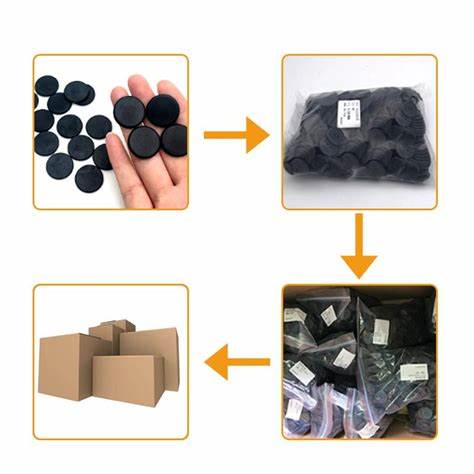
For the other hot selling RFID PPS Laundry Tag products

NFC Chip Options: NTAG213 vs NTAG215 vs NTAG216
Choosing the right NFC chip depends primarily on how much information the application needs to store on the tag.
For simple garment identification or a URL-based digital product page, NTAG213 can often provide sufficient memory. Applications requiring more locally stored information can use NTAG215 or NTAG216.
| NFC Chip | User Memory | Recommended Application |
|---|---|---|
| NTAG213 | 144 bytes | Garment ID, URL, basic product information |
| NTAG215 | 504 bytes | Product data, extended identification, more NDEF content |
| NTAG216 | 888 bytes | Larger data requirements and more advanced NFC applications |
| MIFARE Ultralight EV1 | Application dependent | Compact identification and customized NFC systems |
NXP specifies 144, 504, and 888 bytes of freely available user memory for NTAG213, NTAG215, and NTAG216 respectively. The NTAG21x family also supports features such as a 7-byte UID, password protection, read-only locking, and NFC counter functionality.
For most garment-tracking systems, it is usually more efficient to store a unique identifier or URL on the NFC tag and keep detailed garment information in a cloud or enterprise database.
NFC Laundry Tag vs UHF RFID Laundry Tag
NFC and UHF RFID are both useful for textile tracking, but they are designed for different reading environments.
NFC is particularly suitable when a user needs to interact with an individual garment using a smartphone or short-range NFC reader. UHF RFID is generally more suitable for automated inventory operations where multiple items need to be identified from a distance.
| Feature | NFC Laundry Tag | UHF RFID Laundry Tag |
|---|---|---|
| Frequency | 13.56 MHz | Typically 860–960 MHz |
| Typical Reader | Smartphone or NFC reader | UHF RFID reader |
| Reading Method | Close-range interaction | Long-range wireless identification |
| Individual Item Interaction | Excellent | Possible |
| Bulk Inventory | Limited | Excellent |
| Smartphone Compatibility | Excellent | Requires compatible hardware |
| Digital Product Experience | Excellent | Usually requires dedicated reader |
| Laundry Management | Suitable | Highly suitable for automated bulk tracking |
| Best Use | Smart garments and individual identification | Laundry sorting and inventory automation |
For a smart clothing product that needs to connect a physical garment to a digital profile, NFC is often the more convenient choice. For a commercial laundry facility handling large volumes of textiles, UHF RFID may be preferable for automated bulk reading.
In some systems, NFC and UHF can also be combined to provide both consumer-facing interaction and industrial inventory management.
How a Washable NFC Tag Works
A washable NFC tag connects a physical textile product with a digital identity.
The basic workflow is simple:
NFC Tag → Unique ID → Database → Product or Textile Information
For example, each garment can receive a unique NFC identifier during production. The identifier can then be associated with information such as garment type, size, color, production batch, owner, rental status, and washing history.
When the garment is returned to a laundry facility, the NFC tag can be scanned and the corresponding record can be retrieved from the management system.
This makes it possible to move from manual textile identification toward a digital tracking workflow.
NFC UID and Laser Serial Number
A washable NFC laundry tag can be supplied with both electronic and visible identification.
The NFC chip has a unique identifier that can be used by the software system, while a laser serial number can be marked directly onto the surface of the PPS housing.
For example:
| Identification | Purpose |
|---|---|
| NFC UID | Electronic identification |
| NDEF Data | Digital information stored on the NFC chip |
| Laser Serial Number | Visible manual identification |
| QR Code | Camera-based backup identification |
| Database ID | Enterprise-level textile record |
Using more than one identification method can improve operational reliability. If an NFC reader is unavailable, staff can still identify a garment from its visible serial number or QR code.
Surface Printing and Customization
The surface of the PPS RFID laundry tag can be customized for branding and identification purposes.
Available options include laser engraving, serial numbers, colorful printing, logos, and other markings depending on the selected manufacturing process.
Standard colors include black, grey, blue, and other available options. Customized colors are available for larger orders, with custom color production specified for quantities above 5,000 pieces.
Customization can be used to distinguish different customers, garment categories, rental programs, departments, or product lines.
Available Sizes
Different textile products require different tag sizes. A small tag can be preferable for lightweight garments, while a larger tag may provide additional space for the internal antenna or improve mechanical integration.
| Diameter | Typical Consideration |
|---|---|
| 15 mm | Small garments and compact textile applications |
| 18 mm | Lightweight apparel and uniforms |
| 20 mm | General-purpose textile tracking |
| 22 mm | Commercial garments and laundry products |
| 23.5 mm | Larger textile applications |
| 25 mm | Applications requiring a larger tag structure |
| Customized | Special garment or equipment requirements |
Thickness options include approximately 2.2 mm, 2.7 mm, and 3.0 mm, with customized dimensions available for specific projects.
The final size should be selected together with the NFC chip, antenna design, textile construction, installation method, and required reading performance.
Installation Methods for Textile Products
The PPS laundry tag can be installed by sewing or embedding it into suitable textile products.
For sewn-in applications, the installation position should be selected to minimize discomfort and reduce mechanical stress on the tag during washing.
For embedded applications, the textile manufacturer can reserve a suitable pocket, cavity, or structural position during production.
The recommended installation method depends on the garment construction, fabric thickness, washing process, and required appearance.
Before mass production, we recommend testing the complete garment rather than testing the NFC tag alone. Textile materials and installation methods can influence NFC performance.
Applications of Washable NFC PPS Tags
Textile Rental
Rental companies can assign a digital identity to uniforms, workwear, hospitality garments, and other reusable products.
The NFC tag can connect each physical item with its rental record, customer information, and service history.
Commercial Laundry
Laundry operators can use RFID and NFC identification to improve textile traceability and reduce manual identification work.
For operations requiring high-volume automated reading, UHF RFID may be used alongside NFC.
Dry Cleaning
Reusable garments can be assigned unique electronic identities to help track items through receiving, cleaning, sorting, storage, and return.
Hotel and Hospitality Textiles
The tags can be integrated into uniforms, towels, linen, robes, and other reusable textile products.
Tracking can help operators understand where textile items are in the service cycle and identify missing or misplaced products.
Healthcare Textiles
Hospital uniforms, linens, and reusable textile products can be digitally identified for improved inventory visibility and process management.
Workwear and Uniform Management
Companies managing large numbers of employee uniforms can use NFC tags to connect each garment with a unique digital record.
This can support issue, return, maintenance, replacement, and service-history workflows.
Logistics and Inventory Tracking
A unique NFC identity can connect a physical textile item with an inventory management platform. The tag can serve as a durable identification point throughout the product lifecycle.
Benefits of PPS Encapsulation
PPS is particularly useful for applications where an RFID or NFC tag must survive demanding environmental conditions.
The double-sided PPS packaging described for this product provides a protective structure around the internal electronic components.
Key advantages include:
- Water-resistant construction
- Moisture protection
- Shock resistance
- High-temperature resistance
- Chemical-resistant material properties
- Compact construction
- Suitable for repeated textile processing
- Suitable for sewing or embedding
- Customizable external surface
The actual durability of a finished tag depends on the complete construction and application conditions. For demanding laundry environments, we recommend validating the final tag under the customer’s actual washing, drying, chemical, and mechanical conditions.
Why Choose a Washable NFC PPS RFID Tag?
Traditional paper labels and ordinary adhesive NFC tags are not designed for repeated industrial laundry cycles.
A PPS NFC laundry tag provides a more durable identification solution for reusable textile products. It allows manufacturers and operators to maintain a persistent digital identity throughout the product lifecycle.
Instead of treating every washing cycle as an isolated process, the NFC tag can become the connection between the physical product and its digital record.
This can support better visibility across production, rental, washing, maintenance, storage, distribution, and end-of-life processes.
Custom NFC Laundry Tags for Your Project
Every textile application has different requirements. We can customize the washable NFC PPS RFID tag according to your project specifications.
Customization options include:
- NFC chip selection
- Tag diameter
- Tag thickness
- PPS color
- Antenna design
- UID-related encoding
- NDEF programming
- Laser serial number
- Logo and surface printing
- Customized markings
- Sewing or embedding requirements
- Packaging
- Application-specific testing
If you already have an NFC or RFID system, we can also help select a compatible chip and tag configuration.
For new projects, we recommend defining the complete application before selecting the final tag size and chip.
How to Select the Right NFC Laundry Tag
The most suitable configuration depends on five main factors: application, memory requirement, tag size, washing environment, and reading method.
| Requirement | Recommended Direction |
|---|---|
| Simple garment identification | NTAG213 |
| URL-based digital product page | NTAG213 |
| More NFC data storage | NTAG215 |
| Larger NFC data requirements | NTAG216 |
| Small garment | 15–18 mm |
| General textile use | 20–22 mm |
| Larger textile products | 23.5–25 mm |
| Individual smartphone interaction | NFC |
| Automated bulk laundry tracking | Consider UHF RFID |
| Repeated commercial washing | PPS encapsulation |
| Visible identification required | Laser serial number |
The correct solution should always be verified through sample testing because the antenna, tag diameter, textile material, installation position, and reader can affect the final NFC performance.
NFC Laundry Tag Testing Before Mass Production
For commercial textile projects, sample testing is an important part of product selection.
We recommend evaluating:
- NFC reading performance before washing
- NFC reading performance after repeated washing
- Performance after drying
- Resistance to the customer’s washing chemicals
- Mechanical durability
- Tag attachment or embedding strength
- Smartphone compatibility
- Reader compatibility
- Surface marking durability
- Performance after the target number of washing cycles
A complete garment test provides more useful results than testing the tag by itself because fabric construction and installation can influence the final reading performance.
Frequently Asked Questions
What is a washable NFC laundry tag?
A washable NFC laundry tag is an NFC-enabled identification tag designed to remain functional after repeated textile-care processes. This product uses PPS encapsulation to protect the internal NFC components.
Can a phone read the NFC laundry tag?
Yes, compatible smartphones can generally interact with NFC tags. The actual reading performance depends on the smartphone, NFC chip, antenna design, tag size, and installation environment.
How many washing cycles can the tag withstand?
The product is specified for more than 150 washing cycles. Actual service life depends on washing temperature, chemicals, drying conditions, mechanical stress, installation method, and other application factors.
What NFC chips are available?
Available options listed for this product include NXP MIFARE Ultralight EV1, NTAG213, NTAG215, and NTAG216, as well as other chip options according to project requirements.
What is the difference between NTAG213, NTAG215, and NTAG216?
The main difference is user memory capacity. NTAG213 provides 144 bytes, NTAG215 provides 504 bytes, and NTAG216 provides 888 bytes of user memory.
Can the tag have a serial number?
Yes. A laser serial number can be added to the surface. Color printing and other customized surface identification options are also available.
Can the color be customized?
Yes. Standard colors include black, grey, blue, and other available colors. Customized colors are available for larger-volume orders, with the listed custom-color threshold being above 5,000 pieces.
Can the tag be sewn into clothing?
Yes. The product is designed to be sewn into or embedded in suitable textile products. The installation method should be selected according to the garment construction and washing process.
Can you customize the size?
Yes. Standard diameters include 15, 18, 20, 22, 23.5, and 25 mm, while customized dimensions can be developed for specific applications.
Is NFC better than UHF RFID for laundry tracking?
Neither technology is universally better. NFC is useful for close-range individual identification and smartphone interaction, while UHF RFID is generally better suited to automated bulk inventory and laundry operations. The best choice depends on the workflow.
Get a Customized Washable NFC PPS RFID Tag
Whether you need NFC tags for textile rental, commercial laundry, dry cleaning, workwear, uniforms, hospitality textiles, healthcare textiles, or inventory management, the tag can be configured around your application requirements.
Send us your required tag diameter, thickness, NFC chip, color, quantity, installation method, and washing conditions. We can recommend a suitable PPS NFC laundry tag configuration and provide samples for application testing.
Contact us today to discuss your washable NFC PPS RFID laundry tag project.