October 21, 2026
Custom NTAG216 NFC Stickers are compact, contactless tags designed for product labeling, digital information sharing, marketing, access applications, and other NFC-enabled solutions. Built with the NXP NTAG216 NFC chip, these stickers provide 888 bytes of user memory, 13.56 MHz contactless communication, and compatibility with NFC-enabled smartphones and readers.
The NFC sticker can be customized in different materials, shapes, sizes, printing styles, and surface finishes. Choose from paper, PET, PVC, epoxy, or other materials according to the application environment and required appearance.
Whether you need a simple NFC URL sticker, a branded product label, or a customized NFC tag for a larger project, the NTAG216 platform provides a practical balance between memory capacity, compatibility, and customization flexibility.
NFC Stickers, equipped with NXP NTAG216 NFC Chip NTAG216 Stickers

Product Details
Integrated Circuit (IC): NXP NTAG216; Air interface
protocol: ISO 14443 A;
Operation Frequency: 13.56 MHz;
Memory:888 bytes;
Operating temperature: from -25°C to 70°C / from -13°F to 158°F;
Storage temperature: from -55°C to 125°C / from -67°F to 257°F

| Material | PVC,Paper, Epoxy, PET or customized |
| Printing | Digital printing or offset printing,silk pritning ect |
| Craft | Bar code/QR Code, Glossy/Matting/frosting ect |
| Dimension | Dia18mm ,22mm,30mm, 25mm, 40*25mm, 45*45mm or customized |
| Frequency | 13.56Mhz |
| Read range | 1-10cm depend on the reader and reading environment |
| Application | Activities, product label ect |
| Lead time | Generally about 7-8 working days, it depends on quantity and your request |
| Payment way | WesterUnion, TT, Trade assurance or paypal ect |
| Sample | Avaliable, about 3-7days after confirmed all sample detail |
Chip Options
| Chip Options | |
| ISO14443A | MIFARE Classic® 1K, MIFARE Classic ® 4K |
| MIFARE® Mini | |
| MIFARE Ultralight ®, MIFARE Ultralight ® EV1, MIFARE Ultralight® C | |
| NTAG213 / NTAG215 / NTAG216 | |
| MIFARE ® DESFire ® EV1 (2K/4K/8K) | |
| MIFARE ® DESFire® EV2 (2K/4K/8K) | |
| MIFARE Plus® (2K/4K) | |
| Topaz 512 | |
Remark:
MIFARE and MIFARE Classic are trademarks of NXP B.V.
MIFARE DESFire are registered trademarks of NXP B.V. and are used under license.
MIFARE and MIFARE Plus are registered trademarks of NXP B.V. and are used under license.
MIFARE and MIFARE Ultralight are registered trademarks of NXP B.V. and are used under license.
Why Choose NTAG216 for NFC Stickers?
NTAG216 is designed for applications that require more available memory than smaller NTAG213 or NTAG215 tags. With 888 bytes of user memory, it provides additional space for NFC data while retaining the compact form factor required for stickers and labels.
An NTAG216 sticker can be programmed with information such as a URL, text, contact information, digital content, or other supported NFC records. For many marketing and product-label applications, the NFC tag can be scanned with a compatible smartphone without requiring a dedicated RFID reader.
The choice of NTAG216 is particularly useful when the application requires more data capacity or when future NFC content may need additional space.

NTAG213 vs NTAG215 vs NTAG216
NTAG213, NTAG215, and NTAG216 are commonly used NFC chips from the NTAG family. The main difference for many applications is their available memory capacity.
| Feature | NTAG213 | NTAG215 | NTAG216 |
|---|---|---|---|
| User Memory | 144 bytes | 504 bytes | 888 bytes |
| 13.56 MHz | Yes | Yes | Yes |
| NFC Smartphone Compatibility | Yes | Yes | Yes |
| Typical Positioning | Basic NFC applications | Medium data requirements | Higher data requirements |
| Suitable for URLs | Yes | Yes | Yes |
| Suitable for Product Labels | Yes | Yes | Yes |
| Larger Data Capacity | Limited | Medium | Highest of the three |
For a simple URL or digital business card, NTAG213 may be sufficient. NTAG215 offers more memory for applications requiring additional data. NTAG216 is a suitable choice when higher user memory capacity is preferred.
The correct chip should be selected based on the actual data structure, application requirements, tag size, and total project cost rather than memory capacity alone.
NFC Sticker Material Options
Different applications require different label materials. This product can be manufactured using paper, PET, PVC, epoxy, or other customized materials.
| Material | Main Characteristics | Recommended Applications |
|---|---|---|
| Paper | Lightweight and economical | Indoor labels, marketing, cards, promotional materials |
| PET | Durable and resistant to moisture and handling | Product labels, industrial identification, long-term use |
| PVC | Flexible and versatile | Promotional stickers, product labels, general-purpose NFC tags |
| Epoxy | Protective and decorative surface | Premium products, promotional items, branded tags |
| Custom Material | Designed according to project requirements | Specialized applications |
Paper is often a practical choice for cost-sensitive indoor applications. PET and PVC are better suited when improved durability is required. Epoxy can provide a more decorative appearance and an additional protective layer.
Material selection should also consider the mounting surface, expected environmental conditions, printing requirements, and intended service life.
Custom NFC Sticker Sizes and Shapes
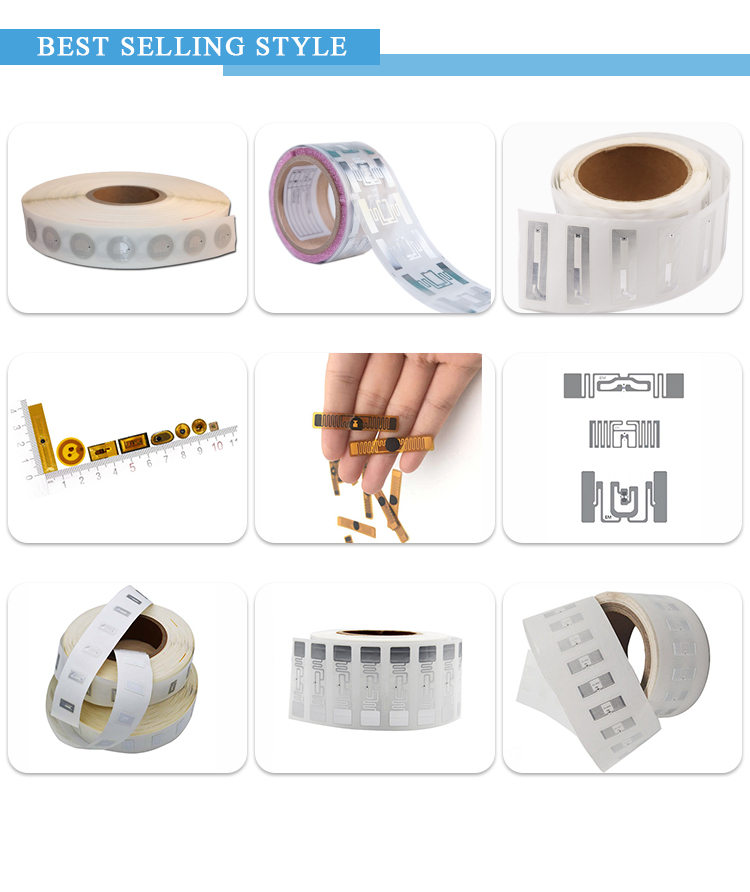
NFC stickers do not need to follow one standard size. The antenna and chip can be designed according to the available space and intended application.
Available options include:
- Round NFC stickers
- Square NFC stickers
- Rectangular NFC labels
- Custom-shaped NFC tags
- Small-format NFC stickers
- Larger branded product labels
Common sizes listed for this product include 18 mm, 22 mm, 25 mm, 30 mm, 40 × 25 mm, and 45 × 45 mm. Custom dimensions can also be discussed for specific projects.
When selecting the size, remember that the physical dimensions of an NFC tag can affect antenna performance and read range. A smaller sticker may be preferable for compact products, while a larger antenna can be useful when greater reading performance is required.
Custom Printing and Finishing
The NFC sticker can be customized to match a brand identity, product package, promotional campaign, or labeling system.
Available printing and finishing options include:
- Digital printing
- Offset printing
- Silk screen printing
- Barcode printing
- QR code printing
- Glossy finish
- Matte finish
- Frosted finish
- Customized artwork and layouts
NFC functionality can be combined with a visible QR code, allowing users to interact with the same digital destination through either NFC or camera scanning.
This combination can be useful for product packaging, promotional materials, review campaigns, menus, information labels, and other customer-facing applications.
How Does an NTAG216 NFC Sticker Work?
An NFC sticker contains a small NFC chip connected to an antenna. When a compatible NFC-enabled smartphone or reader is brought close to the sticker, the reader communicates with the chip through the 13.56 MHz NFC interface.
A typical workflow is:
NFC smartphone or reader → NFC antenna → NTAG216 chip → stored NFC data → digital content
For example, an NTAG216 sticker can be programmed with a URL. When a compatible smartphone detects the NFC tag, the stored NFC record can be used to open the associated web address.
The sticker itself does not require a battery. NFC communication is powered by the electromagnetic field generated by the compatible reader.
Common Applications
NTAG216 NFC stickers can be used in a wide range of applications where contactless information access is useful.
Product Labels
Add NFC functionality to product packaging or labels. Customers can tap the NFC sticker to access product information, instructions, websites, registration pages, or other digital resources.
Marketing and Promotions
NFC stickers can connect physical marketing materials with online content. They can be integrated into promotional campaigns, posters, displays, packaging, and point-of-sale materials.
Digital Business Information
An NFC sticker can be programmed to share contact information, a website, social media profile, or other digital resources.
Customer Reviews
Businesses can use NFC stickers to direct customers to an online review page. A visible QR code can also be printed on the same sticker to provide an alternative scanning method.
Asset and Equipment Identification
Customized NFC labels can be attached to equipment, tools, or other assets where contactless identification is useful.
Event and Promotional Materials
Small NFC stickers can be incorporated into event materials, invitations, promotional products, membership materials, and branded merchandise.
NFC Sticker vs QR Code
NFC and QR codes can provide access to the same digital destination, but the user interaction is different.
| Feature | NFC Sticker | QR Code |
|---|---|---|
| Interaction | Tap or bring phone close | Open camera and scan |
| Visible Code Required | No | Yes |
| Printed Information | Can be combined with printing | Required for scanning |
| Smartphone Compatibility | Requires compatible NFC function | Broad camera compatibility |
| Branding | Highly customizable | Highly customizable |
| Physical Wear | Depends on sticker material | Depends on printed surface |
| Best Use | Fast contactless interaction | Universal visual scanning |
For many applications, NFC and QR codes can work together rather than being treated as competing technologies. An NFC sticker can provide a fast tap experience while a printed QR code gives users an alternative way to access the same content.
NFC Sticker for Metal Surfaces
Standard NFC stickers are generally designed around a specific antenna configuration and mounting environment. Metal surfaces can affect NFC antenna performance and may reduce reading performance if a conventional NFC tag is placed directly on metal.
If the tag will be installed on metal equipment, machinery, shelves, vehicles, or metal packaging, tell us the mounting environment before production.
A specialized NFC tag design, such as an on-metal configuration, may be more appropriate depending on the application.
This is an important consideration when choosing the NFC inlay, antenna design, sticker thickness, and final construction.
Custom NFC Sticker Manufacturing
For custom projects, the NFC sticker can be configured according to several requirements.
| Customization | Available Options |
|---|---|
| NFC Chip | NTAG213, NTAG215, NTAG216 and other supported chips |
| Material | Paper, PET, PVC, Epoxy, customized |
| Shape | Round, square, rectangular, custom |
| Size | Standard or customized |
| Printing | Digital, offset, silk screen and more |
| Surface | Glossy, matte, frosted and customized |
| Visual Code | Barcode, QR code |
| NFC Data | URL and other supported NFC records |
| Packaging | Customized according to project requirements |
Before mass production, artwork, chip type, tag dimensions, material, printing, encoding requirements, and application environment should be confirmed.
NFC Sticker Read Range
The listed read range for this product is approximately 1–10 cm, but this should not be treated as a guaranteed distance for every installation.
Actual NFC performance depends on factors such as:
- Smartphone or reader model
- Antenna size and design
- Tag dimensions
- Tag orientation
- Mounting material
- Nearby metal
- Environmental conditions
- NFC reader power and antenna characteristics
For a new application, testing samples under the actual installation conditions is recommended before placing a large production order.
Quality and Sample Testing
For customized NFC stickers, sample testing is an important part of the development process. Samples can be used to verify the physical appearance, printing quality, NFC performance, dimensions, material, and compatibility with the intended reader or smartphone.
Samples are generally available approximately 3–7 days after all sample details have been confirmed.
For larger projects, testing should ideally be performed using the final material, size, antenna configuration, and mounting environment rather than relying only on a generic NFC sample.
Production Lead Time and Ordering
Standard production is generally around 7–8 working days, although the actual lead time depends on order quantity, artwork, material, encoding requirements, customization, and production schedule.
A typical ordering process is:
- Define the application – Explain how and where the NFC sticker will be used.
- Select the chip – Confirm whether NTAG216 or another chip is appropriate.
- Choose material and size – Select paper, PET, PVC, epoxy, or a customized option.
- Confirm artwork – Provide the logo, graphics, QR code, barcode, or other artwork.
- Confirm NFC data – Specify the URL or other information to be encoded if encoding is required.
- Approve samples – Test the physical product and NFC performance.
- Begin mass production – Production starts after specifications are confirmed.
Payment options listed for the product include T/T, Western Union, PayPal, and Trade Assurance, subject to the final order arrangement.
Why Use a Custom NTAG216 NFC Sticker?
A custom NFC sticker combines a programmable contactless chip with a physical label that can be designed around your product or brand.
Key benefits include:
- 888 bytes of user memory
- 13.56 MHz NFC communication
- Compact and lightweight sticker format
- Multiple material choices
- Custom sizes and shapes
- Full-color and other printing options
- QR code and barcode integration
- Suitable for product labeling and marketing
- Can be customized for different NFC applications
- Samples available before mass production
The main advantage of NTAG216 is its relatively high memory capacity within the NTAG213/215/216 family, making it useful when an application requires more user memory than NTAG213 or NTAG215.
Frequently Asked Questions
What is an NTAG216 NFC sticker?
An NTAG216 NFC sticker is a label containing an NXP NTAG216 NFC chip and antenna. It operates at 13.56 MHz and provides 888 bytes of user memory for supported NFC data.
Can an NTAG216 sticker be customized?
Yes. The sticker can be customized in material, size, shape, printing, surface finish, and other specifications according to the project requirements.
Can I print a QR code on the NFC sticker?
Yes. QR codes and barcodes can be incorporated into the printed design. This allows users to access information either by NFC or by scanning the visible code.
Can an NFC sticker be used on metal?
A standard NFC sticker may not perform well when attached directly to metal. If the application involves metal surfaces, an appropriate NFC tag construction should be evaluated and tested before mass production.
What is the difference between NTAG213 and NTAG216?
The primary difference for many applications is user memory. NTAG213 provides 144 bytes, NTAG215 provides 504 bytes, and NTAG216 provides 888 bytes of user memory.
What size NFC sticker should I choose?
The appropriate size depends on the available installation area, antenna requirements, visual design, and expected reading performance. Standard sizes are available, and customized dimensions can also be considered.
How far can an NTAG216 NFC sticker be read?
The listed read range is approximately 1–10 cm. Actual performance varies according to the reader, smartphone, antenna, tag dimensions, mounting surface, orientation, and surrounding environment.
Can I order samples before mass production?
Yes. Samples are available. The listed sample lead time is approximately 3–7 days after the sample specifications are confirmed.
Request a Custom NTAG216 NFC Sticker
If you are looking for custom NTAG216 NFC stickers for product labels, marketing materials, packaging, customer reviews, asset identification, or other NFC applications, provide your required chip, material, size, quantity, artwork, and intended application.
For the most accurate recommendation, include the following information when requesting a quotation:
| Information | Example |
|---|---|
| NFC Chip | NTAG216 |
| Material | PET |
| Shape | Round |
| Size | 30 mm diameter |
| Printing | Full-color logo |
| Surface | Matte |
| NFC Data | URL |
| Quantity | 1,000 / 10,000 / 50,000 pcs |
| Application | Product label |
| Mounting Surface | Plastic / glass / metal |
Providing these details allows the NFC sticker construction, antenna design, printing, and production requirements to be evaluated before manufacturing.