October 21, 2026
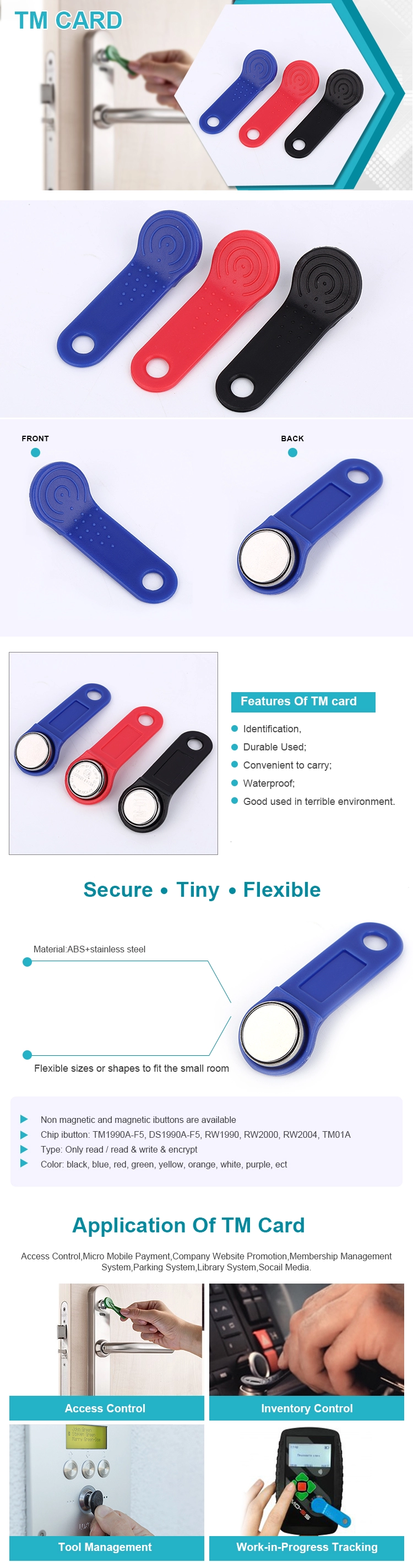
The 1990A-F5 RW1990 Magnetic Dallas iButton DS1990A Tag is a compact contact-type electronic identification tag designed for access control, equipment identification, asset management, and other applications that require reliable digital identification through a 1-Wire interface.
Available with compatible chip configurations such as RW1990A, RW1990B, DS1990A, and TM1990-F5, this iButton-style tag combines a durable stainless-steel contact housing with a compact ABS body. The tag provides a 64-bit identification number and supports contact-based communication with a compatible iButton reader.
Its small form factor, engraved ID, wide operating temperature range, and rugged construction make it suitable for indoor and outdoor identification systems where a physical contact point is preferred over conventional wireless RFID or NFC communication.
Product Parameter
| Item | 1990a-f5 rw1990 Magnetic Dallas iButton DS1990A Tag |
| Material | ABS , Stainless Steel |
| Size | ibutton size: 17mm*6mm |
| Color | Red, green, blue, yellow, black, etc |
| Working Temperature | -40 ~ +85 degree |
| Read-Write Method | Contact |
| Memory | 64 bits |
| ID number | Engraved |
| Chip | RW1990A, RW1990B, DS1990A, TM1990-F5 |
| Application | Intelligent Community, Postal Service, Railway St, etc. |

What is 1990a-f5 rw1990 Magnetic Dallas iButton DS1990A Tag?
—- An iButton is a computer chip which is enclosed in a 16mm thick durable weather resistant
stainless steel can. Because of their small size and extreme durability, iButtons can travel virtually anywhere.
How does an 1990a-f5 rw1990 Magnetic Dallas iButton DS1990A Tag communicate?
The iButton is a slave device and requires a master to initiate communication to it. A master can be a PC or a micro processor. With the master constantly polling the iButtons, communication to iButtons can be started by a simple touch to a 1-Wire interface called a Blue Dot Receptor. Every iButton has a unique 64-bit serial number, which gives it a unique 1-Wire network address.

Applications of 1990A-F5 Dallas iButton Tags
iButtons are frequently attached to key fobs, rings, watches, or other personal items for applications such as access control to buildings and computers. Additionally, iButtons are commonly mounted to storage crates, trucks, and other equipment for asset management. Furthermore, iButtons are mounted to refrigeration units, outdoor environments, and even to animals for various data logging tasks
The 1990A-F5 can be used in systems where a unique electronic identity needs to be assigned to people or physical assets.
Access Control
The tag can be used as an electronic access key for doors, gates, cabinets, computers, and restricted areas. A reader checks the tag’s identification number against an authorized user database.
Asset Identification
iButton tags can be attached to equipment, containers, tools, vehicles, or storage units. The fixed ID allows software to associate each physical asset with a unique record.
Tool Management
Tools can be assigned individual electronic IDs to support check-in, check-out, and usage tracking.
Transportation and Railway Systems
The contact-based format can be integrated into equipment identification or controlled-access systems used in transportation environments, subject to the requirements of the specific system.
Outdoor Equipment
The durable iButton format can be useful for outdoor equipment where physical contact identification is preferred over wireless tags.
Community and Building Management
The tag can be integrated into access systems for residential communities, buildings, parking areas, utility rooms, and other controlled locations.
How Does the 1990A-F5 iButton Work?
The tag operates as a 1-Wire slave device. A compatible reader, microcontroller, or computer-side interface acts as the bus master and initiates communication.
When the iButton is placed against the reader contact, the reader establishes communication with the device and retrieves its identification information. The identification number can then be compared with records stored in the access control or asset management system.
A typical system works as follows:
iButton Tag → Contact Reader → 1-Wire Interface → Controller → Software Database
The DS1990A uses a single data signal together with ground for 1-Wire communication. Its 64-bit registration number consists of an 8-bit family code, a 48-bit serial number, and an 8-bit CRC. This structure allows the host system to identify and validate the device during communication.
Because the reader initiates the communication, the tag itself does not normally operate as an independent wireless transmitter.
64-Bit Identification and 1-Wire Communication
One of the main advantages of the DS1990A-style architecture is its unique identification number.
For the genuine DS1990A, the 64-bit ROM is structured as:
| ROM Field | Length | Function |
|---|---|---|
| Family Code | 8 bits | Identifies the 1-Wire device family |
| Serial Number | 48 bits | Unique device identification |
| CRC | 8 bits | Error checking |
The 48-bit serial number provides the primary device identity, while the family code identifies the device type and the CRC is used for data integrity checking.
This structure is useful for access control and asset tracking because the physical tag can carry a fixed electronic identity that the software system associates with a user, vehicle, tool, container, or other asset.
RW1990A, RW1990B, DS1990A and TM1990-F5 Comparison
The product page lists RW1990A, RW1990B, DS1990A, and TM1990-F5 as available chip options. These should be treated as different chip configurations rather than automatically assuming that every electrical characteristic is identical.
| Chip Option | Typical Role | 64-bit ID Concept | 1-Wire / Contact Applications | Recommended Verification |
|---|---|---|---|---|
| RW1990A | Rewritable Dallas-key style ID | Yes | Access control and identification | Reader compatibility |
| RW1990B | Rewritable Dallas-key style ID | Yes | Identification systems | Reader and writing compatibility |
| DS1990A | Original serial-number iButton family | Yes | Access, inventory, tool management | Confirm DS1990A support |
| TM1990-F5 | Dallas-key compatible form factor | Yes | Contact identification | Confirm reader protocol |
For replacement projects, compatibility should be checked at the system level. The reader’s communication protocol, accepted family code, ID format, writing method, and software logic can all affect whether a particular chip configuration can be used as a direct replacement.
For customers developing a new system, we recommend specifying the required chip model and reader interface rather than ordering only by the external 1990A-F5 appearance.
1990A-F5 vs. Standard RFID and NFC Tags
The 1990A-F5 is a contact identification product, while most RFID and NFC tags are designed for wireless communication. Choosing between them depends on the reader architecture and operating environment.
| Feature | 1990A-F5 iButton | RFID Tag | NFC Tag |
|---|---|---|---|
| Communication | Physical contact | Wireless | Wireless |
| Reader Distance | Contact | Usually from short to longer range | Very short range |
| Power Source | Reader-powered interface | Passive or active | Usually passive |
| Identification | Digital ID | UID / memory data | UID / memory data |
| Metal Housing | Available | Depends on tag type | Depends on tag type |
| Accidental Reading | Low | Possible within read field | Possible at close range |
| Typical Use | Access keys, equipment ID | Logistics, access, inventory | Phones, smart cards, marketing |
| Reader Alignment | Physical contact | Wireless field | Wireless field |
A contact iButton can be preferable when the system requires an intentional physical interaction. For example, touching a key to a reader can provide a clear user action and reduce unintended reads from nearby tags.
By contrast, RFID or NFC may be more appropriate when the application requires contactless operation.
Durable Stainless-Steel Contact Housing
The 1990A-F5 uses a combination of ABS and stainless-steel materials. The metal contact structure is designed for repeated interaction with compatible readers, while the compact housing allows the tag to be integrated into key fobs, access keys, equipment identification devices, or other carriers.
The original DS1990A is specified with a durable stainless-steel iButton package designed to withstand environmental exposure such as dirt, moisture, and shock. Its coin-shaped package also works with self-aligning mating receptacles.
This makes the iButton format suitable for applications where a small electronic identifier needs to remain physically accessible while attached to an object.
Wide Operating Temperature Range
The product is specified for an operating temperature range of -40°C to +85°C.
This wide temperature range can be useful for outdoor access control, industrial equipment identification, transportation-related applications, and other installations exposed to changing environmental conditions.
The official DS1990A documentation also specifies a -40°C to +85°C operating temperature range for its F5 package.
Actual environmental performance can depend on the complete assembly, including the selected chip, housing, reader, mounting method, and installation environment.
Compact 17 mm × 6 mm Form Factor
The 1990A-F5 product is listed at approximately 17 mm × 6 mm, providing a compact form factor for applications where installation space is limited.
Its small size makes it practical for:
- Key fobs
- Access keys
- Rings and wearable items
- Equipment identification
- Tool tracking
- Storage containers
- Vehicle and transportation equipment
- Industrial assets
The official DS1990A documentation identifies the F5 iButton package as a compact coin-shaped format, with detailed package dimensions provided in the manufacturer’s datasheet.
For projects requiring tight mechanical tolerances, the final dimensional drawing should be confirmed before mass production.
Common Installation Formats
The small iButton package can be integrated into different physical carriers depending on the application.
| Installation | Typical Use |
|---|---|
| Key Fob | Personal access control |
| Key Ring | Door and gate access |
| Equipment Mount | Asset identification |
| Tool Holder | Tool management |
| Vehicle Mount | Vehicle or fleet identification |
| Container Mount | Logistics and storage |
| Custom Housing | OEM access systems |
The DS1990A ecosystem also supports accessories such as adhesive pads, mounting clips, lock rings, snap-in fobs, and iButton probes.
Contact iButton vs. Contactless Identification
The main difference between this product and contactless RFID technology is the communication method.
A contact iButton must physically touch the reader. This provides a deliberate interaction and can simplify applications where the user is expected to present a key directly to a reader.
Contactless RFID, on the other hand, allows identification without physical contact. This can be useful for fast vehicle access, inventory portals, warehouse gates, and other applications where users or assets should not need to touch the reader.
Neither approach is universally suitable for every application. The correct technology depends on read distance, installation conditions, reader design, user interaction, security architecture, and existing system compatibility.
Why Choose a 1990A-F5 iButton Tag?
The 1990A-F5 format provides several practical characteristics for OEM and replacement projects:
- Compact iButton-style mechanical format
- Contact-based communication
- 64-bit identification
- Engraved ID option
- Stainless-steel contact construction
- ABS housing
- -40°C to +85°C operating range
- Multiple color options
- Several compatible chip configurations
- Suitable for custom access control and asset identification projects
For customers replacing existing Dallas-key style products, the most important consideration is compatibility with the existing reader and software system.
OEM and Custom Manufacturing Options
For larger projects, the iButton tag can be supplied according to application requirements.
Possible customization and production options include:
| Customization | Available Consideration |
|---|---|
| Chip | RW1990A / RW1990B / DS1990A / TM1990-F5 |
| Housing Color | Red, green, blue, yellow, black, etc. |
| ID | Engraved identification |
| Carrier | Key fob, ring, custom holder, etc. |
| Packaging | Bulk or project-specific packaging |
| Application | Access control, asset tracking, OEM systems |
Before production, customers should provide the reader model or existing tag specification whenever possible. This allows the required chip configuration and communication compatibility to be confirmed.
How to Choose the Right iButton Chip
If you are replacing an existing Dallas key, identify the original chip before selecting a replacement.
The following information is useful:
- Existing tag model or chip marking
- Reader model
- Communication protocol
- Whether the ID needs to be read-only or rewritable
- Required family code
- Physical package dimensions
- Operating temperature requirements
- Required ID format
- Quantity required
- Any existing software or access-control restrictions
For a DS1990A-based system, the original device provides a unique 64-bit registration number and functions as a 1-Wire serial-number device.
For systems using RW1990-series devices, compatibility should be confirmed separately because the ability to write or clone an identification number can depend on the specific chip implementation and reader.
Frequently Asked Questions
Is the 1990A-F5 an RFID tag?
No. The 1990A-F5 is a contact-type iButton/Dallas-key style identification tag. It communicates through physical contact with a compatible reader rather than through conventional wireless RFID communication.
Does the 1990A-F5 support 1-Wire?
Yes. The DS1990A is a 1-Wire serial-number device, and the product is designed for Dallas/iButton-style contact identification systems. The exact protocol compatibility should be confirmed for the selected chip configuration.
How many bits does the DS1990A ID contain?
The DS1990A contains a unique 64-bit registration number. It consists of an 8-bit family code, a 48-bit serial number, and an 8-bit CRC.
Is the ID engraved?
The product specification lists the ID number as engraved. The exact marking format and customization requirements should be confirmed for the order.
Can it replace an existing RW1990A key?
It may be suitable when the existing reader supports the selected replacement chip and communication format. Because RW1990A, RW1990B, DS1990A, and TM1990-F5 are different device configurations, reader compatibility should be confirmed before ordering.
What is the operating temperature?
The product is specified at approximately -40°C to +85°C. The official DS1990A documentation also specifies -40°C to +85°C for its F5 package.
Can the tag be used outdoors?
The iButton format is designed for durable identification applications, and the stainless-steel package of the DS1990A is resistant to environmental exposure. However, the complete installation should be evaluated for the actual outdoor environment, including water exposure, chemicals, mechanical impact, UV exposure, and mounting conditions.
What readers can read the 1990A-F5?
A compatible Dallas/iButton contact reader or 1-Wire interface is required. Reader compatibility depends on the chip configuration, electrical interface, protocol implementation, and software.
Is this product suitable for OEM projects?
Yes. The compact form factor, multiple chip options, color choices, and engraved identification make the 1990A-F5 suitable for OEM access control, asset identification, equipment management, and other custom projects.
Order 1990A-F5 RW1990 Dallas iButton Tags
The 1990A-F5 RW1990 Magnetic Dallas iButton DS1990A Tag is designed for applications that need compact, durable, contact-based electronic identification.
With a 64-bit identification architecture, 1-Wire communication, stainless-steel contact construction, multiple chip options, and an operating range of -40°C to +85°C, it can be integrated into access control, asset management, tool tracking, transportation, community management, and OEM identification systems.
When requesting a quotation, provide the required chip model, quantity, ID requirements, housing color, reader model, and application environment. For replacement projects, supplying a photo or model number of the existing iButton can also help verify compatibility before production. Please feel free to contact us.