October 29, 2026
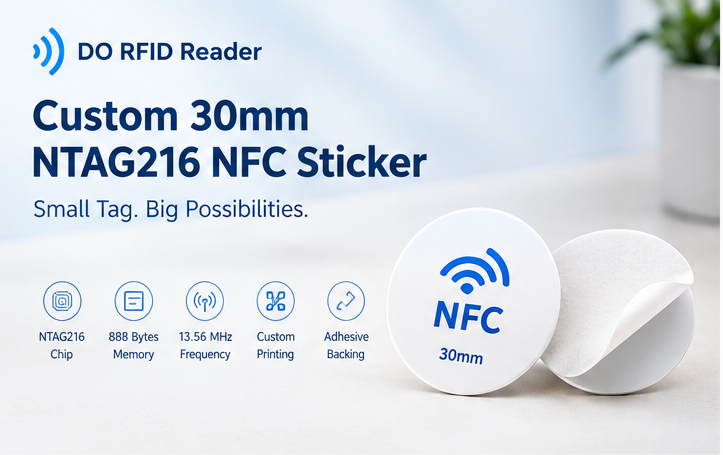
At DO RFID Reader, we provide custom 30mm NTAG216 NFC stickers that help businesses connect physical products with digital information. Designed for product identification, smart labeling, inventory management, and customer engagement, our NFC stickers combine a compact round format with reliable contactless communication and flexible data programming.
Powered by the NXP NTAG216 chip, these 13.56 MHz NFC tags offer 888 bytes of user memory, making them suitable for storing website links, product identifiers, contact information, and other digital data. Their adhesive backing makes them easy to apply to product packaging, retail displays, equipment, and other compatible surfaces.
We customize NFC stickers to match your business requirements, including label dimensions, printed graphics, logos, QR codes, and data encoding. Whether you need a small batch for product testing or a larger production order, our team works with you to develop an NFC labeling solution that fits your application.
Key Product Features
- 30mm round NFC sticker with custom sizing options
- NXP NTAG216 chip operating at 13.56 MHz
- 888 bytes of user-writable memory
- Compatible with supported NFC-enabled smartphones and readers
- Custom printing, branding, and data encoding
- Adhesive-backed design for convenient application
- Suitable for retail, logistics, equipment identification, and smart product labeling
Custom 30mm NTAG216 NFC Sticker Specifications
Our 30mm NTAG216 NFC sticker combines a compact design with flexible digital functionality. It can be programmed with relevant information before shipment or integrated into your existing NFC encoding workflow.
| Parameter | Specification |
|---|---|
| Product Type | Custom NFC Sticker |
| Tag Shape | Round |
| Standard Diameter | 30mm |
| Chip Model | NXP NTAG216 |
| Operating Frequency | 13.56 MHz |
| NFC Technology | NFC Type 2 |
| User Memory | 888 bytes |
| Communication | Contactless NFC |
| Read/Write Capability | Up to 100,000 write cycles |
| Data Retention | Up to 10 years under specified conditions |
| Face Material | PET film |
| Attachment | Adhesive backing |
| Environmental Protection | IP65 rating for the specified product configuration |
| Operating Temperature | -20°C to 85°C |
| Printing Options | Logo, text, QR code, and custom graphics |
| Customization | Size, artwork, encoding, and selected materials |
| Typical Applications | Product labeling, inventory, retail, and asset identification |
The final construction can be tailored to your application. Contact our team to discuss the required dimensions, surface material, printing method, operating environment, and chip configuration for your project.
Why Choose the NTAG216 Chip?
The NTAG216 is a widely used NFC chip for applications that require convenient smartphone interaction and enough memory for flexible data storage. Its 888-byte user memory provides more room than many basic NFC tag options, making it useful for a variety of business labeling projects.
With a compatible smartphone or NFC reader, users can access programmed information by bringing the device close to the tag. Depending on the application, this information may include a website URL, product details, contact information, digital instructions, or an identifier connected to a business database.
Key Benefits of NTAG216
- Flexible data storage: Store URLs, text, identifiers, and supported NDEF records.
- Convenient interaction: Enable quick tap-based access to digital information.
- Broad application potential: Support marketing, product identification, and asset management workflows.
- Reusable memory: Update writable data when your workflow and tag configuration allow it.
- Compact integration: Add digital functionality without significantly changing product packaging.
For businesses developing connected packaging, smart labels, or NFC-enabled customer experiences, NTAG216 offers a practical balance of memory capacity, usability, and integration flexibility.
How Does a 30mm NFC Sticker Work?
An NFC sticker contains a chip and antenna that communicate with a compatible NFC-enabled device at close range. Once the tag is encoded, a user can tap it with a supported smartphone or reader to retrieve the stored information or initiate a supported action.
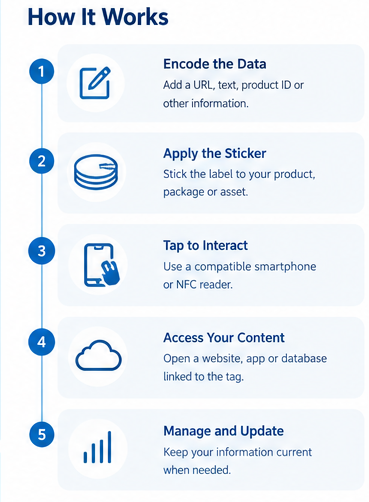
The process is straightforward:
- Define the data: Choose the website URL, product identifier, text, or other supported information.
- Encode the tag: Write the selected data to the NFC chip using compatible equipment.
- Apply the sticker: Attach the label to the intended product, package, display, or asset.
- Tap to interact: A compatible device reads the tag and presents the relevant information or action.
- Connect to your system: Where needed, use a URL or identifier to access a website, application, or business database.
For example, a manufacturer can place an NFC sticker on a product box and encode a product page URL. Customers can tap the sticker to open the page, while the manufacturer can update the online content without changing the physical label.
The NFC sticker stores the programmed data; online records, analytics, and dynamic content can be managed through your own website or software platform.
How Does a 30mm NFC Sticker Work
Main Applications of Custom NFC Stickers
Our custom 30mm NFC stickers can support different business processes by connecting physical items with digital resources.
Retail Products and Smart Packaging
Retail brands can add NFC stickers to packaging, promotional materials, and product displays. Customers can tap a tag to access product specifications, usage instructions, brand information, or online shopping pages.
This approach helps businesses provide additional information without increasing the amount of printed text on the package. Custom logos and graphics also help maintain a consistent brand presentation.
Typical uses:
- Product information and digital catalogs
- Smart packaging and interactive displays
- Brand engagement and promotional campaigns
- Links to product manuals and care instructions
Logistics and Warehouse Identification
NFC stickers can help identify packages, storage containers, shelves, and inventory items. By encoding a unique identifier or a link to a tracking record, businesses can simplify item lookup and reduce repetitive manual data entry.
Workers can scan tags using compatible NFC devices and connect the identified item to warehouse or logistics software.
Typical uses:
- Inventory identification
- Warehouse location references
- Package and container identification
- Internal asset and stock management
NFC scanning can support logistics workflows at designated checkpoints. Automated location tracking and shipment status updates require the appropriate readers, software, and connected information systems.
Medical Equipment and Asset Management
Healthcare facilities and equipment suppliers can use NFC labels to connect physical equipment with digital asset records. A tag can store an equipment ID or link to a system containing relevant maintenance and usage information.
Staff can tap the tag to access the appropriate record, subject to the permissions and functionality of the connected system.
Typical uses:
- Equipment identification
- Maintenance record access
- Calibration schedule lookup
- Inventory and asset audits
For medical environments, the sticker materials and attachment method should be selected to suit the cleaning procedures and surfaces involved.
Industrial Equipment and Maintenance
Manufacturers can attach NFC stickers to tools, machines, enclosures, and serviceable components. Technicians can use them to access equipment manuals, maintenance instructions, inspection forms, or service histories.
A unique identifier can connect each tagged asset to its corresponding record, helping teams organize information across production facilities and service locations.
Marketing, Events, and Customer Engagement
NFC stickers can turn printed materials and physical products into interactive touchpoints. Businesses can use them to link customers to landing pages, event schedules, registration forms, product demonstrations, and other digital experiences.
Since online content can be updated independently of the sticker, the same physical label can continue to direct visitors to a maintained web page when the destination remains appropriate.
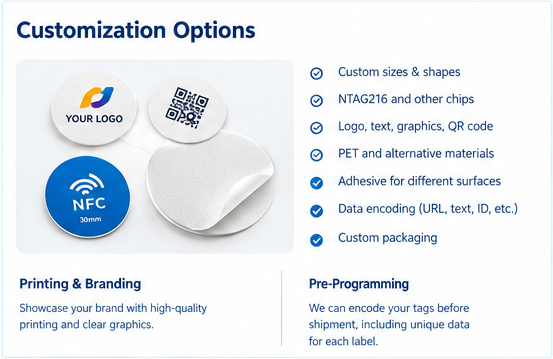
Customization Options for Your NFC Stickers
At DO RFID Reader, we understand that different products require different label designs. We offer customization options to help you align the NFC sticker with your packaging, operating environment, and brand identity.
| Customization Item | Available Options | Business Benefit |
|---|---|---|
| Diameter | Standard 30mm and custom sizes | Fits different product surfaces |
| Shape | Round and selected custom shapes | Matches packaging and design requirements |
| Chip | NTAG216 and other suitable NFC chip options | Supports different memory and application needs |
| Printing | Logo, text, graphics, and QR code | Strengthens brand recognition |
| Face Material | PET and selected material alternatives | Matches appearance and environmental requirements |
| Adhesive | Options selected for the intended surface | Supports reliable attachment |
| Data Encoding | URL, text, identifiers, and supported NDEF records | Simplifies deployment |
| Packaging | Customized packing arrangements | Supports handling and distribution |
Custom Printing and Branding
We can incorporate your company logo, product graphics, serial information, QR codes, or other suitable artwork into the label design. A printed NFC sticker can combine visual identification with contactless digital access.
For a consistent appearance across multiple products, we can work from your artwork and agreed layout specifications.
Pre-Programming and Data Encoding
If your project requires ready-to-use tags, we can discuss encoding requirements before production. Depending on the order, data may include a shared website URL, individual identifiers, or other supported records.
For projects involving unique data for every tag, provide the required data format and encoding rules so the production workflow can be planned accordingly.
NTAG216 vs. NTAG213 vs. NTAG215
Choosing the right NFC chip depends on memory requirements, data complexity, and project cost. NTAG213, NTAG215, and NTAG216 belong to the same general family of NFC chips, but their user memory capacities differ.
| Feature | NTAG213 | NTAG215 | NTAG216 |
|---|---|---|---|
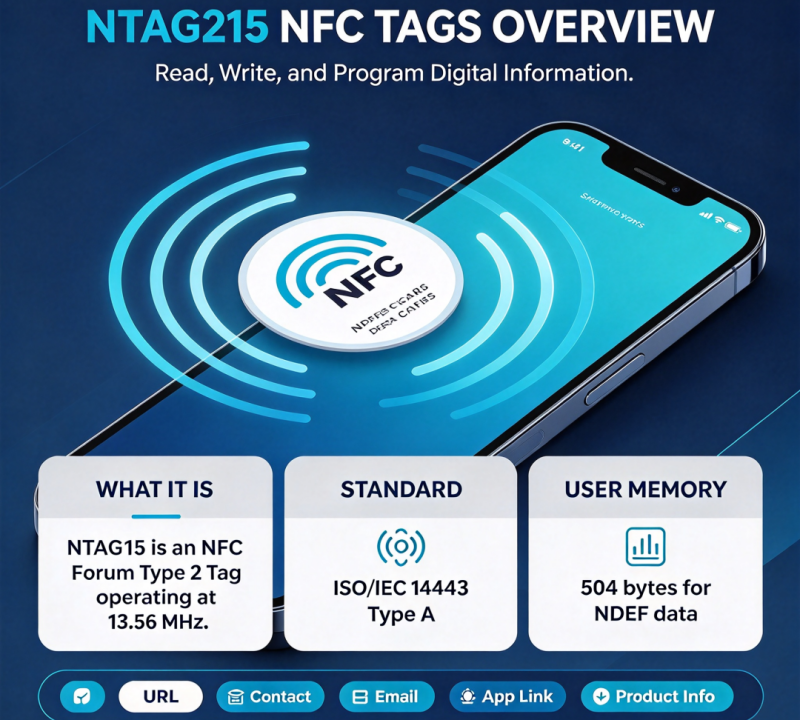
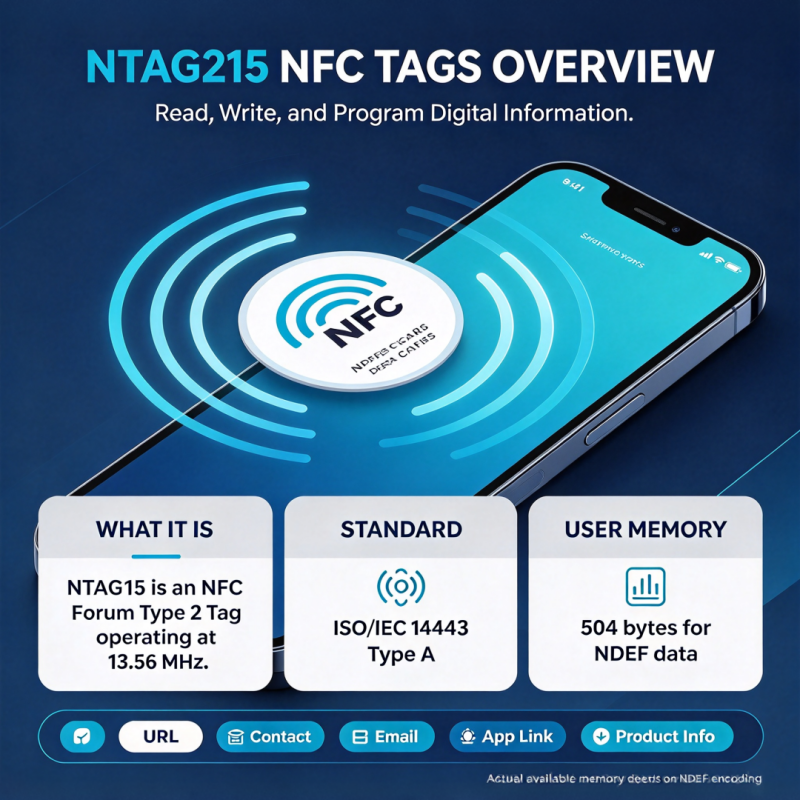
| User Memory | 144 bytes | 504 bytes | 888 bytes |
| Operating Frequency | 13.56 MHz | 13.56 MHz | 13.56 MHz |
| NFC Type | Type 2 | Type 2 | Type 2 |
| Website Links | Suitable | Suitable | Suitable |
| Short Text and IDs | Suitable | Suitable | Suitable |
| Larger NDEF Records | More limited | Moderate capacity | More available space |
| Typical Selection | Basic labeling | General-purpose applications | Applications needing more memory |
Memory values refer to the nominal user memory available on these chip models.
Which Chip Should You Choose?
Choose NTAG213 when your application mainly needs a short URL or basic identifier and minimizing tag cost is a priority.
Choose NTAG215 when you need more storage flexibility for moderately sized records or application-specific data.
Choose NTAG216 when you prefer additional user memory for more complex NDEF content, longer text records, or future changes to your data requirements.
Our team can help you select a chip based on the actual data to be stored, expected smartphone compatibility, and the intended use of the sticker.
NFC Sticker vs. RFID Label vs. QR Code
NFC stickers, RFID labels, and QR codes all help identify products or connect physical items to digital information. However, they use different technologies and suit different workflows.
| Feature | NFC Sticker | UHF RFID Label | QR Code |
|---|---|---|---|
| Technology | 13.56 MHz NFC | Typically UHF RFID | Optical code |
| Interaction | Close-range tap | Reader-based radio scanning | Camera scanning |
| Smartphone Use | Supported by compatible NFC phones | Usually requires compatible RFID hardware | Supported by most smartphone cameras |
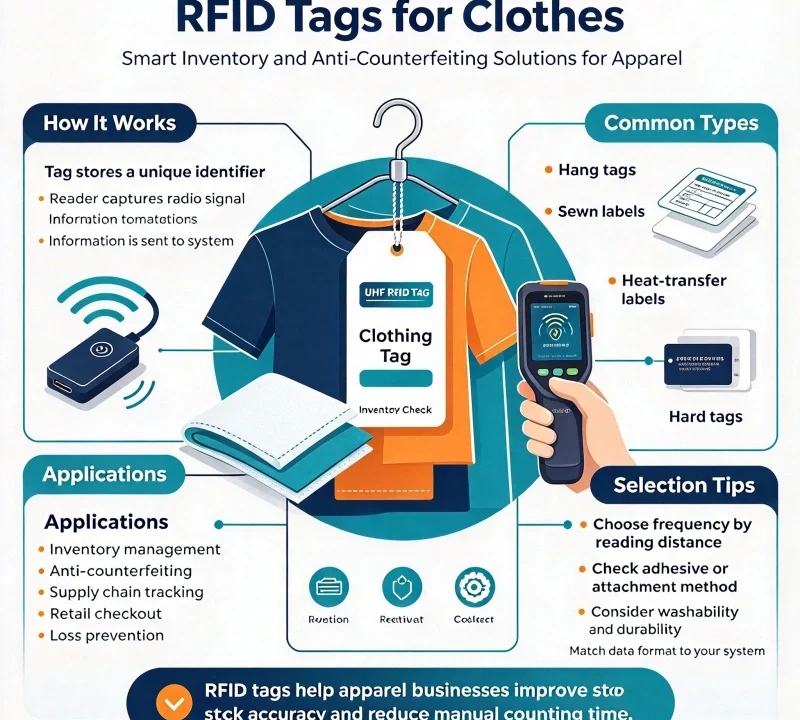
| Multiple-Item Reading | Generally one tag at a time | Can identify multiple tags in a suitable system | Usually scanned individually |
| Typical Reading Range | A few centimeters, depending on device and tag | Can reach several meters in suitable conditions | Depends on camera and visibility |
| Data Access | Stored records or linked online content | Tag data and connected inventory systems | Encoded text or URL |
| Best-Fit Applications | Interactive products and mobile access | Bulk inventory and supply-chain workflows | Low-cost visual identification |
NFC is a strong choice when users need a simple tap-based experience. UHF RFID is often more suitable for bulk identification across a warehouse, while QR codes provide an economical option when visual scanning meets the application requirements.
These technologies can also work together. For example, a product may use a QR code for broad camera compatibility and an NFC sticker for convenient contactless interaction.
Adhesive, Materials, and Environmental Performance
A suitable label construction helps maintain consistent performance throughout the product’s intended service life. Our standard product configuration uses PET face material with an adhesive backing for practical application on compatible surfaces.
The selected materials influence appearance, attachment, resistance to everyday handling, and suitability for different environments.
Material and Installation Considerations
- PET face material: Provides a practical surface for printed graphics and product identification.
- Adhesive backing: Supports convenient installation on suitable, clean, dry surfaces.
- Compact construction: Fits many product packages, containers, and equipment surfaces.
- Environmental requirements: Temperature, moisture, chemicals, and cleaning procedures should guide material selection.
- Surface compatibility: Curved, textured, oily, or metal surfaces may require a different construction.
Our standard specification includes an IP65 protection rating and an operating temperature range of -20°C to 85°C for the specified configuration.
For metal products, standard NFC stickers may experience reduced communication performance because metal can interfere with the tag antenna. An anti-metal NFC design may be more suitable for equipment, metal containers, and other conductive surfaces.
NFC Sticker Programming and Data Management
An NFC sticker becomes useful when its programmed data supports a clear business objective. Before production, we recommend defining what users should see when they tap the tag and how that information will be maintained.
Common Data Formats
| Data Type | Example Application |
|---|---|
| Website URL | Product page or online catalog |
| Product ID | Item identification and database lookup |
| Plain Text | Short instructions or reference information |
| Contact Record | Business contact details |
| Application Link | Access to a compatible web or mobile workflow |
| Unique Identifier | Inventory and asset record association |
For many business applications, storing a URL or unique identifier is more flexible than placing all product information directly on the chip. Your website or database can then maintain detailed records, product updates, manuals, and other content.
Static and Dynamic Content
A static NFC record contains data programmed directly into the tag. If that information changes, the writable record must be updated.
A dynamic content workflow can use a fixed URL that redirects to content managed on your website. You can update the destination page without physically reprogramming every sticker, provided the URL and supporting web service remain available.
The best option depends on your data management strategy, security requirements, and whether tags need individual identities.
Our Custom NFC Sticker Manufacturing Process
DO RFID Reader works with businesses to develop NFC labels that fit their product and operational requirements. Our process focuses on defining the specifications clearly and coordinating the required customization.
Step 1: Requirement Discussion
Share the intended application, required quantity, preferred dimensions, chip type, surface material, and operating environment.
Step 2: Design and Specification
We discuss the label structure, printing artwork, adhesive options, and data encoding requirements to establish the product configuration.
Step 3: Sample Evaluation
Where appropriate, sample labels can help you evaluate appearance, fit, smartphone interaction, and suitability for your application before moving to a larger order.
Step 4: Production and Quality Control
We coordinate production and inspection according to the agreed specifications, including relevant appearance and NFC functionality checks.
Step 5: Encoding and Delivery
For orders requiring pre-programming, we confirm the data format and encoding workflow. Finished products are prepared according to the agreed packing and delivery arrangements.
How to Order Custom 30mm NTAG216 NFC Stickers
To help us prepare a suitable solution, please share the key details of your project when contacting our team.
| Information Needed | Example |
|---|---|
| Product Size | 30mm round |
| Chip Model | NTAG216 |
| Order Quantity | Required quantity |
| Printing | Logo, QR code, or blank |
| Encoding | URL, product ID, or custom data |
| Application Surface | Paper, plastic, glass, or metal |
| Working Environment | Indoor, outdoor, or industrial |
| Delivery Requirements | Target delivery date and destination |
Providing these details helps us recommend a suitable construction and prepare a more accurate quotation. If you are still developing your project, we can discuss the options based on your application and budget.
Frequently Asked Questions
What is a 30mm NTAG216 NFC sticker?
It is a round adhesive NFC label with a 30mm diameter and an NTAG216 chip. The sticker can store supported digital records and communicate with compatible NFC-enabled devices at close range.
Can I use the sticker with a smartphone?
Yes. NTAG216 stickers work with compatible NFC-enabled smartphones and readers. The exact user experience depends on the device, operating system, programmed data, and application.
How much data can an NTAG216 sticker store?
The NTAG216 provides 888 bytes of user memory. This is suitable for URLs, identifiers, short text, and supported NDEF records. For larger information resources, a website or database link is generally more practical.
Can you print our company logo on the sticker?
Yes. We offer custom printing options, including company logos, text, QR codes, and other suitable graphics. You can provide your artwork and preferred layout for customization.
Can the NFC data be changed after programming?
Writable records can generally be updated using compatible NFC equipment, provided the relevant memory is not locked and the tag configuration permits rewriting. Permanently locked records cannot be changed.
Can these NFC stickers be used on metal surfaces?
For metal surfaces, an anti-metal NFC sticker is generally recommended. Metal can interfere with the antenna of a standard NFC tag, so the label construction should match the installation surface.
Can you encode the tags before shipment?
We can discuss pre-encoding requirements for your order. Please provide the desired URL, text, identifier format, or data file structure so we can determine the appropriate encoding workflow.
Do you offer custom sizes and shapes?
Yes. Although 30mm round stickers are the standard product described here, we can discuss other dimensions and selected shapes according to your design and application requirements.
What information should I provide to request a quotation?
Please share your required quantity, chip model, dimensions, printing artwork, encoding requirements, application surface, and delivery destination. Our team can then help you determine the appropriate product configuration.
Request a Quote for Custom NTAG216 NFC Stickers
Looking for a reliable supplier of custom NFC stickers for your products, packaging, warehouse, or equipment? DO RFID Reader provides customizable NFC labeling solutions designed around your application requirements.
Whether you need branded 30mm NTAG216 stickers, pre-encoded NFC labels, custom dimensions, or an alternative chip configuration, our team is ready to discuss your project.
Tell us what you need to identify, connect, or manage, and we will work with you to develop an NFC sticker solution that fits your requirements.

Au is an RFID and NFC manufacturer based in Shenzhen, China, with over 10 years of experience.