November 20, 2026
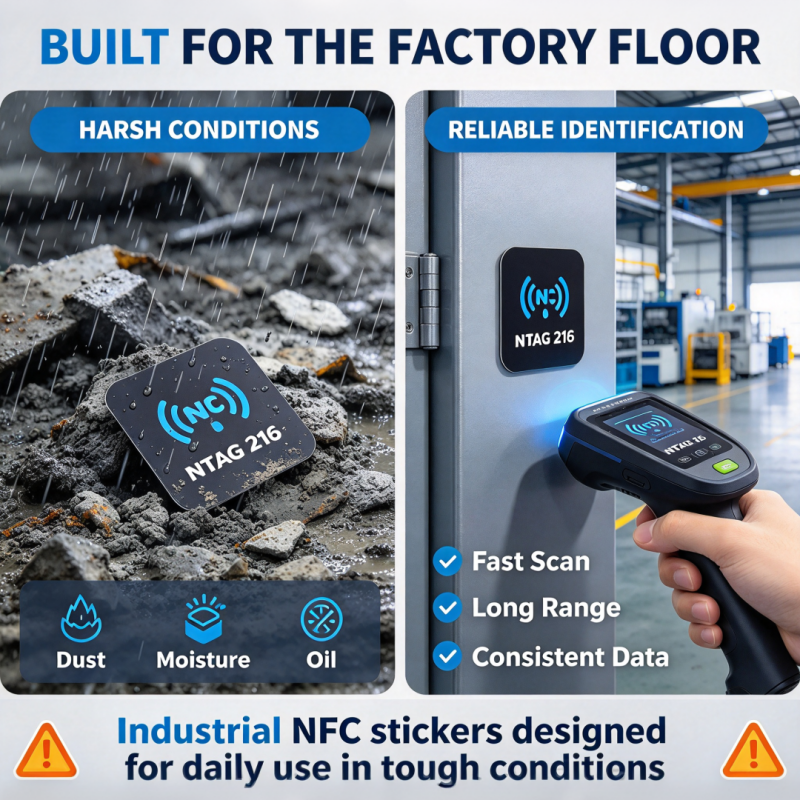
Industrial environments demand more from NFC labels than ordinary product identification or promotional applications. Manufacturing equipment, outdoor machinery, warehouse assets, industrial containers, and reusable tools are frequently exposed to moisture, dust, friction, temperature fluctuations, and chemical cleaning agents. Under these conditions, conventional paper NFC labels and lightweight adhesive stickers may deteriorate, lose adhesion, or become difficult to scan.
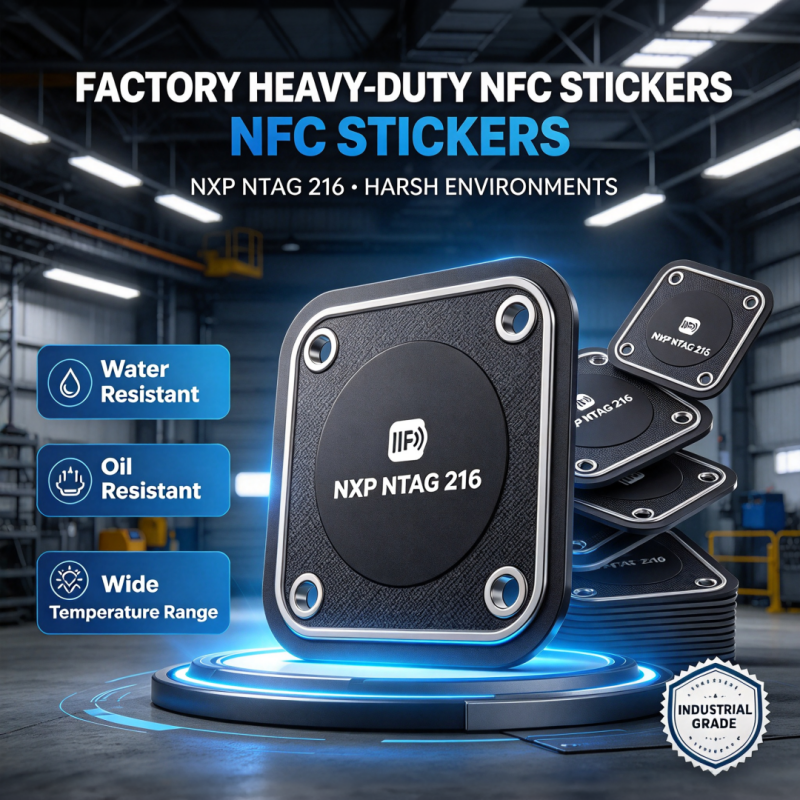
For businesses looking for a more reliable identification solution, factory heavy-duty industrial NFC stickers with NXP NTAG216 offer a practical combination of contactless communication, flexible data storage, and customizable physical construction.
However, selecting an industrial NFC sticker involves more than choosing a chip. The complete tag structure—including the antenna, protective materials, adhesive, surface compatibility, and encapsulation—determines whether the finished product can withstand its intended working environment.
As an experienced RFID and NFC manufacturer, DO RFID Group provides NFC tag manufacturing and customization solutions for industrial identification, equipment management, product tracking, and other business applications.
This guide explains how NTAG216 industrial NFC stickers work, which construction factors influence durability, how to choose the right configuration, and what industrial buyers should consider before placing a bulk order.
1. What Are Heavy-Duty Industrial NFC Stickers?
Heavy-duty industrial NFC stickers are contactless identification labels designed for applications where ordinary NFC stickers may not provide sufficient mechanical or environmental protection.
They combine an NFC integrated circuit, an antenna, a substrate, and a protective outer layer into a finished label or tag assembly. Depending on the application, manufacturers can customize the structure using different materials, protective coatings, adhesive systems, and dimensions.
Unlike standard promotional NFC stickers, industrial versions are selected according to their actual operating conditions.
Typical requirements include:
- Resistance to water, humidity, and dust.
- Improved protection against scratches and abrasion.
- Reliable adhesion to industrial surfaces.
- Compatibility with equipment identification workflows.
- Suitable performance under specified temperature conditions.
- Protection against selected oils, cleaning agents, and chemicals.
- Consistent NFC communication after installation.
A heavy-duty NFC sticker can be used to identify a machine, connect a physical asset to its digital maintenance record, or provide workers with quick access to product and equipment information.
The important distinction is that industrial durability comes from the complete physical construction, not simply from the NFC chip model.
2. Why Choose NXP NTAG216 for Industrial NFC Applications?
NXP NTAG216 is a widely used NFC chip designed for contactless communication with compatible NFC devices and readers.
It belongs to the NTAG21x family and complies with NFC Forum Type 2 and ISO/IEC 14443 Type A specifications.
Its relatively large user memory makes it suitable for applications requiring more encoded information than a simple identification link.
Key NTAG216 Technical Specifications
| Parameter | Specification |
|---|---|
| Chip manufacturer | NXP Semiconductors |
| Chip model | NTAG216 |
| Total EEPROM | 924 bytes |
| User memory | 888 bytes |
| Operating frequency | 13.56 MHz |
| Communication protocol | ISO/IEC 14443 Type A |
| NFC Forum standard | Type 2 |
| Data transfer rate | 106 kbit/s |
| Unique identifier | 7-byte UID |
| Write endurance | 100,000 cycles |
| Data retention | 10 years |
| Power supply | Passive, no battery required |
These are chip-level specifications. The performance and environmental resistance of the completed industrial tag must be evaluated separately.
2.1 Large Memory Capacity for Asset Information
NTAG216 provides 888 bytes of user memory, offering additional flexibility for NFC data encoding.
Depending on the data format and application, it can store:
- Equipment identification information.
- Product URLs and digital documentation links.
- Maintenance instructions.
- Serial number references.
- Service and inspection information.
- Contact information.
- Multiple NDEF records.
For industrial applications, it is often more efficient to store a unique asset identifier or a web address that connects to a centralized management platform rather than attempting to store an entire maintenance database on the tag.
This approach allows businesses to update digital records without physically replacing or rewriting every NFC label.
2.2 Battery-Free Operation
NTAG216 operates as a passive NFC chip.
It does not require an internal battery. Instead, it receives the energy needed for communication from the electromagnetic field generated by a compatible NFC reader or smartphone.
This provides several practical advantages:
- No battery replacement.
- No battery charging.
- Reduced routine maintenance.
- Compact tag construction.
- Convenient integration into identification labels.
For large industrial deployments, passive NFC technology can simplify long-term identification management.
2.3 Smartphone and Reader Compatibility
NTAG216 supports standard NFC communication at 13.56 MHz.
Compatible NFC-enabled smartphones and readers can interact with properly configured tags without requiring a proprietary communication protocol.
The actual reading distance depends on antenna dimensions, reader power, installation materials, tag orientation, and surrounding electromagnetic conditions.
For more information about the wider technology, visit our NFC tags product and technology page.
3. What Makes an Industrial NFC Sticker Suitable for Harsh Environments?
A common mistake when purchasing industrial NFC stickers is focusing entirely on waterproof ratings or advertised temperature ranges.
A product may have a protected chip but still fail because its adhesive cannot withstand the installation surface. Similarly, a waterproof enclosure does not automatically guarantee resistance to chemical exposure or repeated abrasion.
A dependable industrial NFC solution should be evaluated through several construction factors.
3.1 Protective Materials and Encapsulation
The external material protects the internal NFC components from environmental exposure and physical damage.
Common material options include:
PET (Polyethylene Terephthalate)
PET is suitable for many flexible NFC label constructions. It offers a relatively thin profile and can support printed designs, making it useful for equipment labels and identification applications where space is limited.
PVC (Polyvinyl Chloride)
PVC can be used in flexible or semi-rigid NFC label structures. It provides design flexibility and can be combined with suitable protective layers for applications requiring improved moisture resistance.
ABS (Acrylonitrile Butadiene Styrene)
ABS is commonly used for rigid protective housings. It is a practical option when a tag needs more physical protection than a conventional thin sticker can provide.
PPS (Polyphenylene Sulfide)
PPS is an engineering thermoplastic suitable for demanding industrial applications requiring elevated-temperature resistance and chemical stability.
For example, specialized PPS NFC tags can be used in industrial laundry tracking and reusable asset identification.
The right material depends on the actual operating environment, not simply on which material has the highest advertised temperature rating.
3.2 Waterproof and Dust Protection
Industrial NFC stickers may be installed in environments involving rain, humidity, cleaning, dust, or occasional water exposure.
For these applications, buyers should evaluate:
- Whether the chip and antenna are fully encapsulated.
- Whether the protective layer has exposed edges.
- Whether moisture can enter through seams or openings.
- Whether the adhesive remains stable after water exposure.
- Whether the finished product has been tested under the required conditions.
IP67 and IP68 classifications may be relevant when the completed product has been tested to the corresponding protection requirements.
However, an IP rating should never be assumed from the use of a waterproof material alone. It should be supported by the applicable finished-product test results.
3.3 Adhesive Performance on Industrial Surfaces
Adhesion is one of the most important factors in heavy-duty NFC sticker selection.
Industrial equipment often has painted metal, stainless steel, plastic, powder-coated surfaces, or slightly curved housings.
Different surfaces require different adhesive properties.
A suitable adhesive should be selected according to:
- Surface energy.
- Surface cleanliness.
- Installation temperature.
- Operating temperature.
- Exposure to moisture and chemicals.
- Surface curvature.
- Required service life.
For example, a sticker applied to a smooth indoor plastic enclosure has different requirements from one installed on an outdoor metal machine exposed to oil and frequent cleaning.
For industrial applications, the adhesive should be tested on the actual target material whenever possible.
3.4 Chemical and Abrasion Resistance
Industrial environments can expose NFC labels to lubricants, oils, detergents, solvents, and other cleaning agents.
The finished tag should be evaluated against the specific substances it may encounter.
Important considerations include:
- Protective coating compatibility.
- Surface discoloration.
- Material swelling or deformation.
- Adhesive deterioration.
- Cracking or delamination.
- NFC read performance after exposure.
There is no universal chemical-resistance claim that applies to every industrial NFC sticker. Resistance must be established for the selected material and chemical combination.
3.5 Temperature Stability
Temperature requirements should distinguish between storage temperature, operating temperature, and short-term exposure temperature.
These are not necessarily the same.
An NFC tag may tolerate a brief high-temperature exposure but may not be suitable for continuous operation under the same conditions.
Industrial buyers should therefore specify:
- Minimum operating temperature.
- Maximum continuous operating temperature.
- Peak exposure temperature.
- Exposure duration.
- Whether repeated heating and cooling occurs.
For applications involving repeated industrial washing or elevated-temperature processes, specialized PPS constructions may be more appropriate than ordinary adhesive NFC labels.
4. Heavy-Duty NFC Sticker Structures for Different Industrial Applications
There is no single NFC sticker construction suitable for every industrial environment.
The following configurations provide a useful starting point when discussing a custom manufacturing project.
| Construction | Main Characteristics | Typical Applications |
|---|---|---|
| PET NFC label | Thin, flexible, printable | Equipment identification |
| PVC NFC sticker | Flexible and customizable | General industrial labeling |
| Protective laminated NFC label | Additional surface protection | Outdoor and frequently handled assets |
| ABS NFC tag | Rigid protective structure | Tools and equipment |
| PPS NFC tag | Engineering polymer housing | Industrial laundry and high-temperature applications |
| On-metal NFC tag | Antenna isolation structure | Metal machinery and equipment |
On-Metal NFC Stickers: An Important Design Consideration
Metal surfaces can interfere with NFC antenna operation because of electromagnetic coupling and eddy-current effects.
Consequently, a conventional NFC sticker may experience reduced performance when attached directly to metal.
For these installations, an on-metal NFC construction may incorporate a ferrite or other suitable electromagnetic isolation layer between the antenna and the metal surface.
This helps maintain more reliable NFC communication.
On-metal designs are especially useful for:
- Industrial machinery.
- Metal storage cabinets.
- Factory equipment.
- Vehicle identification.
- Steel containers.
- Server racks.
- Metal tools and components.
Buyers should specify whether the tag will be installed directly on metal or on a non-metallic surface. This information can significantly influence antenna design, thickness, dimensions, and reading performance.
5. Industrial Applications of NXP NTAG216 Heavy-Duty NFC Stickers
The combination of contactless identification and durable physical construction makes industrial NFC labels useful in several sectors.
5.1 Manufacturing Equipment Identification
Manufacturing facilities manage large numbers of machines, production tools, and components.
An industrial NFC sticker can provide a direct digital access point for each identified asset.
A technician can scan the label using an NFC-enabled device to access:
- Equipment identification numbers.
- Maintenance schedules.
- Operating instructions.
- Inspection records.
- Repair documentation.
- Relevant safety information.
Instead of searching through paper documents or manually entering serial numbers, workers can access the associated digital information through a simple NFC interaction.
5.2 Warehouse and Inventory Management
Warehouses frequently handle reusable containers, pallets, storage equipment, and industrial tools.
NFC stickers can connect physical items to digital inventory records.
Typical applications include:
- Asset identification.
- Receiving and dispatch verification.
- Inventory checks.
- Container identification.
- Equipment allocation.
- Inspection records.
NTAG216 can store an identification reference or system URL, while the associated inventory information remains in the company’s management software.
This provides a practical way to connect physical assets with digital records.
5.3 Industrial Maintenance and Inspection
Maintenance teams often need immediate access to equipment information.
By attaching an NFC label to a machine or inspection point, businesses can simplify the process of retrieving relevant maintenance information.
For example:
- A technician approaches a machine.
- The technician scans its NFC sticker.
- The corresponding equipment record opens.
- The technician checks the maintenance history.
- The inspection result is recorded in the connected system.
The NFC sticker provides the identification interface, while the connected software handles the actual record management.
5.4 Equipment Rental and Asset Management
Rental companies need to track tools, machinery, and reusable equipment throughout their operating lifecycle.
NFC identification can help connect each asset to its digital record.
A scan can provide access to:
- Asset identification.
- Rental information.
- Inspection history.
- Maintenance status.
- Return instructions.
- Product documentation.
For frequently handled equipment, the label construction should be selected according to expected abrasion, handling frequency, and cleaning conditions.
5.5 Industrial Laundry and Reusable Textile Management
Industrial laundry operations involve repeated washing, handling, and exposure to elevated temperatures.
Conventional adhesive stickers are generally not the preferred construction for textiles undergoing repeated industrial washing.
Specialized PPS NFC tags offer a different approach, using a protective engineering-polymer housing for demanding laundry applications.
DO RFID Group also offers a dedicated PPS NFC tag with NXP NTAG216 for industrial laundry applications.
This is an example of why industrial NFC products should be selected according to their actual installation and operating conditions.
6. NTAG216 vs. NTAG213 vs. NTAG215: Which Chip Should You Choose?
NTAG213, NTAG215, and NTAG216 belong to the same NXP NTAG21x family.
They share the same general NFC communication technology but provide different user memory capacities.
| Feature | NTAG213 | NTAG215 | NTAG216 |
|---|---|---|---|
| User memory | 144 bytes | 504 bytes | 888 bytes |
| Total EEPROM | 180 bytes | 540 bytes | 924 bytes |
| Frequency | 13.56 MHz | 13.56 MHz | 13.56 MHz |
| NFC standard | Type 2 | Type 2 | Type 2 |
| Typical application | Simple URLs | Moderate data requirements | Larger NDEF messages |
| Industrial customization | Available | Available | Available |
When Should You Choose NTAG213?
NTAG213 is suitable when the application only requires a short URL, a simple identification record, or a basic NFC interaction.
It may be a cost-effective choice for large-scale identification projects with limited data requirements.
When Should You Choose NTAG215?
NTAG215 provides more user memory than NTAG213.
It can be considered when the encoded data requires more space but does not need the maximum memory capacity offered by NTAG216.
When Should You Choose NTAG216?
NTAG216 is a good option when:
- More NDEF storage is required.
- Multiple data records need to be encoded.
- The project specifically specifies NTAG216.
- Future encoding flexibility is important.
- A larger data payload is needed.
An important purchasing consideration is that higher memory capacity does not automatically mean greater physical durability.
If your main requirement is resistance to heat, water, chemicals, or mechanical impact, prioritize the finished tag construction and environmental testing rather than selecting a chip solely by its memory size.
7. How to Customize Industrial NFC Stickers at the Factory
For B2B buyers, customization is often more important than purchasing a standard off-the-shelf NFC sticker.
Different industries have different installation requirements, identification formats, and data management workflows.
A professional NFC manufacturing solution should consider several customization dimensions.
7.1 Chip Selection
Select the appropriate chip according to the data storage requirement and system compatibility.
Available options may include:
- NXP NTAG213.
- NXP NTAG215.
- NXP NTAG216.
- Other NFC chips for specialized applications.
7.2 Size and Shape
Industrial equipment varies significantly in available installation space.
Custom dimensions and shapes can help improve installation convenience and visual consistency.
Possible formats include:
- Round NFC stickers.
- Square NFC labels.
- Rectangular industrial labels.
- Compact equipment identification tags.
- Custom-shaped labels.
7.3 Material and Surface Finish
Depending on the application, buyers can discuss different face materials, protective layers, finishes, and adhesive configurations.
The final choice should be based on the target environment and installation surface.
7.4 Printing and Identification
Custom printing can combine NFC functionality with traditional visual identification.
Available design requirements may include:
- Company logos.
- Serial numbers.
- QR codes.
- Barcodes.
- Equipment identification numbers.
- Warning symbols.
- Product information.
For branding and label design projects, explore our custom printed NFC stickers.
7.5 Pre-Programming and Data Encoding
NFC stickers can be supplied blank or programmed according to an agreed data format.
For example, an industrial project may require each tag to contain:
- A unique asset number.
- A product URL.
- An equipment record link.
- A maintenance information page.
- A company-defined identification reference.
For variable-data projects, each physical tag should be matched with the corresponding data record.
This is especially important when manufacturing thousands of labels for different machines or assets.
To understand the encoding process, see our NFC tag programming guide.
8. What Should Industrial Buyers Check Before Ordering in Bulk?
Purchasing industrial NFC stickers without verifying the application requirements can create avoidable problems during installation and deployment.
Before placing a production order, buyers should confirm the following information.
Industrial NFC Sticker Purchasing Checklist
1. Chip specification
- Is NXP NTAG216 required?
- Is 888-byte user memory sufficient?
- Does the chip meet the project’s NFC compatibility requirements?
2. Installation surface
- Will the tag be installed on plastic, glass, painted metal, or stainless steel?
- Is an on-metal construction required?
- Is the installation surface flat or curved?
3. Environmental conditions
- Will the tag encounter rain or water immersion?
- Is it exposed to oil, detergents, or solvents?
- What are the minimum and maximum operating temperatures?
- Is repeated abrasion or pressure washing expected?
4. Adhesive requirements
- What is the target surface material?
- Is the adhesive required to withstand moisture?
- Will the equipment experience temperature cycling?
5. NFC reading requirements
- Will employees use smartphones or dedicated readers?
- What reading distance is required?
- Does the label need to work after installation on the actual equipment?
6. Production requirements
- What is the expected order quantity?
- Is custom printing required?
- Does every label need a unique serial number?
- Should the tags arrive pre-programmed?
- Are samples required before mass production?
Providing these details helps the manufacturer recommend a more suitable tag structure and reduces the risk of selecting an inappropriate product.
9. Why Work with a Factory for Heavy-Duty Industrial NFC Stickers?
Working directly with an NFC manufacturer can provide greater flexibility when developing an industrial identification project.
Rather than purchasing a standard label and attempting to adapt it to an unsuitable environment, buyers can discuss the complete product configuration before production.
DO RFID Group provides RFID and NFC manufacturing solutions for different business applications, including industrial identification, custom NFC stickers, asset management, and specialized tag products.
Factory Customization Advantages
Application-Based Product Selection
The NFC chip, antenna, protective materials, and adhesive can be considered together according to the intended application.
OEM and ODM Support
Businesses can discuss customized dimensions, printing, product appearance, and tag configurations for their projects.
Pre-Programming Options
Where the project requires it, NFC tags can be encoded according to agreed data specifications before delivery.
Sample Evaluation
Testing representative samples before bulk production helps buyers verify installation compatibility, NFC reading performance, and material suitability.
Bulk Manufacturing
Factory-direct sourcing provides a practical route for businesses that need repeat orders, project-specific configurations, or larger quantities.
Our industrial NFC sticker product page provides another starting point for discussing application-specific requirements.
10. Frequently Asked Questions About Industrial NTAG216 NFC Stickers
Q1. Are NXP NTAG216 NFC stickers suitable for harsh industrial environments?
They can be suitable when the finished tag is designed for the intended environmental conditions.
The NTAG216 chip provides the NFC communication functionality, while the protective materials, encapsulation, adhesive, and antenna construction determine the physical durability of the completed product.
For demanding environments, buyers should confirm the actual temperature, moisture, chemical, and abrasion requirements before selecting a configuration.
Q2. Are NTAG216 NFC stickers waterproof?
Waterproof performance depends on the finished tag construction.
A properly sealed and tested NFC tag can be designed for applications involving moisture or water exposure. However, not every NTAG216 sticker automatically has an IP67 or IP68 rating.
Always request the relevant product specifications and test information.
Q3. Can industrial NFC stickers be attached directly to metal?
Yes, but a suitable on-metal NFC construction is normally required.
Metal can interfere with NFC antenna performance. An appropriate ferrite-backed or otherwise isolated antenna structure helps address this issue.
Standard NFC stickers should not be assumed to work reliably when attached directly to metal.
Q4. How much data can an NTAG216 NFC sticker store?
NXP NTAG216 has 924 bytes of total EEPROM, including 888 bytes of user memory.
The actual space available for an NDEF message depends on the memory configuration and formatting.
Q5. Can NTAG216 NFC stickers be customized with company logos?
Yes. Customization can include logos, colors, serial numbers, QR codes, dimensions, and selected surface finishes, depending on the chosen label construction.
Printing and NFC data encoding are separate processes and should be specified independently.
Q6. Can the NFC data be rewritten?
NTAG216 supports up to 100,000 write cycles under the chip’s specified conditions.
The tag can be rewritten while the relevant memory remains writable and the necessary access permissions are available.
If the memory is permanently locked, rewriting will no longer be possible.
Q7. Do industrial NFC stickers require batteries?
No. NTAG216 is a passive NFC chip and does not require a battery.
It receives operating energy from the electromagnetic field generated by a compatible NFC reader.
Q8. Can I order custom NTAG216 NFC stickers in bulk directly from the factory?
Yes. Buyers can discuss chip selection, dimensions, materials, printing, encoding, and packaging requirements with the manufacturer.
For industrial projects, it is recommended to confirm the intended installation surface and environmental conditions before approving mass production.
Q9. Are industrial NFC stickers suitable for outdoor use?
They can be designed for outdoor applications, provided the selected materials, adhesive, protective structure, and NFC antenna meet the actual exposure requirements.
UV exposure, rain, temperature changes, and installation conditions should all be considered.
Q10. Can I request samples before placing a bulk order?
Sample evaluation is recommended for industrial NFC projects.
It allows buyers to verify the physical construction, NFC reading performance, installation compatibility, and suitability for their specific working environment before committing to a larger order.
11. Get Custom Heavy-Duty Industrial NFC Stickers from DO RFID Group
Choosing an industrial NFC sticker is not simply about selecting a chip with sufficient memory. The complete solution must match the actual working environment, installation surface, identification requirements, and long-term operational expectations.
With NXP NTAG216 technology, customized label structures, and factory manufacturing support, businesses can develop NFC identification solutions for machinery, equipment, warehouses, reusable assets, and industrial operations.
Whether you need waterproof NFC labels, customized industrial identification stickers, on-metal NFC tags, or specialized high-temperature NFC products, the right configuration starts with understanding your application.
Contact DO RFID Group to discuss your industrial NFC sticker project.
Share your required chip, dimensions, installation surface, operating temperature, environmental exposure, and estimated quantity. Our team can help evaluate the appropriate NFC tag construction and customization options for your project.
Visit DO RFID Group to explore our NFC and RFID product solutions and request a quotation.

Au is an RFID and NFC manufacturer based in Shenzhen, China, with over 10 years of experience.