November 20, 2026
Choosing the right animal RFID reader is not simply about finding a scanner with a longer reading distance or more features. The most important step is identifying the RFID technology used by your existing animal tags, then matching the reader’s frequency, protocol, reading method, data interface, and operating environment to your actual application.
Whether you manage cattle on a commercial farm, identify pets in a veterinary clinic, conduct animal research, or develop an automated livestock tracking system, selecting the right RFID reader can improve identification accuracy, simplify data collection, and reduce operational costs.
In this guide, we explain how to choose an animal RFID reader based on real purchasing requirements, compare different reader technologies and device configurations, and highlight the technical factors that should be verified before placing an order.
If you are already evaluating equipment, explore our Animal RFID Reader product range to see available identification solutions.
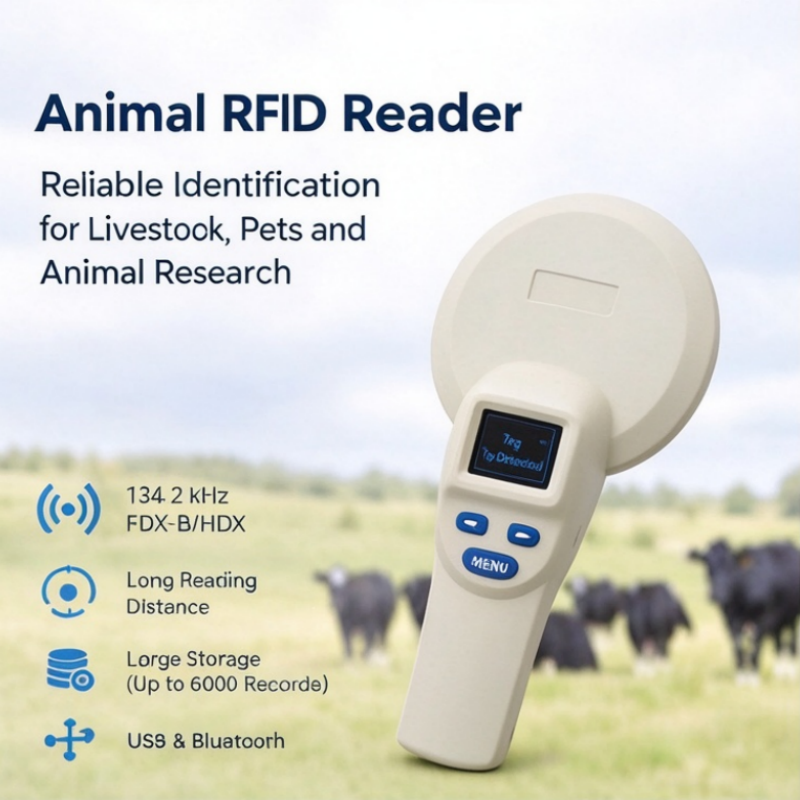
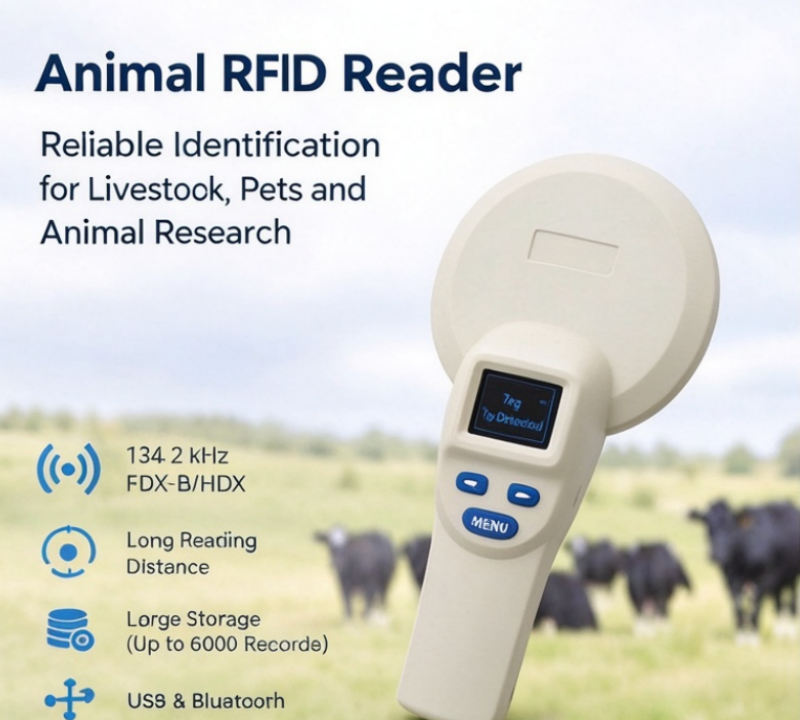
Handheld Animal RFID Reader
1. Understand Your Animal RFID Identification Requirements First
Before comparing animal RFID readers, start by understanding what you actually need to identify.
Different animals may use different RFID transponders, and even two tags designed for the same animal species may operate with different frequencies or communication protocols.
For example:
- Cattle and sheep commonly use electronic RFID ear tags.
- Dogs and cats often use implanted glass microchips.
- Laboratory animals may use small injectable transponders.
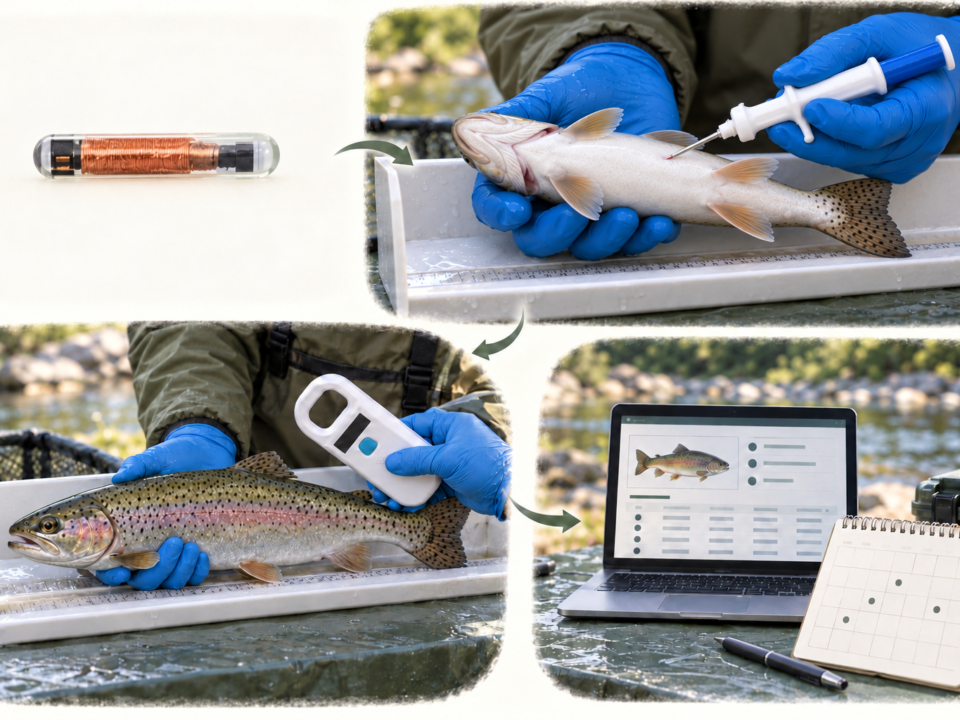
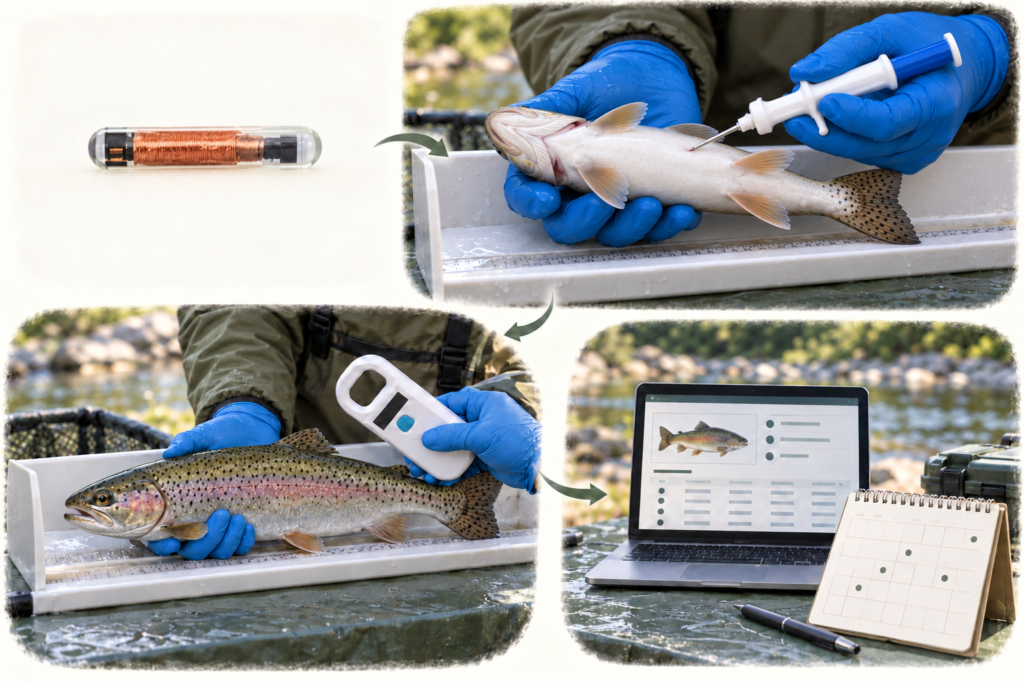
- Fish and aquatic animals may use Passive Integrated Transponder (PIT) tags.
- Poultry and birds may use electronic leg bands or other specialized identification tags.
These applications do not necessarily require the same reader.
Animal Type, Tag Type and Recommended Reader
| Application | Common RFID Tag | Recommended Reader Configuration |
|---|---|---|
| Cattle identification | Electronic ear tags | Handheld or stick reader |
| Sheep and goat management | Electronic ear tags | Portable animal RFID reader |
| Pet identification | Injectable glass microchips | Compact microchip scanner |
| Veterinary clinics | ISO-compatible pet microchips | Handheld microchip reader |
| Laboratory animals | Small RFID glass tags | Compact handheld or desktop reader |
| Fish tracking | PIT tags | Handheld, stick or fixed PIT reader |
| Automated livestock management | Compatible electronic animal tags | Fixed reader with suitable antenna |
The key point is that animal species alone do not determine reader compatibility. The actual transponder technology must be checked.
For a more detailed understanding of the identification hardware, see our RFID animal tags and identification solutions.
Three Questions to Ask Before Buying
Before requesting a quotation, answer these questions:
- What RFID tag or microchip is already installed in the animal?
- What frequency and protocol does that tag use?
- How and where will the tag be scanned?
If you do not know the tag specifications, provide the supplier with the tag model, product datasheet, or a photograph of its packaging.
This simple step can prevent purchasing a reader that cannot recognize your existing tags.
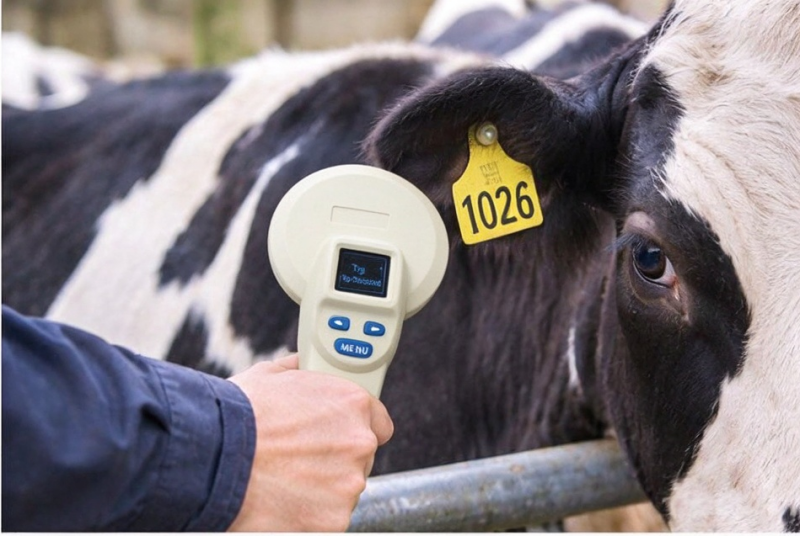
RFID reader scanning animal ear tags
2. Check RFID Frequency and Protocol Compatibility
Frequency and protocol compatibility are among the most important factors when choosing an animal RFID reader.
Many animal identification systems use Low Frequency (LF) RFID technology, particularly 125 kHz and 134.2 kHz. However, these frequencies are not interchangeable simply because they both belong to the LF category.
125 kHz vs. 134.2 kHz Animal RFID
Although both operate in the low-frequency range, their typical applications and supported transponder formats can differ.
| Feature | 125 kHz | 134.2 kHz |
|---|---|---|
| Frequency category | LF RFID | LF RFID |
| Common identification formats | EMID and selected LF formats | FDX-B, HDX and other supported animal formats |
| Typical applications | Selected animal and general-purpose identification systems | Standardized livestock and pet identification |
| Compatibility | Requires a compatible 125 kHz reader | Requires a compatible 134.2 kHz reader |
| Purchasing consideration | Confirm the exact chip format | Confirm the supported animal identification protocol |
For standardized animal identification projects, 134.2 kHz readers supporting the appropriate ISO 11784/11785 protocols are commonly relevant.
However, do not assume that every 134.2 kHz reader supports every animal tag.
The reader must decode the same communication format used by the transponder.
For projects using multiple RFID technologies, compare the available RFID reader solutions before selecting a device.
FDX-B vs. HDX: What Is the Difference?
FDX-B and HDX are two important communication technologies used in animal identification systems under ISO 11785.
They use different communication methods, which means a reader must explicitly support the appropriate protocol.
FDX-B (Full Duplex B)
FDX-B tags communicate with the reader while the reader’s energizing field is present.
This technology is widely used in companion animal microchips and livestock identification systems.
HDX (Half Duplex)
HDX tags store energy from the reader’s electromagnetic field and transmit their identification data during the reader’s listening period.
This communication arrangement is used in various livestock identification applications.
FDX-B vs. HDX Comparison
| Feature | FDX-B | HDX |
|---|---|---|
| Communication method | Tag responds while the field is active | Tag responds during the field-off period |
| Standard | ISO 11784/11785 | ISO 11784/11785 |
| Typical applications | Pets and livestock | Livestock and selected animal tracking systems |
| Reader requirement | FDX-B-compatible decoder | HDX-compatible decoder |
| Compatibility | Cannot automatically read HDX-only tags | Cannot automatically read FDX-B-only tags |
Which one should you choose?
The answer depends on the tags already being used in your animal identification program.
If your livestock carries FDX-B tags, select an FDX-B-compatible reader. If your project uses HDX tags, choose a reader that explicitly supports HDX.
For farms managing animals with mixed tag formats, a reader supporting both FDX-B and HDX can provide greater flexibility.
Important: ISO compatibility should not be confused with independent device certification. If your project requires officially certified equipment, check the specific device listing and certification status rather than relying only on a supplier’s general compatibility statement.
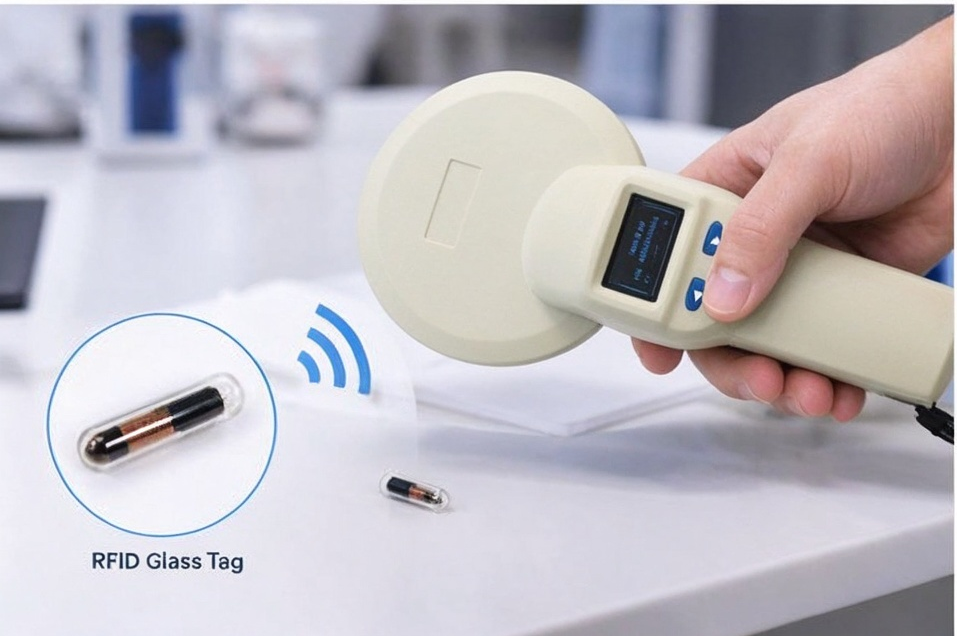
Compatibility Testing of Reader and RFID Glass Tag
3. Choose the Right Animal RFID Reader Type for Your Application
After confirming frequency and protocol compatibility, the next step is choosing the correct physical reader configuration.
A compact microchip scanner, a handheld livestock reader, and a fixed RFID reader may all identify animals, but they are designed for different workflows.
Handheld Animal RFID Reader
A handheld animal RFID reader is suitable for applications where operators need to identify individual animals at different locations.
Typical applications include:
- Livestock identification and registration.
- Veterinary examinations.
- Animal breeding management.
- Field inspections.
- Laboratory animal identification.
Handheld devices are particularly useful when mobility and direct identification are more important than continuous automated reading.
When comparing handheld models, check:
- Supported tag formats.
- Screen visibility.
- Battery capacity and operating time.
- Internal memory.
- USB or wireless connectivity.
- Device weight and ergonomic design.
A portable reader with internal storage can also be useful when animals are identified in locations without reliable internet access.
RFID Stick Reader for Livestock
A stick reader is designed for livestock operations where the operator needs additional reach.
Its extended design makes it easier to scan electronic ear tags around cattle, sheep, and goats without bringing a small handheld scanner directly beside the tag.
Typical applications include:
- Cattle handling facilities.
- Sheep and goat farms.
- Livestock auctions.
- Animal weighing stations.
- Breeding and sorting operations.
When selecting a stick reader, consider the length of the device, antenna configuration, handling convenience, and compatibility with your existing electronic identification tags.
A longer reader is not automatically better. The appropriate length depends on the animals, handling equipment, and available working space.
Desktop Animal RFID Reader
Desktop readers are useful when animals or samples are identified in a controlled working environment.
For example, veterinary laboratories and research facilities may use desktop readers to register microchip IDs directly into a computer-based database.
Important features include:
- USB connectivity.
- Supported operating systems.
- Keyboard emulation or software integration.
- Reading stability.
- Compatibility with the required transponder formats.
If your workflow primarily involves computer-based registration, a compact USB device may be more practical than a larger handheld terminal.
Explore our USB RFID reader range for computer-connected identification applications.
Fixed Animal RFID Reader
Fixed RFID readers are designed for automated animal identification at predetermined locations.
Typical installation points include:
- Livestock gates.
- Feeding stations.
- Animal weighing systems.
- Sorting lanes.
- Automated handling equipment.
Unlike handheld readers, fixed systems may require additional antennas, controllers, power supplies, and software integration.
Before purchasing a fixed reader, define the required reading zone and how animals will pass through it.
You should also verify whether the system needs to identify one animal at a time or detect multiple tagged animals within a controlled area.
Which Reader Type Should You Choose?
| Working Requirement | Recommended Configuration |
|---|---|
| Scanning individual animals during fieldwork | Handheld reader |
| Identifying cattle or sheep around handling equipment | Stick reader |
| Registering microchips at a computer workstation | Desktop USB reader |
| Automatically identifying animals at a gate | Fixed reader |
| Collecting identification data with additional observations | Handheld terminal with suitable software |
The most suitable device is the one that fits your identification workflow, rather than simply the one with the largest specification list.
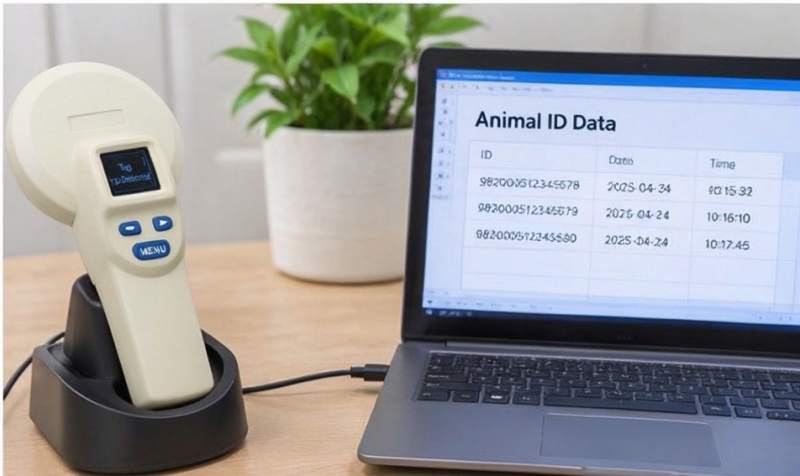
Scenarios for connecting an Reader to a computer for data transfer
4. Evaluate RFID Reading Distance in Real Working Conditions
Reading distance is another important purchasing consideration.
Many buyers compare animal RFID readers based on their maximum advertised reading distance. However, a manufacturer’s maximum specification does not necessarily represent the distance achievable in every application.
Actual performance depends on several factors.
Tag Size and Antenna Design
The size and design of an RFID transponder can significantly affect reading performance.
For example, an electronic livestock ear tag generally has a different antenna structure from a small injectable glass microchip.
Even when both tags operate at 134.2 kHz, their achievable reading distances may be different.
The reader’s antenna design and sensitivity also influence performance.
Tag Orientation
The position of the RFID tag relative to the reader antenna can affect signal coupling.
If the tag is incorrectly oriented, the reading distance may decrease.
This is particularly important when scanning animals that are moving or standing at different angles.
Environmental Conditions
The surrounding environment may influence reading stability.
Potential factors include:
- Nearby electrical equipment.
- Electromagnetic interference.
- Metal structures around the scanning area.
- Antenna installation position.
- Animal movement.
- The distance between the tag and reader.
These conditions should be considered when evaluating a reader for a real farm or veterinary environment.
How to Test Reading Distance Before Purchasing
We recommend the following procedure:
- Prepare the exact RFID tag model used in your project.
- Confirm its frequency and protocol.
- Position the reader and tag as they would be used in the actual application.
- Test several tag orientations.
- Repeat the test with multiple tags.
- Record the stable reading distance rather than only the maximum occasional reading.
For example, a reader that consistently identifies a tag at a shorter distance may be more useful than one that occasionally achieves a longer reading distance but performs inconsistently.
If your project involves fish identification or wildlife research, our guide to choosing a PIT tag reader for fish and wildlife provides additional information about different reading arrangements.
5. Consider Data Storage and Connectivity
An animal RFID reader does more than detect an electronic identification number.
In most professional applications, the collected ID must be transferred to another system for registration, analysis, or management.
Therefore, the data interface should be considered before purchasing the reader.
USB Connectivity
USB is a practical option for connecting readers to computers.
Depending on the reader, USB communication may support:
- Direct ID transmission.
- Keyboard emulation.
- Data synchronization.
- Computer-based registration.
- Integration with compatible software.
For simple identification tasks, keyboard emulation can be particularly convenient because the reader sends the tag ID to the active input field.
However, buyers should verify the actual output format and host compatibility.
Bluetooth Connectivity
Bluetooth is useful when animal identification takes place away from a fixed computer workstation.
For example, a veterinarian may scan an animal and transfer its identification number to a compatible tablet or mobile device.
Before selecting a Bluetooth-enabled reader, confirm:
- Supported Bluetooth version.
- Compatibility with the intended operating system.
- Pairing procedure.
- Data output format.
- Whether the required application supports the reader.
Do not assume that Bluetooth connectivity guarantees compatibility with every mobile application.
Internal Memory and Offline Operation
For farms, field researchers, and livestock inspectors, offline data collection can be important.
A reader with internal memory can store identification records while operators work in areas without internet connectivity.
Some devices also record additional information such as scan time.
Before purchasing, check:
- Number of records supported.
- Available storage capacity.
- Data export options.
- Memory retention.
- Whether records can be reviewed directly on the device.
For example, the Animal RFID Reader information on our website describes a reader configuration with storage for up to 6,000 tag records, together with USB and optional wireless communication features. Confirm the exact model specification before ordering.
The objective is to select a reader that fits your data management workflow, not simply one with the largest memory capacity.
6. Select the Right Reader for Different Animal Identification Applications
Different industries have different identification requirements.
Understanding the operating environment helps narrow down the available reader options.
Animal RFID Readers for Cattle and Livestock Farms
Livestock farms often identify animals during feeding, weighing, vaccination, breeding, and transportation.
The reader should be compatible with the electronic ear tags already used on the farm.
For manual identification, handheld readers provide flexibility.
For livestock handling facilities, stick readers may offer a more convenient scanning position.
For automated identification, fixed readers can be integrated into weighing systems, gates, and sorting equipment.
The most important requirements are reliable tag recognition, practical reading distance, and easy data transfer.
Animal RFID Readers for Veterinary Clinics
Veterinary clinics commonly use microchip scanners to identify dogs, cats, and other companion animals.
In this environment, portability and tag compatibility are particularly important.
A suitable scanner should:
- Support the relevant microchip protocols.
- Be easy to operate with one hand.
- Provide a clear display.
- Offer stable close-range identification.
- Allow identification numbers to be recorded or transferred.
Veterinary clinics should confirm which microchip standards are required in their target market before selecting a scanner.
RFID Readers for Laboratory Animals
Research facilities often need accurate individual identification of animals throughout an experiment.
An RFID reader may be used to associate an animal’s unique ID with laboratory records, experimental groups, treatment history, and observation data.
For these applications, repeatable identification and reliable data management are more important than simply maximizing reading distance.
A compact reader or computer-connected device may be appropriate depending on the laboratory workflow.
RFID Readers for Fish and Wildlife Research
Fish and wildlife identification projects often use PIT tags to monitor individual animals over time.
The correct reader configuration depends on the research method.
A handheld reader may be suitable for identifying fish during recapture, while a fixed reading arrangement may be required to monitor tagged animals passing through a specific location.
For larger research projects, antenna design, tag orientation, detection coverage, and data recording become important parts of the overall system.
7. Check Software Integration and Future Expansion
A common purchasing mistake is evaluating the RFID reader independently from the software system.
In practice, the reader is only one component of an animal identification system.
A typical setup includes:
- An RFID tag attached to or implanted in the animal.
- An RFID reader that captures the unique identification number.
- A computer, mobile device, or controller that receives the data.
- Animal management software that connects the ID to an individual animal record.
The system may be used to manage:
- Animal identification.
- Vaccination history.
- Feeding records.
- Breeding information.
- Weight measurements.
- Animal movement.
- Health and treatment records.
Before purchasing, ask the supplier about available communication interfaces and software integration options.
For projects requiring custom functionality, clarify whether the reader supports SDKs, communication protocols, or customized data output.
You should also consider future expansion.
A device suitable for a small veterinary clinic may not be the best choice for a large livestock operation with automated gates and centralized data management.
Selecting a reader with the right integration capabilities can reduce future replacement and development costs.
8. Evaluate the Manufacturer, Quality Control and Customization Capabilities
For B2B buyers, selecting the correct RFID reader is only part of the purchasing decision.
The reliability of the manufacturer also matters, especially when ordering equipment for long-term projects or bulk deployment.
Here are several factors worth evaluating.
Product Manufacturing Experience
Look for a supplier with experience in RFID hardware development, manufacturing, and technical support.
A manufacturer with a broader RFID product portfolio may also be able to support related tags, readers, and system components.
You can learn more about D.O RFID’s manufacturing capabilities and RFID solutions.
Quality Control
Before placing a large order, ask about:
- Product functional testing.
- RFID reading performance testing.
- Communication interface testing.
- Battery and charging tests.
- Product consistency between batches.
- Warranty and after-sales support.
For large-scale deployments, sample testing is particularly valuable.
OEM and ODM Customization
Some buyers require more than standard commercial RFID readers.
For example, distributors and system integrators may need:
- Customized product branding.
- Special communication interfaces.
- Customized firmware.
- Different housing configurations.
- Integration with existing software.
- Specific reader and tag combinations.
If you are purchasing for a larger project, discuss customization requirements with the manufacturer before finalizing the order.
It is also worth reviewing the wider RFID product portfolio to determine whether the same supplier can support your related tag requirements.
9. Common Mistakes to Avoid When Buying an Animal RFID Reader
Even experienced buyers can make mistakes when selecting animal identification equipment.
The following issues are worth checking before ordering.
Mistake 1: Choosing a Reader Based Only on Frequency
A reader operating at 134.2 kHz is not necessarily compatible with every 134.2 kHz animal tag.
The supported protocol must also match.
Always check FDX-B, HDX, or other required formats.
Mistake 2: Assuming Every Animal RFID Reader Can Read Pet Microchips
Livestock ear tags and implanted pet microchips may use different tag designs and operating conditions.
A reader designed for one application should not automatically be assumed to work with every other animal identification product.
Mistake 3: Comparing Maximum Reading Distance Without Testing
Advertised reading distances are usually measured under specific conditions.
Actual performance depends on the reader, antenna, transponder, orientation, and environment.
Test with your actual tags whenever possible.
Mistake 4: Ignoring Data Transfer Requirements
A reader may successfully capture an animal ID but still be unsuitable if it cannot transmit the data to your existing software or mobile device.
Check the communication interface before purchasing.
Mistake 5: Ordering Large Quantities Without Sample Testing
For B2B projects, ordering samples before mass production is a practical way to reduce purchasing risks.
Test the reader with your actual tags, software, and working environment.
A short compatibility test can prevent much larger problems after deployment.
10. Animal RFID Reader Buying Checklist
Before requesting a quotation, use the following checklist to organize your technical requirements.
| Selection Factor | Questions to Confirm |
|---|---|
| Animal type | Cattle, sheep, pets, fish, laboratory animals or others? |
| Tag type | Ear tag, glass microchip, PIT tag or another transponder? |
| Frequency | 125 kHz, 134.2 kHz or another frequency? |
| Protocol | EMID, FDX-B, HDX or another supported format? |
| Reader configuration | Handheld, stick, desktop or fixed? |
| Reading distance | What distance is required in actual working conditions? |
| Connectivity | USB, Bluetooth, serial or another interface? |
| Data storage | Is internal memory required? |
| Software | Which application or management platform will receive the data? |
| Environment | Indoor, outdoor, farm, laboratory or automated handling facility? |
| Customization | Is OEM/ODM or firmware customization required? |
| Quantity | Sample order, small batch or bulk procurement? |
The more information you provide, the easier it is for a manufacturer to recommend the appropriate reader configuration.
11. Why Choose D.O RFID for Animal RFID Reader Solutions?
D.O RFID provides RFID identification products for different industries and application requirements.
Our product portfolio covers animal identification readers, RFID tags, RFID cards, and other RFID hardware solutions.
For animal identification projects, our reader range includes different configurations designed for applications such as livestock management, pet identification, and research.
Depending on the specific model, available features may include:
- Support for specified animal RFID transponder formats.
- Handheld identification.
- USB communication.
- Optional wireless connectivity.
- Internal data storage.
- Portable identification terminals.
We also support customers who need to match RFID readers with their existing animal tags and data management requirements.
For distributors, project contractors, and system integrators, we can discuss product selection, sample evaluation, and customization requirements.
Rather than recommending a reader based only on its appearance or advertised reading distance, we encourage buyers to provide their tag specifications and application details first.
This allows the appropriate reader configuration to be evaluated before a purchasing decision is made.
12. Frequently Asked Questions About Animal RFID Readers
What frequency is commonly used for animal RFID readers?
134.2 kHz is widely used in standardized animal identification systems, including many livestock and pet microchip applications.
However, selected animal identification systems also use 125 kHz and UHF technologies. Always check the actual tag specifications before selecting a reader.
Can an animal RFID reader read both FDX-B and HDX tags?
Yes, some animal RFID readers support both FDX-B and HDX.
However, not every 134.2 kHz reader supports both protocols. Confirm that the exact model explicitly lists the required compatibility.
Can one RFID reader identify cattle, sheep, dogs, and cats?
A reader may support multiple animal applications if it is compatible with the transponders used by those animals.
However, different tag types and physical designs may require different reader configurations.
The correct selection should be based on the actual RFID tags rather than the animal species alone.
What is the difference between an animal microchip scanner and a livestock RFID reader?
An animal microchip scanner is generally designed for implanted transponders, such as those used for pet identification.
A livestock RFID reader is commonly designed for electronic ear tags and may use a handheld, stick, or fixed configuration.
The main differences involve tag compatibility, antenna design, physical configuration, and working distance.
What reading distance should I expect from an animal RFID reader?
There is no universal reading distance for all animal RFID readers.
The actual distance depends on the reader antenna, tag dimensions, tag orientation, operating environment, and supported technology.
Ask the manufacturer for test conditions and verify performance using your actual transponders.
Can an animal RFID reader transfer data to a computer?
Many readers support USB communication, while selected models also offer Bluetooth or other interfaces.
Depending on the device, tag IDs may be transmitted through keyboard emulation, serial communication, or a compatible software interface.
Confirm the output format and operating system compatibility before purchasing.
Do animal RFID readers need internet access?
Not necessarily.
Some readers can identify tags and store records locally without an internet connection. The collected information can then be transferred to a computer or management platform later.
Whether this is possible depends on the reader’s memory and data management functions.
Can I customize an animal RFID reader for my project?
Customization availability depends on the reader model and project requirements.
Possible requirements may include product branding, communication interfaces, firmware functions, or integration with an existing identification system.
Contact the manufacturer with your technical requirements to evaluate the available options.
How can I choose the correct animal RFID reader supplier?
Compare more than the quoted unit price.
Check product specifications, tag compatibility, sample testing, manufacturing capabilities, quality control, customization support, and after-sales service.
For large projects, request technical confirmation of the exact reader and tag combination before placing a bulk order.
Conclusion: Choose the Animal RFID Reader Based on Your Tags and Working Requirements
Choosing an animal RFID reader starts with understanding the RFID tags used in your identification system.
Frequency and protocol compatibility should be checked first. Next, consider the reader configuration, reading distance, connectivity, data storage, software integration, and operating environment.
A handheld reader may be ideal for mobile animal identification, while a stick reader can be more practical for livestock handling. Desktop readers support computer-based registration, and fixed readers can provide automated identification at controlled locations.
For B2B buyers, sample testing and supplier evaluation are equally important.
The best animal RFID reader is not necessarily the device with the most features. It is the device that works reliably with your tags, fits your operational workflow, and supports your long-term identification requirements.
Looking for the Right Animal RFID Reader for Your Project?
Whether you need a handheld livestock scanner, a pet microchip reader, a desktop RFID device, or a customized animal identification solution, D.O RFID can help you evaluate suitable options.
Send us your RFID tag specifications, required reading distance, application, and estimated order quantity.
Our team can help you identify a suitable reader configuration and discuss sample testing, bulk orders, and OEM/ODM requirements.
Contact D.O RFID Today to Get a Quote

Do RFID is a leading China-based manufacturer with over 15 years of experience. We specialize in customized RFID readers, tags, and cards, delivering high-quality, tailored solutions that meet your unique business needs and drive seamless, efficient identification.