September 14, 2026
In the lobby of an office building in downtown Singapore, thousands of employees tap their ID cards at the turnstile every morning. Across town, a student swipes a campus card to buy coffee, enter the library, and print documents — all using the same piece of plastic. And in the pocket of a Paris Metro commuter, a contactless ticket card validates entry in less time than it takes to blink.
Chances are, many of those cards are running MIFARE Classic technology. Introduced by NXP Semiconductors in 1994, MIFARE Classic has become one of the most widely deployed contactless smart card platforms in the world, with more than 12 billion ICs sold and use across more than 40 different applications globally. Available in two memory configurations — 1 kilobyte (1K) and 4 kilobyte (4K) — MIFARE Classic cards power access control systems, public transport ticketing, campus IDs, loyalty programs, and countless other everyday transactions.
But what exactly sets the 1K apart from the 4K? Is the extra memory worth the additional cost? And given the security vulnerabilities that have emerged over the years, should you even be using MIFARE Classic for new projects at all?
This comprehensive guide breaks down everything you need to know about MIFARE Classic 1K and 4K: technical specifications, real-world applications, security considerations, competitive alternatives, and a clear framework for choosing the right card for your specific needs.
1. What Is MIFARE Classic? Understanding the Technology
MIFARE Classic is a contactless smart card IC platform developed by NXP Semiconductors that operates at 13.56 MHz and complies fully with the ISO/IEC 14443 Type A international standard for contactless integrated circuit cards. The technology was first introduced in 1994, and over the past three decades, it has become the de facto standard for a vast range of applications — from office door access to urban transit systems.
MIFARE Classic cards are passive devices: they contain no battery and draw power from the electromagnetic field generated by a reader. When a card comes within range (typically up to 100mm, depending on reader and antenna design), the reader powers the card’s chip, and the two devices exchange encrypted data to authenticate and authorize the transaction. A complete ticketing transaction can be completed in less than 100 milliseconds, allowing for high-throughput applications like bus boarding and subway gate entry.
The platform is available in two primary memory configurations: MIFARE Classic 1K (1,024 bytes of EEPROM) and MIFARE Classic 4K (4,096 bytes of EEPROM). Both versions share the same underlying architecture, security protocol, and radio frequency characteristics — the only substantive difference is the amount of storage available.
2. MIFARE Classic 1K vs 4K: Technical Specifications Side by Side
If you are evaluating MIFARE Classic cards for a project, understanding the memory structure is essential. The difference between 1K and 4K is not merely “four times the storage” — the internal organization of that storage is fundamentally different.
2.1 Memory Capacity
| Specification | MIFARE Classic 1K | MIFARE Classic 4K |
|---|---|---|
| Total EEPROM | 1,024 bytes (1 KB) | 4,096 bytes (4 KB) |
| Usable storage | ~752 bytes | ~3.4 KB |
| Number of sectors | 16 sectors | 40 sectors |
| Blocks per sector | 4 blocks each | 32 sectors: 4 blocks each / 8 sectors: 16 blocks each |
| Block size | 16 bytes (fixed) | 16 bytes (fixed) |
| Keys per sector | 2 (Key A and Key B) | 2 (Key A and Key B) |
The MIFARE Classic 1K memory is organized into 16 sectors, each of which contains 4 blocks of 16 bytes, for a total of 64 blocks. Each block holds 16 bytes of data. Not all of this memory is available for user data, however. Each sector’s fourth block (known as the “sector trailer”) is reserved for access control information — two secret keys (Key A and Key B) and access condition bits. As a result, the actual usable storage on a 1K card is approximately 752 bytes.
The MIFARE Classic 4K has a more complex structure. It contains 40 sectors total. The first 32 sectors follow the same layout as the 1K: 4 blocks of 16 bytes each. The remaining 8 sectors, however, are quadruple-sized, containing 16 blocks each (15 data blocks plus 1 trailer block). This gives the 4K card approximately 3.4 KB of usable storage — roughly 4.5 times the usable memory of the 1K variant.
2.2 Access Control and Key Structure
Both versions share the same per-sector security model. Each sector has its own sector trailer block (the last block in that sector) that contains:
- Key A: 6 bytes, mandatory for authentication (cannot be read after programming)
- Key B: 6 bytes, optional; can be used for authentication or user data storage
- Access bits: 4 bytes defining read/write/increment/decrement permissions for each block
To read or write any data block in a sector, the reader must first authenticate with either Key A or Key B for that specific sector. This mutual three-pass authentication follows ISO/IEC DIS 9798-2 specifications. After successful authentication, the reader can perform operations on the blocks of that sector according to the access permissions defined in the sector trailer.
The ability to assign different keys to different sectors — a feature present in both 1K and 4K — enables multi-application use cases. For example, a single campus card could allocate sector 1 for building access (managed by security), sector 2 for cafeteria payments (managed by catering), and sector 3 for library borrowing (managed by administration) — all with independent keys and access policies.
2.3 Read Range and Performance
Both versions operate at 13.56 MHz with a data transfer rate of 106 kbit/s. The typical read range is up to 100mm (approximately 4 inches), though this varies depending on reader antenna design, card antenna geometry, and environmental factors. MIFARE Classic includes an intelligent anti-collision feature that allows multiple cards to be present in the reader field simultaneously; the anti-collision algorithm selects each card individually and ensures transactions are processed correctly without data corruption.
The cards are rated for approximately 200,000 write cycles and a data retention period of 10 years, making them suitable for long-term deployment in demanding environments.
2.4 UID Options
MIFARE Classic cards are available with either a 4-byte or a 7-byte unique identifier (UID). The 4-byte UID variants are more common in legacy systems, while 7-byte cards are sometimes preferred for applications requiring globally unique identification to prevent collisions across large deployments.
3. Key Applications: Where MIFARE Classic 1K and 4K Are Used
3.1 Public Transport Ticketing
The single most common application for MIFARE Classic is public transport ticketing. Major cities worldwide — from London to Seoul to San Francisco — have adopted MIFARE-based e-ticketing systems for buses, subways, trains, and ferries. The fast transaction speed (under 100 ms) allows high gate throughput, and the ability to read cards through wallets and bags provides a frictionless user experience.
For basic fare collection and stored-value applications, the 1K version is almost always sufficient. A typical transit card stores a balance, a transaction log, and perhaps a few timestamps — easily fitting within the 752 bytes of usable storage on a 1K card.
However, more sophisticated transport systems — such as those supporting zone-based pricing, multiple fare products, or journey history — may require the additional capacity of a 4K card.
3.2 Access Control
Physical access control — office buildings, hotels, schools, hospitals, and industrial facilities — represents another enormous market for MIFARE Classic cards. The cards can be programmed to store a user’s access privileges for specific doors, time zones, and security levels. HID Global, one of the world’s largest access control manufacturers, offers MIFARE Classic credentials in multiple form factors including cards and key fobs.
For most access control deployments, the 1K card is entirely adequate. Even a complex access profile — with permissions for dozens of doors, multiple time schedules, and multi-level security clearances — rarely exceeds a few hundred bytes of storage.
3.3 Campus Cards and Corporate IDs
Universities and large corporations issue MIFARE Classic cards that serve multiple functions: building access, cafeteria payments, library borrowing, printing and copying, attendance tracking, and event access — all on a single piece of plastic. This multi-application use case is where the 4K card truly shines. By allocating different sectors to different applications (each with its own keys and access permissions), a single 4K card can serve as a student’s entire digital wallet for the campus.
3.4 Loyalty Programs and Micropayments
MIFARE Classic cards are widely used in closed-loop micropayment environments such as coffee shop loyalty programs, vending machines, and concession stands at events and stadiums. These applications typically require limited storage — a customer ID, a point balance, and some transaction history — making the 1K version the economical choice.
3.5 Event Ticketing and Hospitality
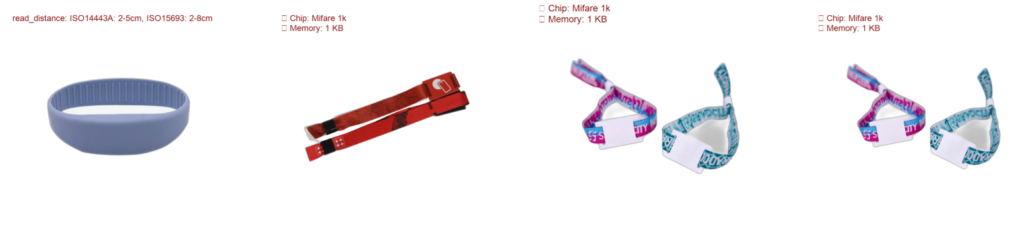
From music festivals to corporate events, MIFARE Classic wristbands and cards are used for entry validation and cashless payments. The 4K card can be advantageous here when multiple entitlements must be tracked — for example, prepaid food and drink quotas, VIP access zones, merchandise credits, and parking validation — all on the same credential.
4. Security Considerations: Why Classic Is No Longer Recommended for New Designs
Here is the most important section of this guide — and the one that may lead you away from MIFARE Classic entirely.
The security of MIFARE Classic cards relies on a proprietary encryption algorithm called Crypto-1. At the time of its introduction in 1994, Crypto-1 was considered sufficiently robust for most applications. However, over the past two decades, researchers have systematically exposed its weaknesses.
4.1 The Crypto-1 Vulnerabilities
In 2008, researchers from Radboud University in the Netherlands demonstrated that they could crack the Crypto-1 encryption on MIFARE Classic cards using relatively modest computational resources. The attack exploited weaknesses in the algorithm’s random number generation and authentication protocol. NXP initially responded with legal action to block the publication of the research details — a move that generated significant controversy in the security community.
The fundamental problem with Crypto-1 is that it is a proprietary, closed algorithm. Unlike open standards such as AES (Advanced Encryption Standard), Crypto-1 has not undergone extensive public peer review and cryptanalysis. The vulnerabilities discovered over the years include:
- Nested authentication attacks: An attacker with access to a single authenticated sector can recover keys for other sectors using timing and cryptographic weaknesses.
- Dark-side attacks: By manipulating the read timing and observing response behavior, attackers can gradually recover sector keys without needing to know any key in advance.
- Weak random number generation: Early MIFARE Classic cards used a predictable pseudo-random number generator (PRNG), making them vulnerable to replay and cloning attacks.
4.2 The 2024 Backdoor Discovery
The vulnerabilities did not end in 2008. In August 2024, security researchers from Quarkslab, led by Philippe Teuwen, published a paper revealing a significant backdoor in numerous MIFARE Classic variants — including NXP MF1ICS5003/MF1ICS5004, Shanghai Fudan FM11RF08S, and Infineon SLE66R35 cards.
The backdoor — present in some cards since at least 1998 — allows an attacker to bypass standard KeyA/KeyB authentication entirely and access any memory content using a “backdoor key” that can be brute-forced in as little as two minutes. Combined with other weaknesses, researchers were able to recover all card contents, including every KeyA and KeyB on the card, within an hour.
4.3 NXP’s Official Position
The most telling signal about MIFARE Classic’s future comes from the manufacturer itself. On NXP’s official product pages for MIFARE Classic EV1 1K and 4K, the company now includes the following warning:
“This product is not recommended for new designs. Instead, we recommend to use our MIFARE DESFire Light IC.”
Similarly, the original MIFARE Classic 1K product page is labeled: “This page contains information on a product that is no longer manufactured (discontinued). Specifications and information herein are available for historical reference only.”
When the company that created a technology tells you not to use it for new projects, you should pay attention.
4.4 What This Means for You
If you are maintaining an existing MIFARE Classic system that already works for your needs and does not process high-value transactions or sensitive data, the risks may be acceptable. Many legacy access control systems continue to operate safely because the physical and organizational controls — security guards, cameras, access logs — provide layers of protection beyond the card itself.
If you are designing a new system, however, choosing MIFARE Classic today is almost certainly a mistake. The security vulnerabilities are well-documented, the manufacturer has officially moved on, and there are better alternatives available at comparable price points.
5. Competitor Analysis: MIFARE Classic vs. The Alternatives
To make an informed decision about MIFARE Classic 1K versus 4K, you must also consider whether you should be using MIFARE Classic at all. Here is how Classic stacks up against the leading alternatives in the market.
5.1 MIFARE Classic vs. MIFARE DESFire
MIFARE DESFire is NXP’s high-security product line, designed for applications requiring robust encryption and multi-application support.
| Aspect | MIFARE Classic (1K/4K) | MIFARE DESFire (EV2/EV3) |
|---|---|---|
| Encryption | Crypto‑1 (proprietary, broken) | AES‑128 / 3DES (open standards, unbroken) |
| Memory structure | Sector/block | File system (AIDs, directories) |
| Multi-application | Per-sector keys possible | Native, with cryptographic separation |
| Certification | None | Common Criteria EAL4+/EAL5+ |
| Transaction speed | 106 kbit/s | Up to 848 kbit/s |
| NXP recommendation | Not for new designs | Recommended |
The security difference is stark. MIFARE DESFire employs AES-128 (Advanced Encryption Standard with 128-bit keys), the same encryption standard used by governments, banks, and military organizations worldwide. AES is an open, public standard that has withstood decades of cryptanalysis. MIFARE DESFire EV3 also meets Common Criteria EAL4+ certification standards — ideal for industries that demand strict security and compliance.
DESFire cards are available in 2 KB, 4 KB, and 8 KB memory configurations, and they use a flexible file system rather than Classic’s rigid sector/block structure. This makes DESFire far more suitable for complex, multi-application systems requiring strong security.
The trade-off is cost: DESFire cards are more expensive than Classic cards, and the reader infrastructure may need upgrading. For high-security applications — government ID, financial payments, medical records — DESFire is the right choice.
5.2 MIFARE Classic vs. MIFARE Plus
MIFARE Plus occupies an interesting middle ground. It is designed to be backward-compatible with MIFARE Classic infrastructure while offering an upgrade path to AES-128 security. In “SL1” (Security Level 1) mode, MIFARE Plus operates in Classic-compatible mode using Crypto-1. In “SL3” mode, it upgrades to AES-128 encryption.
For organizations with large existing Classic deployments, MIFARE Plus allows a gradual migration: issue new cards in Plus format that work with existing readers in SL1 mode, then upgrade readers to SL3 and migrate to AES security over time without a disruptive “rip and replace.”
5.3 MIFARE Classic vs. NTAG Series
NTAG chips (NTAG213, NTAG215, NTAG216) are designed for consumer-facing NFC applications where simplicity and broad smartphone compatibility matter more than security. They are commonly used in smart posters, product authentication, and NFC business cards.
| Aspect | MIFARE Classic | NTAG213/215/216 |
|---|---|---|
| Security | Crypto‑1, per-sector keys | Password protection only |
| Memory | 1K / 4K | 180 / 540 / 924 bytes |
| Smartphone compatibility | Variable | Excellent (NFC Forum Type 2) |
| Typical use | Access control, payments | Marketing, pairing, sharing |
NTAG chips use the same ISO 14443A protocol at 13.56 MHz, so they work with most NFC-enabled smartphones — whereas MIFARE Classic support on phones is inconsistent because of the proprietary Crypto-1 implementation.
For simple data-sharing applications where security is not paramount, NTAG chips are often a better choice than MIFARE Classic.
5.4 MIFARE Classic vs. MIFARE Ultralight
MIFARE Ultralight is the budget entry in the MIFARE family, designed for disposable and limited-use applications. With 64 bytes of memory (expandable to 192 bytes in EV1 variants), Ultralight cards are intended for single-event tickets, visitor passes, and other short-duration applications.
Ultralight cards offer minimal security and cannot be used for access control or payment systems requiring mutual authentication. For their intended use case — replacing magnetic stripe and barcode tickets — Ultralight is a cost-effective solution.
6. Choosing the Right Card: A Decision Framework
With the technical specifications, applications, security concerns, and alternatives laid out, here is a practical decision framework to guide your choice.
6.1 When to Choose MIFARE Classic 1K
- You are maintaining an existing system that already uses MIFARE Classic cards and cannot justify a migration budget.
- Your application requires only basic storage (a user ID, a balance, a few timestamps).
- The deployment is low-security — no financial transactions, no sensitive personal data.
- You have no plans to add multiple applications to the same card beyond what fits in 1K.
- Cost is the absolute overriding constraint and you need the least expensive card available.
6.2 When to Choose MIFARE Classic 4K
- You need more storage than 1K provides for your use case — multiple applications, larger data records, or complex access profiles.
- You are locked into MIFARE Classic due to existing infrastructure constraints.
- Your system uses per-sector key isolation and you need the extra sectors for different applications.
Important: If you are selecting MIFARE Classic 4K for a new project, ask yourself honestly whether the reasons for choosing Classic at all are compelling enough to outweigh the well-documented security risks. For most new designs, the answer is no.
6.3 When to Avoid MIFARE Classic Entirely
- You are designing a new system — start with DESFire or Plus instead. NXP itself recommends this.
- Your application processes financial transactions or stores personally identifiable information (PII).
- Your system requires certification (government, healthcare, financial compliance).
- You expect the system to remain in service for more than 3–5 years — Classic will only become more vulnerable over time.
- You need reliable smartphone compatibility — MIFARE Classic support on mobile phones is inconsistent.
7. Frequently Asked Questions
Q: What is the actual usable memory on MIFARE Classic 1K vs. 4K?
The 1K card offers approximately 752 bytes of usable storage after reserving blocks for sector trailers and keys. The 4K card offers approximately 3.4 KB of usable storage.
Q: Can I upgrade from MIFARE Classic to MIFARE Plus or DESFire without replacing all my readers?
MIFARE Plus offers a migration path: it can operate in Classic-compatible mode (SL1) with existing readers, then be upgraded to AES security (SL3) as you replace readers. DESFire generally requires DESFire-compatible readers, but many modern readers support multiple protocols.
Q: Are MIFARE Classic cards still secure enough for basic access control?
That depends on your threat model. For a small office where the risk of someone acquiring specialized RFID hacking hardware (Proxmark3, approximately $400) and spending time to crack a card is low, Classic may be acceptable. For a high-security facility, government building, or any environment with valuable assets, Classic is not secure enough.
Q: Can smartphones read MIFARE Classic cards?
It varies. Some Android phones with NXP’s NFC controller chips can read MIFARE Classic cards, but iOS devices generally cannot. Unlike NTAG chips (which are NFC Forum Type 2 compliant), MIFARE Classic uses proprietary protocols that are not universally supported by phone manufacturers.
Q: What is the price difference between MIFARE Classic 1K and 4K?
The 4K version typically costs approximately 20–40% more than the 1K version at wholesale volumes. Both are inexpensive in bulk — often less than one dollar per card in quantities of 1,000 or more.
Q: Are there counterfeit MIFARE Classic cards that I should avoid?
Yes. “Magic cards” or “Chinese backdoors” are unauthorized clones that allow rewriting of the manufacturer block (including UID). These are widely available on online marketplaces and are intended for hacking and cloning. Using them in a production system invites security compromise. Always purchase MIFARE products from authorized NXP partners to ensure authenticity.
Q: How long do MIFARE Classic cards last?
MIFARE Classic cards are rated for approximately 200,000 write cycles and 10 years of data retention, making them suitable for long-term deployment in most environments. Physical wear on the card body or antenna is usually the limiting factor.
8. Final Recommendations
After reviewing the technical specifications, applications, security vulnerabilities, and competitive alternatives, here are the final, actionable recommendations:
If you are maintaining an existing MIFARE Classic 1K system that works for you, stick with 1K unless you have a demonstrable need for more storage. The 4K card offers no additional security and adds cost; the extra memory is useful only for specific multi-application scenarios.
If you are building a new system, do not use MIFARE Classic at all. The security vulnerabilities are real and well-documented. The manufacturer has officially labeled the product as not recommended for new designs. Start with MIFARE DESFire for high-security applications, MIFARE Plus for migration scenarios, or NTAG series for simple NFC sharing use cases that do not require strong authentication.
If you must use MIFARE Classic due to legacy infrastructure constraints, the 4K version is the right choice when you need: (a) more than 752 bytes of usable storage, (b) more than 16 sectors for independent key management, or (c) the ability to store larger data records across multiple applications on a single card.
The world of contactless smart cards has moved on since 1994. MIFARE Classic served its purpose well for decades, enabling millions of fast, convenient transactions every day. But technology evolves, and so do the threats. For new projects, the choice is clear: skip Classic and start with a platform designed for the security requirements of today — and tomorrow.

Do RFID is a leading China-based manufacturer with over 15 years of experience. We specialize in customized RFID readers, tags, and cards, delivering high-quality, tailored solutions that meet your unique business needs and drive seamless, efficient identification.