September 14, 2026
In the modern era of security and automation, access control systems are no longer a luxury but a necessity. At the heart of these systems lies the access control card reader, the device that acts as the gatekeeper, determining who gets in and who stays out. With a wide array of technologies available, choosing the right reader for your specific needs can be a daunting task.
This guide is designed to demystify the world of access control card readers. We will explore the major types, their underlying technologies, key features, and ideal applications. By the end, you’ll have a clear understanding of which reader type best aligns with your security requirements, budget, and operational environment.
As a leading manufacturer in this field, DO RFID Reader, a factory of the D.O RFID Group, has been at the forefront of developing and supplying high-quality, reliable access control solutions for over 14 years. Our commitment to “Source Quality Products and Enjoy Efficient Service” drives us to provide not only robust hardware but also the knowledge to help our customers make informed decisions.
1. Magnetic Stripe Readers: The Legacy Standard
Magnetic stripe (or magstripe) readers are one of the oldest and most recognizable forms of access control technology. They work by reading the magnetic information encoded on the black or brown stripe on the back of a plastic card, much like a traditional credit card.
How They Work: The reader contains a magnetic head that, when the card is swiped through it, detects the changes in the magnetic field on the stripe. These changes are translated into a digital code that is sent to the access control panel for verification.
Key Characteristics:
- Cost: Very low initial cost for both readers and cards.
- Durability: The magnetic stripe is prone to wear and tear from frequent swiping and can be easily damaged by exposure to magnets, heat, or moisture.
- Security: Offers very low security. The data on the stripe is static and can be easily copied or cloned with inexpensive equipment.
- Convenience: Requires a physical swipe, which can be slower and less convenient than other methods, especially with gloves or in wet conditions.
Best For: Low-security applications where cost is the primary driver, such as gym memberships, hotel room keys, or basic time-and-attendance tracking. Due to their security vulnerabilities, they are being rapidly phased out of professional security environments.
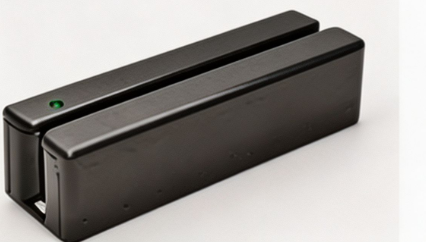
Magnetic stripe reader
2. Proximity (RFID) Readers: The Workhorse of Modern Access Control
Proximity readers, primarily based on Radio-Frequency Identification (RFID) technology, have become the industry standard for a wide range of access control applications. They offer a significant leap in convenience and durability over magstripe readers.
These readers can be further categorized by their operating frequency, which dictates their performance, read range, and typical use cases.
2.1 Low-Frequency (LF) RFID Readers (125 kHz)
LF readers are the simplest and most common type of proximity reader.
- Technology: They use electromagnetic induction to power a simple chip in the card (or fob) and read its unique ID number.
- Read Range: Very short, typically 2-10 cm (1-4 inches). The user must hold the credential close to the reader.
- Pros: Inexpensive, highly reliable, and perform well near metal or water, which can interfere with higher frequencies.
- Cons: Low data capacity, slow read speed, and relatively low security. Many older LF formats (like EM4100) are considered obsolete due to cloning vulnerabilities.
- Common Formats: EM4100, HID Prox.
2.2 High-Frequency (HF) RFID Readers (13.56 MHz)
HF readers represent a major step up in capability and security. This frequency band includes the widely adopted NFC (Near Field Communication) standard.
- Technology: Also uses inductive coupling but can support more complex communication protocols. NFC is a subset of HF RFID designed for secure, short-range communication between devices like smartphones and readers.
- Read Range: Short, usually up to 10 cm (4 inches), promoting a deliberate “tap” action.
- Pros: Higher data capacity, faster read speeds, and support for advanced security features like mutual authentication and encryption. This makes them much more resistant to cloning. They are also the standard for contactless smart cards and mobile credentials (using a smartphone’s NFC).
- Cons: More expensive than LF readers. Performance can be degraded by nearby metal objects.
- Common Standards: ISO/IEC 14443 (Type A/B – used in MIFARE, DESFire, FeliCa), ISO/IEC 15693.
2.3 Ultra-High-Frequency (UHF) RFID Readers (860-960 MHz)
UHF technology is designed for long-range, high-speed reading, often used in logistics and inventory, but it has niche applications in access control.
- Technology: Uses electromagnetic waves (like a radio) rather than magnetic fields. The reader emits a signal that powers the tag and reads its data.
- Read Range: Can be several meters (up to 10-15m or more with specialized setups).
- Pros: Excellent for vehicle access control (e.g., parking gates) or tracking assets/people over a wider area without requiring a deliberate tap.
- Cons: Poor performance near water and metal, which absorb UHF signals. Requires more power and is generally more expensive. Not ideal for secure, individual door access due to its long range, which can lead to accidental or unauthorized reads.
- Common Standard: EPC Gen2 (ISO/IEC 18000-63).
A Comparison of RFID Frequencies for Access Control
| Feature | Low-Frequency (LF) | High-Frequency (HF/NFC) | Ultra-High-Frequency (UHF) |
|---|---|---|---|
| Frequency | 125 kHz | 13.56 MHz | 860-960 MHz |
| Read Range | 2-10 cm | Up to 10 cm | 1-15+ meters |
| Data Capacity | Very Low | Medium to High | Medium |
| Read Speed | Slow | Fast | Very Fast (bulk reads) |
| Security | Low | High (with modern standards) | Low to Medium |
| Cost | $ | $$ | $$$ |
| Best Application | Basic, low-security access | Secure door access, Mobile Credentials | Vehicle ID, Long-range tracking |
At DO RFID Reader, we specialize in manufacturing a full range of HF/NFC and LF readers. Our 14 years of experience and investment in top-tier Heidelberg printing technology ensure our products meet the highest quality standards for demanding applications, including serving as a long-term supplier for the Austria metro card system.
DO RFID Reader offers the RFID Access Reader. Engineered with precision and built to last.
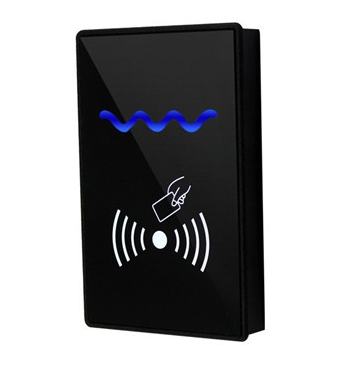
RFID Readers
3. Smart Card Readers: Enhanced Security and Functionality
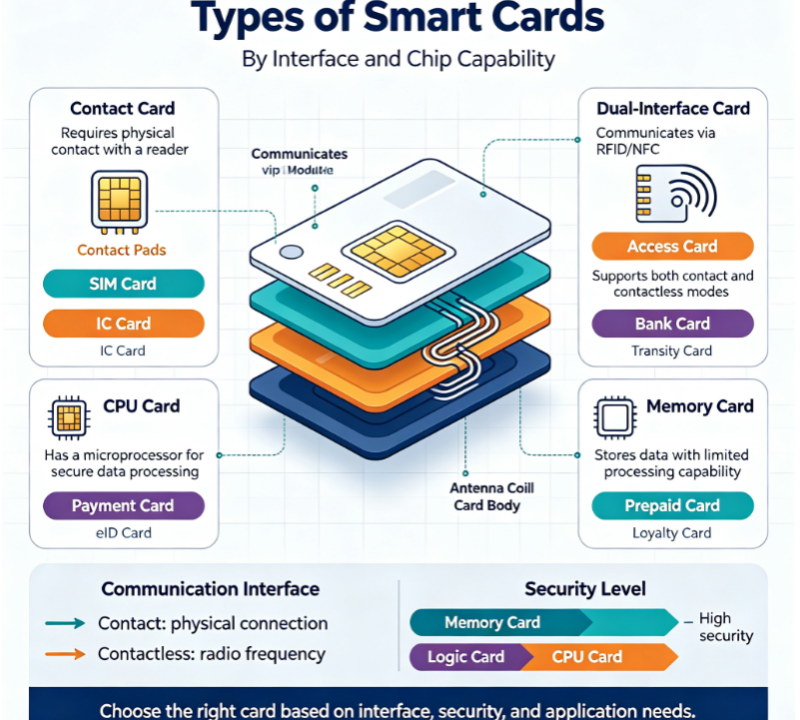
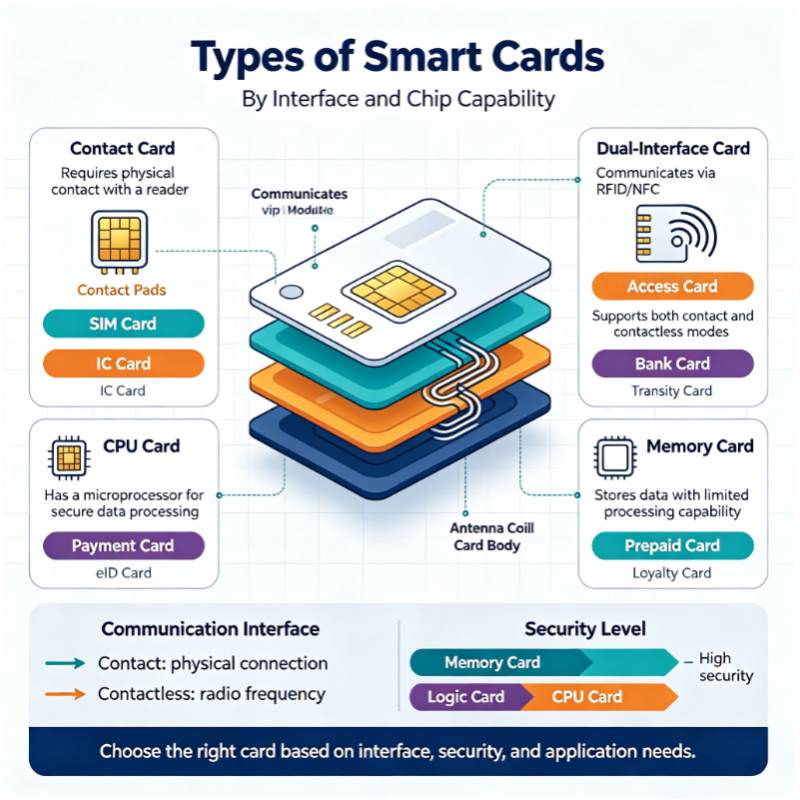
Smart card readers are a subset of HF readers that interface with cards containing an embedded microprocessor (a tiny computer chip). This allows for far more sophisticated interactions than a simple ID number exchange.
- Contact vs. Contactless:
- Contact Smart Card Readers: Require the card to be physically inserted into the reader so that electrical contacts on the card touch contacts inside the reader. This provides a very secure and stable connection but is slower and the contacts can wear out.
- Contactless Smart Card Readers: Use HF RFID/NFC technology to communicate with the chip wirelessly. This offers the same high level of security as contact cards but with the speed and convenience of a tap. Today, most smart card deployments for access control are contactless.
- Key Advantages:
- High Security: The embedded chip can perform cryptographic operations, store multiple secure applications (e.g., access, payment, ID), and protect data with PINs.
- Large Memory: Can store significant amounts of data on the card itself.
- Multi-Application: A single card can serve many purposes beyond just opening a door.
- Best For: High-security government facilities, financial institutions, corporate campuses, and any environment requiring strong authentication and multi-function credentials.
4. Biometric Readers: Authentication Based on “Who You Are”
Biometric readers take access control to a personal level by verifying a user’s unique physical or behavioral characteristics. This eliminates the need for a physical credential that can be lost, stolen, or shared.
DO RFID Reader offers Android Access Control Body Thermal Camera for use with facial recognition devices.
Common Biometric Modalities:
- Fingerprint Scanners: The most common and cost-effective biometric method. They map the unique ridges and valleys of a fingerprint.
- Facial Recognition: Uses a camera to analyze facial geometry. Modern systems are highly accurate and offer a completely touchless experience.
- Iris Scanners: Considered one of the most accurate biometric methods, they map the unique patterns in the colored ring of the eye.
- Palm Vein Scanners: Maps the vein pattern in a user’s palm using near-infrared light. It’s highly secure as the pattern is internal and difficult to spoof.
Key Considerations:
- Security: Extremely high, as it’s nearly impossible to forge a live biometric trait.
- Convenience: No need to carry a card or remember a PIN. However, environmental factors (dirty fingers, poor lighting) can sometimes affect performance.
- Privacy: Organizations must have clear policies on how biometric data is stored (ideally as a mathematical template, not an image) and used to address privacy concerns.
- Cost: Generally more expensive than card-based systems.
Best For: High-security areas (data centers, R&D labs), environments where hygiene is critical (hospitals, food processing), and scenarios where eliminating shared credentials is a priority.
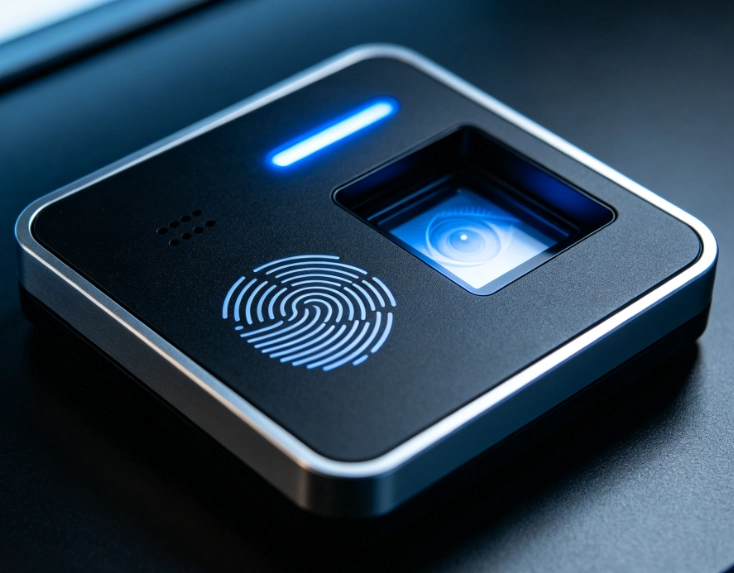
Fingerprint Scanners
5. Installation & Deployment Best Practices
A successful access control system relies not just on the right hardware, but also on correct installation. Here are key best practices to ensure optimal performance and longevity of your card readers.
- Environmental Considerations: For outdoor installations, always choose a reader with an appropriate IP (Ingress Protection) rating. An IP65 rating is typically the minimum for protection against dust and low-pressure water jets from any direction, while IP67 offers protection against temporary immersion. Ensure the reader’s housing material (often vandal-resistant polycarbonate or metal) can withstand local weather conditions, including UV exposure and extreme temperatures.
- Mounting and Placement: Install the reader at a standard ergonomic height (typically 1.2m – 1.4m or 4ft – 4.5ft from the floor). Avoid mounting directly on large metal surfaces, as this can interfere with the RF field of proximity and smart card readers, significantly reducing their read range. If mounting near metal is unavoidable, use readers specifically designed with anti-metal properties.
- Wiring and Connectivity: Use high-quality, shielded twisted-pair cabling (like CAT5e or better) for data lines to minimize electromagnetic interference (EMI), especially when running cables parallel to power lines. Always follow the manufacturer’s specifications for maximum cable distance. For new installations, strongly prefer OSDP (Open Supervised Device Protocol) over legacy Wiegand for its superior security and bi-directional communication capabilities.
At DO RFID Reader, our outdoor-rated models are rigorously tested to meet IP65/IP67 standards, ensuring reliable operation in the harshest environments, a testament to our commitment to quality that has made us a trusted supplier for critical infrastructure like the Austria metro system.
6. Cybersecurity Considerations
In today’s connected world, physical security devices are part of your IT network and must be secured accordingly. Ignoring cybersecurity can render even the most advanced hardware vulnerable.
- Secure Communication Protocols: The choice of communication protocol is paramount. Wiegand, while simple, transmits data in plain text and is unidirectional, making it highly susceptible to eavesdropping and tampering (“sniffing” attacks). In contrast, OSDP (Open Supervised Device Protocol) is the modern, secure standard. It features AES-128 encryption for all data transmissions, provides real-time supervision of the reader’s health, and enables secure remote management. Migrating to OSDP is a critical step in hardening your access control system.
- Credential Security: The security of your system is only as strong as its weakest credential. Legacy credentials like basic 125 kHz EM4100 cards use static, unencrypted IDs that are trivial to clone. Modern HF/NFC smart cards (e.g., MIFARE DESFire EV3, Seos) use mutual authentication and dynamic encryption, making them exponentially more secure. Always opt for encrypted, dynamic credentials for any application beyond the most basic.
- Firmware and Updates: Choose a manufacturer like DO RFID Reader that provides a clear and secure path for firmware updates. This ensures your devices can be patched against newly discovered vulnerabilities throughout their lifecycle, protecting your investment.
Our core value of “Source Quality Products” extends to cybersecurity. All our OSDP-compliant readers come with secure channel enabled by default, and we offer a robust framework for secure, over-the-air firmware management.
7. Mobile Credentials & The Cardless Trend
The future of access control is in your pocket. Mobile credentials leverage the NFC and Bluetooth capabilities of smartphones to replace physical cards, offering unmatched convenience and a modern user experience.
- How It Works: There are two primary technologies:
- NFC (Near Field Communication): The user simply taps their smartphone (which stores a secure digital credential in its Secure Element or Trusted Execution Environment) on the reader, just like a physical smart card. This method is highly secure and power-efficient.
- BLE (Bluetooth Low Energy): The reader constantly broadcasts a signal. When an authorized user’s phone is within range (typically 1-3 meters), the phone and reader authenticate each other, allowing for true hands-free or “approach-to-open” access without the user needing to take their phone out of their pocket.
- Benefits: Mobile credentials eliminate the cost and hassle of issuing, replacing, and managing physical cards. They enable instant provisioning and revocation from a central dashboard, enhance user convenience, and support advanced features like location-based permissions and visitor management.
- Reader Requirements: To support mobile credentials, your reader must be a multi-technology device capable of communicating via both 13.56 MHz (for NFC) and 2.4 GHz BLE. It must also be compatible with leading mobile access platforms (e.g., Apple Wallet, Google Wallet).
DO RFID Reader’s latest generation of multi-technology readers is fully equipped to support both NFC and BLE mobile credentials, empowering our clients to seamlessly transition to a cardless future while enjoying our standard 3-year warranty and 24/7 technical support.
8. Multi-Technology and Multi-Factor Readers: The Future of Flexibility
The most advanced readers on the market today are multi-technology and support multi-factor authentication (MFA), offering unparalleled flexibility and security.
- Multi-Technology Readers: A single reader can support multiple credential types. For example, one device might read legacy LF cards, modern HF/NFC smart cards, and even accept mobile credentials via BLE (Bluetooth Low Energy) or NFC from a smartphone. This is invaluable for organizations undergoing a technology transition, allowing them to maintain a single reader infrastructure while migrating users to newer, more secure credentials over time.
- Multi-Factor Authentication (MFA): These readers require two or more of the following:
- Something you have (a card or phone).
- Something you know (a PIN).
- Something you are (a fingerprint or face). For instance, a user might be required to present their smart card and enter a PIN, or place their finger on a scanner and have their phone in their pocket for a BLE handshake. This layered defense dramatically increases security.
Best For: Any organization looking for a future-proof, scalable, and highly secure access control solution. It provides a seamless user experience while accommodating diverse user needs and credential preferences.
9. Communication Protocols: How Readers Talk to the System
The physical technology of the reader is only half the story. The protocol it uses to communicate with the access control panel is equally important for security and functionality.
- Wiegand: An old, simple, and unidirectional protocol. It’s easy to install (just two data wires) but offers no encryption or error-checking, making it vulnerable to eavesdropping and tampering. It’s still common but should be avoided for new, security-conscious installations.
- RS-485: A robust, serial communication standard that supports long cable runs and multiple devices on a single bus. It’s more secure than Wiegand but still lacks built-in encryption.
- OSDP (Open Supervised Device Protocol): The modern, industry-standard protocol developed by the Security Industry Association (SIA). It is bidirectional, supports AES-128 encryption for secure communication, provides health monitoring of the reader, and enables advanced features like remote firmware updates and buzzer/light control. OSDP is the recommended choice for all new professional access control systems.
DO RFID Reader ensures that our products are equipped with modern communication interfaces, including OSDP, to provide our customers with the highest levels of security and manageability.
You might also be interested in:
RFID access control wristbands
Customized Hotel key Access Control T5577 RFID Cards
Conclusion: Choosing the Right Reader for Your Needs
Selecting an access control card reader is a strategic decision that balances security, convenience, cost, and future scalability. Here’s a quick summary to guide your choice:
- For basic, low-budget needs: A simple LF Proximity reader may suffice, but be aware of its security limitations.
- For a secure, reliable, and versatile standard: HF/NFC Smart Card readers are the optimal choice for most commercial and institutional applications.
- For the highest security and to eliminate credential sharing: Biometric readers are the gold standard.
- For a future-proof, flexible infrastructure: Invest in Multi-Technology/Multi-Factor readers with OSDP communication.
At DO RFID Reader, we understand that every project is unique. With our 15 years of experience, commitment to quality, and comprehensive product line—from LF and HF readers to custom-designed solutions—we are your trusted partner in building a secure and efficient access control system. We back all our products with a 3-year warranty and 24/7 technical support, embodying our core value: Source Quality Products and Enjoy Efficient Service. Contact DO RFID Reader for more information.

Do RFID is a leading China-based manufacturer with over 15 years of experience. We specialize in customized RFID readers, tags, and cards, delivering high-quality, tailored solutions that meet your unique business needs and drive seamless, efficient identification.