
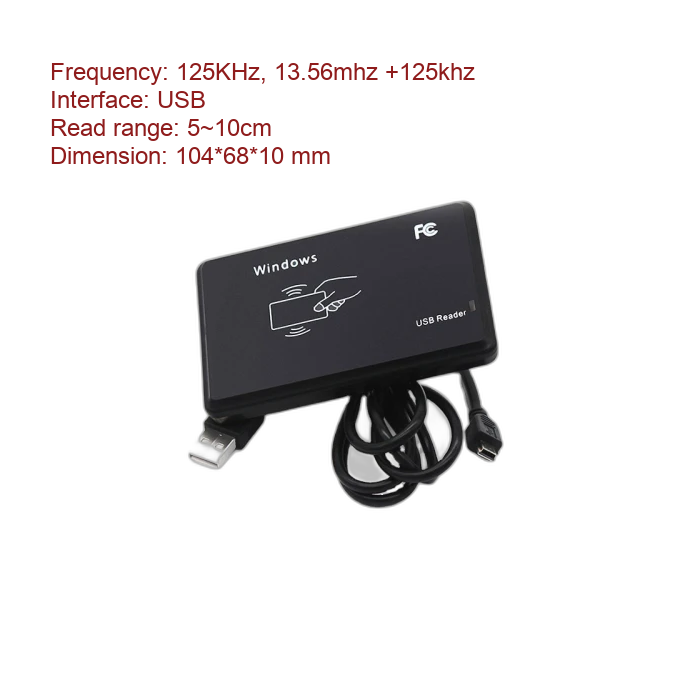
Product Overview
The USB Dual Frequency RFID Proximity Sensor Card Desktop Reader from do rfid reader manufacturer combines 125kHz and 13.56MHz reading capabilities in a single compact desktop unit. Designed for system integrators, access control distributors, and industrial project contractors, this plug-and-play RFID reader eliminates the need for driver installation or software configuration. When connected to a Windows computer, the reader automatically outputs card data into any active text field, making it suitable for identification verification, time attendance logging, membership management, and secure area entry control. The dual-frequency support allows organizations to operate mixed-card environments without deploying separate reader hardware for each frequency type.
Product Advantages
Procurement teams evaluating RFID readers for commercial deployment require hardware that reduces installation complexity while maintaining reading reliability across different card types. This USB desktop reader addresses that need by supporting both 125kHz proximity cards and 13.56MHz smart cards in one device. For wholesalers and distributors supplying access control components, this dual-frequency capability means lower inventory complexity and broader end-user compatibility. Project managers deploying identification systems across multiple sites benefit from consistent read performance and standardized USB connectivity. The factory behind this product maintains stable batch-to-batch consistency, ensuring that large-scale deployments receive identical hardware performance across all units. Bulk purchasing from the manufacturer reduces per-unit cost and simplifies supply chain management for long-term projects.
Key Features
- Dual-frequency reading support – operates at 125kHz and 13.56MHz simultaneously, compatible with EM, Mifare, and other common proximity and smart card formats
- True plug-and-play operation – no driver installation or software setup required; Windows automatically recognizes the device upon USB connection
- Automatic card data output – card numbers appear directly in open Excel, Word, notepad, or custom software fields without manual input
- Compact desktop form factor – measures 104mm x 68mm x 10mm, suitable for countertop installation in reception areas, turnstile kiosks, and check-in points
- Read range up to 10cm – reliable proximity reading for standard ISO card sizes and key fob formats
- Wide operating temperature range – functional from -25°C to 75°C, suitable for both indoor climate-controlled environments and semi-outdoor installation points
- Low power consumption – operates at DC 5V with 70mA working current, suitable for continuous commercial operation
- Two mechanical variants available – flat model with fixed USB cable and rugged model for higher-durability deployment environments
Technical Specifications
| Operating Frequencies | 125kHz + 13.56MHz (dual-frequency concurrent support) |
| Supported Card Types | 125kHz EM-compatible proximity cards, 13.56MHz Mifare-compatible smart cards |
| Output Format | Default: first 10 digits decimal card number (last 8 digits decimal available upon request) |
| Read Range | 5cm – 10cm (dependent on card type and environmental conditions) |
| Card Read Speed | 0.2 seconds per read |
| Communication Interface | USB (HID keyboard emulation, no driver required) |
| Communication Speed | 106 kbit/s |
| Power Supply | DC 5V (+/- 5%) via USB port |
| Working Current | 70mA |
| Operating Temperature | -25°C to 75°C |
| Storage Temperature | -20°C to 80°C |
| Operating Humidity | 10% to 90% (non-condensing) |
| Dimensions (L x W x H) | 104mm x 68mm x 10mm (flat model) |
| Weight | 135g (unit only); 100g with USB cable (alternate variant) |
| Color | Black |
| System Compatibility | Windows (all versions that support HID keyboard devices) |
| Write Capability | Read-only device; does not support card writing or HID card reading |
Industrial Applications
System integrators and project contractors deploy this dual-frequency USB reader in environments where card-based identification needs to be captured directly into software applications without manual keyboard entry. Common commercial applications include staff attendance recording at reception desks, visitor check-in systems in corporate lobbies, membership card verification at fitness centers and clubs, student ID registration in educational institutions, and patient identification in healthcare administration areas. Distributors supplying access control components to security installation companies recommend this reader for sites transitioning from 125kHz-only systems to mixed-frequency environments. The compact desktop footprint allows integration into existing countertop layouts without requiring additional mounting hardware or power outlets beyond the USB port. For project managers overseeing multi-building deployments, the consistent read performance across temperature ranges ensures reliable operation in both air-conditioned offices and unconditioned entrance areas.
OEM / ODM Manufacturing Support
do rfid reader manufacturer offers comprehensive OEM and ODM customization for this USB desktop reader. Procurement managers ordering for private-label distribution can request custom branding on the housing, customized output format configurations (first 10 digits or last 8 digits decimal), and packaging designed for retail or wholesale channels. The factory supports customization of cable length, connector types, and housing color for bulk orders. Engineering teams can modify the default card number output sequence to match existing software integration requirements without additional middleware. For ODM projects requiring unique form factors or enclosure designs, the in-house manufacturing team evaluates feasibility and provides production timelines based on order volume. Minimum order quantities for custom configurations start at 500 units, with sample approval available before mass production begins.
Factory Production Advantages
The manufacturing facility behind do rfid reader manufacturer operates with over two decades of production experience in RFID hardware. Production lines are configured for both standard catalog products and custom OEM orders, with batch consistency maintained through in-line quality inspection at multiple assembly stages. For wholesalers and distributors placing repeat orders, the factory maintains component inventory for the critical electronic modules, reducing lead time variability across order cycles. Each reader undergoes functional testing before packing, including read range verification at both frequencies and USB communication validation. Export packaging follows international shipping standards, with individual unit boxes suitable for retail display and bulk carton packing for wholesale logistics. The factory supports sea freight, air freight, and express courier shipments from Shenzhen port, with standard order processing completed within 3 to 5 working days after confirmation.
Bulk Supply & Project Deployment Support
Project contractors and system integrators procuring readers for large-scale deployments benefit from the factory’s ability to supply consistent batches across multiple project phases. When a deployment requires 1,000 or more units across several sites, the production team schedules batch manufacturing to ensure all units share identical firmware version, output configuration, and mechanical tolerances. For distributors managing ongoing wholesale relationships, the factory offers tiered pricing based on annual volume commitments, with production slots reserved for regular order cycles. Technical documentation including installation guides, output format specifications, and integration notes is provided with bulk orders to reduce deployment engineering time. The factory also supports after-sales technical consultation for integrators configuring the reader with third-party access control software or custom-developed identification platforms.
Frequently Asked Questions
Q: Does this reader require any software installation to function?
A: No. The reader uses USB HID keyboard emulation and is recognized by Windows automatically. Card data appears directly in any active text field without additional software or driver installation.
Q: Can this reader write data to RFID cards?
A: No. This is a read-only device designed for identification and data capture applications. It does not support writing to cards or reading HID-format proximity cards.
Q: What card number format does the reader output by default?
A: The default output is the first 10 digits of the decimal card number. If your system requires the last 8 digits decimal format, please specify this requirement when placing your order so the factory can configure the output accordingly.
Q: What is the lead time for bulk orders of this reader?
A: Standard orders are processed within 3 to 5 working days after confirmation. Bulk orders of 5,000 units or more typically ship within 7 to 15 working days, depending on current production load and customization requirements.
Q: Can I order a sample to evaluate before committing to a bulk purchase?
A: Yes. Sample units are available with the buyer covering shipping costs. The factory can provide free sample units for qualified wholesale or OEM inquiries. Contact the sales team with your expected order volume to arrange sample shipment.
Q: What customization options are available for OEM orders?
A: Custom branding on the housing, custom output format configuration, modified cable length or connector type, custom packaging design, and housing color changes are available for OEM orders. Minimum quantities apply for different customization levels.
Q: Is this reader compatible with non-Windows operating systems?
A: The reader is designed and tested for Windows operating systems using HID keyboard emulation. Compatibility with other operating systems depends on their support for USB HID devices and may require additional configuration.
Q: How should I store the reader if not used immediately after purchase?
A: Store in a dry environment within the storage temperature range of -20°C to 80°C and humidity between 10% and 90% to prevent electronic component degradation before deployment.