September 28, 2026
If you are searching for Dog Microchip Cost, the price of the microchip itself is only one part of what you may actually pay. A veterinary clinic may charge for the RFID microchip, implantation procedure, registration, consultation, or additional pet services. For manufacturers, veterinary distributors, and bulk buyers, the factory cost is calculated differently again.
A useful way to understand the total expense is:
Dog Microchip Cost = Microchip + Implantation + Registration + Additional Veterinary Services
In many markets, dog microchipping is a relatively affordable one-time identification procedure, but the final retail price varies according to country, clinic, chip specification, registration service, and local regulations.
This guide explains Dog Microchip Cost, how animal RFID microchips work, what standards buyers should look for, the difference between a microchip and GPS tracker, and what veterinary clinics, distributors, and pet-product companies should consider when purchasing dog microchips in bulk.
What Is a Dog Microchip?
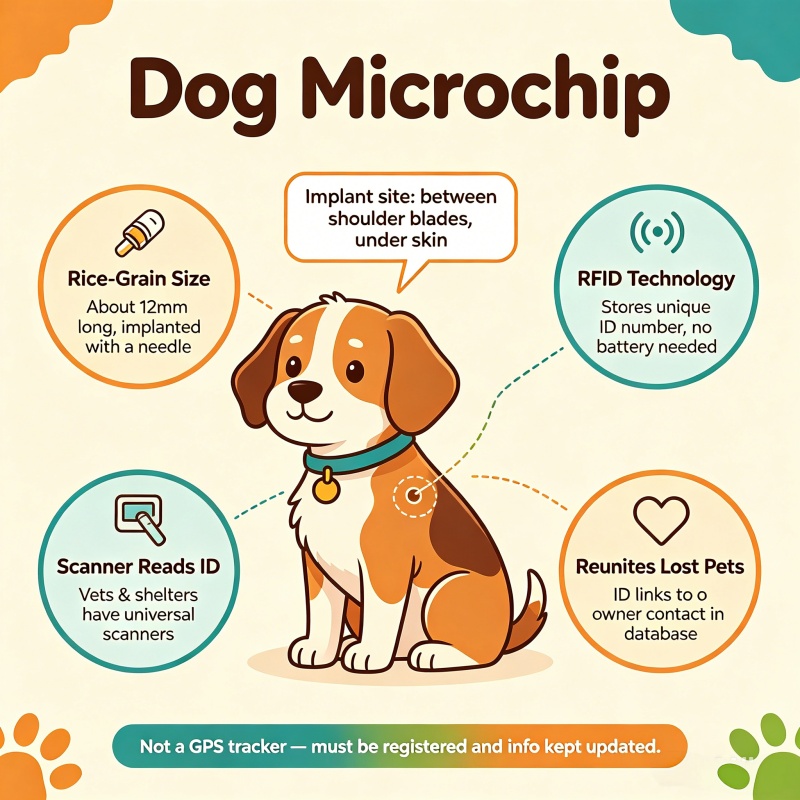
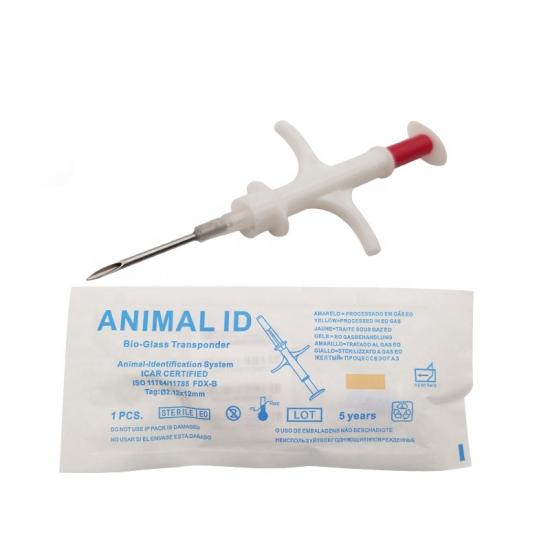
A dog microchip is a small electronic identification transponder designed to provide a permanent identification number for an animal.
The device is commonly contained inside a biocompatible glass capsule and uses passive RFID technology. Unlike a GPS tracker, it normally does not contain a battery and does not continuously transmit the dog’s location.
The microchip stores or communicates a unique identification number. When a compatible scanner is placed close to the animal, the scanner activates the passive transponder and reads the identification number.
The number can then be checked against an animal identification database to find the registered owner’s contact information.
This distinction is important:
The microchip identifies the dog; the database connects the identification number with the owner.
Therefore, implanting a chip without completing the appropriate registration process may reduce its usefulness if the dog becomes lost.
How Much Does a Dog Microchip Cost?
The Dog Microchip Cost paid by a pet owner depends heavily on location and what is included in the veterinary service.
A typical retail charge may include several components:
| Cost Component | What It Covers |
|---|---|
| Microchip | RFID identification transponder |
| Implantation | Veterinary procedure for inserting the chip |
| Registration | Linking the chip ID to owner information |
| Consultation | Veterinary examination or appointment |
| Documentation | Pet identification or travel paperwork where applicable |
| Additional Services | Vaccination, health checks, or other veterinary services |
A useful distinction for buyers is between retail cost and factory cost.
A pet owner may pay a veterinary clinic for a complete service, while a distributor purchasing thousands of units is primarily concerned with:
- Unit price
- MOQ
- Chip specification
- Encoding
- Sterilization
- Packaging
- Quality control
- Shipping terms
- Certification
- Private-label options
Consequently, the price of a physical microchip purchased directly from a manufacturer should not be compared directly with the final amount charged by a veterinary clinic.
For pet owners, Dog Microchip Cost is typically around US$25–50 in the United States, £20–35 in the UK, and approximately AUD $50–110 in Australia, although prices vary by clinic, region, registration, and additional veterinary services.
Why Does Dog Microchip Cost Vary?
There is no single worldwide price because several factors influence the total cost.
Country and Region
Veterinary labor costs, database services, regulations, and healthcare pricing vary considerably between countries.
A microchip procedure in a major city may cost more than the same procedure in a smaller location.
Veterinary Service Fees
The physical RFID device is only part of the service. The veterinarian or clinic also provides professional implantation and may include a consultation.
Registration Fees
Some identification databases provide registration as part of the service, while others may have separate charges or different policies.
Microchip Specification
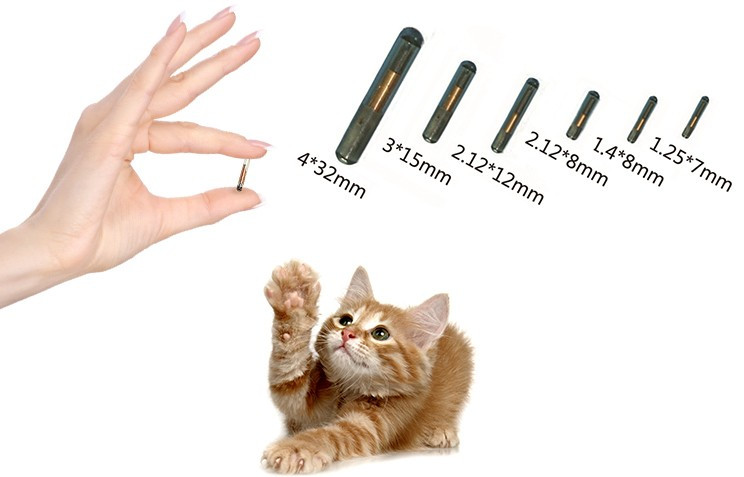
Different chips can have different technical specifications, packaging requirements, encoding options, and reader compatibility.
For international applications, compatibility with the required animal-identification system is particularly important.
Additional Services
If microchipping is performed during a puppy vaccination, health examination, or international travel appointment, the final invoice may contain several services.
What Does a Dog Microchip Actually Do?
A standard dog microchip performs one primary function:
Permanent electronic identification.
For example, a simplified identification process looks like this:
Dog → RFID Scanner → Unique Chip ID → Identification Database → Registered Owner
If a lost dog is taken to a veterinary clinic or animal shelter, staff can scan the animal.
The scanner reads the unique identification number. The number can then be searched in the appropriate database.
If the owner’s information is registered and current, the organization may be able to contact the owner.
This is why keeping registration information updated is just as important as implanting the microchip.
How Does a Dog Microchip Work?
Most animal identification microchips used for dogs are passive RFID transponders.
They do not continuously broadcast a signal.
Instead, the process generally works as follows:
Step 1: The scanner generates a radio-frequency field
A compatible reader is brought close to the implanted microchip.
Step 2: The microchip receives energy
The passive transponder obtains energy from the scanner’s electromagnetic field.
Step 3: The chip responds
The microchip communicates its unique identification number to the reader.
Step 4: The scanner displays the number
The identification number appears on the reader.
Step 5: The ID is checked against a database
Authorized personnel can use the identification number to locate the corresponding registration record.
This technology allows a tiny device to provide long-term animal identification without requiring a replaceable battery.
Does a Dog Microchip Have GPS?
No. A standard identification microchip is not a GPS tracker.
This is one of the most important points to understand when evaluating Dog Microchip Cost.
A microchip is designed primarily for identification, while a GPS tracker is designed for location monitoring.
| Feature | Dog Microchip | GPS Tracker |
|---|---|---|
| Animal identification | Yes | Usually not the primary function |
| GPS positioning | No | Yes |
| Battery | Normally no | Yes |
| Charging | No | Usually required |
| Permanent implantation | Designed for this purpose | Generally not |
| Real-time location | No | Yes |
| Database registration | Commonly required | Usually app/account based |
| Main purpose | Identification | Location tracking |
A microchip therefore cannot tell an owner where a dog is currently located.
For maximum protection, some owners may use both technologies: a permanent identification microchip plus a GPS device for active location tracking.
How Much Does It Cost to Microchip a Puppy?
The cost to microchip a puppy follows the same basic principle as adult dog microchipping.
However, puppies frequently visit a veterinarian for several routine services, so owners may have the opportunity to combine microchipping with another appointment.
The total bill can therefore include:
- Microchip
- Implantation
- Puppy examination
- Vaccination
- Registration
- Pet passport or travel documentation where applicable
For breeders, shelters, and veterinary organizations, purchasing microchips in bulk can be considerably different from purchasing a single unit through a clinic.
Bulk buyers should evaluate the complete supply package rather than focusing only on the lowest unit price.
Is Dog Microchipping a One-Time Cost?
The implantation of a passive identification microchip is generally a one-time procedure designed for long-term identification.
However, registration information may need to be updated.
For example, if ownership changes or the owner moves to another address, the database record should be updated according to the relevant registration system.
Potential costs can therefore occur around:
- Initial registration
- Ownership transfer
- Database services
- Administrative updates
- Pet travel documentation
The physical chip itself does not normally require battery replacement.
How Long Does a Dog Microchip Last?
A passive RFID microchip is designed for long-term animal identification.
Because it does not normally rely on a battery, there is no routine charging or battery replacement.
However, long-term reliability depends on factors such as:
- Proper implantation
- Product quality
- Biocompatible construction
- Reader compatibility
- Correct registration
- Periodic verification by veterinary professionals
Veterinary clinics can scan the chip when appropriate to confirm that it remains readable and that the identification number corresponds with the animal’s records.
Are Dog Microchips Safe?
Microchipping is generally considered a routine identification procedure when performed properly by a qualified veterinary professional.
The microchip is designed for implantation under the animal’s skin and is typically enclosed in a biocompatible material.
For manufacturers and professional buyers, product quality is especially important.
A reliable animal RFID microchip should be evaluated for:
- Material quality
- Encapsulation
- Readability
- Unique identification
- Scanner compatibility
- Sterile packaging
- Needle quality
- Manufacturing consistency
- Traceability
Pet owners should have the procedure performed by an appropriately qualified professional rather than attempting implantation themselves.
What Standards Should a Dog Microchip Meet?
For international animal identification applications, ISO 11784 and ISO 11785 are particularly important standards to understand.
ISO 11784
ISO 11784 specifies the structure of the radio-frequency identification code used for animals.
It provides a standardized framework for animal identification numbering.
ISO 11785
ISO 11785 specifies the technical concept and communication protocols associated with radio-frequency identification of animals.
Animal identification systems commonly encountered in international markets include 134.2 kHz technology and FDX-B systems.
For veterinary clinics and distributors, standards compatibility is important because a chip that cannot be read by the equipment used in the target market can create serious operational problems.
Before placing a bulk order, buyers should confirm the exact chip technology and reader compatibility rather than relying only on the word “RFID.”
What Should Veterinary Clinics Look for When Buying Dog Microchips?
Veterinary clinics have different priorities from individual pet owners.
The main purchasing considerations include:
Reliable Readability
Every chip should provide consistent performance with compatible scanners.
Sterile Packaging
Microchips supplied for implantation should be appropriately packaged and sterilized according to the applicable requirements.
Unique Identification
Each chip should have an appropriate unique identification number and reliable traceability.
Scanner Compatibility
The chip should work with the readers used by the clinic and within the target identification system.
Needle Quality
The implantation system should be designed for professional veterinary use and supplied with appropriate needles and packaging.
Batch Consistency
Large veterinary organizations need consistent performance across different production batches.
Dog Microchip Cost for Distributors and Wholesale Buyers
For distributors, the biggest mistake is to evaluate a supplier based only on the quoted unit price.
A lower unit price may not represent a lower total procurement cost.
Consider this example:
Supplier A
- Lower chip price
- Higher MOQ
- Standard packaging only
- Longer lead time
Supplier B
- Slightly higher chip price
- Lower MOQ
- Customized packaging
- Faster production
- Better batch traceability
Supplier B may actually be more economical for a distributor building a branded product line.
Wholesale buyers should therefore calculate:
Total Landed Cost = Product Cost + Packaging + Sterilization + Encoding + Freight + Duties + Other Import Costs
This provides a much more realistic comparison.
Dog Microchip Cost for Manufacturers and OEM Buyers
If you are purchasing dog microchips for a veterinary supply company, pet-product brand, animal shelter network, or distribution business, OEM capability can become an important consideration.
Depending on the manufacturer, buyers may request:
- Private-label packaging
- Custom labels
- Custom instruction cards
- Different needle configurations
- Batch coding
- Individual identification-number management
- Customized cartons
- Bulk packaging
- Documentation support
For large orders, it is also useful to request a production sample before confirming mass production.
A professional supplier should be able to explain the chip’s technical specifications, identification format, packaging, sterilization process, and quality-control procedures.
Dog Microchip vs RFID Pet Tag
Another common question is whether an implanted microchip is better than an RFID collar tag.
They serve different purposes.
An implanted microchip is designed to remain with the animal even if a collar is lost.
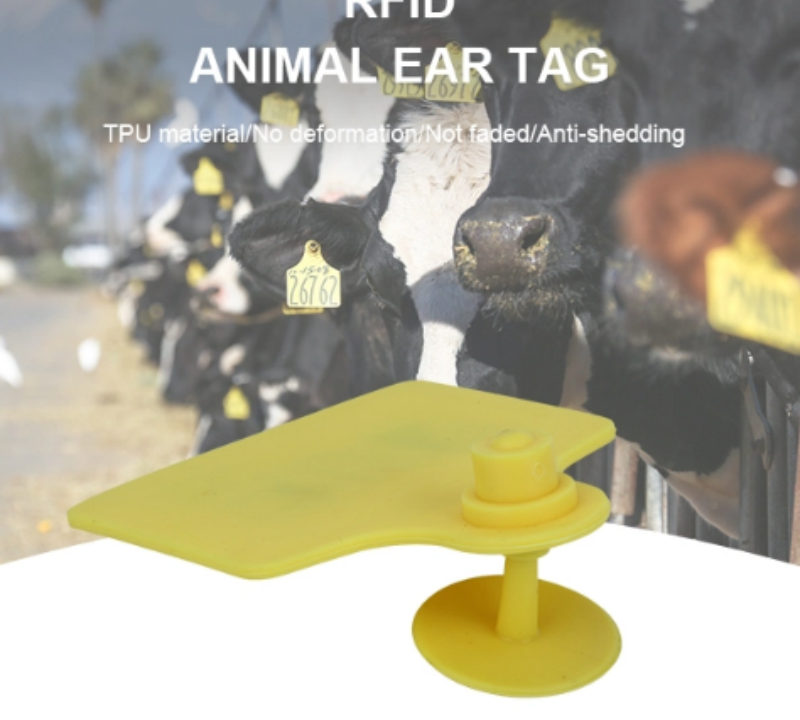
An RFID pet tag is externally attached and can provide additional identification or information.
For commercial applications, the two products can complement each other.
For example:
Implanted Microchip + RFID Collar Tag + Registration Database
can create multiple identification points.
The appropriate combination depends on the animal-care application and the requirements of the organization.
What Problems Does a Dog Microchip Solve?
A good animal identification system addresses several practical problems.
Lost Dogs
A microchip can provide a permanent identification method when a dog is found without reliable physical identification.
Lost Collars
Unlike a collar tag, an implanted microchip remains with the animal.
Ownership Identification
A registered chip number can connect the animal with its owner’s database record.
Shelter Management
Animal shelters can use electronic identification to help manage animal records.
Veterinary Records
A unique identification number can help associate an animal with relevant records.
International Animal Movement
Microchip compatibility can become particularly important when animals travel internationally, depending on the destination’s rules.
How to Choose a Dog Microchip Manufacturer
For B2B buyers, choosing a manufacturer requires more than comparing prices.
Before placing an order, ask the supplier:
- What RFID frequency does the microchip use?
- Is it compatible with ISO 11784/11785 requirements?
- Does it support FDX-B?
- Is each chip uniquely encoded?
- What material is used for the capsule?
- Is sterile packaging available?
- What is the MOQ?
- What is the production lead time?
- Can the supplier provide samples?
- Can packaging be customized?
- How is batch traceability managed?
- What quality-control procedures are used?
- Which scanners are compatible with the product?
- What documentation can be provided?
- What after-sales support is available?
These questions can help buyers avoid focusing on price alone.
Dog Microchip Cost: Retail Price vs Factory Price
One of the most important distinctions in the animal RFID market is the difference between retail service pricing and factory pricing.
A pet owner might search:
“How much does a dog microchip cost?”
But a distributor may ask:
“What is the FOB price for 10,000 dog microchips?”
These are completely different purchasing scenarios.
The veterinary retail price can include professional service, registration, administration, and other costs.
The factory quotation generally focuses on the physical product and agreed manufacturing services.
For B2B buyers, the final quotation may depend on:
- Quantity
- Chip model
- RFID technology
- Encoding requirements
- Sterilization
- Needle
- Packaging
- Private label
- Delivery terms
- Destination
Therefore, requesting a quotation based on a complete specification will normally produce a more useful result than simply asking for the “dog microchip price.”
Frequently Asked Questions About Dog Microchip Cost
How much does a dog microchip cost?
Dog Microchip Cost varies by country, veterinary clinic, chip specification, registration, and additional services. The total retail price is usually higher than the factory cost because veterinary service and administration may be included.
Is microchipping a dog expensive?
Compared with many other veterinary procedures, microchipping is generally a relatively low-cost, one-time identification service. However, actual prices depend on the location and services included.
Does a dog microchip have GPS?
No. A standard dog identification microchip is a passive RFID device and does not provide real-time GPS tracking.
Can I track my dog with a microchip?
No. A microchip provides identification rather than live location tracking. A GPS tracker is required for real-time location information.
How long does a dog microchip last?
A passive RFID microchip is designed for long-term identification and does not normally require battery replacement.
Does a dog microchip store the owner’s address?
The microchip primarily provides a unique identification number. Owner information is normally associated with that number through a registration database.
Does a dog microchip need to be registered?
Registration is essential for the identification system to connect the chip number with the correct owner or animal record.
What frequency does a dog microchip use?
Many internationally used animal identification systems operate at 134.2 kHz, including systems based on relevant ISO animal-identification standards.
What are ISO 11784 and ISO 11785?
They are international standards associated with electronic identification of animals, covering the identification code structure and technical communication requirements.
Can a dog microchip be scanned internationally?
Compatibility depends on the microchip and reader system. Buyers involved in international animal movement should verify the applicable destination requirements and use compatible identification technology.
How much does a dog microchip cost for wholesale orders?
Wholesale pricing depends on order quantity, chip specification, encoding, sterilization, packaging, customization, and shipping terms. The factory price can be substantially different from the retail veterinary service price.
Should distributors buy the cheapest dog microchip?
Not necessarily. Readability, standards compatibility, quality consistency, sterilization, traceability, packaging, and after-sales support can be more important than the lowest initial unit price.
Final Thoughts on Dog Microchip Cost
Understanding Dog Microchip Cost requires looking beyond the price printed on a veterinary invoice.
For pet owners, the total cost may include the RFID chip, implantation, registration, and additional veterinary services. For veterinary clinics, shelters, distributors, and pet-product companies, the decision is more technical and commercial.
The most important factors include RFID technology, ISO compatibility, unique identification, scanner readability, sterile packaging, quality control, MOQ, customization, and total landed cost.
Most importantly, remember that a dog microchip is an identification technology, not a GPS tracker. Its value comes from combining a reliable physical transponder with accurate registration and a properly managed animal identification database.
For B2B buyers, the best tags supplier is therefore not necessarily the one offering the lowest Dog Microchip Cost. A more valuable supplier is one that can provide consistent product quality, standards-compatible technology, reliable production, customization, traceability, and long-term supply support.
Retail Dog Microchip Cost: roughly US$25–50 in many U.S. veterinary settings.
Wholesale factory pricing: quote based on specifications and order quantity.

Do RFID is a leading China-based manufacturer with over 15 years of experience. We specialize in customized RFID readers, tags, and cards, delivering high-quality, tailored solutions that meet your unique business needs and drive seamless, efficient identification.